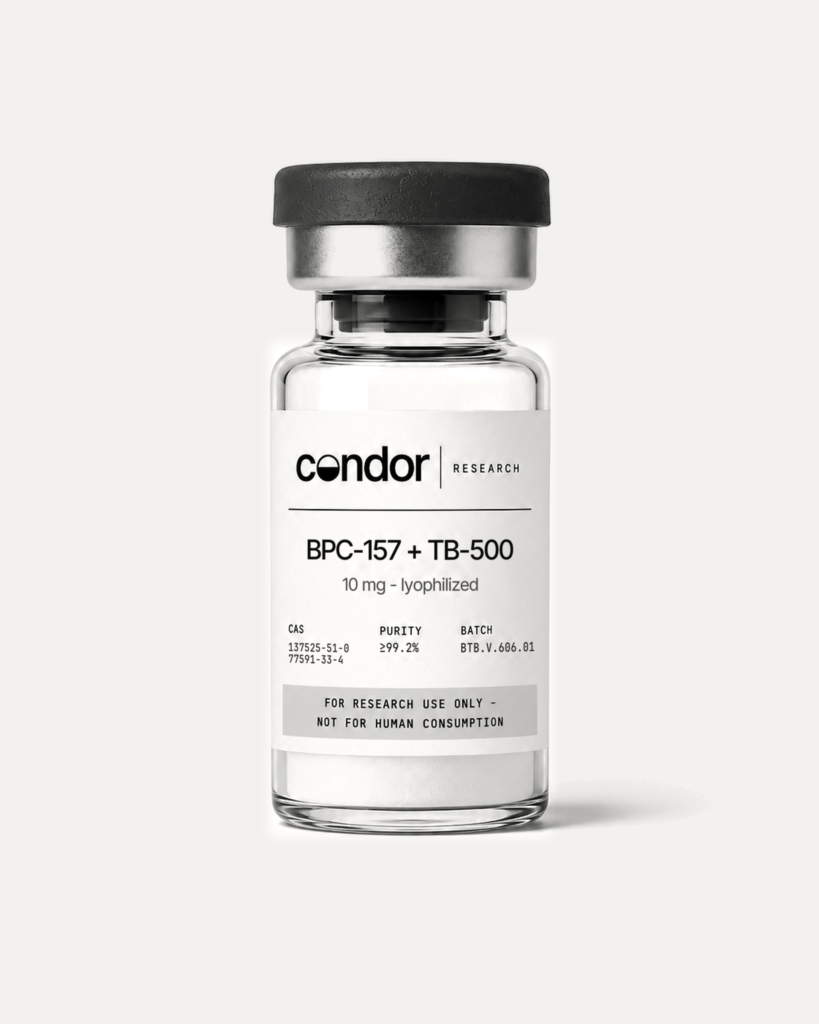
Lyophilisé · ≥99% (HPLC) ·
Fourni lyophilisé. La reconstitution se fait généralement avec de l'eau bactériostatique.
BPC-157 + TB-500 is a dual-peptide research blend combining BPC-157 (Body Protection Compound-157), a synthetic 15-amino-acid pentadecapeptide (sequence GEPPPGKPADDAGLV; CAS 137525-51-0; MW 1419.5 g/mol) derived from human gastric juice, with TB-500, a synthetic analogue of the actin-sequestering peptide Thymosin Beta-4 (CAS 77591-33-4; MW 4963 g/mol). Both components are supplied lyophilised at ≥99% purity by HPLC. For laboratory research use only; not for human or veterinary use.
This blend pairs two of the most extensively investigated peptides in regenerative and cytoprotective research, BPC-157 and TB-500, in a single co-formulated vial. The combination is studied because the two molecules act through largely distinct mechanisms — one rooted in gastric cytoprotection, the other in actin-binding cell motility — making them a frequent pairing in tissue-repair model systems.
Two repair peptides with separate origins. BPC-157 is a synthetic pentadecapeptide derived from a protective protein in gastric juice, characterised as a pleiotropic, stable agent in a large experimental literature (Sikiric et al., 2024). TB-500 is the synthetic, bioavailable fragment corresponding to the active region of thymosin β4, a naturally occurring actin-sequestering peptide expressed across many human tissues during development (Faa et al., 2024).
What the research explores. Each component has its own body of experimental work, and together they are studied across complementary repair themes:
All of the activity described here comes from in-vitro and animal studies; these findings characterise biological behaviour in experimental models and do not demonstrate efficacy or safety in humans. Full citations are listed under the Scientific References tab.
Specification & quality. Each individually sealed vial contains 10 mg of BPC-157 and 10 mg of TB-500 as a white lyophilized powder at ≥99% purity by HPLC, soluble in water. Every batch is third-party tested, and a Certificate of Analysis (COA) is available. Store at −20 °C, protected from light and moisture; shelf life 24 months from the manufacture date.
This product is intended for laboratory research use only (RUO). It is not a drug, food, cosmetic, or dietary supplement, and is not for human or veterinary use, ingestion, or diagnostic application. Handling is restricted to qualified research professionals operating in an appropriately equipped laboratory.
Fourni exclusivement pour un usage de recherche en laboratoire in vitro (RUO). Ne constitue ni un médicament, ni une denrée alimentaire, ni un complément ; ne convient pas à un usage humain ou vétérinaire.
Certificat d'analyse — un COA propre au lot est fourni avec chaque commande et disponible sur demande.
Each lot is tested by an independent third-party laboratory for identity (mass spectrometry) and purity (HPLC). The Certificate of Analysis for your specific batch ships with the order and is available on request — no house data, no exceptions.
Ces références illustrent la littérature de recherche relative à ce composé. Toutes les données mentionnées concernent exclusivement des modèles in vitro et animaux.
Il s'agit d'un flacon unique co-formulé et lyophilisé associant deux peptides de recherche régénérative largement étudiés : le BPC-157 (10 mg), un 15-mer d'origine gastrique, et le TB-500 (10 mg), un fragment de thymosine bêta-4. Il est fourni strictement comme matériel de référence réservé à la recherche pour des études in vitro et animales de réparation tissulaire et de cytoprotection.
Le mélange les associe parce que le BPC-157 et le TB-500 agissent par des voies moléculaires différentes dans les modèles de réparation tissulaire, ils sont donc étudiés comme des réactifs complémentaires plutôt que redondants. Co-formuler les deux dans un seul flacon permet aux chercheurs de les étudier ensemble dans des conditions identiques. Réservé à la recherche, sur modèles in vitro et animaux.
Le mélange co-formule 10 mg de BPC-157 et 10 mg de TB-500 dans un seul flacon, reconstitués ensemble, de sorte que les deux sont toujours étudiés selon un ratio combiné fixe. Les acheter séparément permet de faire varier chaque peptide indépendamment. Les quantités correspondent aux flacons autonomes de 10 mg. Les deux formats sont réservés à la recherche.
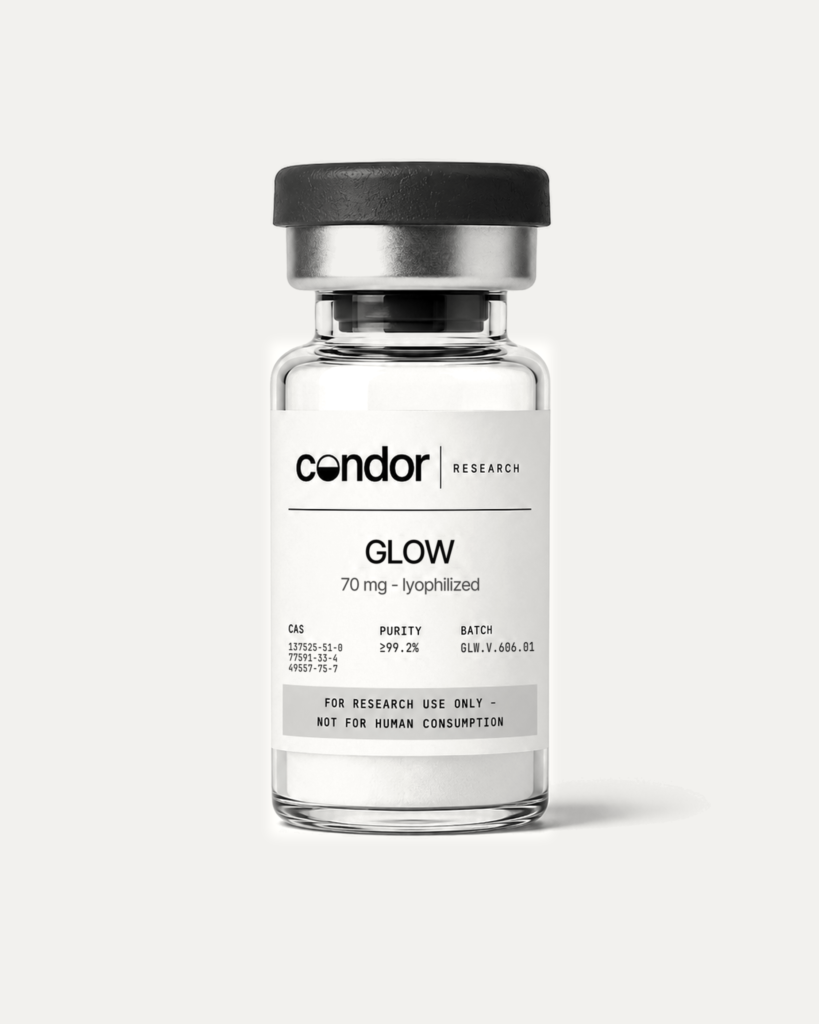
Le mélange BPC-157 + TB-500 contient deux peptides de réparation (10 mg chacun). GLOW ajoute du GHK-Cu (50 mg), un tripeptide chélateur de cuivre étudié dans la recherche sur la régénération cutanée et la réparation tissulaire, ce qui en fait une formulation à trois peptides. Choisissez le mélange à deux peptides pour un système plus simple, ou GLOW pour inclure le peptide de cuivre. Réservé à la recherche.
En teneur peptidique, oui : le mélange contient 10 mg de BPC-157 et 10 mg de TB-500, correspondant aux quantités des flacons autonomes. La différence est qu'ils sont co-formulés dans un seul flacon et reconstitués ensemble selon un ratio fixe, plutôt que préparés indépendamment. Réservé à la recherche, sur modèles in vitro et animaux.
La pureté est vérifiée par composant. Pour les mélanges, la spécification HPLC >=99 % s'applique à chaque peptide individuellement, confirmée par un test tiers indépendant avant co-formulation, avec un certificat d'analyse par lot. Pour demander le COA couvrant les deux composants d'un lot spécifique, contactez info@condorresearch.com.
Les deux peptides sont solubles dans l'eau, un seul diluant permet donc de reconstituer le mélange au laboratoire. Par exemple, ajouter 2 mL d'eau bactériostatique au flacon de 20 mg (10 mg + 10 mg) donne 5 mg/mL de BPC-157 et 5 mg/mL de TB-500 ; ajustez le volume pour d'autres concentrations cibles. Réservé à la préparation pour la recherche, pas à un usage humain.
Oui. Condor fournit le mélange BPC-157 + TB-500 strictement comme matériel de référence réservé à la recherche (in vitro) aux professionnels et institutions, et non comme médicament ou produit destiné à un usage humain ou vétérinaire. Il incombe aux acheteurs de vérifier la légalité de l'importation dans leur pays. Questions : info@condorresearch.com.
Conservez le flacon scellé du mélange à -20 °C, à l'abri de la lumière ; durée de conservation de 24 mois à compter de la fabrication. Le peptide lyophilisé est stable pour un court transport à température ambiante, l'expédition avec accumulateurs de froid n'est donc généralement pas nécessaire. Toute préparation et manipulation est réservée à la recherche in vitro et animale, jamais à un usage humain ou vétérinaire.
Reconstitution was clean with no visible particulates. The lot-specific COA matched the assay we ran in-house — purity is exactly as stated.
We verify every incoming compound by HPLC; this batch came back within tolerance of the certificate. Dispatch from the EU warehouse was quick.
Cold-chain handling was respected end to end. Vials arrived sealed, labelled and intact. Documentation is the most thorough I've seen from an EU supplier.
Solubilité et stabilité conformes à la description. Une étoile retirée uniquement car les options d'expédition express sont limitées, mais la qualité n'est pas en cause.
Cookies
Nous utilisons des cookies strictement nécessaires au fonctionnement de la boutique. Avec votre consentement, nous utilisons également des cookies d'analyse (attribution des commandes) et marketing (Omnisend). Consultez notre Politique relative aux cookies.