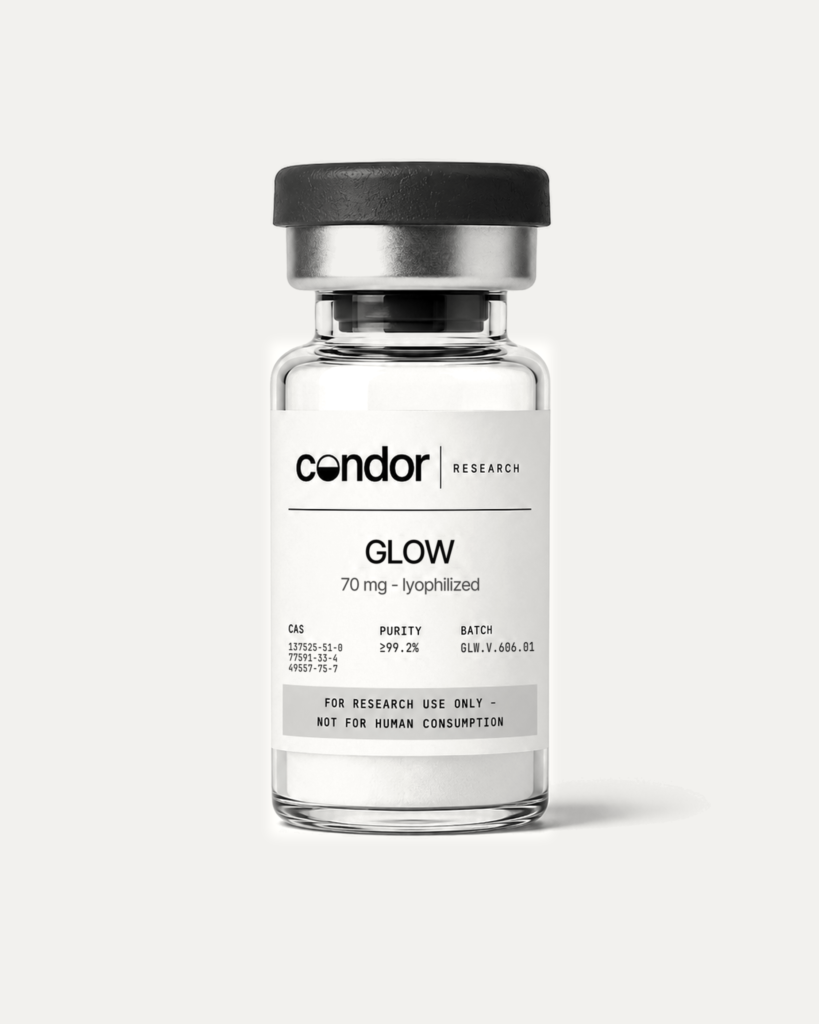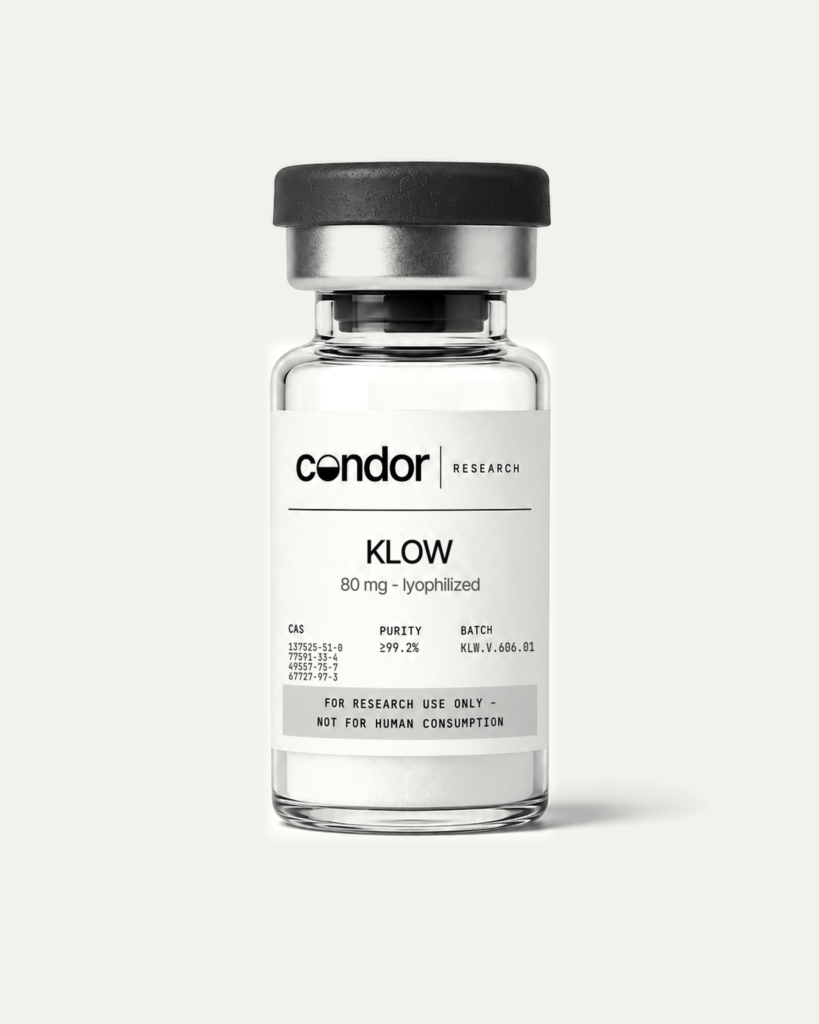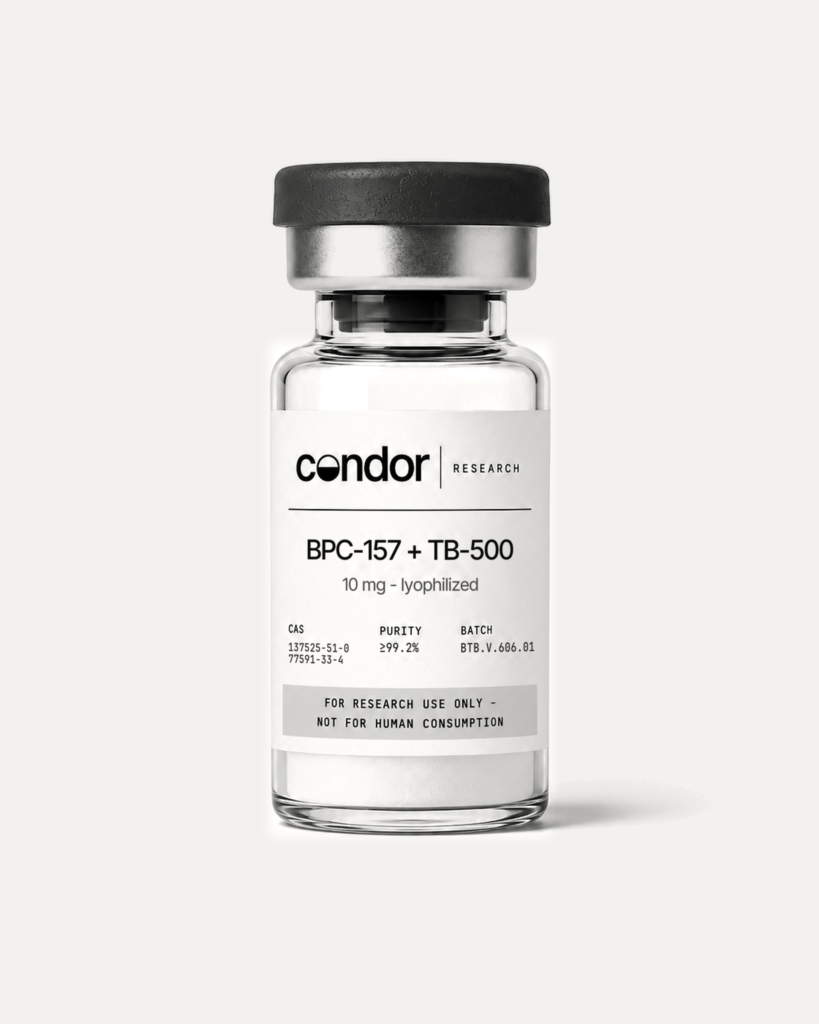
Liofilizado · ≥99% (HPLC) ·
Suministrado liofilizado. La reconstitución suele realizarse con agua bacteriostática.
BPC-157 + TB-500 is a dual-peptide research blend combining BPC-157 (Body Protection Compound-157), a synthetic 15-amino-acid pentadecapeptide (sequence GEPPPGKPADDAGLV; CAS 137525-51-0; MW 1419.5 g/mol) derived from human gastric juice, with TB-500, a synthetic analogue of the actin-sequestering peptide Thymosin Beta-4 (CAS 77591-33-4; MW 4963 g/mol). Both components are supplied lyophilised at ≥99% purity by HPLC. For laboratory research use only; not for human or veterinary use.
This blend pairs two of the most extensively investigated peptides in regenerative and cytoprotective research, BPC-157 and TB-500, in a single co-formulated vial. The combination is studied because the two molecules act through largely distinct mechanisms — one rooted in gastric cytoprotection, the other in actin-binding cell motility — making them a frequent pairing in tissue-repair model systems.
Two repair peptides with separate origins. BPC-157 is a synthetic pentadecapeptide derived from a protective protein in gastric juice, characterised as a pleiotropic, stable agent in a large experimental literature (Sikiric et al., 2024). TB-500 is the synthetic, bioavailable fragment corresponding to the active region of thymosin β4, a naturally occurring actin-sequestering peptide expressed across many human tissues during development (Faa et al., 2024).
What the research explores. Each component has its own body of experimental work, and together they are studied across complementary repair themes:
All of the activity described here comes from in-vitro and animal studies; these findings characterise biological behaviour in experimental models and do not demonstrate efficacy or safety in humans. Full citations are listed under the Scientific References tab.
Specification & quality. Each individually sealed vial contains 10 mg of BPC-157 and 10 mg of TB-500 as a white lyophilized powder at ≥99% purity by HPLC, soluble in water. Every batch is third-party tested, and a Certificate of Analysis (COA) is available. Store at −20 °C, protected from light and moisture; shelf life 24 months from the manufacture date.
This product is intended for laboratory research use only (RUO). It is not a drug, food, cosmetic, or dietary supplement, and is not for human or veterinary use, ingestion, or diagnostic application. Handling is restricted to qualified research professionals operating in an appropriately equipped laboratory.
Suministrado exclusivamente para uso en investigación de laboratorio in vitro (RUO). No es un medicamento, alimento ni complemento; no apto para uso humano ni veterinario.
Certificado de análisis — el COA específico del lote se envía con cada pedido y está disponible previa solicitud.
Each lot is tested by an independent third-party laboratory for identity (mass spectrometry) and purity (HPLC). The Certificate of Analysis for your specific batch ships with the order and is available on request — no house data, no exceptions.
Las referencias son ilustrativas de la literatura de investigación sobre este compuesto. Todas las afirmaciones se refieren únicamente a modelos in vitro y animales.
Es un único vial coformulado y liofilizado que combina dos péptidos de investigación regenerativa ampliamente estudiados: BPC-157 (10 mg), un péptido de 15 aminoácidos de origen gástrico, y TB-500 (10 mg), un fragmento de timosina beta-4. Se suministra estrictamente como material de referencia para uso en investigación destinado a estudios in vitro y en animales de reparación tisular y citoprotección.
La mezcla los combina porque BPC-157 y TB-500 actúan mediante vías moleculares diferentes en modelos de reparación tisular, por lo que se estudian como reactivos complementarios y no solapados. Coformular ambos en un vial permite a los investigadores estudiarlos juntos en condiciones idénticas. Solo para uso en investigación, en modelos in vitro y en animales.
La mezcla coformula 10 mg de BPC-157 y 10 mg de TB-500 en un vial, reconstituidos juntos, de modo que ambos se estudian siempre en una proporción combinada fija. Comprarlos por separado permite variar cada péptido de forma independiente. Las cantidades coinciden con los viales individuales de 10 mg. Ambos formatos son solo para uso en investigación.
La mezcla BPC-157 + TB-500 contiene dos péptidos de reparación (10 mg cada uno). GLOW añade GHK-Cu (50 mg), un tripéptido con capacidad de unión al cobre estudiado en investigación de regeneración cutánea y tisular, convirtiéndolo en una formulación de tres péptidos. Elija la mezcla de dos péptidos para un sistema más sencillo, o GLOW para incluir el péptido de cobre. Solo para uso en investigación.
En contenido de péptido, sí: la mezcla contiene 10 mg de BPC-157 y 10 mg de TB-500, coincidiendo con las cantidades de los viales individuales. La diferencia es que se coformulan en un único vial y se reconstituyen juntos en una proporción fija, en lugar de prepararse de forma independiente. Solo para uso en investigación, en modelos in vitro y en animales.
La pureza se verifica por componente. En las mezclas, la especificación de ≥99% por HPLC se aplica a cada péptido individualmente, confirmada mediante análisis independiente por terceros antes de la coformulación, con un certificado de análisis del lote. Para solicitar el certificado de análisis que cubra ambos componentes de un lote concreto, contacte con info@condorresearch.com.
Ambos péptidos son solubles en agua, por lo que un único diluyente reconstituye la mezcla en el laboratorio. Por ejemplo, añadir 2 mL de agua bacteriostática al vial de 20 mg (10 mg + 10 mg) produce 5 mg/mL de BPC-157 y 5 mg/mL de TB-500; ajuste el volumen para otras concentraciones objetivo. Solo para preparación en investigación, no para uso humano.
Sí. Condor suministra la mezcla BPC-157 + TB-500 estrictamente como material de referencia para uso en investigación (in vitro) a profesionales e instituciones, no como medicamento ni producto para uso humano o veterinario. Los compradores son responsables de confirmar la legalidad de la importación en su país. Consultas: info@condorresearch.com.
Conserve el vial sellado de la mezcla a -20 °C, protegido de la luz; la vida útil es de 24 meses desde la fabricación. El péptido liofilizado es estable durante un transporte breve a temperatura ambiente, por lo que generalmente no se requiere envío en frío. Toda la preparación y manipulación es exclusivamente para investigación in vitro y en animales, nunca para uso humano ni veterinario.
Reconstitution was clean with no visible particulates. The lot-specific COA matched the assay we ran in-house — purity is exactly as stated.
We verify every incoming compound by HPLC; this batch came back within tolerance of the certificate. Dispatch from the EU warehouse was quick.
Cold-chain handling was respected end to end. Vials arrived sealed, labelled and intact. Documentation is the most thorough I've seen from an EU supplier.
La solubilidad y la estabilidad fueron como se describía. Resto una estrella solo porque las opciones de envío exprés son limitadas, pero la calidad no está en duda.
Cookies
Utilizamos cookies estrictamente necesarias para el funcionamiento de la tienda. Con su consentimiento, también utilizamos cookies analíticas (atribución de pedidos) y de marketing (Omnisend). Lea nuestra Política de cookies.