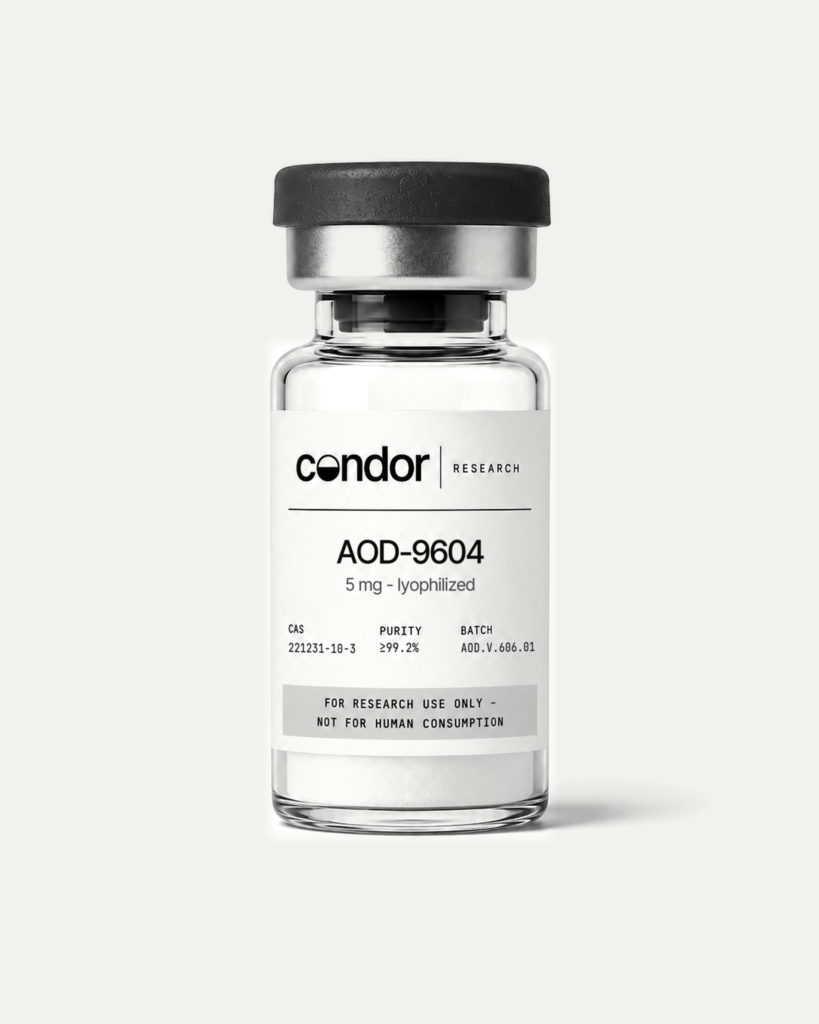
Liofilizado · ≥99% (HPLC) ·
Suministrado liofilizado. La reconstitución suele realizarse con agua bacteriostática.
AOD-9604 (Anti-Obesity Drug 9604) is a synthetic 16-amino-acid peptide fragment corresponding to the C-terminal region (Tyr-hGH177–191) of human growth hormone, modified with a tyrosine residue at the N-terminus to enhance stability; CAS 221231-10-3; molecular formula C78H123N23O23S2; molecular weight 1815.1 g/mol; studied in adipogenesis, lipolysis regulation, and metabolic research models. Supplied lyophilised at HPLC ≥99% purity. For laboratory research use only; not for human or veterinary use.
Derived from the very tail of the human growth-hormone molecule, AOD-9604 is a synthetic peptide fragment corresponding to the C-terminal lipolytic domain of hGH (residues 177-191) with an added tyrosine and a stabilising disulfide bridge. It was designed around a simple hypothesis: that the fat-metabolising activity of growth hormone could be isolated from the rest of its signalling, and it has since become a reference compound in metabolic-peptide research.
One function, distilled from a larger hormone. Full-length growth hormone exerts many effects, of which lipid mobilisation is only one. Investigators mapped this lipolytic activity to the hormone's C-terminal region and synthesised the corresponding fragment to probe it in isolation (Ng et al., 2000). Because the peptide reproduces fat-metabolism signalling without acting through the classic IGF-1-raising pathway, it offered a cleaner experimental window into adipocyte regulation.
What the research explores. The fragment has been examined across metabolic and musculoskeletal models:
All such findings stem from in vitro and animal research; no human-use conclusions are implied. Full citations are listed under the Scientific References tab.
Physicochemical profile. CAS 221231-10-3 · Molecular formula C₇₈H₁₂₃N₂₃O₂₃S₂ · Molecular weight 1815.1 · Sequence Tyr-Leu-Arg-Ile-Val-Gln-Cys-Arg-Ser-Val-Glu-Gly-Ser-Cys-Gly-Phe (Cys⁷–Cys¹⁴ disulfide) · Appearance: white lyophilized powder · Solubility: soluble in water.
Specification & quality. Each individually sealed vial contains 5 mg of AOD-9604 as a white lyophilized powder of ≥99% purity by HPLC. Every batch is third-party tested, with a Certificate of Analysis (COA) available. Store at −20 °C, protected from light and moisture. Shelf life: 24 months from the manufacture date.
This product is intended for laboratory research use only (RUO). It is not a drug, food, cosmetic, or dietary supplement, and is not for human or veterinary use, ingestion, or diagnostic application. Handling is restricted to qualified research professionals operating in an appropriately equipped laboratory.
Suministrado exclusivamente para uso en investigación de laboratorio in vitro (RUO). No es un medicamento, alimento ni complemento; no apto para uso humano ni veterinario.
Certificado de análisis — el COA específico del lote se envía con cada pedido y está disponible previa solicitud.
Each lot is tested by an independent third-party laboratory for identity (mass spectrometry) and purity (HPLC). The Certificate of Analysis for your specific batch ships with the order and is available on request — no house data, no exceptions.
Las referencias son ilustrativas de la literatura de investigación sobre este compuesto. Todas las afirmaciones se refieren únicamente a modelos in vitro y animales.
AOD-9604 es un fragmento peptídico sintético correspondiente al dominio lipolítico C-terminal de la hormona de crecimiento humana (residuos 177-191), con una tirosina añadida y un puente disulfuro estabilizador. A diferencia de un secretagogo, deriva de la propia molécula de GH. Condor Research lo suministra como vial de 5 mg, ≥99% por HPLC, estrictamente para uso en investigación in vitro.
AOD-9604 reproduce únicamente el fragmento C-terminal (residuos 177-191) de la hormona de crecimiento asociado a su actividad lipolítica, en lugar del aparato de señalización que desencadena la liberación de GH. Por tanto, es un fragmento derivado de la GH, no un secretagogo: no estimula los receptores de GHRH ni de grelina como lo hacen CJC-1295 o Ipamorelin. Es un péptido de referencia Solo para uso en investigación.
Se sitúan en puntos diferentes del eje de la GH. CJC-1295 es un secretagogo análogo de GHRH, modelado sobre la hormona que señaliza en un punto anterior para liberar hormona de crecimiento. AOD-9604 es, en cambio, un fragmento de la propia molécula de GH (residuos 177-191), estudiado por su dominio lipolítico. Ambos se suministran estrictamente como materiales de investigación in vitro.
Tesamorelin es un análogo de GHRH, una molécula de tipo secretagogo que actúa en un punto anterior a la hormona de crecimiento. AOD-9604 es un fragmento de la propia molécula de GH (residuos 177-191), estudiado como su dominio lipolítico en lugar de como una señal estimuladora de la liberación. Son péptidos de investigación distintos que abordan extremos opuestos de la biología de la GH, ambos vendidos exclusivamente para uso in vitro.
Representan capas diferentes del eje GH/IGF. AOD-9604 es un fragmento corto de la propia hormona de crecimiento (residuos 177-191). IGF-1 LR3 es un análogo recombinante mucho más grande, de 83 residuos, del factor de crecimiento similar a la insulina tipo 1, el efector corriente abajo. Por tanto, AOD-9604 se sitúa en el nivel de la GH e IGF-1 LR3 en el nivel del IGF. Ambos son materiales de referencia Solo para uso en investigación.
AOD-9604 es un fragmento peptídico de la hormona de crecimiento (residuos 177-191), soluble en agua y suministrado como liofilizado. SLU-PP-332 es un agonista de ERR de molécula pequeña no peptídica, soluble en DMSO. Son clases de compuesto completamente diferentes estudiadas en investigación metabólica. Ambos se ofrecen estrictamente como materiales de referencia in vitro, sin protocolos de uso proporcionados.
Cada lote se analiza en un laboratorio independiente por terceros, con identidad y pureza confirmadas por HPLC y espectrometría de masas, y se envía con un certificado de análisis específico del lote que certifica una pureza ≥99%. La secuencia indicada, el puente disulfuro y el peso molecular (1815,1) corresponden al AOD-9604. Para solicitar el certificado de análisis del lote actual, escriba a info@condorresearch.com.
AOD-9604 es un polvo liofilizado soluble en agua, disuelto en un diluyente acuoso compatible para la preparación in vitro, eligiendo el volumen para alcanzar la concentración analítica objetivo a partir del vial de 5 mg. Conserve el vial sellado a -20 °C, protegido de la luz (vida útil de 24 meses). Esto es solo preparación analítica; no se proporciona orientación de dosificación humana o veterinaria.
No — AOD-9604 se suministra estrictamente como material de referencia Solo para uso en investigación (in vitro): no es un medicamento, complemento ni producto sanitario, y no es apto para administración ni consumo humano o veterinario. Las ventas están restringidas a profesionales e instituciones mayores de 18 años. Los compradores son responsables de confirmar la legalidad de la importación en su propia jurisdicción.
Reconstitution was clean with no visible particulates. The lot-specific COA matched the assay we ran in-house — purity is exactly as stated.
We verify every incoming compound by HPLC; this batch came back within tolerance of the certificate. Dispatch from the EU warehouse was quick.
Cold-chain handling was respected end to end. Vials arrived sealed, labelled and intact. Documentation is the most thorough I've seen from an EU supplier.
La solubilidad y la estabilidad fueron como se describía. Resto una estrella solo porque las opciones de envío exprés son limitadas, pero la calidad no está en duda.
Cookies
Utilizamos cookies estrictamente necesarias para el funcionamiento de la tienda. Con su consentimiento, también utilizamos cookies analíticas (atribución de pedidos) y de marketing (Omnisend). Lea nuestra Política de cookies.