
What the FDA Actually Evaluated in Seven Peptides: The July 2026 Compounding Committee Record
FDA staff said no to all seven peptides; the PCAC advised six. Our matrix of 343 cited references: uses, human data, votes, authorship and status. v1.0.
FDA staff said no to all seven peptides; the PCAC advised six. Our matrix of 343 cited references: uses, human data, votes, authorship and status. v1.0.
In July 2026 an advisory committee of the US Food and Drug Administration (FDA) spent two days on seven peptides that are widely sold online: BPC-157, KPV, TB-500, MOTS-c, emideltide (also called DSIP), epitalon and Semax. The question in front of it was narrow. It was not whether these substances work or are safe, and it was not a drug approval. It was whether pharmacies that prepare individual prescriptions should be allowed to use them as raw ingredients. The FDA’s own scientists had recommended against all seven. The committee, whose vote is advice only, recommended six. At the cut-off date of this dossier, 25 October 2026, the agency had not announced a decision. This page reconstructs, from the FDA’s 15 official meeting documents and our own counts, what the agency’s reviewers actually examined: which use, which studies, which chemistry, which safety signals. It is a description of a regulatory record, not information about using any of these substances.
Version 1.0, 25 October 2026. Condor Research Editorial. Last reviewed: 25 October 2026. Every count, registry entry and regulatory status was checked against primary sources on that date; literal queries are in the method note, and the classified reference census can be downloaded as dataset.json (CC BY 4.0).
Central question. When the FDA’s reviewers evaluated these seven peptides for the 503A bulk drug substances list, what use did they evaluate, what evidence did they actually have in front of them, and how much of that evidence comes from the groups that first described each compound?
What did the FDA’s reviewers find, substance by substance?
Evidence level, in one line: for the uses the FDA evaluated, the human record ranges from none (KPV, TB-500, MOTS-c) to a handful of small studies from the 1980s and 1990s (emideltide) and a single 2005 meeting abstract (BPC-157); the staff judged all seven “not well characterised”.
| Substance and identity | Use evaluated by FDA | Human evidence reviewed | Nonclinical evidence | Characterisation | Safety concerns | FDA staff | Committee (yes-no-abstain) | Agency, 25 Oct 2026 |
|---|---|---|---|---|---|---|---|---|
| BPC-157 15 residues; PubChem CID 9941957; UNII 8ED8NXK95P |
Ulcerative colitis | 5 clinical studies located (1 study in healthy volunteers reported in 2 company meeting abstracts; 1 randomised placebo-controlled meeting abstract in ulcerative colitis, n=53; 3 small reports from one US clinic). For the evaluated use: 1 trial, reported only as an abstract. | Rodent organ-protection models (colonic fistula, liver and gut lesions); dose-response not established; molecular target not identified; toxicology limited to one 28-day rat and dog programme. | Not well characterised: non-standard naming; no data on peptide impurities, aggregates, bioburden or endotoxin; nominated substance inconsistent with the certificate of analysis submitted. | Immunogenicity (aggregation, peptide-related impurities); human safety data limited to two studies of up to two weeks; no human pharmacokinetic data for the dosage forms proposed; 3 FAERS reports. FAERS: 3 reports to 2025-12-04 (administration-site reaction; shortness of breath; diffuse hyperpigmentation and gingival darkening), causality unclear. | Do not add (free base and acetate)1 | 8-6-1 (advised listing)23 | Pending; not in Category 1; no proposed rule45 |
| KPV 3 residues; Lys-Pro-Val; alpha-MSH(11-13); PubChem CID 125672 |
Wound healing and inflammatory conditions (psoriasis, eczema given as examples) | None. No study administering KPV to humans was located by the nominator or the FDA. | Anti-inflammatory effects in rodent colitis and wound models and in cell systems; no pharmacokinetic or toxicology studies identified. | Not well characterised: non-standard naming; no impurity, aggregate or microbiological data; no certificate of analysis in the nomination; limited water solubility relevant to the proposed products. | No clinical or nonclinical safety data; immunogenicity and aggregation not assessed. FAERS: 0 reports to 2025-12-03. | Do not add (free base and acetate)6 | 8-6-1 (advised listing)23 | Pending; not in Category 1; no proposed rule45 |
| TB-500 7 residues; Ac-Leu-Lys-Lys-Thr-Glu-Thr-Gln-OH (N-acetylated thymosin beta-4 17-23); PubChem CID 62707662; UNII QHK6Z47GTG |
Wound healing (inferred by the FDA from the nomination's description of the actin-binding site) | None. No study in which TB-500 was given to people for any condition was located. | No in vivo wound-healing study of TB-500; one in vitro study in which TB-500 did not promote closure of scratch wounds in fibroblasts; animal pharmacokinetic studies showing breakdown to shorter peptides; no toxicology studies. | Not well characterised: the molecular formula and the CAS number given in the nomination match neither TB-500 form; no impurity, aggregate, microbial or endotoxin tests in the literature or the certificate of analysis. | No clinical or nonclinical safety data; immunogenicity risk singled out for the dosage forms proposed. FAERS: 0 reports to 2025-03-26. | Do not add (free base and acetate)7 | 8-6-1 (advised listing)23 | Pending; not in Category 1; no proposed rule45 |
| MOTS-c 16 residues; MRWQEMGYIFYPRKLR; PubChem CID 146675088; UNII A5CV6JFB78 |
Obesity and osteoporosis (FDA meeting page); the briefing states the six nominated uses were not evaluated for lack of information | None. No study administering MOTS-c to humans was located. | In vitro and rodent studies only; dose-response missing; molecular targets unknown; no toxicology studies. | Not well characterised: non-standard naming; no impurity, aggregate or endotoxin data; water solubility relative to the proposed product unknown. | No human data by any route; immunogenic risk of a 16-residue peptide not assessable. The FDA notes MOTS-c is listed as prohibited in the Global DRO database (WADA list). FAERS: 0 reports to 2025-03-09. | Do not add (free base and acetate)8 | 7-5-2 (advised listing)23 | Pending; not in Category 1; no proposed rule45 |
| Emideltide 9 residues; Delta sleep-inducing peptide (DSIP), WAGGDASGE; PubChem CID 68816; UNII YN28Z5YZ73; WHO INN Proposed List 70 |
Chronic insomnia, narcolepsy, opioid withdrawal | Chronic insomnia: 7 publications 1981-1992, 3 to 18 participants each (Health Affairs counts 72 enrolled, possibly overlapping). Narcolepsy: 1 single-patient report. Withdrawal: 2 open-label studies (107 and 7 participants). | Sleep-promoting effects across species via opioid-dependent mechanisms; stimulates endorphin release; addictive potential not studied; no toxicology studies. | Not well characterised: named as a common name, not a USAN; multiple salts and moieties sold under the name; no impurity, aggregate or endotoxin data; formulation of the proposed product not shown to be feasible without a co-solvent. | Insomnia studies reported no significant adverse effects in small numbers; withdrawal studies reported transient headache, nausea and vertigo, and cases of hypotension; immunogenicity; long-term intermittent use not characterised. FAERS: 0 reports to 2024-03-03. | Do not add (free base and acetate)9 | 6-7-1 (advised against)23 | Pending; not in Category 1; no proposed rule45 |
| Epitalon 4 residues; Ala-Glu-Asp-Gly (AEDG); PubChem CID 219042; UNII O65P17785G |
Insomnia | No study in patients with insomnia. One clinical study in healthy people (melatonin and circadian-gene measures, n=20) and one review by the originating group. | Raises serum melatonin in animals; no behavioural or EEG sleep studies; mouse genotoxicity and tumour studies limited (single dose level, females only, short exposure). | Not well characterised: non-standard naming; data on identity, purity and quality for the proposed product lacking. | No clinical safety data; immunogenicity; the FDA flags a mechanistic carcinogenicity concern because epitalon is reported to activate telomerase and lengthen telomeres. FAERS: 0 reports to 2025-12-08. | Do not add (free base and acetate)10 | 7-4-1 (advised listing)23; RAPS reports 7-5-111 | Pending; not in Category 1; no proposed rule45 |
| Semax 7 residues; Met-Glu-His-Phe-Pro-Gly-Pro (ACTH(4-7)-PGP); PubChem CID 9811102; UNII I5FAL2585H |
Cerebral ischaemia (with 'nootropic' folded in), migraine, trigeminal neuralgia (from 'analgesia') | Effectiveness: two references, a congress abstract (unknown number of participants) and a 1996 report (12 with migraine; 25 with trigeminal neuralgia or dental plexalgia). Four Russian-language clinical articles were not considered because no verified English translation was available. | Pleiotropic effects in rodents (neurotrophic, antithrombotic, analgesic, antidepressant- and anxiolytic-like); potentiation of amphetamine-induced striatal dopamine release in mice raised an abuse-potential concern; no toxicology studies. | Not well characterised: non-standard naming; impurity and aggregate data lacking; container-closure information missing for one proposed product. | No human pharmacokinetic data; most references silent on safety; possible antithrombotic effect raises bleeding concern; immunogenicity. FAERS: 1 report to 2025-12-03 (eye pain and burning after a product bought online). | Do not add (free base and acetate)12 | 8-5-1 (advised listing)23 | Pending; not in Category 1; no proposed rule45 |
The Condor matrix of the July 2026 PCAC evaluations. FDA columns summarise the staff evaluations (memos dated 11-15 May 2026); committee votes are secondary (McDermott Will & Schulte and the Health Affairs Forefront per-member table agree on every tally); no official minutes were posted. Doses, concentrations, dosage forms and routes proposed in the nominations are deliberately omitted. Checked 2026-10-25.
7 of 7 staff evaluations concluded that the balance of the four statutory criteria “weighs against” listing, for both the free base and the acetate salt of each peptide.13
1 of 7 substances, emideltide, has placebo-controlled studies published as full papers in a use the FDA evaluated; the largest had 16 participants and the most recent is from 1992. For BPC-157 the only randomised data are a 2005 meeting abstract (n=53).
2,641 public comments had been posted to the meeting docket (FDA-2025-N-6895) by 25 October 2026, 791 of them in the previous 90 days.14
In plain terms: for each peptide, FDA scientists asked four questions: is it clearly defined chemically, has it been used in pharmacy practice, is there evidence it works for the condition proposed, and are there safety concerns. For all seven they answered that the evidence was too thin, and that they could not even be sure what exactly is sold under each name.
Who decides what: staff, committee and agency
Three different things happened, and they are often merged in coverage. First, multidisciplinary FDA teams (compounding compliance, pharmaceutical quality and new drugs) wrote an evaluation of each substance, dated between 11 and 15 May 2026, applying the four criteria set by the 2019 final rule: physical and chemical characterisation, safety, evidence of effectiveness or lack of it, and historical use in compounding, balanced substance by substance.13 Second, the Pharmacy Compounding Advisory Committee (PCAC) heard those evaluations, public speakers and FDA presenters, and voted on the questions “Should [substance] (free base) be placed on the list?” and the same for the acetate.15 The committee’s role is advisory. Third, the agency makes the decision, which the briefing documents say will not be final “until input from the advisory committee process has been considered and all reviews have been finalized”.13
All seven nominations had been withdrawn by the nominators before the meeting: LDT Health Solutions on behalf of the International Peptide Society (BPC-157, emideltide, epitalon, Semax) and Wells Pharmacy Network (all seven). The FDA evaluated the substances “on its own initiative” and kept the withdrawn nominations’ information in the record.13 Because it was unclear which form had been nominated, every evaluation covers both the free base and the acetate.
| Step | Nature | Outcome | Evidence for the outcome |
|---|---|---|---|
| FDA staff (multidisciplinary review teams) | Evaluation against four criteria; recommendation | Against listing, all 7 (14 forms) | Briefing documents, May 202613 |
| Pharmacy Compounding Advisory Committee | Advisory vote, non-binding | 6 recommended, 1 (emideltide) not | Secondary sources only; no minutes posted2113 |
| FDA (agency decision) | Final determination; rulemaking or interim category | None located | Federal Register, 503A list, meeting page, docket, all checked 2026-10-25541614 |
Three separate steps. Only the first is documented by the FDA itself; the second rests on press and law-firm reports; the third had not occurred at the cut-off.
One FDA slide shown on 23 July matters for reading any outcome: once a bulk drug substance is on the 503A list, “unless specific limitations are included on the entry”, it “can be compounded for any use or via any route of administration”.17 The use evaluated is therefore the use under which the evidence was weighed, not a limit on what a listing would cover. A law-firm analysis argues that this is why nominations were withdrawn: so that any listing would not be tied to the nominated indications. That is their interpretation, not a statement by the nominators.18
In plain terms: the scientists said no to all seven, the advisers said yes to six, and the agency has not yet said anything final. The advisers’ yes is a recommendation, not a permission.
How did these seven substances reach the committee?
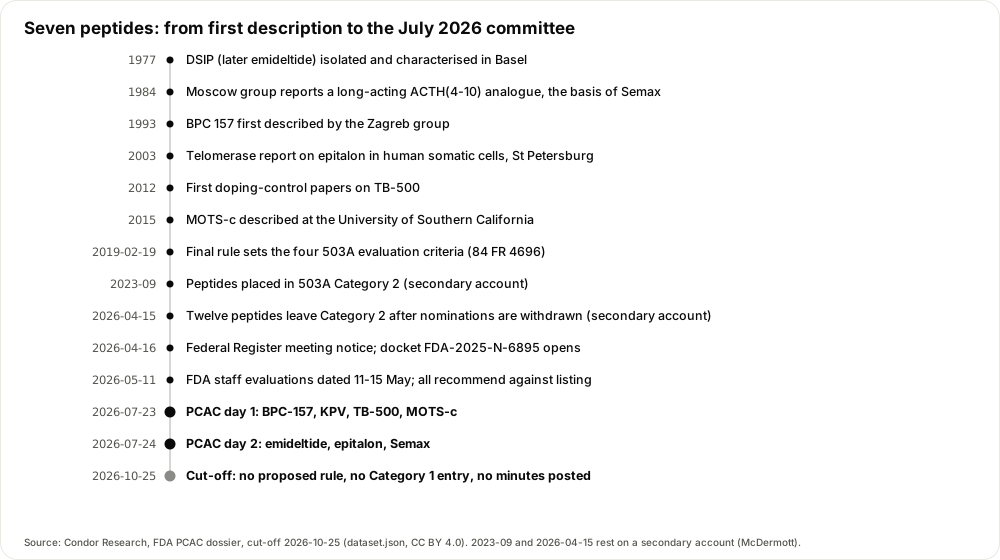
The oldest of the seven is emideltide, isolated in Basel in 1977 as a peptide that increased slow-wave EEG activity in rabbits.19 Semax descends from a Moscow programme on ACTH(4-10) analogues first reported in 1984.20 BPC-157 was first described by a Zagreb group in 1993, as part of a “stomach-stress-organoprotection” hypothesis.21 Epitalon’s best-known paper, on telomerase in human cells, is from St Petersburg in 2003.22 MOTS-c was described in 2015 at the University of Southern California.23 TB-500 has no academic origin: it is a synthetic acetylated fragment of thymosin beta-4 that entered the literature through doping-control laboratories in 2012.2425
On the regulatory side, a law firm’s account says that in September 2023 the FDA placed more than a dozen peptides in Category 2 of its interim 503A policy (“significant safety risks”), and that on 15 April 2026 twelve were removed from Category 2 after their nominations were withdrawn.2 The FDA’s own category list, last updated 14 May 2026, no longer lists any of the seven in Category 2 and refers to substances “previously in category 2 but were withdrawn”.4 The meeting was announced in the Federal Register on 16 April 2026.26
In plain terms: these peptides span fifty years of research, from a 1970s sleep peptide to a 2015 mitochondrial one. Their path to this meeting ran through a 2023 safety classification, a withdrawal of every nomination in 2026, and the agency’s decision to review them anyway.
Which use did the FDA evaluate, and which did it set aside?
The FDA evaluates a bulk substance “in the context of the uses proposed” in a nomination, and adds uses that are widespread or pose serious risks.17 What it evaluated is narrower than what was nominated, and narrower still than what is marketed:
- BPC-157: nominated for ulcerative colitis, Crohn’s disease, coeliac disease and tendonitis; only ulcerative colitis was evaluated, because the nominations did not support the others and no clinical studies in those populations were located.1
- KPV: wound healing and inflammatory conditions, with psoriasis and eczema given as examples.6
- TB-500: the nomination described the peptide rather than a use (“the active site within the protein thymosin beta-4 responsible for actin binding, cell migration and wound healing”); the FDA therefore evaluated wound healing.7
- MOTS-c: the record is internally inconsistent. The briefing lists six nominated uses (insulin resistance, obesity, osteoporosis, vascular calcification, muscle and fat metabolism, longevity) and states that the FDA “did not evaluate” them for lack of information; its conclusion then cites obesity and osteoporosis as serious conditions with approved therapies, and the FDA meeting page lists “obesity and osteoporosis” as the uses evaluated.816
- Emideltide: chronic insomnia (the nominations said “insomnia”), narcolepsy and opioid withdrawal; “paradoxical sleep disorder” was not evaluated.9
- Epitalon: insomnia only. The nomination’s other uses, including anti-ageing, longevity and telomere lengthening, were set aside for lack of supporting information.10
- Semax: cerebral ischaemia, migraine and trigeminal neuralgia. “Analgesia” became migraine and trigeminal neuralgia because those were the populations in the submitted reference; “nootropic” was folded into cerebral ischaemia because it has no ICD-10 code or treatment guideline; ADHD was not evaluated for lack of literature.12
For every evaluated use, the FDA noted that approved therapies exist and that the condition is serious, two factors it weighs under the safety and effectiveness criteria.13
In plain terms: each peptide was judged against one or a few named medical conditions, chosen from what the nominations could support. Most of what these peptides are promoted for online was never evaluated at all.
What did the FDA find about identity and chemistry?
All fourteen forms (seven free bases, seven acetates) were judged “not well characterized”. The two reasons recur in every document: the names used do not follow an established nomenclature (USAN, INN or IUPAC), so different substances can be sold under one name; and data on critical quality attributes, such as peptide-related impurities, aggregates, bioburden and bacterial endotoxins, were missing from the nominations and the public literature.167891012 An FDA presentation on “conflated bulks and common name challenges” opened both meeting days.27 Substance-specific findings:
- TB-500: the molecular formula and the “AKA CAS #” given in the nomination match neither the free base nor the acetate.7
- BPC-157: the nominated substance was not consistent with the certificate of analysis submitted with it.1
- Emideltide: the FDA cites the 1993 WHO list in which the name was proposed as an INN, but treats it as a common name that is not a USAN, and reports encountering “multiple salts, and derivatives, including different active moieties” sold under it.9
- KPV and MOTS-c: no certificate of analysis was included in the nomination.68
The FDA’s documents give an identity record for each (amino-acid sequence and, where it exists, a UNII code); these are listed in the matrix above alongside PubChem identifiers that we checked on 25 October 2026.28 An FDA identifier is a registration of a structure, not a statement about any product.
In plain terms: the reviewers could not pin down what a pharmacy would actually receive when it ordered one of these peptides. For TB-500, even the formula and registry number in the nomination did not match the molecule.
What human evidence did the FDA review?
The table lists every study in people that the FDA describes in the effectiveness or safety sections of its evaluations, plus one large Russian study it set aside. It gives design, size, duration and endpoint, and the result as reported by the authors or characterised by the FDA. Doses, schedules and routes are deliberately omitted.
| Substance | Study | Design | Participants (n) | Duration | Endpoint or measure | Reported result (authors or FDA) | Group |
|---|---|---|---|---|---|---|---|
| BPC-157 | Veljaca et al. 2002; 20031 | Placebo-controlled phase 1 (company meeting abstracts) | 32 randomised (24 active) | Not stated in FDA table | Tolerability, pharmacokinetics | No significant adverse events attributed; plasma levels mostly below quantification; no full paper located | Developer (Pliva) |
| BPC-157 | Ruenzi et al. 20051 | Multicentre randomised double-blind placebo-controlled (meeting abstract) | 53 (46 completed) | 2 weeks | Disease Activity Index, mild-to-moderate ulcerative colitis | Between-group difference 1.6 points, 95% CI crossing zero; endpoint not defined in detail | Developer (Pliva) |
| BPC-157 | Lee and Padgett 202129 | Retrospective chart review, one clinic | 17 (16 surveyed) | 6 to 12 months recall | Patient-reported knee pain | Self-reported relief; no validated instruments | Unaffiliated clinic |
| BPC-157 | Lee et al. 202430 | Open pilot, one clinic | 12 women | Not used here | Interstitial cystitis symptoms | Authors report resolution in 10 of 12 on a global response scale; no control group | Unaffiliated clinic |
| BPC-157 | Lee and Burgess 202531 | Open safety pilot, one clinic | 2 | 2 days | Laboratory values, vital signs | No changes or side effects reported | Unaffiliated clinic |
| Emideltide | Schneider-Helmert et al. 198132 | Double-blind crossover, healthy volunteers | 6 | Single sessions | Sleep after infusion | Authors report more sleep, no sedation | Basel |
| Emideltide | Schneider-Helmert and Schoenenberger 198133 | Randomised double-blind placebo crossover | 6 with chronic insomnia | 3 nights | Polysomnography, sleepiness scale | Authors report longer, less interrupted sleep | Basel |
| Emideltide | Schneider-Helmert and Schoenenberger 19839 | Series of small double-blind studies | Small (series) | Varied | Sleep and psychophysiology | Authors report effects beyond sleep induction | Basel |
| Emideltide | Schneider-Helmert 198634 | Double-blind, age-stratified | 18 (9 + 9) | 8 nights + 1-week follow-up | Sleep latency, efficiency | Author reports normalisation of sleep | Basel |
| Emideltide | Schneider-Helmert 198735 | Double-blind, placebo baseline | 14 | 7 nights | Night sleep, daytime performance | Author reports improved sleep and alertness | Basel |
| Emideltide | Monti et al. 198736 | Randomised double-blind placebo crossover | 6 with severe insomnia | 4 nights per period | Polysomnography | Differences already present at baseline; 'little clinical significance' | Unaffiliated (Montevideo) |
| Emideltide | Bes et al. 199237 | Double-blind matched-pairs parallel groups | 16 with chronic insomnia | 3 nights | Objective and subjective sleep | Weak effects, partly due to change in the placebo group; 'not likely to be of major therapeutic benefit' | Unaffiliated (Netherlands) |
| Emideltide | Schneider-Helmert 198438 | Single-patient report | 1 with narcolepsy | Not used here | Sleep | Uninterpretable for effectiveness (FDA) | Basel |
| Emideltide | Dick et al. 198439 | Open-label | 107 (47 alcohol, 60 opioid) | Not used here | Withdrawal symptoms | Authors report benefit; 9 minor and 3 serious adverse events (FDA count) | Unaffiliated (Geneva) |
| Emideltide | Backmund et al. 199840 | Open-label | 7 with opioid dependence | Not used here | Detoxification | Only 2 of 7 completed the protocol and detoxified (FDA) | Unaffiliated (Munich) |
| Epitalon | Ivko et al. 202141 | Clinical study in healthy people | 20 | 20 days | Melatonin and circadian-gene expression | No clinical sleep outcome; FDA: therapeutic relevance unclear | Originating network |
| Semax | Cherkasova et al. 200242 | Congress abstract, rats and people | Unknown | Not stated | Clotting-related laboratory measures | Full results not given (FDA) | Developer (Ashmarin) |
| Semax | Koroleva et al. 199643 | Uncontrolled, single administration | 12 migraine; 25 trigeminal neuralgia or dental plexalgia | Minutes | Unvalidated pain-sensitivity scale, evoked potentials | No change in typical trigeminal neuralgia; FDA: lack of effectiveness | Developer (Kamensky, Nezavibat'ko) |
| Semax | Gusev et al. 2018 (not considered by FDA)44 | Controlled comparison after ischaemic stroke, in Russian | 110 | Not used here | Plasma BDNF, motor scale, Barthel index | Authors report higher BDNF and better recovery; excluded under 21 CFR 10.20(c)(2) | Clinical partner of developers |
Every human study described in the effectiveness or safety sections of the FDA evaluations, plus the 2018 Semax study the FDA set aside. Rows are publications; one study can appear in more than one publication. KPV, TB-500 and MOTS-c: none. Doses, schedules and routes are omitted. ‘Group’ uses the predefined originating groups in the method note.
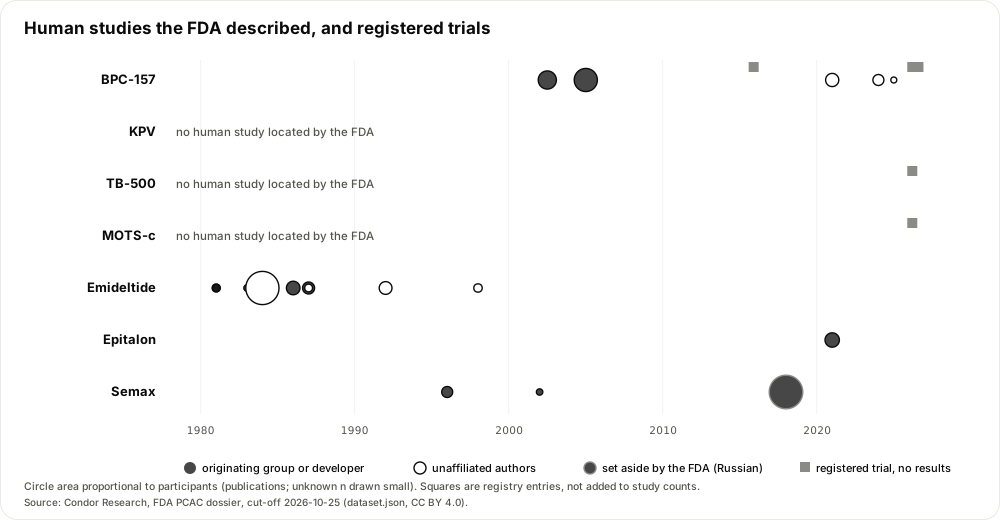
Three patterns stand out in our reading of the documents.
BPC-157: one abstract carries the evaluated use. The FDA located five clinical studies. Two are meeting abstracts from the developer of the PL 14736 formulation in healthy volunteers, with no full paper located; one is a 2005 randomised, placebo-controlled abstract in 53 people with ulcerative colitis, in which the between-group difference in the disease activity score was 1.6 points with a 95% confidence interval that crosses zero; and three are reports by one first author from private clinics in Florida (17, 12 and 2 people).1293031 None of the five has a Zagreb-group author; the two developer abstracts have authors from the company that ran the clinical programme. The FDA also notes that plasma levels were mostly undetectable in the studies that measured them.1
Emideltide: the positive studies come from one group. The FDA found the insomnia evidence “inconclusive and at best preliminary”.9 Our cross-tabulation shows why. The four Basel publications on insomnia by Schneider-Helmert, two of them with the peptide’s co-discoverer Schoenenberger, report longer or better sleep in 6, 18 and 14 people.333435 The two double-blind studies by unaffiliated groups found otherwise: in Montevideo (6 people), differences “already existed for the baseline values” and the improvement was “of little clinical significance”; in the Netherlands (16 people), the effects were “weak and in part could be due to an incidental change in the placebo group”.3637 The withdrawal evidence is two open-label studies, from Geneva and Munich, with no control group.3940
Semax: the largest study was not read. The FDA considered two references for effectiveness: a 2002 congress abstract with an unstated number of human participants, and a 1996 report on 12 people with migraine and 25 with trigeminal neuralgia or dental plexalgia, in which typical trigeminal neuralgia showed no change.4243 Four Russian-language clinical articles on stroke and cerebrovascular disease were “not considered as part of this evaluation” because no verified English translation was available, citing 21 CFR 10.20(c)(2).12 One of them, a 2018 study of 110 patients after ischaemic stroke, has an English abstract in PubMed reporting higher plasma BDNF and better functional scores with Semax.44 Every human reference the FDA cites for Semax effectiveness has an author from the developer group or its clinical partners.
For epitalon, the FDA located no study in people with insomnia; one 2021 study in 20 healthy people measured melatonin-related and circadian-gene outcomes, without a clinical sleep outcome.1041 Other human data in the epitalon reference list concern epithalamin, a pineal extract, or mixtures of the two.45 For KPV, TB-500 and MOTS-c, the nominations did not include, and the FDA did not find, any study in which the substance was given to people.678
In plain terms: three of the seven peptides have never been formally studied in people. For the other four, the studies are small, mostly old, and often from the same lab that discovered the peptide; where an outside team repeated the work for emideltide, it did not find a meaningful benefit.
How much of the cited literature comes from one group?
We classified every reference in the seven evaluations and measured authorship concentration: the share of primary studies of the substance (human, animal, in vitro, chemistry or human observational) with at least one author from a predefined originating group. The unit is the publication. This measures co-authorship, not control of data or the quality of any study, and it says nothing by itself about whether results are right. The groups were fixed before counting (see method note); TB-500 has no originating group, so the thymosin beta-4 lineage is used as a proxy and the figure should be read as such.
| Substance | Originating group (predefined) | Core, primary studies | Core + partners | Core + co-author network | Core, incl. reviews | Core + partners, human studies | PubMed census, core |
|---|---|---|---|---|---|---|---|
| BPC-157 | Zagreb (Sikiric/Seiwerth); broad adds Pliva (PL 14736) authors | 21/39 (53.8%) | 25/39 (64.1%) | 26/39 (66.7%) | 29/50 (58.0%) | 3/6 (50.0%) | 176/232 (75.9%) |
| KPV | alpha-MSH tripeptide lineage (Lipton/Catania); broad adds Münster (Luger/Brzoska/Böhm) and Atlanta (Merlin) | 2/8 (25.0%) | 3/8 (37.5%) | 2/8 (25.0%) | 2/11 (18.2%) | no records | 21/123 (17.1%) |
| TB-500 | no TB-500 originator; thymosin beta-4 lineage (Goldstein/Kleinman/Sosne) used as proxy | 1/6 (16.7%) | 1/6 (16.7%) | 1/6 (16.7%) | 1/6 (16.7%) | no records | 2/30 (6.7%) |
| MOTS-c | University of Southern California (Lee C/Cohen P) | 3/11 (27.3%) | 3/11 (27.3%) | 6/11 (54.5%) | 4/15 (26.7%) | no records | 38/257 (14.8%) |
| Emideltide | Basel discoverers (Monnier/Schoenenberger) and clinical arm (Schneider-Helmert); broad adds Graf | 13/47 (27.7%) | 13/47 (27.7%) | 14/47 (29.8%) | 13/54 (24.1%) | 7/14 (50.0%) | 34/449 (7.6%) |
| Epitalon | St Petersburg (Khavinson/Anisimov); broad adds Kyiv and Sukhumi collaborators | 20/27 (74.1%) | 23/27 (85.2%) | 24/27 (88.9%) | 26/33 (78.8%) | 3/3 (100.0%) | 107/167 (64.1%) |
| Semax | Moscow developers (Ashmarin/Myasoedov/Kamensky/Nezavibat'ko/Andreeva); broad adds IMG RAS and clinical partners | 41/54 (75.9%) | 46/54 (85.2%) | 46/54 (85.2%) | 42/56 (75.0%) | 10/12 (83.3%) | 109/212 (51.4%) |
Authorship concentration: share of publications with at least one author from the originating group. FDA columns use the unique references in each evaluation; the PubMed column uses all relevant records (surname plus initial). Co-authorship, not control or quality. TB-500 has no originator; its row uses the thymosin beta-4 lineage as a proxy. The MOTS-c PubMed value is an upper bound (common names). Source: dataset.json.
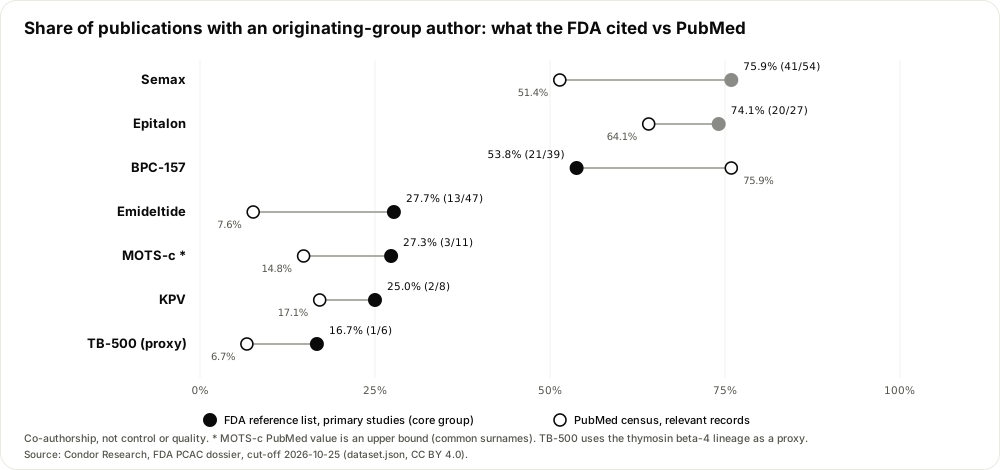
75.9% of the Semax primary studies the FDA cited (41 of 54) have an author from the Moscow developer group; with its documented partners, 85.2%. In all of PubMed the figure is 51.4%, so the FDA’s list is more concentrated than the literature it was drawn from.
The comparison with PubMed cuts both ways. For six of the seven substances the FDA’s list is more concentrated in the originating group than PubMed as a whole. We did not separate the references the nominators submitted from those the FDA found itself, so we do not attribute the difference to either. For BPC-157 it is the reverse: 75.9% of the 232 relevant PubMed records carry a Sikiric or Seiwerth author, against 53.8% of the FDA’s primary references; the FDA’s list also includes work from groups in China and Taiwan and doping-control papers.1 Sensitivity analyses (core group only, core plus documented partners, any co-author of the core group within the list, all substance-specific references including reviews, and human studies only) move the figures but do not change which three lists are the most concentrated (Semax, epitalon, BPC-157). For human studies alone, the originating group or its partners account for 3 of 3 epitalon references, 10 of 12 Semax, 7 of 14 emideltide and 3 of 6 BPC-157 (the last three being the developer company, not the Zagreb group).
Our earlier census of the whole epitalon literature (165 PubMed records, 17 October 2026) found 73% of records from the St Petersburg origin group, using names and affiliations, and all three human studies from that group; the FDA list is consistent with that picture.46
In plain terms: for Semax and epitalon, three out of four studies the FDA looked at were co-written by the team that created the peptide. That does not make them wrong, but it means few outside labs have checked the results.
What did the FDA cite, and how much of the literature is that?
| Substance | Unique refs | Human | Animal | In vitro | Chemistry or observational | Review | Related molecule | Context | Primary studies | PubMed relevant | Share of PubMed cited |
|---|---|---|---|---|---|---|---|---|---|---|---|
| BPC-157 | 65 | 6 | 27 | 4 | 2 | 11 | 0 | 15 | 39 | 232 | 17.7% |
| KPV | 17 | 0 | 5 | 3 | 0 | 3 | 2 | 4 | 8 | 123 | 8.1% |
| TB-500 | 20 | 0 | 1 | 2 | 3 | 0 | 7 | 7 | 6 | 30 | 23.3% |
| MOTS-c | 19 | 0 | 7 | 2 | 2 | 4 | 0 | 4 | 11 | 257 | 5.4% |
| Emideltide | 87 | 14 | 24 | 6 | 3 | 7 | 4 | 29 | 47 | 449 | 11.4% |
| Epitalon | 61 | 3 | 13 | 10 | 1 | 6 | 8 | 20 | 27 | 167 | 14.4% |
| Semax | 74 | 12 | 35 | 7 | 0 | 2 | 2 | 16 | 54 | 212 | 16.5% |
| Total | 343 | 35 | 112 | 34 | 11 | 33 | 23 | 95 | 192 | 1470 |
Composition of the reference lists in the seven FDA evaluations (unit: unique reference; 11 within-list duplicates removed) and the share of our PubMed census that the FDA cited (references with a PMID that are not context, over relevant records). Blind second coding of 52 references: 78.8% agreement, kappa 0.72. PubMed run 2026-10-25.
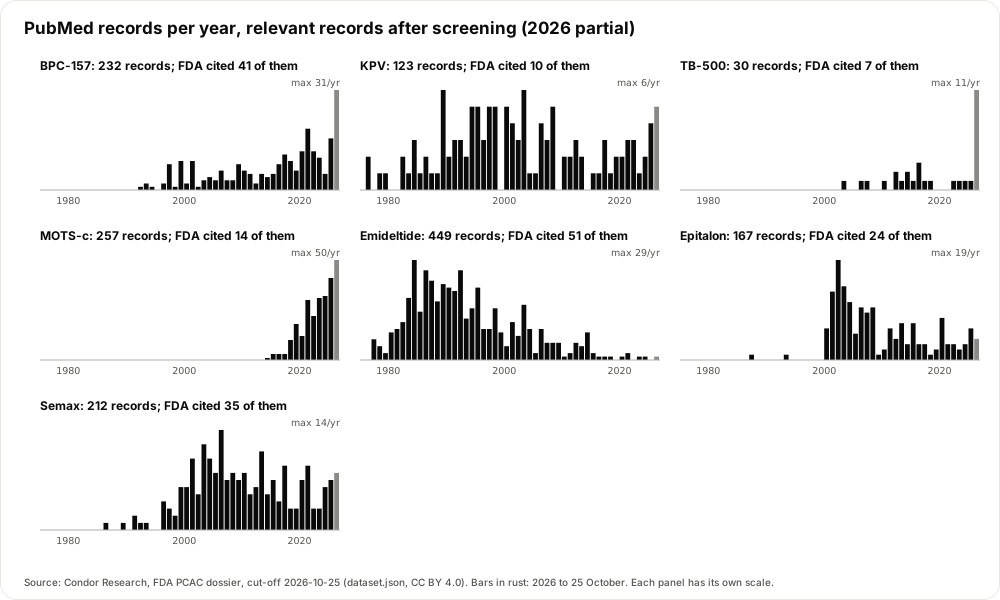
The seven reference lists contain 354 entries, 343 after removing 11 duplicates within lists. 95 (27.7%) are context: clinical guidelines for the evaluated conditions, epidemiology, general work on peptide aggregation and immunogenicity (one 2017 aggregation review appears in all seven lists), and comparator drugs. 23 concern a related but different molecule, such as thymosin beta-4 and its fragments other than TB-500 (7 of the 20 TB-500 references), the pineal extract epithalamin, ACTH(4-10) or Selank. That leaves 192 primary studies of the seven substances, 35 of them with data from people who received a substance.
Measured against our PubMed census, the FDA’s lists cite between 5.4% (MOTS-c) and 23.3% (TB-500) of the relevant indexed literature. This is not a criticism: an evaluation for a compounding list is not a systematic review, and the FDA states that it searched for evidence on the specific uses evaluated. It does mean that “the FDA reviewed the literature” refers to a selection, much of it supplied by the nominators. Publication on several of these peptides is accelerating: 31 of the 232 BPC-157 records and 11 of the 30 TB-500 records are dated 2026.
In plain terms: about a quarter of what the FDA cited is background reading, not research on the peptides. The rest is a small, targeted slice of a larger literature, chosen around one or two medical conditions per peptide.
Which trials are registered, and what has reported?
| Substance | Registry ID | Sponsor | Phase | Country | Planned n | Status | Results posted | In FDA evaluation |
|---|---|---|---|---|---|---|---|---|
| BPC-157 | NCT02637284 | PharmaCotherapia d.o.o. | Phase 1 | Mexico | 42 | Unknown (last update 2015-12-22) | No | Mentioned by the FDA |
| BPC-157 | NCT07437547 | Hudson Biotech | Phase 2 | China | 120 | Recruiting | No | Not mentioned (registered 2026-02-22) |
| BPC-157 | NCT07803250 | University of Arkansas | Phase 1 | United States | 30 | Not yet recruiting | No | Registered after the briefings (2026-08-12) |
| TB-500 | NCT07487363 | Hudson Biotech | Phase 1/2 | China | 80 | Recruiting | No | Not mentioned (registered 2026-03-14) |
| MOTS-c | NCT07505745 | Hudson Biotech | Phase 2 | China | 120 | Recruiting | No | Not mentioned (registered 2026-03-14) |
Interventional trials on ClinicalTrials.gov that administer one of the seven substances, API v2, 2026-10-25. Excluded and listed in dataset.json: BPC-157: NCT07752381 (multi-ingredient gummy, completed, no results). Epitalon: NCT07888595 (multi-ingredient serum, registered 2026-10-08). MOTS-c: 6 records measure endogenous MOTS-c without administering it. KPV, emideltide and Semax: 0 records. Registry entries are trials, not publications, and are not added to study counts.
The only registered trial the FDA mentions is a 2015 phase 1 study of BPC-157 in healthy volunteers in Mexico (42 planned participants), for which no results were posted and no publication was found.147 Three trials by one sponsor, of BPC-157, TB-500 and MOTS-c, were registered in February and March 2026, before the evaluations were dated, and are not mentioned in them. None of the five interventional trials located has posted results.47
In plain terms: a few trials have been registered, most of them in 2026, but none has reported any results yet.
What mechanisms and safety signals did the FDA describe?
The FDA’s documents are cautious about mechanism, and the distinction between what is established and what is proposed is clearer in them than in most public summaries. In our reading:
- Reported in nonclinical work and treated as findings in the FDA’s account: emideltide’s sleep-promoting effects across species and their dependence on opioid mechanisms, including stimulated endorphin release without direct opioid-receptor binding; epitalon’s ability to raise serum melatonin in animals; Semax’s pleiotropic effects in rodents (neurotrophic, antithrombotic, analgesic, antidepressant- and anxiolytic-like); MOTS-c’s metabolic effects in rodents and cells; KPV’s anti-inflammatory effects in rodent models.9101286
- Not established: a molecular target for BPC-157 or MOTS-c; dose-response relationships for BPC-157 and MOTS-c; the mechanism by which epitalon changes melatonin in vivo; any in vivo wound-healing effect of TB-500 itself (one in vitro study found none, while a metabolite fragment appeared active).18107
- Safety concerns raised by the staff: immunogenicity for all seven, linked to aggregation and peptide-related impurities; possible addiction liability for emideltide, given its opioid-system effects, and cases of hypotension in withdrawal studies; abuse potential for Semax, because it potentiated amphetamine-induced striatal dopamine release in mice, and bleeding risk from its antithrombotic properties; a mechanistic carcinogenicity concern for epitalon, because it is reported to activate telomerase and lengthen telomeres, which the FDA notes are generally associated with increased cancer risk.9121048
- Toxicology: no toxicity studies at all were identified for KPV, TB-500, MOTS-c, emideltide or Semax; for BPC-157, one programme of 28-day repeat-dose, genotoxicity and reproductive studies; for epitalon, mouse genotoxicity and tumour studies that the FDA found too limited.14910
- Adverse-event reports: FAERS searches returned 3 reports for BPC-157, 1 for Semax and none for the other five, with the FDA noting that compounders under 503A generally do not report adverse events.1128
In plain terms: in animals, most of these peptides do something measurable, but nobody has pinned down how most of them work. The reviewers’ main safety worry was that peptides of uncertain purity can provoke immune reactions; for epitalon they added that the very effect it is famous for, on telomeres, is a theoretical cancer concern.
How did the committee vote, according to whom?
No official minutes, transcript or summary of the votes had been posted on the FDA meeting page by 25 October 2026 (page last updated 6 August 2026).16 Every tally below is therefore secondary and attributed. The sources report one tally per substance, applied to both forms; one of them states explicitly that the free base and acetate votes were identical on day 1.18
| Substance | RAPS5011 | FDA Law Blog18 | McDermott2 | Health Affairs (per member)3 | Boesen & Snow51 | Eligible voters (roster)52 | Check |
|---|---|---|---|---|---|---|---|
| BPC-157 | 8-6-1 | 8-6-1 | 8-6-1 | 8-6-1 | 8-6-1 | 15 | Consistent |
| KPV | 8-6-1 | 8-6-1 | 8-6-1 | 8-6-1 | – | 15 | Consistent |
| TB-500 | – | 8-6-1 | 8-6-1 | 8-6-1 | – | 15 | Consistent |
| MOTS-c | – | 7-5-2 | 7-5-2 | 7-5-2 | – | 14 | Consistent |
| Emideltide | 6-7-1 | – | 6-7-1 | 6-7-1 | 7-6 (against; no abstention stated) | 14 | Notation differs; outcome agrees |
| Epitalon | 7-5-1 | – | 7-4-1 | 7-4-1 | – | 12 | Discrepant: 7-5-1 exceeds the roster |
| Semax | 8-5 (abstention not stated) | – | 8-5-1 | 8-5-1 | – | 14 | Consistent |
Committee votes as reported by each secondary source (yes-no-abstain; a dash means the source gives no count). The Health Affairs values are our sums of its per-member Exhibit 4. Eligible voters are counted from the topic restrictions printed in the FDA final roster. FDA staff recommended against all seven.
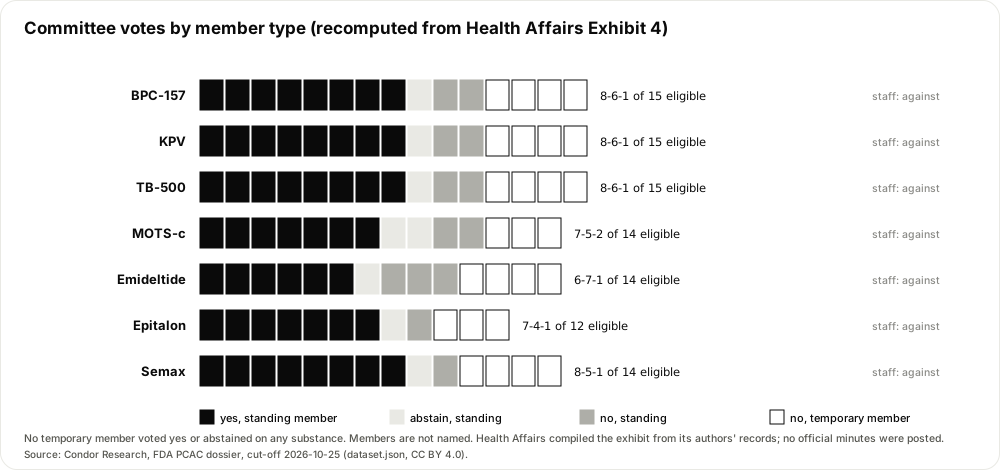
The epitalon discrepancy. RAPS reports 7 in favour, 5 against and 1 abstention; McDermott and the Health Affairs table report 7-4-1.1123 The FDA’s final roster restricts several members to specific topics. Counting the members eligible for the epitalon question gives 12 (9 standing members and 3 temporary members), so a 13-vote tally such as 7-5-1 cannot be produced from that roster, while 7-4-1 sums to exactly 12.52 The same check holds for every other tally reported by McDermott and Health Affairs (15, 15, 15, 14, 14 and 14 eligible voters). The roster check does not prove which count is correct, but it is consistent with 7-4-1. For emideltide, one law-firm blog writes “7-6”; the other sources write 6 in favour, 7 against and 1 abstention, so the outcome agrees and the notation differs.51
Who voted which way. Recomputed from the Health Affairs per-member table: every yes vote on every substance came from standing members; the eight temporary members, drawn from academic medicine, a government health system and patient and consumer advocacy, cast no yes votes and no abstentions. Of the standing members casting yes votes, the authors list all but one as having “identified potential conflicts of interest”, and “not found” for the remaining one; the representative of the US Pharmacopeia (acting chair) voted no on all seven, and the representative of the National Association of Boards of Pharmacy abstained on all seven.3 These are the Health Affairs authors’ classifications, not ours; we report them in aggregate and do not name individuals.
In plain terms: the committee’s yes votes were narrow, usually by two votes. The members brought in for this meeting from universities and patient groups voted no, and the yes votes came from regular members, most of whom the Health Affairs authors list as having potential conflicts of interest.
What has the agency decided?
No final decision was located on 25 October 2026. We checked four places on that date: the Federal Register API returned no document mentioning any of the seven peptides after the 16 April 2026 meeting notice5; the FDA’s 503A category list (updated 14 May 2026) did not include any of the seven in Category 14; the meeting page carried no minutes or announcement16; and the regulations.gov docket held the April notice and public comments only14. Law-firm analyses describe two possible next steps: notice-and-comment rulemaking to add substances to the 503A list, which they expect in late 2026 or 2027 or later, and an interim Category 1 entry, which the FDA has used for other substances after advisory meetings.218 According to one report, the FDA’s acting compounding director told the committee that the agency has gone against a PCAC recommendation at least once.18 The committee is due to consider five further peptides (GHK-Cu, dihexa acetate, LL-37, PEG-MGF and melanotan II) before the end of February 2027.24
In plain terms: as of 25 October 2026, the official status of all seven peptides is the same as it was before the meeting. Anyone describing them as approved or newly permitted is ahead of the record.
What is claimed, and what do the documents show?
| # | Claim circulating after the meeting | Verdict | What the documents show |
|---|---|---|---|
| 1 | The FDA approved BPC-157 and five other peptides in July 2026. | Contradicted | An advisory committee voted; it does not approve anything. FDA staff had recommended against all seven. At the cut-off there was no proposed rule in the Federal Register and none of the seven was in Category 1 of the 503A list.1354 |
| 2 | Compounding pharmacies can now legally use these peptides. | Not supported | Federal status had not changed at the cut-off. Law-firm analyses describe notice-and-comment rulemaking, or an interim Category 1 entry, as the next step; neither had occurred. This dossier does not assess legality.2184 |
| 3 | The FDA reviewed the evidence and found these peptides safe. | Contradicted | For every substance the staff found the safety information insufficient and raised immunogenicity concerns; for KPV, TB-500 and MOTS-c no human data of any kind were located.1678 |
| 4 | The committee's vote was a strong endorsement. | Qualified | Four of the six positive recommendations passed by two votes and two by three (epitalon by two in the RAPS count). In the per-member table published in Health Affairs Forefront, no temporary member voted yes on any substance.3 |
| 5 | Epitalon passed 7 to 5. | Disputed | RAPS reports 7-5-1; McDermott and the Health Affairs table report 7-4-1. The roster restricts epitalon to 12 eligible voters, so a 13-vote total is not arithmetically possible on that roster.112352 |
| 6 | Emideltide lost 7 to 6. | Qualified | Boesen & Snow write '7-6'; RAPS, McDermott and the Health Affairs table give 6 yes, 7 no, 1 abstention. The outcome is the same; the counts are written differently.511123 |
| 7 | The FDA reviewed hundreds of BPC-157 studies. | Qualified | The BPC-157 evaluation cites 65 references; 15 are context (guidelines, epidemiology, peptide science). Of the 39 primary studies, 21 have a Zagreb-group author. The only trial in the evaluated use is a 2005 meeting abstract.1 |
| 8 | There is no human research on any of these peptides. | Qualified | The FDA located human studies for BPC-157, emideltide, Semax and epitalon, all small or uncontrolled; it located none for KPV, TB-500 or MOTS-c.191210 |
| 9 | TB-500 is thymosin beta-4, so the thymosin beta-4 literature applies. | Contradicted | The FDA evaluated Ac-LKKTETQ, a 7-residue acetylated fragment. Of the 20 references in its TB-500 evaluation, 7 concern thymosin beta-4 or other fragments of it; it found no in vivo wound study of TB-500 itself.724 |
| 10 | Semax was assessed as a nootropic. | Qualified | The FDA folded 'nootropic' into cerebral ischaemia because the term has no ICD-10 code or guideline, and it did not evaluate ADHD. Four Russian-language clinical papers were set aside for lack of verified translations.12 |
| 11 | Epitalon was reviewed as an anti-ageing peptide. | Contradicted | Only insomnia was evaluated. The telomerase findings appear in the safety section, as a mechanistic carcinogenicity concern.1022 |
| 12 | Clinics asked the FDA to list these peptides, and the FDA is responding to them. | Qualified | All nominations were withdrawn. The FDA evaluated the substances on its own initiative and kept the nominations' information in the record.1318 |
| 13 | The FDA always follows its advisory committee. | Qualified | The FDA's acting compounding director said at the meeting that the agency had gone against a PCAC recommendation at least once (as reported by Hyman, Phelps & McNamara); McDermott writes that it rarely diverges.182 |
Thirteen claims found in vendor, clinic and news pages and in forum threads reviewed on 25 October 2026, checked against the FDA documents and the secondary sources named. Claims are quoted as claims; verdicts describe the record, not legality or suitability for any use.
What this record allows, and does not allow, us to say
- The FDA’s staff evaluated each peptide against one to three named conditions, chosen from what the withdrawn nominations could support; their conclusions say nothing about the many other uses for which these peptides are promoted, and a listing would not be limited to the evaluated use unless the entry said so.
- For KPV, TB-500 and MOTS-c, no study in which the substance was given to people was located by the nominators or the FDA. Statements about their effects in people are not supported by this record.
- For BPC-157, the only randomised data in the evaluated use are one 2005 meeting abstract (n=53) whose reported between-group difference was not statistically distinguishable from zero. No full report of that trial was located.
- For emideltide, the positive insomnia studies come from the discoverers’ group, and the two unaffiliated double-blind studies concluded the effect was of little clinical value. This record does not support an insomnia effect.
- For Semax, the FDA’s effectiveness review rested on two small references and excluded the Russian-language clinical literature on stroke. Its negative effectiveness finding is a finding about the English-language record it considered, not about all published clinical work.
- Authorship concentration in what the FDA cited is highest for Semax and epitalon (three in four primary studies) and lower for BPC-157 than in PubMed as a whole. This measures co-authorship, not quality.
- The committee’s six positive recommendations were narrow and are advice. At the cut-off the agency had not acted on them, and no source located describes these substances as approved.
- Vote tallies rest on secondary sources. Where they differ (epitalon), the meeting roster is consistent with 7-4-1, not 7-5-1.
What is not known
- Whether the FDA will accept, reject or defer the committee’s six positive recommendations, by what instrument (proposed rule or interim Category 1 entry), and with what limitations on use, form or route.
- The official vote record: the FDA has not posted minutes or a transcript; the recorded webcast would allow each tally to be verified independently.
- The full results of the 2005 BPC-157 ulcerative colitis trial and of the 2002-2003 company studies in healthy volunteers, none of which was located as a full paper.
- Whether the four Russian-language Semax studies, once translated, would change the FDA’s assessment of cerebral ischaemia; and whether any of them has been independently replicated.
- What the five interventional trials registered on ClinicalTrials.gov will report, and whether they will report at all; none had posted results at the cut-off.
- The identity and impurity profile of material actually sold under each of the seven names, which the FDA found it could not establish from the nominations or the literature.
- For epitalon, whether the telomerase activity reported by the originating group in cultured cells has any bearing on cancer risk in vivo, which the FDA raised as a theoretical concern.
Method note
Primary documents. The 15 official documents of the 23-24 July 2026 meeting: the briefing introduction, the seven substance briefings (FDA evaluation plus nominations), the voting questions, the final agenda, the final roster, the two days of FDA presentations, the webcast notice and the Federal Register notice of 16 April 2026; and, separately, the FDA meeting page. Texts were extracted from the PDFs and read selectively: executive summary, evaluated uses, sections on effectiveness and safety, and conclusion of each briefing. Concentrations and dosage forms proposed in the nominations are not reproduced anywhere in this dossier.
Reference census. The reference lists of the seven evaluations (354 entries; MANIFEST compiled by Condor Research) were parsed into authors, year and title; 11 duplicates within a list were removed (343 unique). Each was coded for evidence type with a fixed codebook: H (data from people who received the substance), A (animal in vivo), V (in vitro or ex vivo), C (chemistry, detection or analytical metabolism), R (review), O (people studied without administration), P (related but different molecule), X (context). Where the FDA text described a study’s population, that description was used. Blind second coding: a random sample of 52 references (15% of 343, above the minimum of 40; seed 20261025) was coded by a second coder (Codex CLI, read-only), given only the codebook and the reference text. Agreement was 78.8% (kappa 0.72); 82.0% (kappa 0.76) excluding the 2 records the second coder could not decide; 92.0% (kappa 0.86) when collapsed to human / other substance-specific / not specific. Most disagreements concerned congress abstracts whose population is clear only from the FDA text. Codes were not changed after comparison.
Authorship concentration. Originating groups were fixed before counting, by surname: BPC-157, Sikiric or Seiwerth (partners: the developer-company authors Veljaca and Ruenzi); KPV, Lipton or Catania (partners: Luger, Brzoska, Böhm, Merlin, Dalmasso); TB-500, no originator, thymosin beta-4 lineage Goldstein, Kleinman or Sosne as a proxy; MOTS-c, Lee or Cohen; emideltide, Monnier, Schoenenberger or Schneider-Helmert (partner: Graf); Semax, Ashmarin, Myasoedov, Kamensky, Nezavibat’ko or Andreeva (partners: 15 named co-workers and clinical collaborators); epitalon, Khavinson, Anisimov, Morozov or Dilman (partners: 8 named collaborators). Headline: core group, primary studies (H, A, V, C, O). Sensitivity: core plus partners; core plus any co-author of a core author within the same list; all substance-specific references including reviews; human studies only. In PubMed the match used surname plus first initial against the core names; “Lee C” and “Cohen P” are common, so the MOTS-c PubMed figure is an upper bound. The unit is always the publication.
PubMed census. Synonyms were taken from PubChem on 25 October 2026 (CIDs 9941957, 125672, 62707662, 146675088, 68816, 9811102, 219042) before searching. Queries (all run 2026-10-25 via NCBI E-utilities, title/abstract fields unless stated): BPC-157, “BPC 157” OR BPC-157 OR BPC157 OR bepecin OR “PL 14736” OR PL-14736 OR PL14736 OR “pentadecapeptide BPC” OR “body protection compound” OR “body protective compound” (234 records); KPV, KPV OR “Lys-Pro-Val” OR “lysyl-prolyl-valine” OR “alpha-MSH(11-13)” and variants (150); TB-500, TB-500 OR TB500 OR “TB 500” OR LKKTETQ OR Ac-LKKTETQ (39); MOTS-c, MOTS-c OR MOTSc OR “MOTS c” OR the full name (266); emideltide, the MeSH heading “Delta Sleep-Inducing Peptide” OR the name OR DSIP OR emideltide OR deltaran (541); Semax, semax (title/abstract and substance name) OR ACTH(4-7)PGP variants OR the sequence (240); epitalon, the substance name OR epitalon, epithalon, epithalone, epitalone, Ala-Glu-Asp-Gly, AEDG (174). Because KPV, DSIP and “TB 500” collide with other uses, every record’s title and abstract were screened with a substance-specific pattern; 1,470 of 1,644 records were retained as relevant. The exact queries and patterns are in dataset.json.
Registries and regulatory checks. ClinicalTrials.gov API v2, query.term with all synonyms, 25 October 2026; interventional studies administering the substance were kept, records measuring endogenous MOTS-c or testing multi-ingredient products were listed separately. Federal Register API (term searches for each peptide and for the committee, from 1 January 2026); FDA 503A category list (PDF, updated 14 May 2026); FDA meeting page; regulations.gov API for docket FDA-2025-N-6895. All on 25 October 2026.
Votes. Tallies from RAPS (23 and 24 July 2026), the FDA Law Blog of Hyman, Phelps & McNamara (24 July 2026, day 1), McDermott Will & Schulte (27 July 2026), Health Affairs Forefront (4 August 2026, per-member Exhibit 4) and a Boesen & Snow blog post. Eligible voters per topic were counted from the FDA final roster’s topic restrictions. Member-level votes are taken from the Health Affairs exhibit and reported only in aggregate.
Limitations. We read the briefings selectively and may have missed a study described only in a section we did not read in full; the MANIFEST was compiled from the reference lists and could contain parsing errors in author names, which affect the concentration measure. Surname matching cannot distinguish namesakes. The FDA’s lists are not systematic reviews, so their composition reflects what nominators submitted. Vote counts are secondary. Full texts of most cited papers were not read; claims about individual studies rely on their abstracts or on the FDA’s description.
Evidence Index rows updated. The Condor Research Evidence Index rows for these substances are superseded by this census: BPC-157 232 relevant PubMed records; KPV 123; TB-500 30 (the earlier row of 1,232 conflated TB-500 with the thymosin beta-4 protein); MOTS-c 257; emideltide 449; Semax 212; epitalon 167. Human-study counts in the earlier index used the MeSH “Humans” tag, which does not indicate administration to people.
Glossary
- 503A bulks list: the list of bulk drug substances that pharmacies may use under section 503A of the US Food, Drug, and Cosmetic Act when a substance has no USP monograph and is not part of an approved drug.
- Bulk drug substance: an active ingredient used to prepare a medicine, as distinct from a finished product.
- Category 1, 2, 3: the FDA’s interim grouping of nominated substances under evaluation, raising significant safety risks, or nominated without adequate support.
- PCAC: the Pharmacy Compounding Advisory Committee, which advises the FDA; its votes are not binding.
- Free base and acetate: two chemical forms of the same peptide, without and with an acetate counter-ion; the FDA evaluated both.
- Critical quality attributes: properties, such as purity, impurities, aggregates and endotoxin, that must be controlled for a medicine to be of consistent quality.
- Immunogenicity: the capacity of a substance to provoke an immune response, which for peptides can be increased by aggregation and impurities.
- FAERS: the FDA Adverse Event Reporting System, a voluntary database of reports that do not establish causation.
- Authorship concentration: our measure of the share of publications with at least one author from a predefined originating group.
- Cohen’s kappa: a measure of agreement between two coders that corrects for agreement expected by chance; 1 is perfect, 0 is chance level.
- Research Use Only (RUO): material supplied for laboratory research, not for use in people or animals.
Frequently asked questions
Did the FDA approve BPC-157, TB-500 or the other peptides in July 2026?
No. On 23-24 July 2026 the FDA's Pharmacy Compounding Advisory Committee, whose votes are advisory, recommended adding six of seven peptides to the 503A bulk drug substances list, a list for pharmacy compounding, not a drug approval. FDA staff had recommended against all seven. On 25 October 2026 no final FDA decision, proposed rule or Category 1 entry had been located.
What did the FDA evaluate each peptide for?
BPC-157 for ulcerative colitis; KPV for wound healing and inflammatory conditions; TB-500 for wound healing; MOTS-c for obesity and osteoporosis according to the meeting page (the briefing says the nominated uses were not evaluated); emideltide (DSIP) for chronic insomnia, narcolepsy and opioid withdrawal; epitalon for insomnia; Semax for cerebral ischaemia, migraine and trigeminal neuralgia.
How did the committee vote on each peptide?
As reported by McDermott Will & Schulte and the Health Affairs Forefront per-member table (yes-no-abstain): BPC-157, KPV and TB-500 8-6-1; MOTS-c 7-5-2; emideltide 6-7-1 (not recommended); epitalon 7-4-1 (RAPS reports 7-5-1); Semax 8-5-1. The FDA had posted no minutes by 25 October 2026.
Why did FDA staff recommend against all seven?
In each evaluation the staff found the substance not well characterised (non-standard names and missing impurity, aggregate and endotoxin data), little or no evidence of effectiveness in the evaluated use, insufficient safety information including immunogenicity concerns, limited information on historical use, and approved therapies available for the conditions evaluated.
Which of the seven have any human studies?
The FDA described human studies for BPC-157 (five small studies, the only randomised one a 2005 meeting abstract), emideltide (insomnia, narcolepsy and withdrawal studies from 1981 to 1998), Semax (two references for effectiveness, with four Russian-language studies set aside) and epitalon (one study in 20 healthy people). It located none for KPV, TB-500 or MOTS-c.
Is the vote count for epitalon 7-5-1 or 7-4-1?
RAPS reports 7-5-1; McDermott and the Health Affairs table report 7-4-1. The FDA final roster restricts several members to specific topics, leaving 12 members eligible to vote on epitalon, which is consistent with 7-4-1 (12 votes) and not with 7-5-1 (13 votes). No official tally had been posted at the cut-off.
How to cite this dossier
Condor Research Editorial. What the FDA evaluated in seven peptides: the July 2026 Pharmacy Compounding Advisory Committee record. Version 1.0, 25 October 2026. https://condorresearch.com/research/fda-pcac-2026-seven-peptides/. Dataset: dataset.json (CC BY 4.0).
Changelog. Version 1.0 (25 October 2026): first publication-ready version; census, double coding, vote reconciliation and decision search all dated 25 October 2026.
Related Condor Research dossiers: the epitalon Evidence Card and full census; what Research Use Only means; the evidence ledger.
Research Use Only. Any of these compounds that Condor Research supplies is sold as a laboratory reagent for research only, not as a medicine, and not for human or veterinary use. None of the seven is approved by the FDA or the EMA for any use; Semax is authorised as a medicine in Russia, which does not change the status of research-grade material. This dossier describes a regulatory record and the published literature; it contains no dosing information and makes no therapeutic claim.
References
- US Food and Drug Administration. July 23-24, 2026 Meeting of the Pharmacy Compounding Advisory Committee. FDA Briefing Document for BPC-157-related bulk drug substances (FDA evaluation dated 2026-05-11, and nominations). Accessed 2026-10-25. Link.
- Ravitz JR, Gadiock PS, Lee JH, et al. Bulk-list bound? PCAC backs majority of peptides in two-day public meeting. McDermott Will & Schulte client alert, 27 July 2026. Secondary source. Link.
- Fu M, Ross JS, Nguyen NTAH, Ramachandran R. FDA advisory committee’s vote may open a drug-compounding back door for unapproved peptides. Health Affairs Forefront, 4 August 2026. DOI 10.1377/forefront.20260803.287322. Exhibit 4 compiled from the authors’ records of the meeting. Link.
- US Food and Drug Administration. Bulk Drug Substances Nominated for Use in Compounding Under Section 503A of the FD&C Act (categories 1-3; updated 2026-05-14). Accessed 2026-10-25. Link.
- Federal Register API, term searches for BPC-157, KPV, TB-500, MOTS-c, emideltide, epitalon, Semax, ‘503A bulk drug substances’ and ‘Pharmacy Compounding Advisory Committee’, publication date from 2026-01-01. Run 2026-10-25; no document after 2026-04-16 mentions any of the seven. Link.
- US Food and Drug Administration. July 23-24, 2026 Meeting of the Pharmacy Compounding Advisory Committee. FDA Briefing Document for KPV-related bulk drug substances (evaluation dated 2026-05-12). Accessed 2026-10-25. Link.
- US Food and Drug Administration. July 23-24, 2026 Meeting of the Pharmacy Compounding Advisory Committee. FDA Briefing Document for TB-500-related bulk drug substances (evaluation dated 2026-05-15). Accessed 2026-10-25. Link.
- US Food and Drug Administration. July 23-24, 2026 Meeting of the Pharmacy Compounding Advisory Committee. FDA Briefing Document for MOTS-c-related bulk drug substances (evaluation dated 2026-05-11). Accessed 2026-10-25. Link.
- US Food and Drug Administration. July 23-24, 2026 Meeting of the Pharmacy Compounding Advisory Committee. FDA Briefing Document for emideltide-related bulk drug substances (evaluation dated 2026-05-11). Accessed 2026-10-25. Link.
- US Food and Drug Administration. July 23-24, 2026 Meeting of the Pharmacy Compounding Advisory Committee. FDA Briefing Document for epitalon-related bulk drug substances (evaluation dated 2026-05-12). Accessed 2026-10-25. Link.
- Eglovitch JS. FDA advisory committee backs two more peptides, rejects one for compounding list. RAPS Regulatory Focus, 24 July 2026. Secondary source for vote counts. Link.
- US Food and Drug Administration. July 23-24, 2026 Meeting of the Pharmacy Compounding Advisory Committee. FDA Briefing Document for Semax-related bulk drug substances (evaluation dated 2026-05-11). Accessed 2026-10-25. Link.
- US Food and Drug Administration. July 23-24, 2026 Meeting of the Pharmacy Compounding Advisory Committee. FDA Briefing Document: Introduction (criteria, substances, points to consider). Accessed 2026-10-25. Link.
- Regulations.gov API v4, docket FDA-2025-N-6895: 1 document (the meeting notice) and 2,641 posted comments, 791 in the 90 days to 2026-10-25. Accessed 2026-10-25. Link.
- US Food and Drug Administration. July 23-24, 2026 Meeting of the Pharmacy Compounding Advisory Committee. Questions (voting questions). Accessed 2026-10-25. Link.
- US Food and Drug Administration. July 23-24, 2026: Meeting of the Pharmacy Compounding Advisory Committee (meeting page; content current as of 2026-08-06; no minutes or transcript listed). Accessed 2026-10-25. Link.
- US Food and Drug Administration. July 23-24, 2026 Meeting of the Pharmacy Compounding Advisory Committee. FDA Presentations, 23 July 2026 (introductory remarks, 503A evaluation process). Accessed 2026-10-25. Link.
- Palmer KL, Snow CD, Bass M. PEPTIDE-L WAVE! PCAC approves four bulk drug substances for the 503A list. FDA Law Blog (Hyman, Phelps & McNamara), 24 July 2026. Secondary source. Link.
- Schoenenberger GA, Monnier M. Characterization of a delta-electroencephalogram (-sleep)-inducing peptide. Proc Natl Acad Sci U S A. 1977. PMID 265572. DOI 10.1073/pnas.74.3.1282.
- Ponomareva-Stepnaya, Nezavibat'ko, Antonova, et al. An analog of ACTH4–10 — A long-action stimulator of learning. Pharmaceutical Chemistry Journal. 1984. DOI 10.1007/bf00769795.
- Sikirić P, Petek M, Rucman R, et al. A new gastric juice peptide, BPC. An overview of the stomach-stress-organoprotection hypothesis and beneficial effects of BPC. J Physiol Paris. 1993. PMID 8298609. DOI 10.1016/0928-4257(93)90038-u.
- Khavinson VKh, Bondarev IE, Butyugov AA. Epithalon peptide induces telomerase activity and telomere elongation in human somatic cells. Bull Exp Biol Med. 2003. PMID 12937682. DOI 10.1023/a:1025493705728.
- Lee C, Zeng J, Drew BG, et al. The mitochondrial-derived peptide MOTS-c promotes metabolic homeostasis and reduces obesity and insulin resistance. Cell Metab. 2015. PMID 25738459. DOI 10.1016/j.cmet.2015.02.009.
- Esposito S, Deventer K, Goeman J, et al. Synthesis and characterization of the N-terminal acetylated 17-23 fragment of thymosin beta 4 identified in TB-500, a product suspected to possess doping potential. Drug Test Anal. 2012. PMID 22962027. DOI 10.1002/dta.1402.
- Ho EN, Kwok WH, Lau MY, et al. Doping control analysis of TB-500, a synthetic version of an active region of thymosin β₄, in equine urine and plasma by liquid chromatography-mass spectrometry. J Chromatogr A. 2012. PMID 23084823. DOI 10.1016/j.chroma.2012.09.043.
- Federal Register. Pharmacy Compounding Advisory Committee; Notice of Meeting; Establishment of a Public Docket; Request for Comments. 2026-04-16, document 2026-07361, docket FDA-2025-N-6895. Link.
- US Food and Drug Administration. July 23-24, 2026 Meeting of the Pharmacy Compounding Advisory Committee. Final Agenda. Accessed 2026-10-25. Link.
- National Center for Biotechnology Information. PubChem Compound Summaries, CIDs 9941957, 125672, 62707662, 146675088, 68816, 9811102 and 219042 (synonyms). Accessed 2026-10-25. Link.
- Lee E, Padgett B. Intra-Articular Injection of BPC 157 for Multiple Types of Knee Pain. Altern Ther Health Med. 2021. PMID 34324435.
- Lee E, Walker C, Ayadi B. Effect of BPC-157 on Symptoms in Patients with Interstitial Cystitis: A Pilot Study. Altern Ther Health Med. 2024. PMID 39325560.
- Lee E, Burgess K. Safety of Intravenous Infusion of BPC157 in Humans: A Pilot Study. Altern Ther Health Med. 2025. PMID 40131143.
- Schneider-Helmert D, Gnirss F, Monnier M, et al. Acute and delayed effects of DSIP (delta sleep-inducing peptide) on human sleep behavior. Int J Clin Pharmacol Ther Toxicol. 1981. PMID 6895513.
- Schneider-Helmert D, Schoenenberger GA. The influence of synthetic DSIP (delta-sleep-inducing-peptide) on disturbed human sleep. Experientia. 1981. PMID 7028502. DOI 10.1007/BF01971753.
- Schneider-Helmert D. Efficacy of DSIP to normalize sleep in middle-aged and elderly chronic insomniacs. Eur Neurol. 1986. PMID 3792404. DOI 10.1159/000116050.
- Schneider-Helmert D. Effects of delta-sleep-inducing peptide on 24-hour sleep-wake behaviour in severe chronic insomnia. Eur Neurol. 1987. PMID 3622582. DOI 10.1159/000116143.
- Monti JM, Debellis J, Alterwain P, et al. Study of delta sleep-inducing peptide efficacy in improving sleep on short-term administration to chronic insomniacs. Int J Clin Pharmacol Res. 1987. PMID 3583493.
- Bes F, Hofman W, Schuur J, et al. Effects of delta sleep-inducing peptide on sleep of chronic insomniac patients. A double-blind study. Neuropsychobiology. 1992. PMID 1299794. DOI 10.1159/000118919.
- Schneider-Helmert D. Effects of DSIP on narcolepsy. Eur Neurol. 1984. PMID 6548968. DOI 10.1159/000115713.
- Dick P, Costa C, Fayolle K, et al. DSIP in the treatment of withdrawal syndromes from alcohol and opiates. Eur Neurol. 1984. PMID 6548969. DOI 10.1159/000115715.
- Backmund M, Meyer K, Rothenhaeusler HB, et al. Opioid detoxification with delta sleep-inducing peptide: results of an open clinical trial. J Clin Psychopharmacol. 1998. PMID 9617990. DOI 10.1097/00004714-199806000-00016.
- Ivko, Linkova, Ilina, et al. AEDG Peptide Regulation of the Expression of Human Circadian Rhythm Genes upon Accelerated Aging of the Pineal Gland. Advances in Gerontology. 2021. DOI 10.1134/s2079057021010380.
- Cherkasova, Ashmarin, Kubatiev, et al. Neuropeptide semax — Effective antithrombotic drug. European Neuropsychopharmacology. 2002. DOI 10.1016/s0924-977x(02)80695-2.
- Koroleva, Meizerov, Nezavibat'ko, et al. Analgesic action of the new drug Semax. Bulletin of Experimental Biology and Medicine. 1996. DOI 10.1007/bf02447659.
- Gusev EI, Martynov MY, Kostenko EV, et al. [The efficacy of semax in the tretament of patients at different stages of ischemic stroke]. Zh Nevrol Psikhiatr Im S S Korsakova. 2018. PMID 29798983. DOI 10.17116/jnevro20181183261-68. Article in Russian; title as translated by PubMed.
- Korkushko OV, Lapin BA, Goncharova ND, et al. [Normalizing effect of the pineal gland peptides on the daily melatonin rhythm in old monkeys and elderly people]. Adv Gerontol. 2007. PMID 17969590. Article in Russian; title as translated by PubMed.
- Condor Research Editorial. Epitalon: Evidence Card and full census. Version 1.0-rc2, 17-18 October 2026. Link.
- ClinicalTrials.gov API v2, query.term searches with all synonyms for each substance; records NCT02637284, NCT07437547, NCT07803250, NCT07487363, NCT07505745 and others listed in dataset.json. Accessed 2026-10-25. Link.
- McNally EJ, Luncsford PJ, Armanios M. Long telomeres and cancer risk: the price of cellular immortality. J Clin Invest. 2019. PMID 31380804. DOI 10.1172/JCI120851.
- Xu C, Sun L, Ren F, et al. Preclinical safety evaluation of body protective compound-157, a potential drug for treating various wounds. Regul Toxicol Pharmacol. 2020. PMID 32334036. DOI 10.1016/j.yrtph.2020.104665.
- Eglovitch JS. FDA advisory committee backs two controversial peptides. RAPS Regulatory Focus, 23 July 2026. Secondary source for vote counts. Link.
- Boesen & Snow. The peptide vote heard round the compounding world. Law firm blog post, undated (accessed 2026-10-25). Secondary source. Link.
- US Food and Drug Administration. July 23-24, 2026 Meeting of the Pharmacy Compounding Advisory Committee. Final Meeting Roster (with topic restrictions for individual members). Accessed 2026-10-25. Link.
Did the FDA approve BPC-157, TB-500 or the other peptides in July 2026?
No. On 23-24 July 2026 the FDA's Pharmacy Compounding Advisory Committee, whose votes are advisory, recommended adding six of seven peptides to the 503A bulk drug substances list, a list for pharmacy compounding, not a drug approval. FDA staff had recommended against all seven. On 25 October 2026 no final FDA decision, proposed rule or Category 1 entry had been located.
What did the FDA evaluate each peptide for?
BPC-157 for ulcerative colitis; KPV for wound healing and inflammatory conditions; TB-500 for wound healing; MOTS-c for obesity and osteoporosis according to the meeting page (the briefing says the nominated uses were not evaluated); emideltide (DSIP) for chronic insomnia, narcolepsy and opioid withdrawal; epitalon for insomnia; Semax for cerebral ischaemia, migraine and trigeminal neuralgia.
How did the committee vote on each peptide?
As reported by McDermott Will & Schulte and the Health Affairs Forefront per-member table (yes-no-abstain): BPC-157, KPV and TB-500 8-6-1; MOTS-c 7-5-2; emideltide 6-7-1 (not recommended); epitalon 7-4-1 (RAPS reports 7-5-1); Semax 8-5-1. The FDA had posted no minutes by 25 October 2026.
Why did FDA staff recommend against all seven?
In each evaluation the staff found the substance not well characterised (non-standard names and missing impurity, aggregate and endotoxin data), little or no evidence of effectiveness in the evaluated use, insufficient safety information including immunogenicity concerns, limited information on historical use, and approved therapies available for the conditions evaluated.
Which of the seven have any human studies?
The FDA described human studies for BPC-157 (five small studies, the only randomised one a 2005 meeting abstract), emideltide (insomnia, narcolepsy and withdrawal studies from 1981 to 1998), Semax (two references for effectiveness, with four Russian-language studies set aside) and epitalon (one study in 20 healthy people). It located none for KPV, TB-500 or MOTS-c.
Is the vote count for epitalon 7-5-1 or 7-4-1?
RAPS reports 7-5-1; McDermott and the Health Affairs table report 7-4-1. The FDA final roster restricts several members to specific topics, leaving 12 members eligible to vote on epitalon, which is consistent with 7-4-1 (12 votes) and not with 7-5-1 (13 votes). No official tally had been posted at the cut-off.