
Does a Research Peptide Need Refrigeration? A Compound-by-Compound Stability Reference
Lyophilized peptide powder is kinetically arrested and tolerates brief ambient excursions; the reconstituted solution needs 2-8 C. The degradation chemistry, referenced.
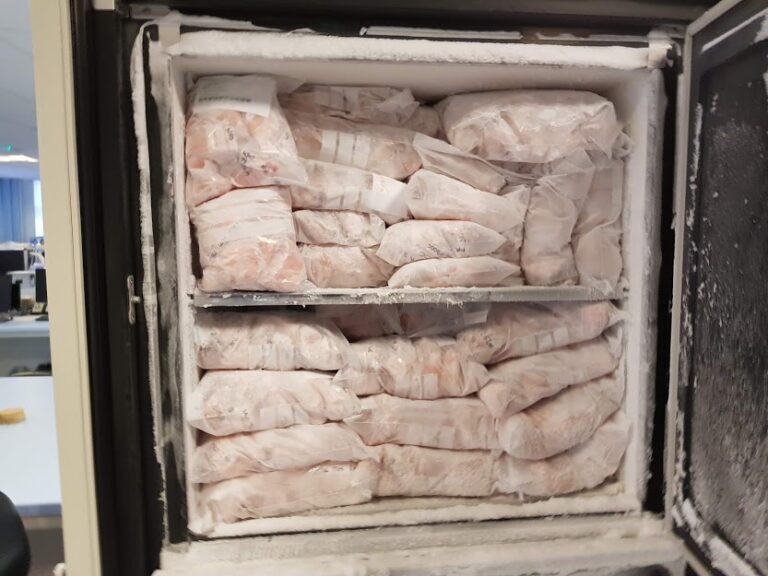
The dry lyophilized powder does not strictly require refrigeration for short periods — it is a kinetically arrested glass that tolerates brief ambient excursions. The reconstituted aqueous solution does need 2-8 C and short use, because adding water restarts the degradation chemistry. This describes material handling only.
A common assumption is that every peptide lives and dies by the refrigerator. The physical chemistry is more specific than that. A freeze-dried peptide powder and its reconstituted solution are two different materials with two different degradation clocks: the dry glass is kinetically arrested and forgiving of a warm afternoon in transit, while the aqueous solution starts degrading the moment water enters the vial. Everything below describes physicochemical stability and laboratory handling of the material — HPLC purity, aggregation, charge variants — not use in people. Nothing here concerns human or veterinary use.
What actually degrades a peptide?
Peptide instability is not one process but a short, well-characterized list. The modern reference divides it into chemical routes — asparagine and glutamine deamidation, aspartate isomerization, methionine and cysteine oxidation, backbone hydrolysis — and physical routes, chiefly aggregation and denaturation.1 The foundational surveys of formulation stability lean on the same three chemical culprits (deamidation, oxidation, aggregation) and note that pH, ionic strength, buffer and temperature all steer them.2
Deamidation is the one worth understanding in detail, because it sets the pace for many sequences. The reaction is intramolecular: the backbone nitrogen of the residue C-terminal to an asparagine attacks the Asn side-chain carbonyl, closing a five-membered cyclic imide (the succinimide, or Asu). That succinimide then hydrolyzes to a mixture of aspartate and isoaspartate.3 The rate-limiting step is that backbone-nitrogen attack, which is why the identity of the neighboring residue dominates: Asn-Gly and Asn-Ser deamidate fastest, because a small, unhindered neighbor makes the ring easy to form. Solvent dielectric and pH tune it further.3
The clearest demonstration that this is a sequence-encoded clock rather than a vague “aging” comes from Robinson and Robinson, who computed and experimentally verified deamidation rates for 1,371 asparagine residues across 126 human proteins.4 The takeaway for storage is blunt: deamidation is neighbor-specific and time-dependent. It runs whenever the peptide is mobile and hydrated, and it slows dramatically when it is neither.
~10,000× Solid-state deamidation rate constants fell about four orders of magnitude once model peptides were in the glassy state versus solution.
Why the dry powder is forgiving
Lyophilization does not make a peptide chemically inert. It makes it slow. In the freeze-dried glassy amorphous state, molecules are locked in a high-viscosity matrix with little translational or rotational freedom, and reactions that need molecular motion nearly stall. Krogmeier and colleagues quantified this directly: deamidation rate constants for model beta-turn cyclic peptides dropped roughly four orders of magnitude once the peptides were in the glassy, low-mobility solid.5 A separate lyophilized monoclonal antibody study found all formulations stable at 5 C, with aggregation and aspartate isomerization rising only when residual moisture was high or storage went above the glass transition temperature (Tg).6
The nuance underneath “below Tg is safe” is that molecular mobility, not the Tg number itself, tracks storage stability. In freeze-dried human growth hormone, degradation well below Tg followed structural relaxation and fast local dynamics more closely than it followed the glass transition alone.7 This is also why lyoprotectant sugars work: trehalose and sucrose form a rigid, low-mobility glass that physically separates and immobilizes the peptide, and in lyophilized insulin a trehalose matrix suppressed covalent dimer formation by restricting that mobility.8
The dry vial is not “stable forever.” It is arrested — a clock that ticks slowly and speeds up with heat, moisture, and time above the glass transition.
Real cold-chain peptide data back up the practical claim that brief warmth is survivable in the dry or finished form. Oxytocin ampoules subjected to controlled temperature cycling degraded only during the elevated-temperature phases and showed no loss during refrigerated periods — heat drove the damage, not the gaps in refrigeration.9 More strikingly, amorphous solid semaglutide retained its native alpha-helix up to 60 C, with a measured Tg near 169 C; its degradation was temperature-dependent but the dry solid tolerated excursions far above fridge temperature.10
Why the reconstituted solution is not
Water is the switch. In lyophilized peptide solids, added moisture accelerates deamidation by two mechanisms at once: it plasticizes the matrix, lowering Tg and raising molecular mobility, and it participates directly as a chemical reactant in the hydrolysis steps.11 The same water-driven picture appears in lyophilized insulin, where rising water content lowered Tg and shifted the system toward covalent dimers and aggregates.12 Reconstitution takes this to its limit: the peptide is now fully mobile, fully hydrated, and the succinimide, oxidation and aggregation pathways all run at solution rates.
How much this matters was measured cleanly for somatropin under identical light stress across three physical states. Aggregation increased by +0.4% in the lyophilized form, +2.7% once reconstituted, and +4.7% once diluted; acidic charge variants rose +2.8% / +7.8% / +6.2% across the same three states.13 The lyophilized powder was the robust state; the reconstituted and diluted solutions were the vulnerable ones. This is the empirical basis for a rule that holds across peptide chemistry: store and ship the powder with reasonable care, but treat the solution as short-lived and keep it cold.
| State | Physical picture | Degradation clock | Handling implication (RUO material) |
|---|---|---|---|
| Lyophilized powder | Glassy, low-mobility solid; kinetically arrested | Very slow; ~10,000× slower deamidation than solution | Tolerates brief ambient excursions and cold-chain-free shipping; cold/dry/dark is best for long holds |
| Reconstituted solution | Fully mobile, fully hydrated | Runs at solution rate; water is reactant and plasticizer | Store 2-8 C; use over a short window; protect from light |
| Diluted / working solution | Lower concentration, more surface and light exposure | Fastest observed aggregation and charge change in the somatropin data | Most fragile state; prepare fresh, minimize hold time |
Rates and percentages are from pharmaceutical proteins and model peptides under in-vitro stress (deamidation kinetics, photostability). They illustrate the degradation chemistry and are not a shelf-life measurement for any specific research compound. RUO material only.
A compound-by-compound read — as inference, not measurement
The honest way to translate this to a specific sequence is to ask which reactive residues it carries, then reason about which routes are live. A sequence with an Asn-Gly or Asn-Ser motif has a fast deamidation site and benefits most from staying dry and cold once in solution. A methionine or cysteine makes oxidation the residue to watch, favoring light protection and minimal air exposure in the reconstituted vial. Sequences that are short and lack Asn/Gln/Met/Cys altogether have fewer fast chemical routes, though physical aggregation remains possible for any peptide. This residue-level reasoning is exactly how the primary literature frames susceptibility, and it is why the general handling advice above is compound-agnostic: the powder is arrested, the solution is not, and the specific residues tell you which pathway dominates once water is added.
Two conventions frame the QC language rather than the chemistry. ICH Q1A(R2), “Stability Testing of New Drug Substances and Products,” defines the standard test conditions (long-term 25 C/60% RH, accelerated 40 C/75% RH, intermediate 30 C/65% RH) at database.ich.org. USP General Chapters <795> (nonsterile compounding beyond-use dating) and <797> (sterile compounding, source of the commonly cited refrigerated in-use window for reconstituted preparations) sit at usp.org. These are conservative handling conventions for sterility and general use, not chemical-stability measurements for any of these peptides. That temperature and humidity — not the calendar — govern the rate is validated directly: a humidity-corrected Arrhenius (ASAP) model for the peptide bacitracin predicted long-term shelf life from short temperature/RH stress and matched real 30 C and 40 C data.14
For deeper handling detail, see the companion references on how to store and reconstitute peptides, on which reconstitution solvent to use, and on how to read a certificate of analysis. Compound-specific storage notes exist for the small molecules where they behave differently from peptides — NAD+, NMN, and 5-Amino-1MQ.
An honest read of the evidence
The load-bearing caveat is provenance. Almost every stability measurement cited here comes from pharmaceutical proteins and model peptides — insulin, human growth hormone, monoclonal antibodies, bacitracin, oxytocin, semaglutide, somatropin, synthetic Asn/Asp hexapeptides. None of it measures BPC-157, TB-500, GHK-Cu, semax, ipamorelin, CJC-1295, PT-141 or epitalon directly. The thesis that a dry peptide is kinetically arrested and its solution is not is true at the level of peptide degradation chemistry, and that is the level at which it should be read. Per-compound guidance in this reference is inference from which reactive residues a sequence contains, not a directly measured shelf-life for that compound.
“Kinetically arrested” is also a rate argument, not a claim of zero degradation. Solid-state deamidation and dimerization are measurable in freeze-dried systems; residual moisture, elevated temperature, and whether the matrix is amorphous or crystalline all still matter.11 The honest statement is “slower and tolerant of brief excursions,” not “stable indefinitely at any temperature.” The Tg and molecular-mobility findings are formulation-dependent, measured on lab lyophilizates with defined sugar and buffer excipients. A crude research-grade lyophilized powder may lack a protective glassy matrix, so its real-world ambient tolerance can be worse than the best-case systems in these papers.
The compounding conventions deserve the same skepticism. The USP <797> refrigerated in-use window and <795> beyond-use dating are defaults for sterility and general handling, not chemical-stability data for these peptides; the specific day-count and its scope have shifted across USP revisions, so the current chapter text should be verified rather than quoted as a fixed number. And the strongest single-compound papers — the 2026 semaglutide and somatropin studies — are recent, peer-reviewed, single-lab studies on one molecule each. They are best read as illustrations of the lyophilized-versus-reconstituted principle, not as consensus across all peptides. Finally, none of this literature supports any conclusion about use in an organism. It is physicochemical QC — purity, aggregation, charge variants — and nothing more.
All materials supplied by Condor Research are Research Use Only (RUO). The findings above describe in-vitro and literature physicochemical behavior of peptide and protein materials — degradation kinetics, aggregation, storage-state stability. They are not a dosing protocol, clinical guidance, or a safety assessment for any organism. Storage recommendations here concern preservation of the material’s chemical integrity for laboratory work only.
Condor Research · Scientific desk
Atrio Sciences s.r.o., IČO 57 669 651, Nitra (SK) · info@condorresearch.com
- Lyophilized peptide powder is a low-mobility glassy solid; solid-state deamidation rate constants fall roughly four orders of magnitude versus solution, so the dry form tolerates brief ambient excursions and cold-chain-free shipping.
- Water is the trigger: added moisture both plasticizes the matrix (lowers the glass transition, raising molecular mobility) and acts as a chemical reactant, so the degradation clock effectively starts at reconstitution.
- The reconstituted and diluted states are the measurably vulnerable ones: under identical light stress, somatropin aggregation rose +0.4% lyophilized versus +2.7% reconstituted versus +4.7% diluted.
- Degradation is sequence-specific: asparagine/glutamine deamidation and aspartate isomerization proceed via a cyclic-imide (succinimide) intermediate whose rate depends heavily on the neighboring residue (Asn-Gly and Asn-Ser are fastest).
- Per-compound storage guidance here is inferred from each sequence's degradation-prone residues (Asn, Gln, Met, Cys), not from directly measured shelf-life for BPC-157, TB-500, GHK-Cu and the rest.
- Temperature and humidity, not calendar time alone, set the rate — validated by humidity-corrected Arrhenius (ASAP) modeling of peptides against real 30 C and 40 C data.
- Refrigerate the powder if convenient, but treat cold storage and short use as mandatory only after reconstitution; ICH and USP conventions frame the QC language, not the peptide chemistry itself.
Does a lyophilized research peptide have to be kept in the fridge?
Not strictly, for short periods. In the freeze-dried glassy state the peptide is kinetically arrested — deamidation and related reactions run roughly four orders of magnitude slower than in solution. That is why suppliers ship the powder without a cold chain and why a brief warm excursion in transit is survivable. Cold, dry and dark remains the best-preserving default for long holds, and residual moisture plus storage above the glass transition are the conditions that erode this tolerance.
Why does the reconstituted solution need refrigeration when the powder does not?
Adding water restarts the chemistry. Moisture both plasticizes the matrix, raising molecular mobility, and acts as a chemical reactant in hydrolysis. Once fully hydrated, the peptide's degradation pathways run at solution rates. The measured contrast is direct: somatropin aggregation under identical light stress rose +0.4% lyophilized versus +2.7% reconstituted versus +4.7% diluted. So the solution gets 2-8 C storage and a short use window; the powder does not require it.
What actually damages a peptide in storage?
Chiefly deamidation of asparagine and glutamine, isomerization of aspartate, oxidation of methionine and cysteine, backbone hydrolysis, and physical aggregation. Deamidation proceeds through a cyclic-imide (succinimide) intermediate and is heavily neighbor-dependent, with Asn-Gly and Asn-Ser as the fastest motifs. Which route dominates for a given sequence depends on which of these reactive residues it carries.
Is the per-compound advice measured directly for BPC-157, GHK-Cu, and similar compounds?
No, and it is important to be clear about that. The primary stability data come from pharmaceutical proteins and model peptides, not from these specific research compounds. The lyophilized-versus-reconstituted principle is true at the level of peptide degradation chemistry, so per-compound notes are inference from each sequence's reactive residues rather than a measured shelf-life for that molecule.
Does temperature or time matter more?
Temperature and humidity set the rate; calendar time alone does not. A humidity-corrected Arrhenius model for the peptide bacitracin predicted long-term shelf life from short high-temperature, high-humidity stress and matched real 30 C and 40 C data. The oxytocin cycling study makes the same point physically: damage accumulated during the hot phases, not during the refrigerated ones.
Do reference standards like ICH and USP settle the storage question for these peptides?
They frame the QC language, not the chemistry of a specific compound. ICH Q1A(R2) defines the standard long-term, intermediate and accelerated test conditions, and USP <795> and <797> set conservative compounding and in-use conventions for nonsterile and sterile preparations. Those are handling defaults for sterility and general use; the actual chemical-stability behavior of a given peptide still comes from its sequence and its physical state, and the current USP chapter text should be verified rather than quoted as a fixed number.