
AI Has Started Designing Peptides: What PeptiVerse Actually Does
PeptiVerse, published in Nature Communications in July 2026, predicts peptide developability from sequence or SMILES. What it does, and what it cannot.
PeptiVerse is an open-source platform from the Chatterjee Lab at the University of Pennsylvania, published in Nature Communications on 16 July 2026. It predicts peptide developability properties — binding affinity, hemolysis, solubility, permeability, toxicity, non-fouling and half-life — from either an amino-acid sequence or a SMILES string, ranking candidates before synthesis.
A peptide that binds its target beautifully can still be useless. It may be degraded within minutes, refuse to dissolve at any workable concentration, lyse red blood cells, or adsorb onto every surface it touches. On 16 July 2026 a group at the University of Pennsylvania published PeptiVerse in Nature Communications: an open-source platform that attempts to predict all of those failure modes at once, from a sequence or a chemical string, before anything is synthesised.1 This article explains what the tool does, how it is built, and where its predictions stop being trustworthy. It is a piece about computational methods and laboratory practice; nothing here concerns human use, and every compound referenced in this context is supplied strictly for research use only.
Why does a peptide that binds well still fail?
Peptides sit between small molecules and antibodies. They can address flat, featureless protein interfaces that small molecules cannot, while remaining synthetically tractable and largely non-immunogenic. That combination is why the field has expanded so quickly, and why the practical questions around what research peptides actually are keep getting more technical rather than less.
The difficulty is that binding is only one axis of a multi-dimensional problem. The industry term is developability: the set of properties that determine whether a molecule can survive the journey from a screening hit to something usable. A candidate has to be soluble enough to formulate, stable enough to persist in the system being studied, permeable enough to reach its target compartment, and non-toxic to the cells around it. Each of those has historically been assessed by a separate assay, late in the process, after synthesis costs have already been sunk.
Computational triage of those properties existed, but it was fragmented and representation-locked. PeptideBERT operates on natural amino acids and cannot accommodate chemical modifications at all. PepLand handles SMILES-encoded chemistry but covers a narrower property set.2 Since most peptides that reach clinical development are chemically modified — cyclised, N-methylated, lipidated, built from non-canonical residues — the tools that could evaluate the widest property range were often precisely the tools that could not read the molecules people were actually building.
What PeptiVerse actually does
PeptiVerse consolidates seven property families into one workflow: binding affinity to a target protein, hemolytic activity, non-fouling behaviour, membrane permeability (reported as PAMPA, Caco-2 and cell penetrance), solubility, toxicity and half-life. Alongside these it returns basic computed descriptors — molecular weight, net charge, hydrophobicity — so that a user can see the physicochemical context of the prediction rather than a bare number.1,2
The decisive design choice is that it accepts either a canonical amino-acid sequence or a SMILES string. One input box, one standardised output, whether the query is a twelve-residue linear peptide or a macrocycle bristling with unnatural chemistry. The platform is open source, with a Gradio web client hosted on HuggingFace Spaces, which means a bench scientist can paste a sequence and read the output without installing anything.3,4
245 SMILES-encoded peptides in the half-life training set — the entire empirical basis for one of the platform’s most consequential predictions.
That number is not a criticism smuggled in early. It is the authors’ own accounting, and their candour about it is the most credible thing in the paper. They describe the half-life literature as sparse, heterogeneous in protocol, and often reported in coarse or qualitative units, and they state plainly that predictive performance across peptide properties is frequently constrained by data availability and experimental variability rather than by model capacity.2
“PeptiVerse is not meant to be finished.” — Pranam Chatterjee, senior author3
How it is built, and why the architecture matters
PeptiVerse does not train enormous models from scratch. It uses frozen pretrained encoders and puts small, task-specific predictors on top of their embeddings. For amino-acid sequences the encoder is ESM-2 at 650 million parameters (esm2_t33_650M_UR50D), the protein language model from Lin and colleagues.5 For chemical structures it uses PeptideCLM, a peptide-aware chemical language model with a tokenizer built for non-canonical peptide chemistry.6
On top of those frozen representations sit conventional machine-learning heads, chosen per property by what worked: kernel and boosting methods such as SVM and XGBoost for hemolysis and permeability, convolutional architectures for solubility, transformer heads for SMILES tasks, and a cross-attention transformer for binding affinity.2 The authors note that gradient-boosted trees remain consistently competitive — a quietly deflationary finding in a field that tends to assume bigger and newer wins.
This architecture is why the platform is cheap to run and easy to extend. It also sets its ceiling. If the frozen encoder does not represent some feature relevant to a property, no amount of head-tuning recovers it, and if the training set is small the head will learn the idiosyncrasies of that set rather than the underlying chemistry.
| Property | Input accepted | Reported training datapoints | Data depth |
|---|---|---|---|
| Non-fouling | Sequence | 13,580 neg / 3,600 pos | Deep |
| Solubility | Sequence | 9,668 / 8,785 | Deep |
| Permeability (PAMPA) | SMILES | 6,869 | Moderate |
| Hemolysis | Sequence, SMILES | 4,765 neg / 1,311 pos | Moderate |
| Binding affinity | Sequence, SMILES | 1,436 seq / 1,597 SMILES pairs | Thin |
| Permeability (penetrance) | Sequence | 1,162 / 1,162 | Thin |
| Permeability (Caco-2) | SMILES | 606 | Thin |
| Half-life | Sequence, SMILES | 130 seq / 245 SMILES | Very thin |
| Toxicity | Sequence, SMILES | — | — |
Training data reported for PeptiVerse predictors.2 “Data depth” is our editorial reading, not a metric from the paper. A dash indicates a figure we could not confirm in the source and have therefore not stated.
From screening filter to design oracle
There are two ways to use a platform like this, and they differ in ambition. The first is retrospective triage: you have a list of candidates, you rank them, and you synthesise the top of the list instead of all of it. That alone is worth having, because synthesis and assay time are the scarce resources in peptide work.
The second is more interesting. Property predictors can be embedded inside generative models as a guidance signal, so that the generator is steered towards developable chemistry while it is producing candidates rather than being judged afterwards. The same laboratory’s generative tools — PepTune, TR2-D2, MOG-DFM and moPPIt — are built to consume exactly this kind of prediction.1,3 That is the sense in which one can reasonably say AI has started designing peptides: not that a model writes a finished drug, but that the optimisation loop now includes properties that used to be discovered only in the wet lab.
An honest read of the evidence
Prediction is not measurement. This distinction is the whole game, and it is worth stating without hedging. A PeptiVerse output is a hypothesis conditioned on historical data of variable quality. A measurement is an observation of the specific material in front of you. The two are not interchangeable and no benchmark score makes them so.
The absolute performance figures are modest. Sequence-based binding affinity reaches a Spearman correlation of 0.557, and solubility an F1 of 0.754.2 Those are respectable for the task and honestly reported, but they describe a tool for ordering a candidate list, not for concluding anything about an individual molecule. The authors also make an evaluation point that deserves wider attention: PepLand reports higher SMILES binding-affinity numbers, but obtained them under random data splits that allow substantial similarity leakage between training and test sets. Under similarity-aware splits, PeptiVerse comes out ahead — with lower headline numbers. Comparing published metrics across papers is therefore close to meaningless unless the split protocol is comparable.
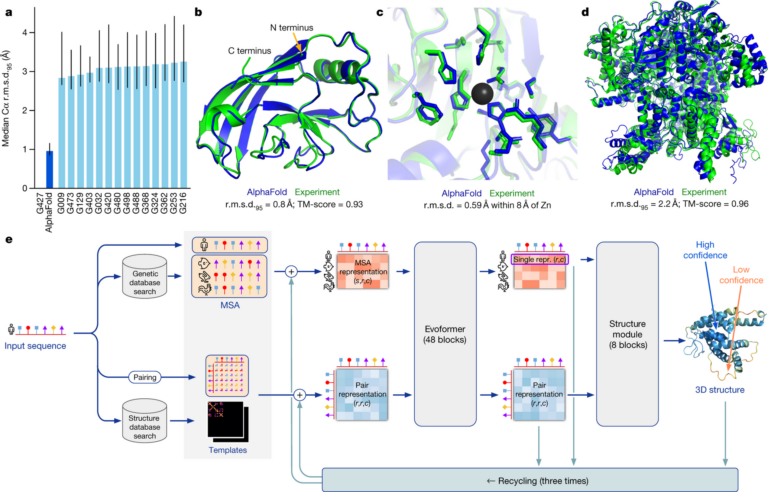
The most sobering result in the paper is not about PeptiVerse at all. The authors found that ipTM, the interface-confidence score produced by structure-prediction models and widely treated as a proxy for binding, showed negligible association with measured binding affinity — around |ρ| ≈ 0.05.2 A number that many groups have been using as a shortlisting criterion carries, on this evidence, almost no information about the quantity of interest. That is the field’s long-running pattern in miniature: in-silico scores that look decisive on a leaderboard and evaporate at the bench.
Two further cautions matter for anyone doing hands-on work. First, none of this touches material quality. A predicted property tells you nothing about what is in a particular vial; that is what analytical chemistry is for, and why HPLC and mass spectrometry exist as separate disciplines from modelling. A prediction is not, and can never be substituted for, a certificate of analysis. Second, predicted half-life refers to biological persistence in an experimental system, not to how a lyophilised or reconstituted material behaves on a shelf — storage stability remains an empirical, handling-dependent question. And when a wet-lab result contradicts a prediction, the prediction is usually not the only suspect; the ordinary causes of irreproducible peptide experiments — adsorption to plasticware, freeze-thaw cycling, buffer composition, undeclared counter-ion content — remain far more common than a genuinely wrong model.
Used with those limits in view, PeptiVerse is a serious contribution: open, transparent about its data, honest about where it is weak, and built so that others can extend it. It shortens the list of things worth making. It does not tell you what any of them will do. All materials and methods discussed here are for laboratory research use only; nothing above constitutes guidance for human or veterinary use, and no compound referenced is intended for consumption.
Condor Research · Scientific desk
Atrio Sciences s.r.o., IČO 57 669 651, Nitra (SK) · info@condorresearch.com
- PeptiVerse was published in Nature Communications on 16 July 2026 by the Chatterjee Lab at the University of Pennsylvania (Nat Commun. 2026;17:6819).
- It predicts seven developability property families — binding affinity, hemolysis, non-fouling, permeability (PAMPA and Caco-2), solubility, toxicity and half-life — plus basic computed descriptors.
- Its key novelty is accepting both canonical amino-acid sequences and SMILES chemical strings, so it works on chemically modified peptides, which prior tools handled only partially.
- Architecture: frozen pretrained encoders (ESM-2 650M for sequences, PeptideCLM for SMILES) with lightweight heads on top — XGBoost, SVM, CNN, transformer — rather than retraining whole models.
- It is open source, with a Gradio web client hosted on HuggingFace Spaces, and is designed to act as a guidance oracle inside generative peptide-design models.
- Training data is thin for the hardest properties: half-life rests on 130 sequence and 245 SMILES datapoints; binding affinity on roughly 1,400–1,600 pairs.
- The authors report that AlphaFold-style interface confidence (ipTM) showed negligible correlation with measured binding affinity, |ρ| ≈ 0.05.
What is PeptiVerse?
An open-source computational platform from the Chatterjee Lab at the University of Pennsylvania that predicts multiple developability properties of therapeutic peptides from either an amino-acid sequence or a SMILES chemical string. It was published in Nature Communications on 16 July 2026.
Why does accepting SMILES matter so much?
Most real peptide drugs are chemically modified — cyclised, N-methylated, containing non-canonical residues, lipidated. Those structures cannot be written as a plain amino-acid sequence. Tools restricted to canonical sequences, such as PeptideBERT, cannot evaluate them at all.
Does PeptiVerse design new peptides, or only score existing ones?
Both, depending on how it is used. As a filter, it ranks candidates you already have. As a guidance oracle inside generative models such as PepTune, TR2-D2, MOG-DFM and moPPIt, its property predictions steer generation from the start rather than judging the output afterwards.
How accurate are the predictions?
Property-dependent and generally modest in absolute terms. The paper reports a Spearman correlation of 0.557 for sequence-based binding affinity and an F1 of 0.754 for solubility. These are useful for ranking candidates, not for deciding anything about a single molecule on their own.
Can a predicted property replace laboratory testing?
No. A prediction is a hypothesis generated from historical data; a measurement is an observation of the material in front of you. Identity, purity and content still require analytical work such as HPLC and mass spectrometry, reported on a certificate of analysis.
Is predicted half-life the same as shelf stability?
No. The half-life models in PeptiVerse concern biological persistence in an experimental system, not how a lyophilised or reconstituted research material behaves in storage. Storage stability is an empirical, handling-dependent question and is unrelated to these predictions.