
Making Peptide Drugs on the Way to Mars: The Stability Problem Nobody Solved Yet
A Mars round trip outlasts most drug shelf lives. Why peptides degrade first in deep space, what on-demand synthesis could fix, and why verification is harder.
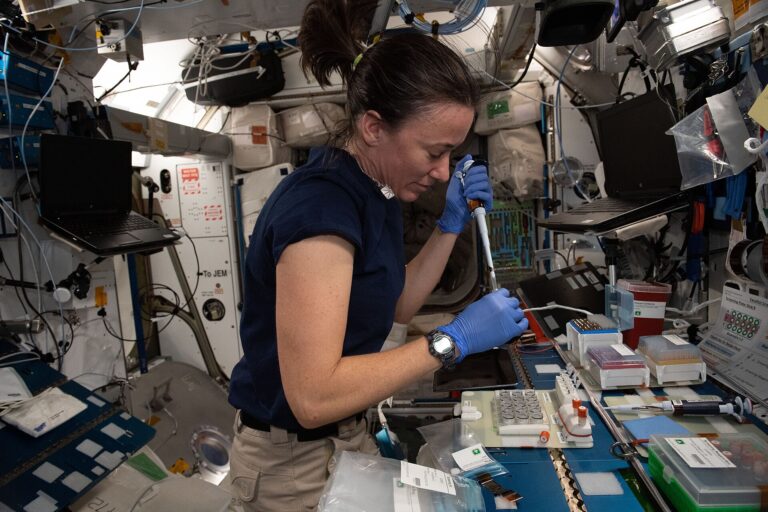
A Mars round trip runs 560 to 900 days, longer than most pharmaceutical shelf lives. Peptides degrade fastest through hydrolysis, deamidation, oxidation and aggregation, accelerated by radiation and the absence of a cold chain. On-demand synthesis is proposed, but in-flight analytical verification remains unsolved and unflown.
A crewed Mars mission is not a long flight. It is a supply chain that terminates at the launch pad. NASA’s design reference architectures put the round trip at roughly 560 days for a short surface stay and about 900 days for a long one, with no resupply, no returns, and no second opinion.1 A meaningful fraction of the pharmacy would expire before the crew got home, and the peptides would go first. The chemistry that decides this is the same hydrolysis, deamidation and oxidation that governs a vial in a freezer in Nitra — which is why a question about Mars turns out to be a question about stability testing. This is a methods and quality-control article, written for research context only; nothing here concerns human use of any compound.
How long does the pharmacy actually last?
The numbers are not close. Approximately 60% of medications flown on the ISS carry a terrestrial shelf life of 36 months or less in their original packaging, and roughly 15% expire in under 24 months.1 Against a 900-day mission with a pre-launch integration period in front of it, that is a formulary designed for a supply chain that no longer exists.
Peptides are the acute case. Peptide and protein biologics are described as particularly unstable, with limited shelf life on the order of six months even with refrigeration.1 The consequence is visible in what actually flies: of 92 medications catalogued in current ISS use, exactly one — the antibiotic bacitracin — is peptide-based.1 That is not a coincidence, it is a selection effect. The unstable molecules never made the manifest, and the crew simply does without the indications they would have covered.
The dominant variable is not exotic. It is temperature. Of 30 peptide drugs assembled into a deep-space formulary database, 17 require refrigeration or freezing for long-term storage — capability that costs up-mass, volume and continuous power on a vehicle that has little of any of them.1 Remove the cold chain and shelf lives collapse from years to weeks.
99.5% loss of shelf life for erythropoietin when moved from refrigerated storage to room temperature — from 18 months to 3 days.1
| Peptide drug | Shelf life, frozen or refrigerated | Shelf life at 20–25 °C | Decrease |
|---|---|---|---|
| Erythropoietin | 18 months | 3 days | 99.5% |
| Abaloparatide | 36 months | 30 days | 97.3% |
| Romiplostim | 36 months | 30 days | 97.3% |
| Ziconotide | 48 months | 60 days (at 37 °C) | 95.9% |
| Tissue plasminogen activator | 12 months | 21 days | 94.2% |
| Insulin | 12 months | 28 days | 92.3% |
| Vasopressin | 24 months | 365 days | 50% |
Adapted from Blum et al. 2026, Table 3.1 These are manufacturer-stated shelf lives for finished, formulated, licensed products under terrestrial conditions — not measurements of research-grade lyophilised material, and not flight data. They are shown to illustrate the magnitude of the cold-chain dependency, not to predict behaviour in any specific storage scenario. Listed for scientific context only; no compound named here is offered or characterised for human use. See whether peptides need refrigeration for the terrestrial version of this problem.
What actually happened to the medicines that flew?
Two flight studies anchor the literature. Du and colleagues stored 35 pharmaceutical formulations aboard the ISS alongside identical ground controls. After 28 months, nine of the ISS medications met United States Pharmacopeia acceptance criteria for active pharmaceutical ingredient content, against 17 of the matched ground controls.2 The USP threshold here is unglamorous and precise: the API concentration must sit within 10% of the label specification.1 Failures increased with time in space irrespective of expiry date, and the authors attributed the gap to chronic low-dose ionising radiation aboard the spacecraft and to repackaging, with temperature and humidity broadly comparable between environments.
Wotring examined nine pharmaceutical products stored over 550 days on the ISS. Four of the nine met USP requirements eight months past their expiration date, and — this is the interesting part — the analysis found no unusual degradation products.3 Nothing exotic was happening. The same chemistry was running, faster.
Nothing exotic was happening to these molecules. The same degradation chemistry was running, just faster — which is the finding that makes the problem tractable and the finding that makes it hard to dismiss.
Why do peptides break first?
A peptide has more ways to fail than a small molecule, and they run in parallel. The backbone hydrolyses. Asparagine and glutamine residues deamidate — Robinson and Robinson measured rates across 306 asparaginyl sequences in model peptides at pH 7.4 and 37 °C and proposed these residues function as molecular timers, which is an elegant idea and a formulator’s problem.4 Methionine and cysteine oxidise. Chains aggregate, and aggregation is frequently irreversible.5 Any one of these can move a lot outside its content specification without changing anything you can see in the vial.
Deep space adds an accelerant that has no terrestrial equivalent. Galactic cosmic rays and solar particle events deposit energy in whatever they pass through, including the drug and its water. Radiolysis generates reactive species that attack exactly the side chains listed above, and the dose is not trivial: the Radiation Assessment Detector aboard the Mars Science Laboratory measured a dose equivalent of 0.66 ± 0.12 sievert for the shortest round-trip cruise with then-current propulsion and comparable shielding.6 Estimates for a 650–920 day Mars mission run to 870–1,200 mSv.1 This is not a shielding problem you solve with money. GCR is dominated by high-energy heavy ions; adding mass produces secondary particle showers, and past a point more shielding buys progressively less.
Microgravity contributes its own uncertainty, and here the honest answer is that we know less than we would like. The best-studied microgravity-and-proteins literature concerns crystallisation for structural biology, not shelf life. What flight data exists on biological production is cautionary: engineered Escherichia coli flown on the ISS produced significantly less melanin than ground controls despite carrying functional tyrosinase, with proteomic and metabolomic signatures of oxidative stress and disrupted redox balance.7 That result is about making molecules rather than storing them, but the warning generalises: the chemistry you validated on the ground is not automatically the chemistry you get.
Can you just make the drug when you need it?
This is the proposal, and it now has a ranked shortlist. An analysis published in npj Microgravity on 9 July 2026 identified 26 peptide-based medications relevant to spaceflight and scored each against ten predefined criteria — regulatory status, shelf stability, storage requirements, NASA Human Research Roadmap risk score, purification burden, chain length, prior recombinant production, functional assay availability, dosing requirements and post-translational modification complexity — with each criterion worth 0 to 2 points.8 Teriparatide scored highest at 17/20, followed by abaloparatide and amylin at 16/20. Angiotensin II, daptomycin, G-CSF, GM-CSF and salmon calcitonin clustered at 14/20.
Teriparatide topping the list makes structural sense. It is 34 amino acids, needs no post-translational modification for activity, has been produced recombinantly, and addresses bone loss — the canonical microgravity pathology. More broadly, 24 of the 30 peptides in the deep-space formulary database have been recombinantly produced, and 21 of 30 are under 100 residues, which is the range where microbial expression is realistic.1
Three production routes are live. Engineered microbes: Bacillus subtilis has been engineered as a platform for on-demand production of pharmaceutical peptides, and forms durable spores that could be transported dry and activated on demand.9 Cell-free systems: Pardee and colleagues demonstrated freeze-dried reaction pellets containing transcription and translation machinery, activated by adding water and a DNA template, producing antimicrobial peptides, vaccine antigens and antibody conjugates from room-temperature-stable inputs.10 And cell-free protein synthesis has genuinely flown: the BioBits platform was validated aboard the ISS, expressing RNA aptamers and fluorescent proteins whose output was confirmed with a handheld fluorescence viewer.11
That last result deserves precision, because it is routinely oversold. What was validated in orbit was a biosensor readout, not a therapeutic dose. The distance between “a fluorescent reporter expressed correctly in microgravity” and “a released batch of a peptide drug” is most of the problem.
If you synthesise it in orbit, how do you know what you made?
This is the half nobody puts in the press release. On Earth, a peptide batch is released against a stack of orthogonal measurements: RP-HPLC for purity, LC-MS for identity and mass confirmation, ion chromatography for counterion content, Karl Fischer for water, endotoxin testing, sterility testing. Those numbers are what a certificate of analysis exists to carry, and the reason HPLC and mass spectrometry are not interchangeable is that each catches failures the other misses.
Consider what that machinery is actually for. Characterisation of a single synthetic antimicrobial peptide by HPLC-QTOF-MS/MS identified one process-related impurity and thirty-two degradation products — hydrolysates, isomers and oxidised forms.12 Thirty-two. From one peptide. That is the population hiding behind a purity figure, and finding it required a quadrupole time-of-flight instrument. In a spacecraft you have a handheld fluorescence reader.
The problems compound. Reference standards have their own shelf lives and would degrade on the same trip as the drug. Endotoxin testing needs either Limulus amebocyte lysate or recombinant Factor C, both cold-chain reagents with expiry dates — so the assay inherits the exact stability problem it is meant to police, and a cell-free system built on bacterial lysate starts with endotoxin already in the room. Sterility testing takes days you may not have. Our note on endotoxins and sterility on a COA covers why these are separate questions from purity. And underneath all of it sits the structural issue: on Earth, the point of release testing is the ability to reject a batch. In transit to Mars, there is nothing to reject it in favour of.
Verification, not synthesis, is plausibly the harder half. Synthesis is a solved chemistry problem being miniaturised. Analytical release in a 2 kg mass budget with no reference standards and no rejection pathway is not a miniaturisation problem — it is an unsolved one.
An honest read of the evidence
The alarming headline number deserves scrutiny, and the field has already applied it. A 2023 reanalysis pooled six prior spaceflight drug stability studies covering 36 drug products exposed to spaceflight for up to 2.4 years in low Earth orbit, and found that all spaceflight-exposed medications remained within 10% of their lot-matched terrestrial controls, with roughly a 1.5-fold increase in degradation rate.13 Non-protective repackaging — moving drugs out of manufacturer packaging into polypropylene containers to save mass — emerged as the dominant factor. In other words, a large part of what looked like a radiation story may be a packaging story.
The remaining caveats are substantial. Every flight dataset comes from low Earth orbit, inside a magnetosphere that provides real protection absent in deep space, so extrapolating these shelf lives to a Mars transit is precisely the kind of extrapolation worth distrusting. Early studies suffered small sample sizes and, in some cases, no terrestrial controls at all. A dedicated review of radiation-induced pharmaceutical instability concluded that the knowledge gaps are wide enough to require a targeted research programme rather than inference from existing data.14 And almost none of the flight data concerns peptides — the molecules with the most to lose have been studied the least, because they were excluded from the manifest for being unstable, which is a circular problem the field has not escaped.
Nor is the solution flight-qualified. The July 2026 analysis is explicitly a scoring framework — a structured ranking of hypotheses, offered to guide development. Nothing on that list has been manufactured in flight and released to a crew. Cell-free synthesis in orbit has produced biosensors. Engineered B. subtilis expressing teriparatide is a terrestrial result. Microbial yield may drop in microgravity for reasons not yet fully mapped. And no in-flight analytical release test exists at any readiness level worth naming.
The reason any of this belongs on a research blog is that the extreme case clarifies the ordinary one. A Mars mission is what happens when you remove the cold chain, the analytical laboratory and the option to reject a batch — and what fails first is peptide stability, measured by methods most people treat as paperwork. On Earth those constraints are all still available, which is the entire argument for using them: controlled storage and reconstitution, lot-specific analytical data, and a COA that reports numbers rather than adjectives. All compounds and methods discussed here are described strictly in a research context. Nothing in this article constitutes guidance for human use, and no compound named is intended for human consumption.
Condor Research · Scientific desk
Atrio Sciences s.r.o., IČO 57 669 651, Nitra (SK) · info@condorresearch.com
- Mars design reference architectures run 560 days (short stay) to 900 days (long stay) with no resupply; roughly 60% of ISS medications carry a terrestrial shelf life of 36 months or less.
- Peptide and protein biologics are the worst case: many hold ~6 months even refrigerated, and only 1 of 92 medications catalogued on the ISS is peptide-based.
- Erythropoietin drops from 18 months refrigerated to 3 days at room temperature — a 99.5% loss of shelf life from cold chain alone.
- Du et al. found 9 of 35 ISS-stored formulations met USP content criteria after 28 months versus 17 of 35 matched ground controls; a later pooled reanalysis attributed most of the gap to non-protective repackaging, not radiation.
- A July 2026 npj Microgravity analysis scored 26 peptide drugs for on-demand production; teriparatide ranked highest at 17/20, followed by abaloparatide and amylin at 16/20.
- Freeze-dried cell-free reaction pellets and engineered Bacillus subtilis are demonstrated on Earth; cell-free protein synthesis has been validated aboard the ISS, but only for biosensors and reporter proteins.
- No analytical release test — HPLC purity, LC-MS identity, endotoxin, sterility — has been flight-qualified, making verification the harder half of the problem.
How long is a Mars mission compared with a drug's shelf life?
NASA's Human Exploration of Mars Design Reference Architecture 5.0 describes a 560-day short-stay mission and a 900-day long-stay mission. Around 60% of medications flown on the ISS have a terrestrial shelf life of 36 months or less, and about 15% expire in under 24 months, so a substantial fraction of the formulary would expire in transit with no resupply available.
Why are peptides more vulnerable in space than small-molecule drugs?
Peptides carry several degradation routes simultaneously — backbone hydrolysis, asparagine and glutamine deamidation, methionine and cysteine oxidation, and aggregation — and most require refrigerated or frozen storage that a spacecraft cannot reliably supply. Of 30 peptides in one deep-space formulary database, 17 need cold storage, and removing it shortens shelf lives from years to weeks.
Does radiation actually degrade peptide drugs?
It is the leading hypothesis but not a settled result. Du et al. attributed faster in-flight degradation partly to chronic low-dose ionising radiation, whereas a 2023 pooled reanalysis of six flight studies found all spaceflight-exposed medications remained within 10% of lot-matched controls and identified non-protective repackaging as the dominant factor. Dedicated radiation-stability data for peptides specifically is thin.
What is an "astropharmacy"?
A proposed compact platform that carries dried engineered microbes or freeze-dried cell-free reagents rather than finished drugs, producing a small dose on demand — typically targeted at 24 to 48 hours — from reagents stable at room temperature, with minimal mass, volume, power and crew time.
Has anyone actually made a peptide drug in orbit?
No. Cell-free protein synthesis has been validated aboard the ISS using RNA aptamer and fluorescent protein biosensors read with a handheld viewer, and Bacillus subtilis has been engineered on Earth to express teriparatide and G-CSF. Producing, verifying and releasing a therapeutic dose in flight remains conceptual.
Why is verification described as harder than synthesis?
Terrestrial batch release requires RP-HPLC, LC-MS, endotoxin assays and sterility testing, each demanding instruments, reference standards and reagents that carry their own mass, power draw and expiry dates. A spacecraft has none of that infrastructure, its reference standards degrade on the same journey as the product, and there is no way to reject a batch and reorder.