
The Hormone That Kept Turning Into Amyloid: Why Amylin Took Thirty Years to Become a Drug
Human amylin forms amyloid fibrils in the pancreas, which is why it was undruggable. Three proline substitutions borrowed from rat amylin fixed it. And its receptor is not a receptor at all.
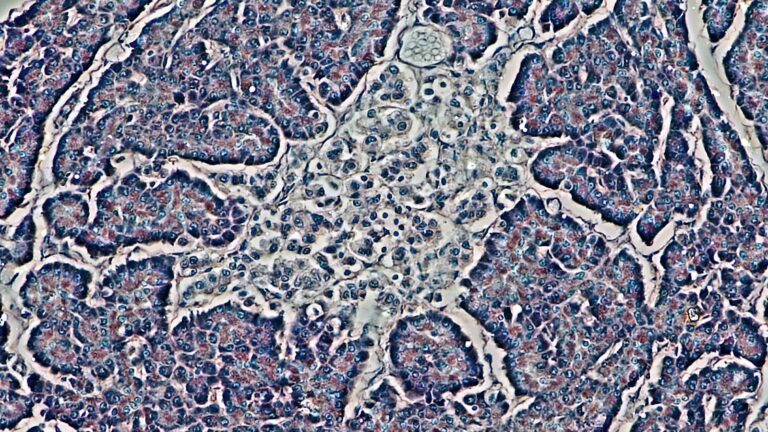
Amylin is a 37-amino-acid hormone co-secreted with insulin from pancreatic β-cells. It has been a known drug target since the 1980s, and for most of that time it was undruggable for a purely chemical reason: human amylin self-assembles into amyloid fibrils, the same deposits found in the islets of most people with type 2 diabetes. The fix came from comparative biology — rat amylin does not fibrillise, and transplanting three of its prolines into the human sequence produced pramlintide. The second oddity is stranger still: there is no gene for an amylin receptor. Amylin signals through the calcitonin receptor when it is complexed with an accessory protein, which is why selectivity claims in this class are harder than they look.
Condor Research supplies reference materials for laboratory research use only. This article is peptide chemistry and receptor pharmacology. Nothing here is a recommendation to use any compound in humans. For the current clinical picture — petrelintide, zenagamtide and the tolerability argument — see our separate overview of amylin analogues in obesity.
The problem: a hormone that precipitates
Amylin — islet amyloid polypeptide, IAPP — is released from β-cells alongside insulin, in roughly a 1:100 molar ratio, in response to the same stimuli. Its physiological jobs are complementary to insulin’s rather than duplicative: it slows gastric emptying, suppresses postprandial glucagon secretion, and promotes satiation through the central nervous system. Insulin handles glucose once it has arrived. Amylin regulates how fast it arrives and when eating stops.
That made it an obvious therapeutic target, and the obvious drug failed for an unglamorous reason. Human amylin is amyloidogenic. It self-assembles into β-sheet fibrils, and those fibrils are found in the islets of most people with type 2 diabetes, where they are implicated in β-cell loss. The hormone whose replacement you want to give is the same molecule that forms the deposits associated with the disease.
For a formulation scientist the consequence is immediate. A peptide that aggregates does not stay in solution, does not survive storage, loses potency unpredictably, and — because aggregates are a recognised immunogenicity risk — cannot be assumed safe to inject repeatedly. Aggregation is not a side issue in peptide development. It is frequently the whole issue.
The fix: three prolines, borrowed from a rat
Rat amylin differs from the human sequence at six residues and does not form fibrils. That single comparative fact is what made the class possible.
Pramlintide, approved in 2005 and known during development by the descriptive name tripro-amylin, took three of those six differences: proline substitutions at positions 25, 28 and 29.
Proline is the residue that does this job, and the reason is structural. Its side chain loops back and bonds to the backbone nitrogen, forming a ring. That ring removes the amide hydrogen needed for one of the hydrogen bonds that hold a β-sheet together, and it constrains the backbone angles the chain can adopt. A proline in the middle of a stretch that wants to form an extended β-strand is a break in the pattern.
Molecular modelling later confirmed that all three substitutions are required: they perturb the formation of long β-sheets and reduce their stability, and removing any of them weakens the effect. Three residues out of thirty-seven converted an unusable hormone into a medicine, without changing what it does at its receptor.
This is worth holding onto as a general lesson about peptides. Sequence determines conformational tendency, conformational tendency determines aggregation, and aggregation determines whether a molecule can be a product. The same logic governs how any peptide behaves in a vial — which is why storage and reconstitution conditions are a property of the sequence, not a generic instruction.
The stranger fact: the receptor is not a receptor
Here is where amylin becomes genuinely unusual pharmacology, and where most summaries of the class go wrong.
There is no gene encoding “the amylin receptor”. Amylin signals through the calcitonin receptor — a different hormone’s receptor — when that receptor is complexed with one of three small accessory proteins called receptor activity-modifying proteins: RAMP1, RAMP2 and RAMP3. The three pairings produce the receptor phenotypes AMY1, AMY2 and AMY3.
The core protein is the same in all three. The accessory protein changes what the receptor recognises. A single-pass membrane protein, associating with a G protein-coupled receptor, alters its ligand selectivity.
Two consequences follow, and both matter when reading claims about this class.
“Selective for the amylin receptor” is an incomplete statement. There are three, they are assembled from parts, and their relative abundance differs by tissue. A ligand characterised against AMY1 has not been characterised against AMY3.
Amylin and calcitonin pharmacology cannot be cleanly separated. Because the shared core is the calcitonin receptor, a molecule engaging this system sits somewhere on a spectrum between selective amylin receptor agonism and dual amylin/calcitonin receptor agonism. That is not a defect in the molecules; it is the architecture. A review by Fischer and Borner, published in Pharmacological Research in August 2026, argues that this position on the spectrum — together with exposure kinetics and which downstream neural circuits get recruited — may determine whether reduced food intake reflects physiological satiation or something closer to aversive signalling.
RAMPs are not an amylin curiosity, either. They modulate several class B GPCRs, including the receptors for calcitonin gene-related peptide and adrenomedullin. Any receptor-selectivity claim about a peptide targeting this family is a claim about a complex, and should name which one was tested.
Why the four-arm trial design was the important part
One clinical detail belongs in a chemistry article, because it is about how evidence is constructed rather than what it showed.
REDEFINE 1, the pivotal trial of the amylin analogue cagrilintide combined with semaglutide, randomised 3,417 adults in a 21:3:3:7 ratio: 2,108 to the combination, 302 to semaglutide alone, 302 to cagrilintide alone, and 705 to placebo. At week 68 the estimated mean change in body weight was −20.4% with the combination against −3.0% with placebo.
The headline number is not the valuable part. The monotherapy arms are. Including cagrilintide alone is what allows the amylin contribution to be separated from the incretin contribution rather than inferred from it. A trial that omits the monotherapy arms can tell you that a combination works; it cannot tell you which component is doing the work, or whether the combination is more than additive.
When reading any combination study — in this class or any other — the first question is whether the single agents were run alongside it. If they were not, the mechanistic claims attached to the result are assumptions.
What generalises
Aggregation propensity is a druggability property. Amylin was undruggable for thirty years because of how it folds, not because of what it does. FDA’s reviewers raised precisely this concern about research peptides in July 2026, noting that aggregates may require size exclusion chromatography or field flow fractionation to detect at all, and that undetected aggregates carry immunogenicity risk.
Small substitutions can change everything except function. Three prolines removed the fibrillisation without removing the pharmacology. That is the peptide medicinal chemist’s whole craft: find the residues that control the liability and leave the ones that control the activity.
Receptor identity can be conditional. “The receptor for X” is sometimes a complex assembled from parts, and selectivity is a statement about which assembly you tested. This is a good habit to carry into reading any proposed mechanism, including for compounds whose targets are still being worked out — the sort of distinction our evidence ledger exists to keep visible.
Related reading
- Human amylin self-assembles into β-sheet amyloid fibrils, the deposits found in the islets of most people with type 2 diabetes, which is why the hormone itself could not be made into a medicine.
- Rat amylin does not fibrillise; pramlintide took three of its proline substitutions, at positions 25, 28 and 29, and modelling confirms all three are required.
- Proline breaks β-sheets because its ring removes a backbone amide hydrogen needed for hydrogen bonding and constrains the backbone angles.
- There is no gene for an amylin receptor: amylin signals through the calcitonin receptor complexed with RAMP1, RAMP2 or RAMP3, producing AMY1, AMY2 and AMY3.
- REDEFINE 1's value was its four-arm design, including a cagrilintide-alone arm, which is what separates the amylin contribution from the incretin contribution.
Why is amylin amyloidogenic?
Human amylin readily adopts extended β-strand conformations that stack into fibrils. Rat amylin differs at six residues and does not fibrillise.
What does proline do to a β-sheet?
Its side chain forms a ring with the backbone, removing an amide hydrogen needed for β-sheet hydrogen bonding and restricting the backbone angles the chain can adopt.
Is there an amylin receptor gene?
No. The amylin receptor is the calcitonin receptor in complex with a receptor activity-modifying protein, RAMP1, RAMP2 or RAMP3.
Why do the monotherapy arms of a combination trial matter?
Without them you cannot tell which component produces the effect, so mechanistic claims about the combination remain assumptions.