
Designed Peptides in August 2026: Three Papers, Three Different Meanings of “Designed”
In one month: computationally designed antimicrobial nanopores that work in mice, an engineered peptide nanopore that detects single α-synuclein species, and LLM-assisted design of cell-penetrating peptides. The three are not the same kind of result.
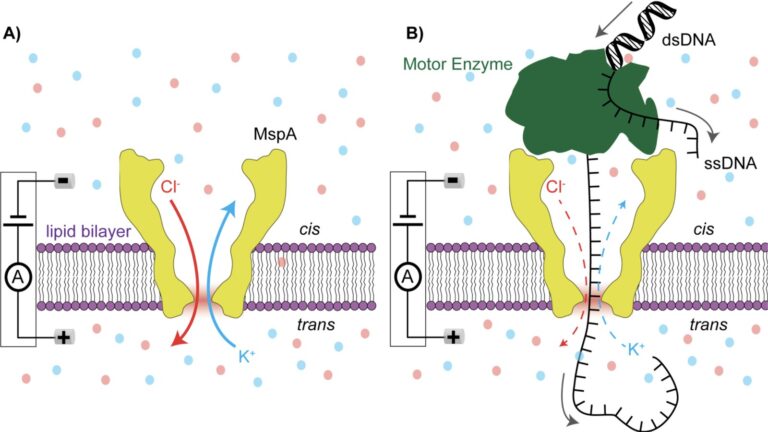
Three peptide-design papers appeared in a single month. On 3 August, *Nature Chemical Biology* published α-helical peptides designed by molecular dynamics simulation that self-assemble into membrane-spanning nanopores, kill drug-resistant bacteria, and work in mouse infection models. On 26 August, *Frontiers in Pharmacology* published a [machine-learning framework](https://condorresearch.com/research/peptiverse-ai-peptide-design/) using rules extracted from large language models to predict and generate cell-penetrating peptides. On 28 August, *Nature Nanotechnology* published an engineered peptide that assembles into tunable α-helical nanopores capable of resolving individual α-synuclein species in a mixture. All three are described as designed peptides. They represent three different levels of evidence, and telling them apart is the useful skill.
Condor Research supplies reference materials for laboratory research use only. This article covers preclinical and computational research. Nothing here is a therapeutic claim or a recommendation to use any compound in humans.
Paper one: designed by physics, validated in animals
Deb, Torres and colleagues at CEITEC Masaryk University, the University of Pennsylvania and the University of Groningen set out to build antimicrobial peptides that kill bacteria by a mechanism resistance has trouble addressing: punching structured holes in the membrane.
The design was driven by molecular dynamics simulation. Sequences were selected computationally for their propensity to form a transmembrane barrel-stave pore — a specific architecture in which helices line up side by side like staves of a barrel, spanning the membrane and leaving a channel down the middle. Simulation proposed the candidates; microscopy, electrophysiology and fluorescence assays tested whether they did what was predicted. The paper includes negative design controls, meaning sequences predicted not to form pores were also made and tested, which is the part that distinguishes a design framework from a lucky screen.
The output was general design guidelines plus 52 modular sequence templates with tunable pore-forming and antimicrobial properties. A tuned lead peptide selectively killed drug-resistant ESKAPEE bacteria, including Acinetobacter baumannii, without harming human cells, and showed anti-infective efficacy in preclinical mouse infection models.
Note what the evidence ladder looks like here: prediction, then biophysical confirmation of the predicted mechanism, then selective killing in culture, then a whole-animal infection model. That is four rungs, and each one is where most such projects stop.
Note also what it is not. Mouse infection models are the beginning of a development path, not the end of one. Antimicrobial peptides have an unhappy clinical history, largely because selectivity for bacterial over mammalian membranes narrows in a living organism and because plasma stability is poor. This paper’s selectivity data are the encouraging part; it is still a preclinical result.
Paper two: designed by machine learning, validated computationally
Yu and colleagues at Southwest Medical University in Luzhou addressed a different problem: predicting which sequences will cross a cell membrane and carry cargo with them — cell-penetrating peptides, the delivery vehicles of peptide pharmacology and a close cousin of the problem of getting a peptide across the blood-brain barrier.
The method is inventive. Rather than feeding sequences to a model as raw strings, the authors extracted interpretable biochemical rules from large language models — GPT-4o and DeepSeek — encoded those rules as binary feature vectors, and combined them with conventional sequence descriptors in hybrid classifiers. On the CPP924 benchmark the best hybrid classifier reached a cross-validated accuracy of 0.91 ± 0.03. The LLM-derived rules outperformed conventional physicochemical and fingerprint descriptors, and combining rule features with amino-acid composition gave the best overall model. The optimised models then generated six novel candidate sequences, each no more than 53% identical to anything in the training set.
Now read the paper’s own conclusion carefully, because it is admirably precise: in-silico evaluation across established tools “supports computational prioritisation of these candidates for experimental testing”.
Nobody has yet put these six peptides on cells. The candidates were assessed with other prediction tools — AlphaFold-3 structural confidence, predicted toxicity and allergenicity — which is prediction checking prediction. That is a legitimate and useful result, and the authors state its limits plainly. It is a shortlist, not a discovery.
The distinction matters because “AI-designed peptide” is becoming a headline phrase that covers everything from this to work with animal data behind it. A model that ranks candidates for testing and a molecule that has cured an infected mouse are separated by the entire experimental enterprise.
Paper three: engineered from nature, and used as an instrument
The Nature Nanotechnology paper is the odd one out, because the peptide here is not a drug candidate at all. It is a component of a measuring device.
The starting material was pPorA, a 40-amino-acid peptide derived from the bacterial porin PorACj, known to form channels in lipid bilayers. The authors tuned its geometry by installing an unnatural amino acid — a D-cysteine at position 24, the residue known to be critical for self-assembly. The result was an octameric α-helical pore existing in two distinct conductance states: small pores at 2.4 nS and large pores at 3.5 nS in 1 M KCl, both from the same octamer.
Two pore sizes gave two sensing regimes. The large pores detected multiple α-synuclein variants, the protein central to Parkinson’s disease, including a pathogenic C-terminal deletion mutant bound with nanomolar affinity (KD ≈ 20 nM). By selectively trapping the protein’s N-terminus electrostatically, the authors could identify individual α-synuclein species within a heterogeneous mixture by charge — and could follow aggregation over time, from monomers through toxic oligomers to fibrils, including how that pathway changed in the presence of an inhibitor. The small pores detected shorter peptides: humanin — one of the mitochondrial-derived peptides — and superoxide dismutase fragments associated with apoptosis and amyotrophic lateral sclerosis.
Distinguishing individual conformational species of an intrinsically disordered protein within a mixture is genuinely difficult, and it is exactly what conventional assays cannot do, because they average. A method that reads one molecule at a time does not have to.
One detail links this paper back to the oldest problem in the field. The authors also built a protease-stable variant by swapping the chirality of the relevant residue. D-amino acid substitution appears here for the same reason it appears in oral peptide design: proteases are stereospecific, and a mirror-image residue is invisible to them.
What the three papers, read together, actually say
“Designed” covers at least three distinct methods. Physics-first design, where simulation of the mechanism proposes sequences. Data-first design, where a model trained on known examples predicts new ones. And engineering from a natural scaffold, where an existing structure is modified toward a specification. These have different failure modes. Physics-first design fails when the simulated mechanism is not the real one. Data-first design fails when the training set does not cover the region being generated into. Scaffold engineering fails least often and generalises least far.
The evidence ladder is the thing to read for. Predicted, then made, then shown to have the predicted structure, then shown to have the predicted activity in vitro, then shown to work in an animal, then shown to work in a person. The August papers sit at rung one (Frontiers), rung five (Nature Chemical Biology) and rung four with an unusual application (Nature Nanotechnology). All three are good work. None of them is a therapy.
Peptides are becoming devices as well as drugs. The nanopore papers are the clearest sign of it. A peptide that self-assembles into a channel with a defined diameter and a measurable conductance is an instrument component, and the same design logic serves precision antimicrobials, molecular sensors and delivery systems — the applications the Nature Chemical Biology authors list explicitly. This is a broader definition of the field than the one implied by a market of vials.
If there is a single practical takeaway, it is a reading habit. When a paper or a press release says a peptide was designed, ask three questions: designed by what method, validated at which rung, and against which negative controls. The August 2026 papers answer all three, each differently, and each honestly. Most coverage of them will not.
Related reading
- Three peptide-design papers appeared in August 2026, and they sit at different rungs of the evidence ladder.
- Nature Chemical Biology, 3 August: α-helical peptides designed by molecular dynamics simulation self-assembled into membrane-spanning nanopores, killed drug-resistant ESKAPEE bacteria without harming human cells, and showed efficacy in mouse infection models.
- Frontiers in Pharmacology, 26 August: an LLM-assisted classifier reached 0.91 cross-validated accuracy and generated six novel cell-penetrating peptide candidates — evaluated in silico only, as the authors state.
- Nature Nanotechnology, 28 August: an engineered peptide formed tunable α-helical nanopores that resolved individual α-synuclein species and detected humanin and superoxide dismutase fragments.
- “Designed” covers at least three different methods — physics-first, data-first, and engineering from a natural scaffold — with different failure modes.
Are AI-designed peptides real drugs yet?
No. The August 2026 machine-learning work produced candidate sequences validated computationally, not in cells or animals. The authors describe it as prioritisation for experimental testing.
What is a peptide nanopore?
Peptides that self-assemble into a channel spanning a lipid membrane. Such pores can kill bacteria by disrupting the membrane, or act as single-molecule sensors.
What does molecular dynamics design mean?
Simulating how candidate sequences behave in a membrane to select those likely to form the intended structure, then testing the selected sequences experimentally.
What should you ask about any “designed peptide” claim?
Designed by what method, validated at which rung of the evidence ladder, and against which negative controls.