
What Is Humanin? The Mitochondrial-Derived Peptide Studied in Ageing
Humanin is a 24-amino-acid mitochondrial-derived peptide encoded in the 16S rRNA region, studied in ageing, apoptosis and metabolic biology. RUO overview.
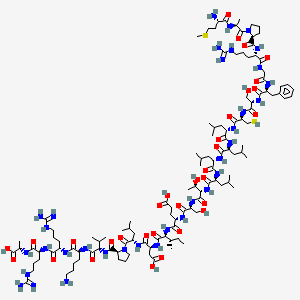
Humanin is a 24-amino-acid mitochondrial-derived peptide encoded within the mitochondrial 16S rRNA (MT-RNR2) region. Discovered in 2001 for rescuing neurons from Alzheimer's-linked toxicity, it is studied as a cytoprotective, anti-apoptotic and metabolic signalling molecule in ageing biology. It has no approved human use.
Humanin is one of the odder entries in the peptide literature — a 24-residue polypeptide whose coding sequence sits not in the nuclear genome but tucked inside the mitochondrial 16S rRNA gene, and which arrived in the scientific record because it kept neurons alive when Alzheimer’s-associated genes should have killed them. Two decades on it anchors a small but active field, that of mitochondrial-derived peptides, and shows up repeatedly in ageing and metabolic biology. Everything below describes laboratory, animal and observational findings, not use in people. Nothing here concerns human or veterinary use.
What is humanin, structurally and genetically?
Humanin is a short secreted polypeptide, most commonly described as 24 amino acids in length, encoded within the mitochondrial 16S rRNA region (MT-RNR2) of the mitochondrial genome. A nuclear-encoded homolog open reading frame (in the MTRNR2L gene family) has also been described, which is part of why the peptide’s exact origin — mitochondrial versus cytoplasmic translation — has been argued over in the literature. It belongs to a class now called mitochondrial-derived peptides (MDPs): small peptides whose coding sequences are embedded in mitochondrial rRNA genes and which appear to function as signalling molecules rather than structural components.6 The MDP concept is what connects humanin to its better-known metabolic sibling, MOTS-c.10
The peptide entered the record in 2001. Hashimoto and colleagues, working in Ikuo Nishimoto’s laboratory at Keio University, ran a functional expression screen on a cDNA library built from occipital-lobe tissue of an Alzheimer’s patient, looking for anything that could keep neurons alive under toxic insult. One clone did exactly that — abolishing neuronal death caused by a wide spectrum of familial Alzheimer’s disease genes and by amyloid-beta (Abeta). They named the gene “Humanin.”1 A companion paper the same year characterised that neuroprotection in more detail, showing the peptide blocked cell death across a range of AD-relevant insults in vitro.2
2001 The year humanin was first reported — as a factor that kept cultured neurons alive against familial-Alzheimer’s genes and Abeta.
What does humanin do at the molecular level?
The dominant theme across the humanin literature is cytoprotection through suppression of apoptosis. In 2003 the Nishimoto group identified insulin-like growth factor-binding protein 3 (IGFBP-3) as a humanin binding partner, tying the peptide to the IGF and insulin signalling axis and linking its survival activity to the regulation of apoptosis.3 Humanin has also been described interacting with the pro-apoptotic protein Bax and signalling through receptor complexes — reported pathways include a tripartite CNTFR/WSX-1/gp130 receptor and the formyl-peptide-receptor-like FPRL1/FPR2 route — to keep cells from committing to programmed death.7 A review from the Cohen group frames all of this under the banner of stress resistance: humanin as a mitochondrial-encoded signal that helps cells weather metabolic and toxic stress.7
Humanin is best understood not as a drug but as a mitochondrial signalling peptide the body appears to make itself — one whose levels fall as animals age.
Much of the more potent experimental work uses an engineered variant rather than the wild-type peptide. Substituting serine 14 with glycine yields HNG, or [Gly14]-humanin, reported to be far more active than the native sequence across neuroprotection and metabolic assays.8 In one rodent study, [Gly14]-humanin reduced Abeta-induced impairment of spatial learning and memory9 — an in vivo readout that helped cement HNG’s status as the reference potent analog. It is worth keeping the distinction sharp: HNG is a non-natural molecule, and results obtained with it do not automatically describe what endogenous humanin does.
Humanin in metabolic biology
Beyond neurons, humanin turns up repeatedly in glucose and insulin biology. A foundational 2009 study reported that in rats humanin acts centrally, in the hypothalamus, to improve peripheral insulin action and glucose metabolism — casting it as a central regulator rather than a purely local cytoprotectant.4 At the level of the pancreatic beta-cell, a potent humanin analog was shown to increase glucose-stimulated insulin secretion through enhanced cellular metabolism,8 and in cultured MIN6 beta-cells humanin promoted mitochondrial biogenesis11 — a mechanistic thread linking the peptide back to the organelle that encodes it.
| Reported observation | Model / system | Reference |
|---|---|---|
| Rescues neurons from familial-AD genes and Abeta | Neuronal cell culture | 1, 2 |
| Binds IGFBP-3; regulates apoptosis | Cell-based assays | 3 |
| Central action improving peripheral insulin action | Rats (in vivo) | 4 |
| Increases glucose-stimulated insulin secretion (analog) | Beta-cells | 8 |
| Promotes mitochondrial biogenesis | MIN6 beta-cells | 11 |
| Declines with age; regulated by IGF-I | Human + animal (observational) | 5 |
| Associated with lifespan / healthspan | Model organisms | 6 |
| Lower in type 2 diabetes subjects | Human (observational) | 10 |
Summary of reported findings. All entries are in-vitro, animal, or observational human correlations; none describes an approved human use or a dosing protocol.
Humanin and ageing
The reason humanin recurs in longevity discussions is a set of observations about how its levels behave over a lifespan. Circulating humanin declines with age and is regulated by IGF-I, a pattern documented in both human samples and animals.5 Work from the Cohen lab has gone further, reporting associations between humanin and lifespan or healthspan across species, with treatment effects in model organisms.6 On the metabolic-disease side, a human observational study found that mitochondrial-derived peptides including humanin are lower in people with type 2 diabetes.10 These threads sit alongside the broader interest in mitochondrial and NAD-related ageing biology explored in our notes on NMN and the human evidence for NAD precursors, and in the mitochondrial-protection literature around SS-31 (elamipretide).
An honest read of the evidence
The gap between how humanin is sometimes discussed and what has actually been demonstrated is wide, and it is worth being blunt about it. Almost everything that sounds therapeutic is preclinical — neuronal cultures, MIN6 and other beta-cell lines, and rodent models. The human data are, with very few exceptions, observational biomarker correlations: plasma humanin measured against age, or against disease status. There are no randomized controlled human trials of humanin, and no approved indication anywhere; the efficacy and safety of administering humanin, or HNG, to a person is simply not established.
Two structural caveats deserve emphasis. First, a large share of the foundational work clusters around a small number of laboratories — the Nishimoto group at Keio for the discovery and early neuroprotection, and the Cohen and Barzilai groups (USC and Einstein) for much of the ageing and metabolic biology. That is normal for a young field, but it means independent, multi-lab replication of some specific claims is still limited. Second, the potent analog HNG is an engineered, non-natural variant; effects seen with HNG do not transfer automatically to endogenous humanin, and potency comparisons are assay-dependent. Even foundational details — the receptor mechanism, and the peptide’s canonical length and mode of translation — have been debated in the literature, so the mechanistic picture is not fully settled.
Finally, correlation is not causation. Observations that humanin falls with age or runs lower in diabetes cannot tell us whether the peptide is a driver of those states or merely a marker of underlying mitochondrial function, nor which direction any causal arrow points. Humanin is a genuinely interesting research-stage molecule in ageing biology; it is not a treatment, and the current evidence does not make it one.
All materials supplied by Condor Research are Research Use Only (RUO). The information above is drawn from in-vitro, animal and observational literature only. It is not a dosing protocol, clinical guidance, or a safety assessment for any organism, and nothing here should be read as describing human or veterinary use. Humanin is described here strictly as a research-use-only reference material and is not a confirmed Condor Research catalogue product.
Condor Research · Scientific desk
Atrio Sciences s.r.o., IČO 57 669 651, Nitra (SK) · info@condorresearch.com
- Humanin is a short mitochondrial-derived peptide (MDP) encoded within the mitochondrial 16S rRNA (MT-RNR2) region, with a nuclear-encoded homolog open reading frame also described.
- It was discovered in 2001 by Hashimoto and colleagues in Ikuo Nishimoto's lab via functional screening of a cDNA library from an Alzheimer's patient, selected for its ability to rescue neurons from familial-AD-gene and Abeta toxicity.
- Reported mechanisms are cytoprotective and anti-apoptotic, including binding to IGFBP-3 and interaction with the apoptotic protein Bax.
- HNG ([Gly14]-humanin) is the classic engineered analog, reported to be substantially more potent than wild-type in neuroprotection and metabolic assays.
- In rodents, humanin acts centrally in the hypothalamus to influence peripheral insulin action, and it promotes mitochondrial biogenesis in cultured beta-cells.
- Circulating humanin declines with age, is regulated by IGF-I, and has been associated with lifespan and healthspan in model organisms.
- Humanin has no approved therapeutic use and no established human dose; all findings below are in-vitro, animal or observational.
What is humanin?
Humanin is a short mitochondrial-derived peptide, usually described as 24 amino acids long, encoded within the mitochondrial 16S rRNA (MT-RNR2) region of the mitochondrial genome. In the laboratory it is studied as a cytoprotective, anti-apoptotic and metabolic signalling molecule.
Who discovered humanin, and how did it get its name?
It was reported in 2001 by Hashimoto and colleagues in Ikuo Nishimoto's laboratory at Keio University. They screened a cDNA library from an Alzheimer's patient's brain tissue for anything that could rescue neurons from familial-AD-gene and Abeta toxicity; the clone that did so was named "Humanin."
What is HNG or [Gly14]-humanin?
HNG is an engineered analog in which serine 14 is replaced by glycine. That single substitution is reported to make the peptide substantially more potent than wild-type in neuroprotection and metabolic assays, and it has shown activity against Abeta-induced cognitive deficits in rats. It is a non-natural research variant, not the endogenous peptide.
How does humanin relate to insulin and metabolism?
In rats, humanin acts centrally in the hypothalamus to influence peripheral insulin action, and in cultured beta-cells it promotes mitochondrial biogenesis and, as a potent analog, increases glucose-stimulated insulin secretion. Human data are limited to observational correlations, such as lower levels in type 2 diabetes.
Is humanin the same kind of molecule as MOTS-c?
Yes — both are mitochondrial-derived peptides encoded within the mitochondrial genome, a small family of short peptides that appear to act as signals. MOTS-c is the sibling most studied in muscle and fat metabolism.
Is humanin approved for any use in people?
No. Humanin has no marketing authorization from the EMA, FDA or any other regulator, no approved indication, and no established human dose. It is a research compound only, and no interventional human trial has established its efficacy or safety.