
How to Store and Reconstitute a Lyophilised Peptide: A Lab Handling Guide
A freeze-dried research peptide arrives as a stable little time capsule. Most of the ways it gets ruined happen on your bench, not in transit. A QC-led guide to temperature, freeze-thaw, oxidation and solvent choice for laboratory sample preparation.
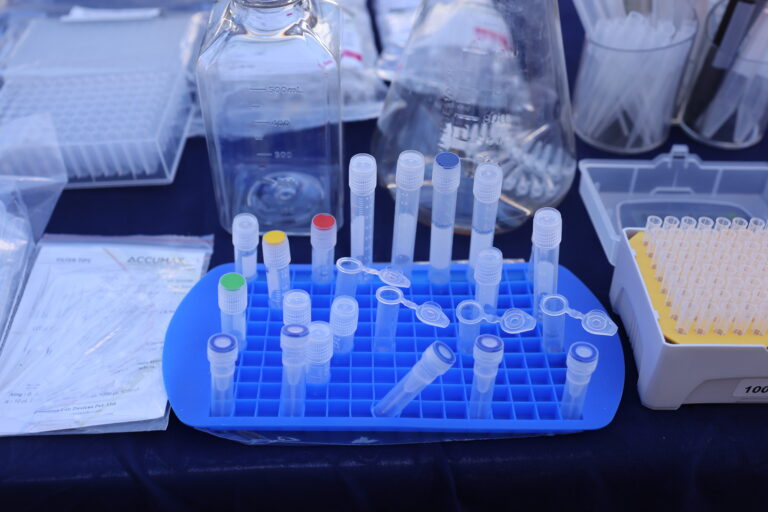
Keep lyophilised research peptides cold, dry and sealed; minimise freeze-thaw cycles and exposure to air, which oxidise sensitive residues. For in-vitro work, choose a reconstitution solvent suited to the assay and to peptide stability. A Certificate of Analysis certifies the vial at release, not your handling afterwards.
A freeze-dried peptide is one of the most patient objects on a laboratory bench. Sealed, dry and cold, a well-made lyophilised powder can sit almost inert for a long time — a little time capsule of intact molecule, waiting. The irony every experienced researcher learns is that the journey from factory to courier to your fridge is rarely where things go wrong. The damage tends to happen afterwards, in the ordinary handling of an opened vial: a warm afternoon on the bench, a fifth trip through the freezer, a cap left loose. The chemistry that the manufacturer worked hard to arrest quietly restarts. This is a guide for the researcher who already has the vial in hand and wants to keep what is inside it intact — framed strictly as laboratory sample preparation for in-vitro and research work, never as preparing anything for human or veterinary use.
Why does freeze-drying make a peptide so stable in the first place?
To understand storage you have to understand what lyophilisation actually does, because it explains almost every handling rule that follows. Peptides degrade through a handful of well-characterised chemical routes — hydrolysis of the backbone, oxidation of vulnerable side chains, deamidation, aggregation — and the great majority of those reactions need one shared ingredient: water3. Liquid water is both reactant and mobiliser; it hydrolyses peptide bonds and gives molecules the freedom to collide, unfold and react3. Freeze-drying removes nearly all of it, leaving an amorphous solid in which molecules are locked in place and the dominant degradation pathways simply have no medium to run in4.
That is why solid-state formulation is the default for fragile biologics and peptides: a dry powder is not merely “more convenient” than a solution, it is a fundamentally slower-ageing physical state45. Think of it as the difference between a document written in wet ink and the same document after it has dried — in the dry state, smudging is no longer the threat it was. The corollary, and the whole basis of careful storage, is that anything which reintroduces water or mobility — humidity, condensation, premature reconstitution — begins to undo the protection that drying bought you4.
What variables does a receiving lab actually control?
It helps to separate what you cannot change from what you can. You did not synthesise the peptide, choose its excipients or run its release testing; that is the manufacturer’s domain, governed by specifications and stability science2. What you do control, the moment the package arrives, is a short and decisive list: temperature, humidity, the number of freeze-thaw cycles you put the material through, exposure to air and light, and your eventual choice of reconstitution solvent. Every one of those maps onto a known degradation pathway, which is what makes them worth taking seriously rather than treating as folklore3.
Temperature is the master variable because reaction rates fall steeply as you cool: colder storage slows hydrolysis, oxidation and aggregation alike, which is precisely why stability programmes test materials across defined temperature and humidity conditions to model shelf life1. Humidity matters for the reason above — a hygroscopic powder that pulls moisture from a humid lab is re-acquiring the very thing drying removed4 — so a properly sealed, desiccated vial that is allowed to reach room temperature before opening avoids condensing water onto cold powder4. None of this is exotic; it is the everyday physical chemistry that the formal stability framework is built to quantify1.
The degradation routes a cold chain is designed to slow — hydrolysis, oxidation, aggregation — all accelerate with temperature, which is why each freeze-thaw cycle and each warm-up of an opened vial is a small, cumulative stress rather than a free action.
Why are freeze-thaw cycles and air the quiet enemies?
Two handling habits deserve special attention because they are easy to do thoughtlessly and hard to reverse. The first is repeated freezing and thawing. Each cycle drags the material through transitions — ice formation, local concentration changes, mechanical and pH shifts at the freezing front — that can stress peptide structure and nudge molecules toward aggregation; this is a recognised vulnerability of protein and peptide preparations and a core reason stability testing exists at all15. The practical lesson is mundane but powerful: in a research setting, aliquoting so that any given portion is thawed once rather than many times removes the cumulative insult almost entirely.
The second enemy is air, and specifically oxygen. Several amino acid residues are intrinsically oxidation-prone — methionine, cysteine and tryptophan chief among them — so any peptide carrying one or more of them is chemically vulnerable the moment oxygen and moisture have access to it3. This is not abstract bookkeeping: where a sequence contains those residues, it is exactly the kind of feature that makes minimising headspace air, shielding an opened vial from light, and avoiding warm storage genuinely worthwhile3. The same residue-level chemistry that makes peptides interesting to formulate is what makes them sensitive to careless storage5.
Which reconstitution solvent suits which research use?
Reconstitution is where a stable solid becomes a working solution — and, inevitably, a less stable one, because you are reintroducing the water and mobility that drying removed4. For in-vitro and analytical work the choice of solvent is an experimental decision, not a default, and it is worth making deliberately. The relevant axes are solubility (will the peptide dissolve cleanly?), pH and buffering (does the assay need physiological conditions?), compatibility with downstream readouts, and the solvent’s own effect on stability over the time the solution will sit5. The table below compares common research-grade solvents qualitatively; it describes laboratory sample preparation only and is emphatically not guidance for preparing anything for human use.
| Research solvent | Typical in-vitro use | Stability / handling note |
|---|---|---|
| Sterile water for irrigation (research grade) | Simple aqueous dissolution where no buffering is needed | Unbuffered; pH can drift and offers no preservative effect, so solutions are best made fresh and kept cold5 |
| Bacteriostatic water (research solvent) | Aqueous reconstitution where a research solution is held longer between uses | Contains a bacteriostatic agent (e.g. benzyl alcohol) as a research solvent; still aqueous, so hydrolysis-driven ageing continues once dissolved3 |
| Phosphate-buffered saline (PBS) | Cell-based and binding assays needing near-physiological pH and ionic strength | Buffers pH, which can favour stability, but salts and pH must suit the specific peptide and assay5 |
| DMSO | Dissolving poorly water-soluble peptides for stock solutions | Excellent solubiliser but a strong solvent: can interfere with assays at higher concentrations and is not appropriate for every peptide chemistry3 |
A qualitative comparison of research-grade reconstitution solvents for laboratory sample preparation. The right choice depends on the peptide’s chemistry and the assay; none of this concerns human or veterinary use.5
Two principles cut across the whole table. First, once a peptide is in solution its stability clock starts ticking again, so research solutions are generally made close to when they are needed and kept cold rather than stockpiled4. Second, the “best” solvent is the one that satisfies your assay’s constraints while doing least harm to the molecule — a judgement only the receiving laboratory can make, because only it knows the experiment2.
What are the honest limits of these recommendations?
Here is the part that vendors rarely volunteer. Storage and reconstitution recommendations are ranges and best practices, not guarantees. The formal stability framework that underlies any “store cold, protect from moisture” instruction is a modelling exercise: materials are tested under defined conditions to estimate how they behave over time, and the resulting recommendation is a well-grounded expectation, not a certainty that applies to every vial under every bench condition1. A manufacturer can tell you what tends to happen; it cannot foresee a freezer that cycles, a lab that runs humid, or a vial opened a dozen times.
The deeper limit concerns the Certificate of Analysis, and it is worth stating plainly. A COA certifies what was in the vial at the moment of release — its identity, its purity, its conformance to specification under recognised acceptance-criteria frameworks2. It says nothing, and can say nothing, about what happens to the material afterwards. The most rigorous certificate in the world cannot survive a sample left on a warm bench all weekend. Identity and purity at release and stability under your handling are two different questions, and conflating them is one of the commonest quiet errors in research-material use2. If you want to understand exactly what a certificate does and does not promise, our guide on how to read a Certificate of Analysis walks through it in detail2.
The bottom line
Good handling is unglamorous and almost entirely about respecting the chemistry that drying suspended: keep the powder cold, dry and sealed; let it reach room temperature before opening; minimise air, light and freeze-thaw cycles; and choose a reconstitution solvent that fits the assay and the molecule rather than reaching for whatever is nearest345. None of this is a protocol for use in a person or animal — it is laboratory sample preparation for in-vitro and research work, and the correct procedure for any given experiment is the receiving laboratory’s responsibility under the standards that govern such materials26. Condor Research supplies these compounds strictly as research reference materials, Research Use Only, not for human or veterinary use. A COA documents the molecule we shipped; keeping it intact — identity preserved, purity uncompromised — is the work that happens on your bench, and it is worth doing well.
- Lyophilisation preserves peptide structure mainly by removing the water that drives hydrolysis and other degradation, turning a fragile molecule into a stable solid-state time capsule.
- The variables a receiving lab actually controls are temperature, humidity, freeze-thaw cycles, exposure to air, and the choice of reconstitution solvent — not the manufacturing.
- Peptides containing methionine, cysteine or tryptophan residues are oxidation-prone, so headspace air and repeated warming are the quiet enemies of an opened vial.
- Reconstitution solvents (research-grade water, PBS, DMSO and similar) differ in pH, solubility and stability behaviour; the right one depends on the in-vitro assay, and this is laboratory sample preparation, not human-use preparation.
- A COA documents identity and purity at release under ICH-style specifications; it cannot vouch for storage and handling done after the vial leaves the lab.
Why does freeze-drying keep a research peptide stable?
Most peptide degradation pathways — hydrolysis of the backbone, deamidation, much aggregation — depend on water as a reactant and a mobiliser. Lyophilisation removes nearly all of it, leaving an amorphous solid in which molecules are locked in place and those reactions have little medium to proceed in. The dry, sealed state is fundamentally slower-ageing than a solution, which is why solid-state formulation is the default for fragile peptides.
Do freeze-thaw cycles really damage a lyophilised peptide?
Repeated freezing and thawing is a recognised stress on peptide and protein preparations: each cycle drives transitions — ice formation, local concentration changes, pH and mechanical shifts — that can nudge molecules toward aggregation and structural change. The cumulative insult is what matters. In a research setting, aliquoting so any portion is thawed once rather than many times removes most of that stress.
Which residues make a peptide oxidation-sensitive?
Methionine, cysteine and tryptophan are the classically oxidation-prone residues. A peptide whose sequence contains one or more of them is chemically vulnerable once oxygen and moisture reach it. That is the rationale for minimising headspace air, protecting opened vials from light, and avoiding warm storage. Whether a given peptide is affected depends on its actual sequence, so the right reference for any specific material is its own characterisation data rather than a rule of thumb.
What is the difference between the common research reconstitution solvents?
Strictly as laboratory sample preparation for in-vitro work: research-grade sterile water gives simple unbuffered dissolution but lets pH drift; bacteriostatic water adds a bacteriostatic agent for solutions held longer between uses; PBS buffers near-physiological pH and ionic strength for cell-based and binding assays; DMSO dissolves poorly water-soluble peptides but is a strong solvent that can interfere with assays. The right choice depends on the peptide's chemistry and the assay, never on human use.
Does a Certificate of Analysis guarantee the peptide will stay good?
No. A COA certifies what was in the vial at release — identity, purity and conformance to specification under recognised acceptance-criteria frameworks. It says nothing about what happens afterwards. The most rigorous certificate cannot survive a sample left on a warm bench all weekend. Identity and purity at release, and stability under your handling, are two separate questions.