
What “99% Pure” on a Peptide COA Really Means: HPLC, Mass Spec and the Limits of a Purity Number
An HPLC purity figure is a percentage of chromatographic peak area, not an absolute concentration and not proof of identity. Here is what that number can and cannot tell you — and why a COA without mass spectrometry has shown you a clean peak of something, not your peptide.
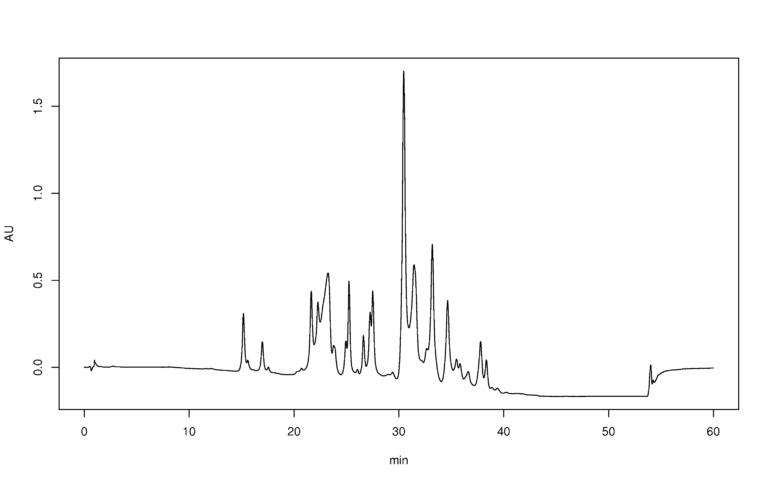
A COA purity figure (usually reversed-phase HPLC read in the low-UV region where the peptide bond absorbs) is the relative area of the main peak versus all detected peaks — not an absolute concentration, not a guarantee against every impurity, and not proof of identity. Confirming the molecule itself requires orthogonal evidence such as mass spectrometry, comparing the calculated mass of the intended sequence to the observed mass. Pharmacopoeial and ICH frameworks (ICH Q6A, ICH Q3A, USP <621>, the EMA synthetic-peptide guideline) define how these specifications and impurity thresholds should be set and reported.
There is a number that appears, almost ritually, near the top of nearly every research-peptide Certificate of Analysis: Purity ≥ 99%. It is reassuring in the way round numbers always are, and it is one of the most quietly misunderstood figures in the entire research-peptide market. Most people read it as a guarantee — ninety-nine parts of the right molecule, one part of harmless leftover, near-perfection bottled in a vial. It is not that. It is a far narrower, far more conditional statement than it looks, and understanding exactly what it does and does not say is the difference between trusting your reagent and merely hoping.
What does the purity percentage on a COA actually measure?
That figure almost always comes from high-performance liquid chromatography, and most often from reversed-phase HPLC with ultraviolet detection, typically read in the low-UV window around 214–220 nm where the peptide bond itself absorbs.5 The instrument pushes your dissolved sample through a column packed with a non-polar stationary phase; different molecules cling to that phase with different tenacity and so emerge at different times. Each compound that absorbs UV light leaves the column at a characteristic retention time and registers as a peak. The software then integrates the area under each peak, following the chromatographic conventions a general chapter such as USP <621> lays out.3
Here is the crucial part. The “purity” reported is the area of the main peak expressed as a percentage of the total area of all detected peaks.3 It is a relative measurement. Think of it as a show of hands in a room: if ninety-nine of every hundred raised hands belong to your target molecule, you have “99% purity” — but only among the people who showed up and raised a hand. Anything that does not absorb UV at that wavelength, or never elutes from the column at all, simply never entered the room.5 The percentage is honest about the chromatogram and silent about everything outside it.
A standard HPLC purity figure is a percentage of relative chromatographic peak area,3 not an absolute concentration of your peptide and not a count of how much of any single impurity is present. The same number can describe two very different vials.
How do you actually read a chromatogram?
Ask any reputable supplier for the chromatogram, not just the headline number, and you will see a baseline with one tall peak and, usually, a scatter of smaller ones. The tall one — the main peak — is, you hope, your peptide. The smaller peaks are related substances: deletion sequences missing a residue, incompletely deprotected fragments, oxidised or aggregated forms, the ordinary debris of solid-phase synthesis.5 The regulatory frameworks that govern drug substances treat exactly these as the thing to control: ICH Q3A is built around identifying, reporting and qualifying such impurities rather than waving them away,2 and ICH Q6A frames purity as one specification among several that together define whether a substance meets its acceptance criteria.1
What you are looking for is not just a big main peak but a clean separation: well-resolved peaks, a flat baseline, a method capable of actually distinguishing closely related impurities from the parent. A purity figure generated by a sloppy or under-resolving method can flatter a sample by hiding co-eluting junk under the main peak — which is precisely why USP <621> specifies system-suitability expectations such as resolution and peak symmetry before a chromatographic result should be trusted at all.3 A number without the method behind it is a number without a pedigree.
Why does HPLC prove purity but not identity?
Evidence snapshot
- Identity evidence: mass spectrometry is used to characterise synthetic peptides; the interpretation depends on which analysis was performed. Chrone et al., 2024.
- Question to resolve: distinguish a molecular-mass result from sequence-level analysis, and read the identity assessment alongside the chromatographic result.
- Reporting: identify the method and the result it supports; complementary methods may be needed for different analytical questions.
Now the part almost nobody tells the buyer. A beautiful, single, symmetrical peak at 99.5% tells you that the sample is chromatographically homogeneous — that it is mostly one thing. It does not tell you what that thing is. Retention time is suggestive, not definitive; a different peptide of similar hydrophobicity can elute in the same neighbourhood. HPLC answers the question “how pure?” It cannot, on its own, answer the question “pure what?”5
That second question belongs to mass spectrometry. By ionising the molecule and measuring its mass-to-charge ratio — whether by electrospray ionisation (ESI-MS) or matrix-assisted laser desorption (MALDI-TOF) — the analysis compares the calculated, theoretical mass of the intended amino-acid sequence against the observed mass of what is actually in the vial.5 If the numbers match within instrument tolerance, you have positive evidence that the molecule has the right molecular weight for your sequence. If they do not, the prettiest chromatogram in the world cannot save it. This is why peptide-characterisation practice, and the EMA’s synthetic-peptide guideline in particular, treats orthogonal confirmation of identity as integral rather than optional.45 For a research material as widely studied and widely scrutinised as BPC-157, the biopharmaceutical-characterisation literature makes the same point: identity and purity are distinct attributes that must each be demonstrated, not inferred from one another.6
Which analytical methods belong on a peptide COA — and what does each one prove?
A serious COA is a small portfolio of complementary tests, each answering a different question. None is sufficient alone; that is the whole point of running more than one.
| Method | What it proves | What it does NOT prove |
|---|---|---|
| RP-HPLC (UV ~214–220 nm) | Relative chromatographic purity — main peak as % of total UV-detected peak area3 | Molecular identity; absolute concentration; anything that doesn’t absorb UV or doesn’t elute5 |
| UPLC / UHPLC | Same purity question at higher resolution — better separation of closely related impurities3 | Identity; non-chromophoric impurities; endotoxin or water content5 |
| ESI-MS | Identity — observed mass vs calculated mass of the intended sequence5 | Quantitative purity %; trace related-substance levels; biological contaminants2 |
| MALDI-TOF | Identity / molecular weight confirmation, robust for intact peptides5 | Fine purity quantitation; counter-ion, water and endotoxin content5 |
The complementary roles of the core analytical methods on a peptide COA. Purity (HPLC/UPLC) and identity (ESI-MS/MALDI-TOF) answer different questions; a credible certificate reports both, in line with ICH Q6A specification practice.1
What do HPLC and mass spectrometry still miss?
Intellectual honesty demands the next admission: even HPLC and mass spectrometry together do not characterise everything that matters. They are blind to several attributes that can decide whether an experiment succeeds or quietly fails.5
First, water content. Lyophilised peptides are hygroscopic, and the powder you weigh may be part peptide, part adsorbed water — which means a vial can be 99% pure by HPLC and still contain meaningfully less peptide than the label implies.5 Second, counter-ion content. Synthetic peptides are usually isolated as salts (commonly trifluoroacetate or acetate), and that counter-ion mass is real mass in the vial that the relative-area purity figure does not address.5 Third, and most consequentially for any biological work, endotoxins and microbial contaminants — bacterial pyrogens are not chromophores in a peptide HPLC method and carry no informative peptide-bond UV signature, so they pass through a purity assay entirely unseen.5 They demand their own dedicated testing, which is the subject of our companion piece on endotoxins and sterility.
There is a final, structural limit worth stating plainly. A purity specification is typically reported as meeting a threshold — “≥ 99%” — not as an exact, immutable value, and an acceptance criterion is a range a batch must fall within, not a per-vial certainty.1 A manufacturer gives you a tested specification, batch by batch; it does not give you a metaphysical guarantee. Reading a COA well means reading it as the conditional, method-dependent document it actually is.
What should you ask a supplier about its analytical methods?
If the number on the certificate is conditional, your defence is to ask better questions. A few worth putting to any supplier: Does the COA include both HPLC purity and a mass-spectrometry identity result, and is the MS data batch-specific?4 Will you provide the actual chromatogram, not just the integrated percentage?3 At what UV wavelength was purity measured, and does the method resolve known related impurities?3 Is the certificate batch-specific to the vial I am buying, rather than a generic product sheet?1 Are endotoxin and water/counter-ion content reported separately?5 A supplier that answers these readily is one that understands its own data. For the wider anatomy of these documents, see how to read a Certificate of Analysis.
None of this is exotic. It is simply the difference between a marketing figure and an analytical claim — between a clean peak of something and verified evidence of the right something at a stated purity. The pharmacopoeial and ICH frameworks exist precisely because identity, purity and impurity control are separate problems that each require their own answer.1234
A word on framing, because it matters here. The compounds discussed throughout this article — BPC-157 and the rest — are research reference materials supplied strictly for in-vitro and laboratory research use only.6 They are not medicines, and nothing above is a protocol, a dosing instruction, or a claim of therapeutic effect. The reason analytical rigour matters in this field is not regulatory theatre; it is that reproducible science is impossible when you cannot say, with evidence, exactly what is in the vial.5 A purity percentage is the beginning of that evidence. A complete COA — HPLC for purity, mass spectrometry for identity, and dedicated tests for everything those two methods cannot see — is the whole of it. Insisting on the difference is what separates a reagent you can trust from a number you merely hope is true.
- “Purity ≥ 99%” on most peptide COAs is a <strong>relative chromatographic peak-area percentage</strong> — the main peak as a fraction of total detected UV-absorbing peaks — not an absolute concentration and not a per-impurity guarantee.<sup><a href="#references">3</a></sup>
- HPLC measures purity <strong>relative to what the detector sees</strong>; it does not by itself prove molecular identity. A clean single peak can still be the wrong molecule.<sup><a href="#references">5</a></sup>
- <strong>Mass spectrometry</strong> (ESI-MS or MALDI-TOF) supplies the missing identity check by comparing the calculated mass of the intended sequence against the observed mass — a COA with no orthogonal identity data is incomplete.<sup><a href="#references">4</a></sup><sup><a href="#references">5</a></sup>
- The pharmacopoeial/ICH framework — ICH Q6A,<sup><a href="#references">1</a></sup> ICH Q3A,<sup><a href="#references">2</a></sup> USP <621>,<sup><a href="#references">3</a></sup> and the EMA synthetic-peptide guideline<sup><a href="#references">4</a></sup> — defines how these specifications and impurity thresholds are meant to be set and reported.
- Even HPLC plus MS do not capture everything — endotoxins, residual water and counter-ion content sit outside both methods, which is why a real COA needs more than a purity line.<sup><a href="#references">5</a></sup>
Does “99% purity” on a COA mean the vial is 99% peptide by weight?
No. It is a relative chromatographic peak-area percentage from HPLC — the main peak as a fraction of all UV-detected peaks — not an absolute concentration by weight.3 A vial can read 99% pure yet contain meaningfully less peptide because of adsorbed water and counter-ion (salt) mass that the purity figure does not address.5
If HPLC shows one clean peak, why do I still need mass spectrometry?
Because HPLC proves the sample is mostly one thing, not what that thing is. Retention time is suggestive but not definitive, and a different peptide can elute in the same region.5 Mass spectrometry (ESI-MS or MALDI-TOF) confirms identity by comparing the calculated mass of your intended sequence against the observed mass, and orthogonal identity confirmation is treated as integral rather than optional in synthetic-peptide quality guidance.4 A COA without that identity evidence has not demonstrated identity.
What wavelength is peptide purity usually measured at, and why?
Reversed-phase HPLC for peptides is typically read in the low-UV window around 214–220 nm, where the peptide bond itself absorbs.5 This makes the method broadly sensitive to peptide-containing species. It also means anything that does not absorb at that wavelength — including bacterial endotoxins — is effectively invisible to the purity assay.
What does HPLC plus mass spectrometry still fail to detect?
Several things that can decide an experiment: residual water content, counter-ion (salt) content such as trifluoroacetate or acetate, and biological contaminants like bacterial endotoxins.5 None of these is captured by a standard purity-plus-identity workup, so a credible COA reports them through separate, dedicated tests.
What questions should I ask a supplier about its analytical methods?
Ask whether the COA includes both HPLC purity and a batch-specific mass-spectrometry identity result;4 whether you can see the actual chromatogram rather than only the integrated percentage; at what UV wavelength purity was measured and whether the method resolves known related impurities;3 whether the certificate is specific to your batch;1 and whether endotoxin and water/counter-ion content are reported separately.5