
Your Mitochondria Secrete Hormones: The MOTS-c and Humanin Story
Mitochondrial-derived peptides (MDPs) like humanin and MOTS-c are encoded inside mtDNA and act like hormones. What the cell, animal and human data actually show.
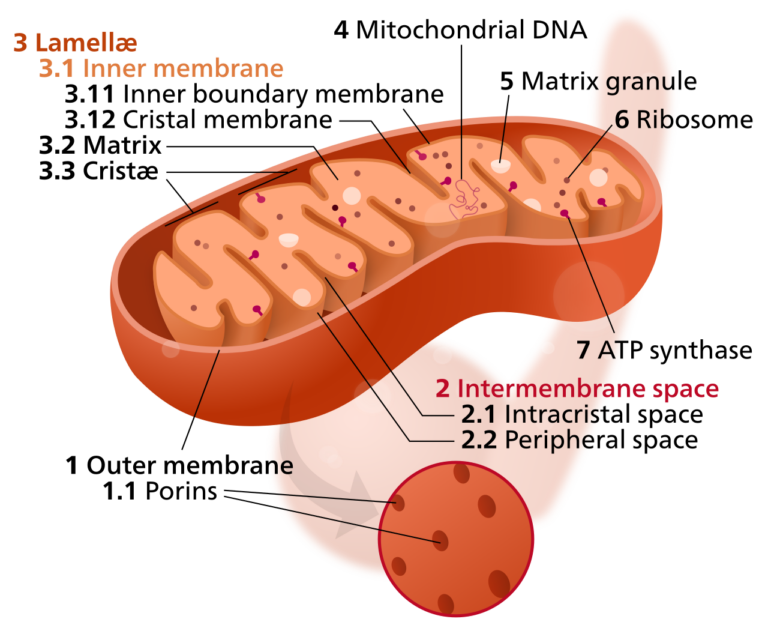
Mitochondrial-derived peptides are short peptides encoded within mitochondrial DNA. Humanin (2001) and MOTS-c (2015) are the best studied. In cell and animal work they act on distant tissues via AMPK and other pathways, behaving like endocrine signals rather than intracellular factors.
For decades the mitochondrial genome was taught as a closed, minimal ledger: 37 genes, 13 of which build subunits of the oxidative-phosphorylation machinery, the rest coding rRNAs and tRNAs. Then two peptides — humanin, cloned in 2001, and MOTS-c, described in 2015 — turned out to be encoded inside that same tiny genome, in reading frames tucked into the ribosomal RNA genes, and to circulate and act on tissues far from any single mitochondrion. That is a strange thing for an organelle to do: secrete a signal. Everything below describes laboratory, animal and observational-human findings, not use in people.
What is a mitochondrial-derived peptide, exactly?
A mitochondrial-derived peptide (MDP) is a short peptide whose coding sequence sits within the mitochondrial genome (mtDNA) rather than the nuclear genome. The conceptual break is that mtDNA was thought to encode only 13 OXPHOS proteins plus the ribosomal and transfer RNAs needed to translate them. MDPs are read from small open reading frames that overlap the mitochondrial rRNA genes, which is why they were missed for so long — nobody was looking for protein-coding potential inside a ribosomal RNA gene.8
The family, as currently described, has three parts: humanin, MOTS-c, and the six small humanin-like peptides (SHLPs). Each was found by a different route, but they share the property that made them interesting — they are secreted, measurable in plasma, and active on cells and tissues at a distance.810
Humanin: the founding peptide (2001)
Humanin was cloned by Hashimoto, Niikura, Nishimoto and colleagues from an occipital-lobe cDNA library of a brain that had been spared in Alzheimer’s disease. In their screen, the peptide rescued cultured neurons from cell death triggered by a wide spectrum of familial Alzheimer’s genes and by amyloid-beta.1 A companion paper the same year mapped out the breadth of that neuroprotective activity across different disease-relevant insults in culture.2 In the mitochondrial-translated form the peptide is 21 amino acids; the ORF lies within the 16S rRNA gene (MT-RNR2).
What made humanin more than a curiosity was that it was secreted and detectable in the circulation, and that its levels tracked with biology outside the brain. That set up the later thesis that the mitochondrion behaves, in part, like an endocrine organ.12
MOTS-c: a muscle-targeting signal (2015)
MOTS-c — Mitochondrial ORF of the 12S rRNA type-c — is a 16-amino-acid peptide reported by Changhan Lee, Pinchas Cohen and colleagues in 2015, encoded in the 12S rRNA gene (MT-RNR1). In mice, MOTS-c targeted skeletal muscle, activated AMP-activated protein kinase (AMPK), enhanced glucose uptake and insulin sensitivity, and reduced diet-induced obesity and insulin resistance.3 The peer commentary published alongside it, by Zarse and Ristow, went further than the authors and called MOTS-c “a mitochondrially encoded hormone.”4
16 amino acids — the length of MOTS-c, a peptide encoded inside a ribosomal RNA gene of mitochondrial DNA.
The more surprising follow-up came in 2018. Kim, Son, Benayoun and Lee showed that under metabolic stress MOTS-c does not stay in the cytoplasm: it translocates to the nucleus and regulates nuclear gene expression, including antioxidant- and metabolism-linked programs.5 That is retrograde signaling — information running from the mitochondrion back to the nuclear genome — carried by a peptide the mitochondrial genome itself encodes.
A peptide written into a ribosomal RNA gene, translated, secreted, and then walked back into the nucleus to change which nuclear genes are read.
The SHLPs, and the exercise and aging links
In 2016 Cobb, Lee and colleagues characterized six further peptides — the small humanin-like peptides, SHLP1 through SHLP6 — encoded in the same 16S rRNA region as humanin. SHLP2 and SHLP3, in particular, showed activity on apoptosis, insulin sensitivity and inflammatory markers in their study systems.7 That expanded the family from a curiosity into something that looked like a coordinated set of signals.
Two lines of data pushed MDPs toward physiology. First, exercise: Reynolds and colleagues reported in 2021 that MOTS-c is induced by exercise in both mice and human skeletal muscle and plasma, and that MOTS-c administration improved physical capacity and countered age-dependent decline in mice.6 Second, aging: circulating humanin declines with age in humans and multiple other species and correlates with measures of longevity and healthspan.9 A separate human-genetics observation found a MOTS-c-region mtDNA variant enriched in Japanese male centenarians — an association, not a mechanism.11
| Peptide | mtDNA gene (ORF) | First reported | Reported activity (cell/animal) |
|---|---|---|---|
| Humanin | 16S rRNA (MT-RNR2) | 2001 | Neuroprotection in culture; IGF-1/GH-axis crosstalk |
| MOTS-c | 12S rRNA (MT-RNR1) | 2015 | AMPK activation, muscle glucose uptake, nuclear translocation |
| SHLP1-6 | 16S rRNA (MT-RNR2) | 2016 | SHLP2/3: apoptosis, insulin sensitivity, inflammation |
Summary of described MDPs. All activities listed are from in-vitro or animal studies and observational human cohorts, not from controlled human dosing trials.
The mitochondrion as an endocrine organ — and why the word “hormone” is used carefully
Because MDPs are secreted, circulate, and act on distant tissues — muscle, brain, pancreas — through receptor and AMPK signaling and crosstalk with the IGF-1/growth-hormone axis, they support the framing of the mitochondrion as an endocrine organ.812 The Zarse and Ristow editorial voiced this independently for MOTS-c.4 Still, “hormone” here is used advisedly: it describes behavior — signaling at a distance — rather than any regulatory-recognized hormone classification. Hormone-like is the honest phrasing.
An honest read of the evidence
The mechanistic story is genuinely interesting, but the evidence base has clear limits that are easy to gloss over. Almost all mechanistic and interventional data come from cell culture and rodents. Robust human interventional trials — where a defined amount of humanin or MOTS-c is administered and outcomes measured — are essentially absent. The human data are observational: peptide levels correlate with age, disease state, or exercise. Correlation of that kind cannot establish that raising an MDP causes a benefit, and the centenarian mtDNA variant and the age-related decline of humanin are associations, not proof.911
The field is also anchored to a small number of originating labs — notably the Cohen and Lee groups at USC.8 Several central claims would benefit from more independent replication, and single-lab findings should not be presented as settled consensus. Some independent reviews exist, including a New Zealand group’s overview of MDPs in energy metabolism, which is useful precisely because it sits outside the founding lab.10 Quantification is another soft spot: humanin and MOTS-c assays (ELISA, mass spectrometry) vary between studies, so absolute “levels” and cross-study comparisons deserve caution. Finally, because these peptides overlap the 16S and 12S rRNA genes, the exact biogenesis — mitochondrial versus cytoplasmic translation, and the precise endogenous peptide length — is still debated; the safe statement is where the ORF sits, not a single settled pathway. None of this makes the biology less real; it makes it early.
All materials supplied by Condor Research are Research Use Only (RUO). Everything above describes in-vitro, animal and observational-literature findings and is not a dosing protocol, clinical guidance, or safety assessment for any organism. No MDP is an approved drug, and there is no validated human dosing regimen. Nothing here concerns human or veterinary use.
Condor Research · Scientific desk
Atrio Sciences s.r.o., IČO 57 669 651, Nitra (SK) · info@condorresearch.com
- MDPs are short peptides encoded WITHIN the mitochondrial genome, not the nuclear genome — breaking the textbook rule that mtDNA encodes only 13 OXPHOS proteins plus rRNAs and tRNAs.
- Humanin, a small peptide from an open reading frame in the 16S rRNA gene (MT-RNR2), was the founding MDP, reported by Hashimoto and colleagues in 2001.
- MOTS-c, encoded in the 12S rRNA gene (MT-RNR1), was reported by Lee, Cohen and colleagues in 2015; in mice it activates AMPK, targets skeletal muscle and improves insulin sensitivity.
- Under metabolic stress MOTS-c translocates to the nucleus and influences nuclear gene expression, a form of mitochondrion-to-nucleus retrograde signaling.
- The SHLPs (small humanin-like peptides 1-6) are six further MDPs from the same 16S rRNA region; SHLP2 and SHLP3 showed metabolic and pro-survival activity in study systems.
- MOTS-c rises with exercise in human muscle and plasma, and circulating humanin declines with age across species — but these human data are observational, not interventional.
- No MDP is an approved drug; there is no validated human dosing. All of this is laboratory, animal and observational-cohort research.
Why is it surprising that mitochondria encode peptides like these?
The mitochondrial genome was taught as encoding only 13 oxidative-phosphorylation proteins plus rRNAs and tRNAs. MDPs are read from small open reading frames overlapping the ribosomal RNA genes, so they violate that tidy rule — protein-coding potential was found where only structural RNA was expected.
What did the original humanin paper actually show?
Hashimoto and colleagues cloned humanin from a cDNA library of an Alzheimer's-spared occipital lobe and found it rescued cultured neurons from death caused by a range of familial Alzheimer's genes and by amyloid-beta. A companion 2001 paper characterized the breadth of that neuroprotection across different insults in culture. These are cell-based observations.
What does MOTS-c do in the studies?
In mice, MOTS-c targeted skeletal muscle, activated AMPK, improved glucose uptake and insulin sensitivity, and reduced diet-induced obesity and insulin resistance. A later study showed it can translocate to the nucleus under metabolic stress to influence nuclear gene expression.
Is there any human evidence?
Yes, but it is observational. MOTS-c rises with exercise in human skeletal muscle and plasma, circulating humanin declines with age across species and correlates with longevity measures, and a MOTS-c-region mtDNA variant is enriched in Japanese male centenarians. None of these are controlled dosing trials, so they show association, not causation.
Are humanin or MOTS-c approved for anything?
No. There is no approved MDP therapy and no established human dosing. They are research compounds studied in cells, animals and observational cohorts. Any framing beyond that is not supported by the literature.
Why do you hedge on calling them hormones?
A peer editorial in Cell Metab called MOTS-c "a mitochondrially encoded hormone," and MDPs do act at a distance via secreted signaling and IGF-1/GH crosstalk. But "hormone" here describes behavior, not a regulatory classification. Hormone-like is the more precise term.