
Why Most Peptides Cannot Be Swallowed — and What It Takes to Change That
Gut proteases destroy peptides and the epithelium blocks them: oral bioavailability is usually under 1%. What SNAC, macrocycles and devices really change.
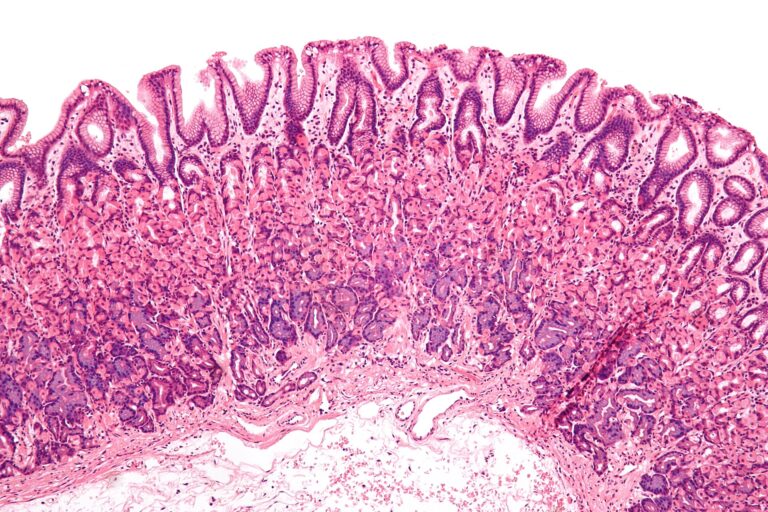
Most peptides cannot be taken orally because gastric and intestinal proteases digest them and the epithelium blocks large, hydrophilic molecules. Unmodified peptides typically show oral bioavailability well under 1–2%. Only deliberate engineering — permeation enhancers, macrocyclisation, N-methylation or ingestible devices — changes that, and even then absorption stays low and highly variable.
A peptide is a chain of amino acids. So is the protein in a meal. The digestive tract is an apparatus evolved to take exactly that class of molecule apart into fragments small enough to absorb, and it is extremely good at the job. That single observation explains most of what follows: why an injectable peptide and an “oral” version of the same sequence are not interchangeable, why the pharmaceutical industry spent four decades and enormous sums to put two or three peptides into a tablet, and why in oral delivery the engineering matters more than the molecule.1 Everything below is laboratory pharmacology written for research use only; none of it is guidance for administration to humans or animals.
What happens to a peptide between the mouth and the bloodstream?
The first barrier is chemical demolition, and it begins immediately. In the stomach, pepsin works at acidic pH and cleaves preferentially beside hydrophobic and aromatic residues. What survives meets the pancreatic enzymes in the duodenum: trypsin (cutting after lysine and arginine), chymotrypsin (after aromatic residues), elastase (after small neutral residues), and the carboxypeptidases, which chew the chain from the C-terminal end. Between them these enzymes cover most of the sequence space a synthetic peptide can occupy — the specificity that makes them efficient at digesting dietary protein makes them efficient at digesting a research peptide.23
Two further enzymatic layers are easy to overlook and matter enormously. The brush border of the enterocyte carries membrane-bound aminopeptidases and dipeptidyl peptidases, so fragments that survive the lumen are trimmed again at the moment of contact with the cell surface. And any peptide that does enter an enterocyte meets cytosolic peptidases inside it. A molecule therefore has to survive not one enzymatic environment but four in series, each with different pH optima and different cleavage preferences.23
Why can a peptide not simply diffuse across the gut wall?
Suppose a peptide survives. It now faces a physical barrier with two possible routes, and both are closed to it.
The paracellular route — between adjacent epithelial cells — is sealed by tight junctions. These restrict passage to small, mostly inorganic solutes and water; a peptide of even a few kilodaltons is far too large. The junctional pathway also represents a negligible fraction of the total mucosal surface area, so even partial leakage contributes little.3 The transcellular route requires passive diffusion through a lipid bilayer, and here the physicochemistry is simply wrong. Peptides are large, hydrophilic, rich in hydrogen-bond donors, carry high polar surface area, and are usually charged at intestinal pH. Lipinski’s rule of 5, the empirical description of what passive oral absorption tolerates, was derived from small molecules, and peptides violate essentially every term of it.4 Work on cell permeability “beyond the rule of 5” has shown that molecules in this space can be made permeable, but only by deliberately shielding the polar groups — permeability here is engineered, never incidental.56
Anything that does cross is then drained by the portal vein into the liver, where first-pass metabolism removes a further share before the compound reaches systemic circulation.13 The arithmetic of four enzymatic layers, a closed epithelium and hepatic extraction converges on the number that defines this field: for unmodified peptides, oral bioavailability is typically well under 1–2%, and often far less.13
0.8% the oral bioavailability of semaglutide measured under the licensed product’s recommended dosing conditions, in a population pharmacokinetic analysis of six clinical pharmacology trials — and that is the figure for a peptide specifically engineered and formulated for oral use.9
What does it actually take to make a peptide orally active?
Four families of solution exist, and the honest summary is that all of them are expensive, none of them is general, and the best of them still leaves almost the entire dose unabsorbed.
Permeation enhancers are the approach that reached the market first. Salcaprozate sodium (SNAC) is co-formulated with semaglutide in the licensed oral tablet, and the mechanism turned out to be more specific than anyone expected. Absorption does not occur in the intestine at all: clinical and preclinical work showed it takes place in the stomach, confined to a small area immediately around the dissolving tablet. SNAC raises local pH in that microenvironment, which both protects the peptide from pepsin and promotes transcellular passage across the gastric mucosa. The effect is transient, compound-specific, and — importantly — showed no evidence of acting on tight junctions.8 More recent work on enhancer mechanisms describes transient membrane defects as the physical basis for this class of effect.1011
The cost of that ingenuity is instructive. Bioavailability remains around 0.8%, which is why the oral dose of semaglutide is far larger than the injected one. It is also why the dosing conditions in the licensed product are so tightly specified: in the pharmacokinetic modelling, post-dose fasting time and the volume of water co-ingested were among the most important covariates on exposure, and within-subject variability in bioavailability was 137%.9 A delivery route on which the same subject absorbs wildly different amounts on different days is a route that has to be controlled with unusual care.
Oral absorption of a peptide is not a property of the peptide. It is a property of the peptide plus a specific enhancer, in a specific tablet, taken under specific conditions — remove any one and the exposure collapses.
Structural engineering attacks the problem at the molecule. Cyclisation and macrocyclic scaffolds remove the free termini that exopeptidases attack and lock the backbone into conformations that can bury polar amide hydrogens; N-methylation masks hydrogen-bond donors directly; D-amino acids and retro-inverso designs present a stereochemistry proteases do not recognise; stapling rigidifies helices; PEGylation and lipidation change size, clearance and membrane association.67 These are not cosmetic changes. They produce a different chemical entity with different target affinity, different selectivity and a different metabolic fate — which is precisely why they cannot be applied retroactively to an existing sequence, and why an “oral form” of a peptide that has not undergone them is a claim about packaging rather than about chemistry.
Formulation covers enteric coatings that defer release past the stomach, polymeric and lipid nanoparticles, self-emulsifying systems, mucoadhesive hydrogels and protease-inhibitor co-formulation.3 Finally, device-based delivery abandons absorption altogether and injects from inside the lumen. The self-orienting millimetre-scale applicator (SOMA), inspired by the leopard tortoise’s ability to right itself, positions against the gastric wall and deploys milliposts of solid drug through the mucosa; with insulin as the model compound it produced plasma levels comparable to subcutaneous administration in rats and swine.12 A companion design, the luminal unfolding microneedle injector, does the equivalent in the small intestine.13 These are elegant, and they are also a candid admission that the barrier proved easier to bypass than to negotiate.
| Strategy | Mechanism | Verified example | What it costs |
|---|---|---|---|
| Permeation enhancer | Local pH buffering plus transient transcellular passage, in the stomach | SNAC with semaglutide8 | Bioavailability still ~0.8%; 137% within-subject variability9 |
| Macrocyclisation / N-methylation | Removes protease-accessible termini; shields H-bond donors | Enlicitide, an oral macrocyclic peptide14 | A new chemical entity; years of dedicated design6 |
| D-amino acids / retro-inverso | Stereochemistry proteases do not recognise | Established peptide-design practice7 | Target affinity often changes or is lost |
| Formulation (enteric, nanoparticle, SEDDS, hydrogel) | Delays release, shields cargo, modifies local environment | Reviewed across oral protein/peptide platforms3 | Few reach approval; gains often modest |
| Ingestible device | Mechanical injection through gastric or intestinal mucosa | SOMA12; luminal unfolding microneedle injector13 | Preclinical (rat, swine); manufacturing complexity |
| Abandon the peptide | Use a non-peptide small molecule at the same target | Orforglipron, an oral small-molecule GLP-1 agonist16 | Only possible where the target is druggable by small molecules |
Approved medicines are cited strictly as documented examples of delivery engineering. Device data are preclinical (rat and swine). Bioavailability figures are compound-specific and do not transfer between molecules. Condor Research supplies materials for laboratory use only and does not sell, supply or recommend any of the medicinal products named above.
The exemplar: what success actually looks like
The clearest demonstration that this problem is solvable arrived in 2026. Enlicitide, a macrocyclic peptide inhibitor of PCSK9, was approved by the FDA on 16 July 2026 as Lipfendra — the first oral PCSK9 inhibitor, a target previously reachable only by injection.15 In CORALreef Lipids, a placebo-controlled phase 3 trial in 2,909 participants, LDL cholesterol fell 57.1% from baseline with enlicitide against a 3.0% rise on placebo: a between-group difference of 55.8 percentage points at week 24.14 In CORALreef HeFH, in adults with heterozygous familial hypercholesterolaemia already taking statins, the difference was 59.4 percentage points at week 24.15
Read that as a delivery result rather than a lipid result. It took a purpose-built macrocyclic scaffold, designed from the outset for oral exposure, to get peptide-class potency out of a tablet. Nothing about it generalises to a linear peptide that happens to have been put in a capsule.
An honest read of the evidence
Here is the part that matters for anyone designing an experiment. Because oral bioavailability for unmodified peptides sits well under 1–2%, an “oral” version of a peptide is not a convenient version of the injectable one. Unless the molecule has been specifically engineered or formulated for oral delivery — cyclised, methylated, enhancer-paired, device-delivered — oral administration is a different experiment with a different, much smaller and much more variable systemic exposure. Two routes that deliver 100% and 0.5% of a nominal amount are not two ways of doing the same thing.
That makes this a reproducibility problem rather than a convenience question. If exposure varies by more than 100% within the same subject even in a licensed, optimised product,9 then an unoptimised oral route introduces a variance term that can be larger than the effect under study. A negative result may mean the compound does nothing; it may equally mean almost none of it arrived. Neither conclusion is available from the data.
Two honest qualifications belong here. First, chain length matters: very short peptides — particularly di- and tripeptides — are handled quite differently, because the intestine maintains dedicated transport machinery for the small fragments that protein digestion produces, and peptidomimetics designed around that chemistry can survive considerably better than long linear sequences.13 The blanket objection is strongest for large, linear, unmodified peptides and weakest at the short end. Second, and more practically, a number of compounds sold in capsule form are not peptides at all but small molecules, for which the proteolysis argument simply does not apply. The question to ask of any capsule is not “is oral absorption plausible?” in the abstract, but “what class of molecule is this, and has anything been done to it?”
The practical discipline follows from the pharmacology. Match the route to the molecule and to what the published literature actually used; do not substitute routes across a body of evidence generated by injection; document the formulation, not just the compound; and treat handling as part of the method, since a peptide’s reconstitution and storage and its temperature history govern how much intact material existed before any route question arose. For the wider picture of how these materials are classified and characterised, see our overview of research peptides.
All compounds discussed here are described solely in the context of published laboratory and clinical pharmacology. Condor Research supplies reference materials for research use only: not for human or veterinary use, not for diagnostic or therapeutic application, and not for administration by any route. The approved medicines named in this article are cited as documented examples of delivery engineering and are not products we sell.
Condor Research · Scientific desk
Atrio Sciences s.r.o., IČO 57 669 651, Nitra (SK) · info@condorresearch.com
- For unmodified peptides, oral bioavailability is typically well under 1–2% — the combined product of proteolysis, a closed epithelium and first-pass hepatic metabolism.
- Four enzymatic layers act in series: gastric pepsin; pancreatic trypsin, chymotrypsin, elastase and carboxypeptidases; membrane-bound brush-border peptidases; and cytosolic peptidases inside the enterocyte.
- Both absorption routes are closed: tight junctions seal the paracellular path, and peptides are too large, hydrophilic and polar for meaningful passive transcellular diffusion, violating essentially every term of Lipinski's rule of 5.
- SNAC enables oral semaglutide by buffering local pH at the gastric mucosa and transiently promoting transcellular passage — absorption occurs in the stomach, close to the tablet, and shows no evidence of acting on tight junctions.
- Even with that engineering, oral semaglutide bioavailability is about 0.8% under recommended dosing conditions, with 137% within-subject variability in bioavailability.
- Enlicitide, a macrocyclic peptide PCSK9 inhibitor, was FDA-approved on 16 July 2026: LDL-C fell 55.8 percentage points versus placebo at week 24 in CORALreef Lipids and 59.4 points in CORALreef HeFH.
- An 'oral' peptide that has not been specifically engineered for oral delivery is not a convenient version of the injectable — it is a different experiment with a small, highly variable exposure, and therefore a reproducibility problem.
Why can peptides not be swallowed like small-molecule drugs?
Three barriers act in series. Gastric pepsin and the pancreatic proteases — trypsin, chymotrypsin, elastase, the carboxypeptidases — cleave the backbone, and brush-border and cytosolic peptidases trim whatever survives. The intestinal epithelium then blocks passage: tight junctions close the paracellular route and peptides are too large, too hydrophilic and too polar for meaningful passive diffusion across the membrane. Whatever crosses faces first-pass hepatic metabolism. The result for unmodified peptides is oral bioavailability typically well below 1–2%.
How does SNAC make oral semaglutide work?
Salcaprozate sodium is co-formulated in the tablet and creates a local microenvironment as the tablet dissolves against the gastric mucosa. Raising local pH protects the peptide from pepsin, and the enhancer transiently promotes transcellular passage across the stomach wall. Absorption is confined to the small area around the tablet, is compound-specific, and showed no evidence of acting on tight junctions. It is a genuinely clever solution — and it still yields only about 0.8% bioavailability.
If bioavailability is only about 1%, how can the tablet work at all?
By giving a much larger dose and accepting the loss, which is why the oral dose is far greater than the injected one, and by controlling the conditions of administration tightly. In the population pharmacokinetic analysis, post-dose fasting time and co-ingested water volume were among the strongest covariates on exposure. Within-subject variability in bioavailability was 137%, softened at steady state only because the molecule has a long half-life and is dosed daily.
Does any peptide reach the market as a genuinely oral drug?
Yes, and the example is recent. Enlicitide, a macrocyclic peptide PCSK9 inhibitor, was approved by the FDA on 16 July 2026 as the first oral drug at that target. In phase 3 it lowered LDL cholesterol by 55.8 percentage points versus placebo at week 24 in CORALreef Lipids and 59.4 percentage points in CORALreef HeFH. It is proof the problem is solvable — by designing a macrocyclic scaffold for oral exposure from the outset, not by repackaging an existing sequence.
Does this objection apply to every compound sold in capsules?
No, and it is worth being precise about it. Many compounds supplied in capsule form are small molecules rather than peptides; they have no peptide bonds for proteases to cleave and their oral pharmacology stands or falls on entirely separate grounds. Among peptides, very short sequences — di- and tripeptides — are also handled differently, since the intestine has dedicated machinery for the fragments of protein digestion. The argument bites hardest against large, linear, unmodified peptides.
Why does route substitution matter for reproducibility?
Because it silently changes the independent variable. A study designed around parenteral exposure and repeated orally without an oral-delivery strategy may deliver a small and highly variable fraction of the nominal amount, so a null result cannot be attributed to the compound rather than to the route. The variance introduced can exceed the effect being measured. Documenting route, formulation and handling alongside compound identity is the minimum needed for a result to be interpretable by anyone else.