
What is Adalank? A stabilised Selank analogue with no literature of its own
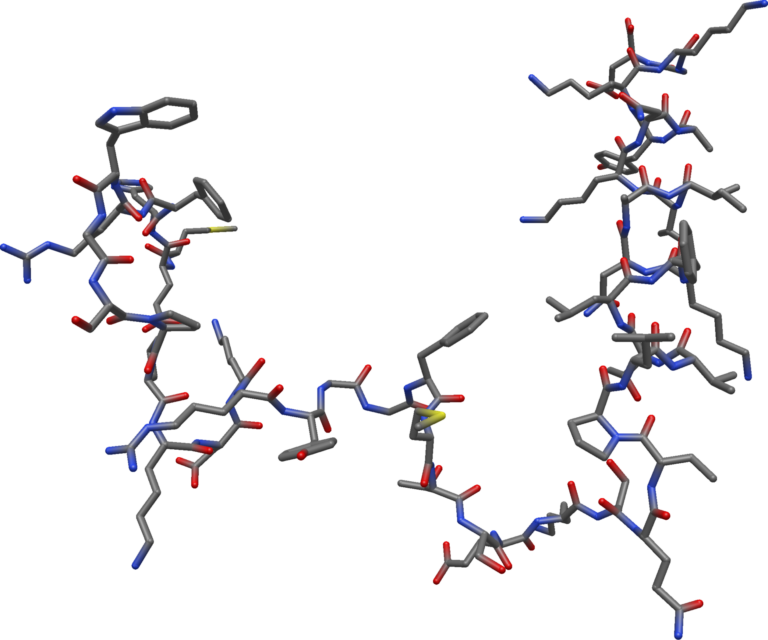
Adalank is marketed as a stabilised analogue of Selank. A PubMed search on 2 August 2026 returned zero records for the name, so no published sequence, stability data or trial exists under it. The claims made for it are borrowed from Selank's literature, which is itself modest.
Adalank appears on vendor listings as a “stabilised” or “second-generation” version of Selank, usually alongside the same bullet points that circulate about Selank itself. The claim is specific enough to be testable: a modified peptide, more resistant to breakdown, otherwise equivalent. So we tested it the way we test any compound before it goes near a catalogue, by looking for the primary literature. There is none under that name. What follows is a description of what exists, what does not, and what would have to exist. All compounds discussed here are research chemicals supplied strictly for laboratory use.
What is actually being claimed
The Adalank pitch has three parts. First, that it is an analogue of Selank, the synthetic heptapeptide Thr-Lys-Pro-Arg-Pro-Gly-Pro developed in Russia. Second, that a structural modification makes it more resistant to enzymatic degradation than Selank. Third, that this improved stability carries the same activity for longer. Each of those is an empirical statement. None of them is inherently implausible. All three are the kind of statement that generates data when it is true, because a laboratory that stabilises a peptide has, by definition, run the assay that shows it.
What is missing is not plausibility. It is the data. That distinction matters, and we will hold to it throughout: absence of published evidence is not evidence of misconduct, and nothing here should be read as an allegation about any supplier. It is a statement about what a public database contains.
The database check, and what a zero-result search means
On 2 August 2026 we queried NCBI PubMed for adalank across all fields. The query returned no items.1 The same day, a title/abstract search for selank returned 68 records.2 The contrast is the whole point: the parent compound has a literature that can be read, criticised and cited. The analogue has a name.
0 PubMed records for “adalank” across all fields, queried 2 August 2026 — no primary publication, no disclosed sequence, no stability assay, no registered trial under that name.
A zero-result search has limits and we will state them. It does not prove that no such molecule was ever synthesised. Compounds are made in industry and never published. Names drift, and a molecule might exist in the literature under a different designation, a code number or a systematic sequence, in which case the marketing name is doing no work for anyone trying to verify it. What the zero result does establish is narrower and sufficient: nobody buying under this name can check the claims made for it, because there is nothing in the public record to check them against.
Selank is itself a stabilised analogue — which cuts both ways
The most useful thing about this case is that the concept being sold is not a fiction. Selank is a stabilised analogue. It was built from tuftsin, the tetrapeptide Thr-Lys-Pro-Arg, by extending the C-terminus with a Pro-Gly-Pro sequence specifically to slow proteolysis. The original comparison of tuftsin against the analogue then designated TP-7 was published in 1995.3 The design rationale — that proline-containing C-terminal extensions confer resistance to peptidases, and that a family of such “glyproline” hybrids can be built deliberately — was set out by the same Moscow group as a general strategy.4 Tuftsin’s own chemistry and its long list of analogues have been reviewed independently.5
So stabilising a short peptide by tail extension is a real, documented, reproducible approach. That is exactly why the Adalank claim deserves a fair hearing rather than a reflex dismissal. The question is not whether such a thing can work. It demonstrably can. The question is whether this one has been shown to, and by whom, and in what assay.
Note also what the Selank programme actually did to earn the word “stabilised”. Investigators labelled the peptide uniformly with tritium, incubated it in blood plasma, and identified the specific fragments it broke into: the pentapeptide TKPRP, the tripeptide TKP, and the dipeptides RP and GP.6 That is what a stability claim looks like when it has been done. If you want the longer treatment of the parent compound, we cover it in our overview of Selank.
What “more stable” would have to mean
Stability is not a property a peptide has in the abstract. It is a rate, measured in a specified matrix, at a specified temperature, against a specified comparator. The standard route is well documented in the peptide development literature: incubate in plasma or serum, sample at timed intervals, quantify the parent by LC-MS/MS, fit a decay curve, and report a half-life with units.7 The broader ADME toolkit for peptides — permeability, proteolysis, renal clearance, half-life extension — has been reviewed in detail and is not obscure.8 A recent example on a different regulatory peptide shows the full shape of it: synthesise the parent and the modified fragment, confirm both structures by mass spectrometry and NMR, then follow degradation kinetics in human plasma side by side.9
A stability claim without a measured half-life is not a result. It is a design intention.
There is a second requirement that gets skipped even more often. Slowing degradation is only useful if the surviving molecule still does something at its target. A modification that adds three residues to a heptapeptide can easily preserve the backbone while altering how it engages whatever it engages. So the honest version of the claim needs two datasets, not one: a stability comparison, and a matched-exposure activity comparison against the parent.4 Neither has been published under the Adalank name.1
| Claim as usually stated | What would demonstrate it | Established method | Published under “Adalank” |
|---|---|---|---|
| “More stable than Selank” | Side-by-side decay curves in the same matrix | Plasma/serum incubation, timed sampling, LC-MS/MS | None located |
| “Longer half-life” | A numeric t½ with units, matrix and species | Pharmacokinetic sampling, non-compartmental analysis | None located |
| “Resists enzymatic breakdown” | Identification of the actual degradation fragments | Fragment assignment by mass spectrometry | None located |
| “Same activity, longer duration” | Target readout at matched exposure versus parent | Binding or functional assay, parallel arms | None located |
| “Improved analogue” | A disclosed sequence and analytical identity | Sequence, HPLC purity, MS confirmation | No sequence published |
Each row states a claim commonly attached to Adalank, the observation that would support it, and the routine method used to produce that observation. The right-hand column reflects a PubMed search across all fields on 2 August 2026.1
An honest read: is Selank’s evidence worth inheriting?
Here is the part most write-ups skip, because it undercuts the parent as well as the analogue. If Adalank’s entire case rests on inheriting Selank’s literature, the value of that inheritance depends on how strong Selank’s literature is. It is not strong. It is real, but it is thin.
Of the 68 title/abstract records retrieved on 2 August 2026, 32 list N. F. Myasoedov among the authors, and 29 are published in Russian.2 That is a body of work concentrated in one country and, to a large degree, in one research network. The proposed mechanism — inhibition of enkephalin-degrading enzymes in plasma — comes from that same network.10 The human studies are small and mostly open or actively controlled rather than placebo-controlled: 62 participants compared against medazepam in one,11 60 against phenazepam in another,12 with psychometric rating scales as endpoints and publication in Russian-language psychiatry journals. An independent review outside that network characterises the compound as one where the available human data are limited relative to the interest it attracts.13
None of this means the findings are wrong. Single-country literatures are not automatically unreliable, and a small trial is still a trial. It does mean that the evidence base has not been through the replication that would let anyone treat it as settled — no large multi-centre replication, little independent confirmation, and a mechanism supported mainly by in vitro work from the originating group. That is the honest read. We apply the same standard when comparing the two best-known peptides from this programme in Selank versus Semax.
Which produces an uncomfortable conclusion for the Adalank pitch. Even if the analogue were exactly what it is described as, it would be inheriting a modest evidence base and adding an undocumented modification to it. The inheritance is thinner than the marketing implies, and the modification has no paperwork at all.
What this means for anyone sourcing research material
For laboratory procurement, the practical consequence is straightforward: a compound with no published sequence cannot be verified as itself. Identity confirmation depends on knowing what you are looking for. Analytical work on peptide products sold online has repeatedly found discrepancies between labelled and actual content, including impurities and quantities well below the stated amount — that work was only possible because the target molecule had a known structure to check against.14 With an undisclosed sequence, even an honest certificate of analysis has nothing definite to certify.
Our position is not that Adalank is anything in particular. It is that we do not stock compounds whose defining claim cannot be checked against a public record, and we would rather say so plainly than write around it. If a sequence, a plasma stability dataset and a comparator arm are published under this name, that position changes on the evidence. Until then, the compound with a literature is Selank, and its literature should be read with its limits in view.
All compounds named here are supplied as reference materials for laboratory research use only. They are not medicines, are not approved by the EMA, FDA or any other regulator for any indication, and are not intended for human or veterinary use. Nothing above is medical advice, a therapeutic claim or dosing guidance.
Condor Research · Scientific desk
Atrio Sciences s.r.o., IČO 57 669 651, Nitra (SK) · info@condorresearch.com
- A PubMed search for "adalank" on 2 August 2026 returned zero records across all fields.
- No published amino acid sequence, purity specification or analytical characterisation appears under the name.
- No registered or published human clinical trial specific to Adalank could be located.
- Selank itself is a real compound with 68 PubMed records under a title/abstract search on the same date.
- Selank is itself a stabilised analogue of tuftsin, so the concept of stabilising a peptide is legitimate and well precedented.
- A stability claim is only demonstrated by degradation curves, identified fragments and a measured half-life in a stated matrix.
- Selank's own evidence base is small, concentrated in one country and one research network, and mostly preclinical.
Is Adalank the same molecule as Selank?
That cannot be answered from public sources, because no amino acid sequence has been published under the name Adalank. A PubMed search across all fields on 2 August 2026 returned zero records. Without a disclosed sequence, the relationship between the two — identical, modified, or unrelated — is not verifiable by anyone outside the supplier.
Does a zero-result search mean the compound does not exist?
No, and we would not claim that. Molecules are synthesised without ever being published, and a compound may appear in the literature under a different name or code. A zero-result search establishes something narrower: there is no public record against which the claims attached to the name can be checked.
What would make a stability claim credible?
A decay curve for the analogue and for Selank measured in the same matrix, at the same temperature, sampled over the same intervals, with the parent peptide quantified by a validated analytical method and a half-life reported in units. Identification of the degradation fragments strengthens it considerably.
Is stabilising a peptide a legitimate approach?
Yes, and Selank is itself the example. It was constructed from tuftsin by adding a Pro-Gly-Pro extension for exactly this reason, and tuftsin analogues form a large documented family. Half-life extension is a standard discipline in peptide development. The approach is sound; the question is always whether a specific instance has been demonstrated.
How strong is Selank's own evidence base?
Modest. Sixty-eight title/abstract records as of 2 August 2026, concentrated in one research network and largely published in Russian, with small human studies using active comparators rather than large placebo-controlled designs. Independent appraisal outside that network is limited.
Why does a published sequence matter for laboratory use?
Because analytical identity confirmation requires a known target. Studies characterising peptide products sold online were able to detect content and purity discrepancies precisely because the labelled molecule had a defined structure. Without one, no independent laboratory can confirm that a vial contains what the label says.