
What Is Vilon? The Lys-Glu (KE) Dipeptide Bioregulator
Vilon is the synthetic Lys-Glu (KE) dipeptide, the smallest of the Khavinson bioregulators. Its chemistry, mouse and cell-culture literature, and honest limits.
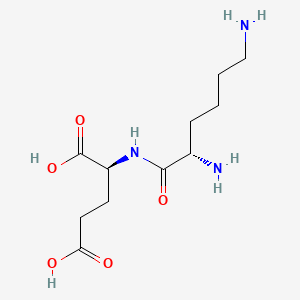
Vilon is a synthetic dipeptide with the sequence Lys-Glu (one-letter code KE), the smallest of the Khavinson short-peptide bioregulators. In mouse and human-cell studies it was reported to modulate immune-cell and chromatin markers. It is a Research Use Only compound with no approved human dosing.
Vilon is one of the shortest molecules in the “peptide bioregulator” catalogue: a two-residue chain of lysine and glutamic acid, written Lys-Glu or KE. It came out of the same Soviet-era thymic-peptide program that produced Thymalin, and it has been studied — almost entirely by one research network — as a putative modulator of immune-cell differentiation, mouse lifespan, and chromatin state in aged human cells. Everything below describes laboratory and literature findings, not use in people or animals for any purpose.
What is Vilon, structurally?
Vilon is a synthetic dipeptide with the sequence L-lysine–L-glutamic acid — H-Lys-Glu-OH, one-letter code KE. It is the simplest member of the family of short peptides that V. Kh. Khavinson and colleagues at the St. Petersburg Institute of Bioregulation and Gerontology grouped under the label “bioregulators.”2 That term is the lab’s own framing for a proposed class of ultra-short regulatory peptides; it is not an independently established pharmacological category, and it is worth reading it as a hypothesis rather than settled taxonomy.
The chemistry is unambiguous. The molecular formula is C11H21N3O5, giving a monoisotopic-free molecular weight of 275.30 g/mol; the compound carries CAS number 45234-02-4 and PubChem CID 7010502. Some vendor and aggregator pages list the molecular weight as 257.30 g/mol. That figure is wrong — it does not reconcile with the formula, and 275.30 g/mol is the value derived directly from C11H21N3O5. The discrepancy is a small but telling example of secondary sources copying each other without checking against a primary structure.
Where did Vilon come from?
Vilon traces back to the thymic-peptide work of Morozov and Khavinson, who described it as a newly synthesized immunomodulatory dipeptide developed alongside Thymogen (L-Glu-L-Trp).1 That program grew out of Thymalin, a bovine thymic extract that was the first peptide-bioregulator preparation cleared for use in the USSR. Vilon was positioned as a minimal active fragment — the idea being that a two-amino-acid sequence could carry a defined regulatory signal rather than the complex mixture of a tissue extract.
It sits inside a family of closely related but genuinely distinct molecules that are easy to confuse. Thymogen is the Glu-Trp (EW) dipeptide. Livagen is the tetrapeptide Lys-Glu-Asp-Ala (KEDA), which shares Vilon’s Lys-Glu N-terminus but is a longer, separate peptide. Epitalon (also spelled Epithalon) is the tetrapeptide Ala-Glu-Asp-Gly (AEDG). Keeping these straight matters, because the literature frequently tests them side by side, and claims made for one are sometimes loosely transferred to another. The broader conceptual scaffolding is covered in our overview of Khavinson peptide bioregulators.
What did the immunology studies report?
The earliest characterisation framed Vilon as an immunomodulator, with reported effects on T-cell differentiation, neutrophil chemotaxis and phagocytosis.1 A more mechanistic study found that among several short peptides, Vilon produced the strongest comitogenic effect on mouse thymocyte proliferation and activated signalling along the sphingomyelin pathway — implicating sphingomyelinase in its action.4 Later work reported that Vilon drove differentiation of pineal CD5+ precursor lymphocytes into T-helpers, cytotoxic T cells and B cells, which the authors proposed as a compensatory role in age-related thymic involution.8
2 Vilon is a two-residue peptide — Lys-Glu — among the smallest molecules ever proposed to carry a specific gene-regulatory signal.
What about the aging and chromatin claims?
The geroprotection line rests on a small set of rodent studies. Khavinson and Anisimov named Vilon explicitly as L-Lys-L-Glu and reported that it increased lifespan and inhibited spontaneous tumour growth in mice.2 The pivotal experiment gave subcutaneous Vilon to female CBA mice from six months of age and reported prolonged lifespan, increased endurance and prevention of spontaneous neoplasms, with no adverse developmental effects noted.3
The chromatin work is the most distinctive part of the Vilon record — and also the part that leans hardest on a single collaborating lab.
A parallel body of chromatin research, largely from a Tbilisi group collaborating with Khavinson, reported that Vilon induces deheterochromatinization — physical decondensation — of total and facultative heterochromatin in cultured lymphocytes from 75-88 year-old donors, and reactivates ribosomal genes, while notably not decondensing pericentromeric structural heterochromatin.5 Companion papers reported the same selective reactivation of age-repressed genes across Vilon and related peptides.6,7 The most recent study in this line, from 2023, again described selective deheterochromatinization of aged lymphocyte chromatin, with each peptide said to act on defined chromosome regions.13
More recent cell-culture work has attached gene-level detail. In aging human mesenchymal stem cells, nanomolar KE was reported to modulate IGF1, FOXO1, TERT, TNKS2 and NFkB expression.12 A 2023 paper reported that KE raised SIRT1 expression and protein synthesis several-fold and lowered PARP1 and PARP2, and used molecular modelling to predict that KE binds GCGG/GGGC double-stranded DNA motifs in those gene promoters.14 Earlier in-silico and marker work proposed roles for Vilon in regulating the aging markers CCL11 and HMGB1.9 In human skin fibroblasts, the KE dipeptide was reported to alter functional-activity markers relative to the AED peptide.10
| Molecule | Sequence | Type |
|---|---|---|
| Vilon | Lys-Glu (KE) | Dipeptide |
| Thymogen | Glu-Trp (EW) | Dipeptide |
| Livagen | Lys-Glu-Asp-Ala (KEDA) | Tetrapeptide |
| Epitalon | Ala-Glu-Asp-Gly (AEDG) | Tetrapeptide |
Sequences of Vilon and commonly confused peptides. All entries describe compounds studied in vitro and in animals only; none of these findings concern human or veterinary use.
An honest read of the evidence
The Vilon literature has a clear shape, and it is important to state its limits plainly. First, almost all of it traces to a single research network — Khavinson and the St. Petersburg Institute of Bioregulation and Gerontology, with the chromatin arm handled by the Lezhava group in Tbilisi. There is essentially no fully independent, unaffiliated replication of the core geroprotection or chromatin findings. One of the very few non-Russian groups to test KE at all did so as part of a panel and found the neuronal-differentiation effects came mainly from other peptides (KED and a compound), not from KE alone.11
Second, the pivotal data are small and dated. The lifespan and oncostatic results2,3 are from around 2000, in a single mouse strain (CBA), from one lab. The chromatin studies are small-n cultures from a narrow 75-88 year-old cohort. There are no large, randomized, or human clinical trials anywhere in this record.
Third, a significant part of the “mechanism” is hypothesis rather than demonstration. The DNA-binding model — KE recognising GCGG/GGGC motifs14 — comes from molecular modelling, not from direct structural or biophysical proof of peptide-DNA binding. The CCL11/HMGB1 story is similarly proposed at the marker level.9 Fourth, several key papers appear in low-visibility or Russian-language venues (Adv Gerontol, Bull Exp Biol Med, Dokl Biol Sci, Georgian Med News), often abstract-only in English, which limits external scrutiny. That does not make them wrong, but it does mean the independent peer-review layer is thin. Finally — as the molecular-weight muddle shows — secondary sources on Vilon are frequently copied uncritically, so any serious reader should go to the primary papers and the formula. The parallel case of independent replication attempts around Epitalon is a useful reference point for how much weight single-lineage claims can bear.
All materials supplied by Condor Research are Research Use Only (RUO). Everything summarised above is drawn from in-vitro and rodent literature; none of it is a dosing protocol, clinical guidance, or a safety assessment for any organism. Vilon holds no EMA or FDA marketing authorisation, and no approved human dosing exists. It is discussed here as a research reference material only and is not currently offered as a Condor Research catalogue product.
Condor Research · Scientific desk
Atrio Sciences s.r.o., IČO 57 669 651, Nitra (SK) · info@condorresearch.com
- Vilon is the synthetic dipeptide Lys-Glu (KE), i.e. H-Lys-Glu-OH — the simplest of the Khavinson short-peptide bioregulators.
- Its molecular formula is C11H21N3O5, MW 275.30 g/mol (CAS 45234-02-4); the 257.30 g/mol seen on some vendor pages is incorrect and does not match the formula.
- Vilon was identified in the thymic-peptide program that produced Thymalin, developed by V. Kh. Khavinson at the St. Petersburg Institute of Bioregulation and Gerontology.
- In female CBA mice, subcutaneous Vilon from month 6 was reported to prolong lifespan and reduce spontaneous tumours — data from a single strain, single lab, circa 2000.
- In cultured lymphocytes from 75-88 year-old donors it induced chromatin decondensation and reactivated ribosomal genes while sparing pericentromeric structural heterochromatin.
- In aging human MSCs, nanomolar KE modulated IGF1, FOXO1, TERT, SIRT1 and PARP gene expression, with peptide-DNA binding proposed only from molecular modelling.
- Nearly all of the evidence traces to one research network; there is no independent replication and no human clinical data.
What is Vilon?
Vilon is a synthetic dipeptide with the sequence Lys-Glu (KE), the smallest of the short peptides that the Khavinson lab groups under the "bioregulator" label. It was identified in the thymic-peptide program that produced Thymalin.
What is Vilon's molecular weight and CAS number?
Vilon has the molecular formula C11H21N3O5, a molecular weight of 275.30 g/mol, CAS number 45234-02-4 and PubChem CID 7010502. Pages listing 257.30 g/mol are in error; that value does not match the formula.
Is Vilon the same as Thymogen, Livagen or Epitalon?
No. Thymogen is Glu-Trp (EW), Livagen is the tetrapeptide Lys-Glu-Asp-Ala (which shares Vilon's Lys-Glu N-terminus but is longer), and Epitalon is the tetrapeptide Ala-Glu-Asp-Gly. Vilon is specifically the Lys-Glu dipeptide.
What did studies report Vilon doing in cells?
In cultured lymphocytes from 75-88 year-old donors, Vilon was reported to decondense chromatin and reactivate ribosomal genes while sparing pericentromeric structural heterochromatin. In aging human MSCs, KE was reported to modulate genes including IGF1, FOXO1, TERT, SIRT1 and PARP1/2. These are laboratory observations, not evidence of any effect in people.
Is there human clinical evidence for Vilon?
No. The record is limited to rodent studies and cell-culture experiments, and it comes overwhelmingly from a single research lineage with little independent replication. There are no randomized human clinical trials.
Is Vilon an approved medicine?
No. Vilon has no EMA or FDA marketing authorisation and no established human dosing. It is supplied strictly as a Research Use Only compound for laboratory and literature study.