
What Is Follistatin-344? The Myostatin-Binding Protein Variant
Follistatin-344 (FS344) is the follistatin cDNA isoform used in AAV gene-therapy muscle trials. What it binds, how it differs from FS288, and what the data show.
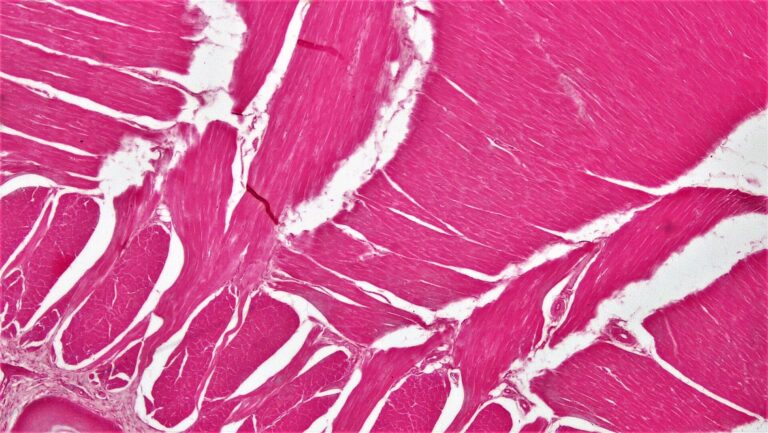
Follistatin-344 (FS344) is an alternatively spliced follistatin isoform used as a cDNA gene-therapy construct. Follistatin binds and neutralizes myostatin, a negative regulator of skeletal muscle. FS344 was chosen for AAV delivery in muscle-disease trials to reduce off-target ligand binding.
Follistatin-344 is one of the more misunderstood names circulating in muscle-biology discussion, because the label attaches to two very different things: a naturally occurring follistatin isoform, and the specific engineered cDNA construct that virologists packaged into an adeno-associated virus for a handful of human muscle-disease trials. The distinction matters more than any single fact about the molecule. Everything below describes laboratory and clinical-trial literature findings, not use in people or any product.
What is follistatin, biochemically?
Follistatin is a secreted, activin-binding glycoprotein. Its best-known role in the muscle literature is as an antagonist of myostatin — also called GDF-8 — a member of the TGF-beta superfamily. Myostatin was identified as a negative regulator of skeletal muscle mass when knockout mice were reported to carry two to three times the normal muscle mass1. The pathway is not a mouse curiosity: naturally occurring loss-of-function mutations in the myostatin gene produce the “double-muscling” phenotype seen in Belgian Blue and Piedmontese cattle, confirming that the same brake operates across species2.
Follistatin sits upstream of that brake. Transgenic mice overexpressing follistatin show pronounced increases in muscle mass, and the effect was shown to depend on myostatin antagonism3. In one study, combining follistatin overexpression with myostatin loss produced roughly a fourfold increase in muscle mass — more than knocking out myostatin alone — which is why follistatin is understood to act on additional TGF-beta ligands beyond myostatin4. That breadth is the double edge of the molecule: it is potent because it is promiscuous.
~4× follistatin overexpression combined with myostatin loss produced up to a fourfold increase in muscle mass in mice — an animal, not human, result.
What does the “344” actually refer to?
Native follistatin is expressed as alternatively spliced isoforms. The two most discussed are FS288 and the longer FS315; they differ in a C-terminal acidic tail that governs heparin binding and cell-surface association5. Biophysical work has mapped how these isoforms diverge in heparin affinity and ligand handling, which in turn changes where in the tissue the protein concentrates and how it engages its targets6. FS344 is best read in this family as a follistatin cDNA/isoform designation used to build a construct, not as a distinct receptor or a proprietary peptide.
The structural logic of neutralization is well resolved. The crystal structure of the myostatin:follistatin-288 complex shows follistatin wrapping around myostatin and occluding the surfaces myostatin would otherwise use to engage its receptors7. Later structural work on follistatin-type domains refined how these molecules sequester the ligand8. In plain terms: follistatin does not switch myostatin off chemically; it physically buries it.
FS344 in the human record is a gene delivered by a virus, not a molecule drawn into a syringe.
How FS344 was actually used: gene therapy, not a peptide
This is the point most online “follistatin 344” material gets wrong. In the two landmark human studies, FS344 was not injected as a protein. The follistatin cDNA was chosen deliberately — the alternatively spliced FS344 form was selected “to avoid potential binding to off-target sites” — and packaged as AAV1.CMV.FS344, an adeno-associated viral vector delivered by intramuscular injection9. The virus carries the gene into muscle fibers, which then express follistatin locally. That is a categorically different intervention from administering a follistatin protein.
| Aspect | AAV.FS344 gene therapy | Injectable follistatin protein |
|---|---|---|
| What is delivered | The FS344 gene, inside a virus | A protein/peptide molecule |
| Human trial evidence | Two small open-label trials911 | None for muscle outcomes |
| Duration of expression | Local, sustained fiber expression | Governed by protein half-life |
| Data transferability | The two do not transfer to each other | |
Comparison of modalities. Trial evidence cited here is investigational gene therapy only; there is no equivalent human muscle-outcome evidence for an injectable follistatin protein, and this table describes literature, not any product.
The two human trials, and their preclinical base
The first was a phase 1/2a trial of follistatin gene therapy in Becker muscular dystrophy, delivering AAV1.CMV.FS344 by intramuscular injection to six patients; some six-minute-walk improvements were reported without serious adverse events9. A follow-up analysis reported sustained ambulation improvement in the patients who responded10. The same construct was then tested in sporadic inclusion-body myositis, where a subset of patients showed functional gains11.
Underneath these sit animal studies. AAV follistatin co-delivery improved muscle function in an aged dystrophic mouse model12, and AAV-mediated follistatin gene therapy improved functional outcomes in a mouse model of facioscapulohumeral dystrophy13. Endogenous follistatin and myostatin have also been examined as circulating biomarkers in human muscular dystrophy, which is context for the biology rather than evidence for a therapeutic protein14. The pattern across this literature is consistent: the strong efficacy signals are animal and gene-therapy-delivered.
An honest read of the evidence
The gene-therapy record for FS344 is genuinely interesting, and genuinely thin. The human trials are very small, open-label, single-center, with no randomized placebo control — six Becker patients9 and a small inclusion-body myositis cohort11. That design supports proof-of-principle, not proof of efficacy. Within those trials the responses were inconsistent: several patients showed no change on the six-minute walk test, so any benefit was not uniform even among the treated. The bulk of the “muscle growth” evidence remains animal work delivered by virus341213.
The most consequential caveat is a modality one. Much of the online “follistatin 344” material silently swaps the AAV gene-therapy construct for a supposed injectable peptide, then imports the trial outcomes as if they applied. They do not. There is no clinical evidence that an injectable follistatin protein or peptide produces muscle effects in humans, and the gene-therapy data cannot be borrowed to fill that gap. Follistatin’s non-specific binding — activins, some BMPs4 — also raises off-target and safety questions that small, short trials have not resolved. And regulators have approved no follistatin muscle therapeutic anywhere; it remains investigational.
All materials supplied by Condor Research are Research Use Only (RUO). The content above summarizes in-vitro, animal, and clinical-trial literature only. It is not a dosing protocol, clinical guidance, performance or physique claim, or safety assessment for any organism, and nothing here should be read as describing use of any product in humans or animals.
Condor Research · Scientific desk
Atrio Sciences s.r.o., IČO 57 669 651, Nitra (SK) · info@condorresearch.com
- Follistatin is an activin-binding glycoprotein that also binds and neutralizes myostatin (GDF-8), a TGF-beta superfamily member and negative regulator of skeletal muscle mass.
- FS-344 is not an injectable peptide in the human trial record — it is a follistatin cDNA construct packaged into an adeno-associated virus (AAV1.CMV.FS344) and delivered into muscle.
- Native follistatin exists as alternatively spliced isoforms (notably FS288 and the longer FS315) that differ in a C-terminal acidic tail governing heparin and cell-surface binding.
- Two small human gene-therapy trials used FS344: a phase 1/2a Becker muscular dystrophy trial and a sporadic inclusion-body myositis trial, both by intramuscular AAV injection.
- The mechanistic rationale: inhibiting myostatin releases a brake on muscle growth; follistatin-overexpressing mice show large muscle mass gains, and combined targeting quadrupled muscle mass in one mouse study.
- Crystallography shows follistatin-288 physically wraps around myostatin and blocks receptor engagement — a structural explanation for neutralization.
- No follistatin muscle drug of any kind is approved in any jurisdiction; every human application to date has been investigational AAV gene therapy under trial.
Is Follistatin-344 the same as a follistatin peptide sold online?
No, and this is the central confusion. In the human literature, FS344 refers to a follistatin cDNA construct delivered by an adeno-associated virus (AAV1.CMV.FS344), not an injectable protein. The trial outcomes describe a virus expressing a gene inside muscle. They say nothing about any injectable follistatin peptide product.
Why was the FS344 isoform chosen for the trials?
The investigators state the alternatively spliced FS344 form was used "to avoid potential binding to off-target sites". Follistatin binds not only myostatin but also activins and some BMPs, so isoform choice was a way to narrow that promiscuity while retaining myostatin antagonism.
How does follistatin actually inhibit myostatin?
Structurally, not chemically. The crystal structure of the myostatin:follistatin-288 complex shows follistatin wrapping around myostatin and blocking the surfaces it needs to engage its receptors. Later work refined how follistatin-type domains sequester the ligand.
What do the human trials actually show?
They show early, limited signals. In six Becker muscular dystrophy patients, some six-minute-walk improvements were reported without serious adverse events, with sustained ambulation in responders on follow-up. A sporadic inclusion-body myositis trial reported functional gains in a subset. All were small, open-label, and uncontrolled.
Is there human evidence for muscle growth from follistatin protein?
No. The muscle-mass evidence base is animal and gene-therapy delivered — for example, follistatin-overexpressing mice and combined-targeting studies that quadrupled mouse muscle mass. There is no clinical evidence that an injectable follistatin protein produces muscle effects in humans.
Is follistatin approved as a muscle drug anywhere?
No. No follistatin muscle therapeutic is approved by the EMA, FDA, or any other regulator. Every human application in the literature is investigational AAV gene therapy conducted under a clinical trial.