
What Is Enclomiphene? The Fertility-Sparing Way to Raise Testosterone
Enclomiphene is the purified trans-isomer of clomiphene, a SERM studied for raising a man’s own testosterone by lifting estrogen’s brake on the brain. It carries unusually strong human evidence for this catalogue, yet remains an investigational, research-use-only reference compound.
Enclomiphene is the trans-isomer of clomiphene, a selective estrogen-receptor modulator studied for raising endogenous testosterone by blocking estrogen feedback at the hypothalamus and pituitary, lifting LH and FSH while sparing sperm production. Despite genuine human trial data, it is not an approved testosterone therapy and is supplied research-use-only with a Certificate of Analysis.
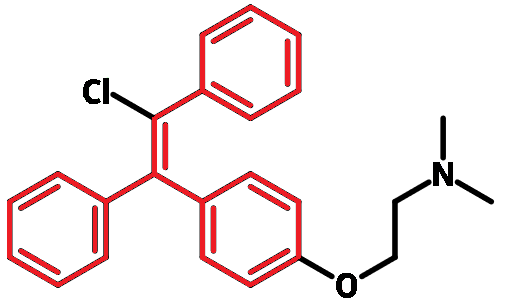
For most of the twentieth century, the textbook fix for a man running low on testosterone was beautifully blunt: give him testosterone. Pour the hormone in from outside, and the blood level climbs. But the body keeps its own books. The brain, sensing a flood of hormone it never ordered, quietly shuts down the factory — the testes go idle, sperm production falters, and what began as a top-up becomes a takeover. Enclomiphene starts from the opposite premise. Instead of shipping in the finished product, it leans on the management. It is a molecule that argues with the brain’s thermostat until the body decides, on its own terms, to make more.
What is enclomiphene, and how is it different from clomiphene?
Clomiphene is one of pharmacology’s classic two-faced molecules: not a single compound but a mixture of two geometric isomers with opposing personalities.9 One half, the cis-isomer zuclomiphene, behaves like an estrogen and lingers in the body for weeks; the other half, the trans-isomer, acts as an estrogen antagonist. Enclomiphene is that cleaner trans-isomer, isolated as a single, well-defined chemical entity.5 Researchers characterising the two forms have shown that the trans and cis isomers differ in their fundamental physicochemical behaviour, not merely their biology — they are genuinely distinct materials that happen to share a skeleton.9
That separation matters. By stripping out the long-lived estrogenic component, enclomiphene was developed as a selective estrogen-receptor modulator (SERM) with a tighter, more predictable profile than the parent mixture — one reason it became an object of sustained interest as a research probe of the male endocrine axis.65
How does enclomiphene raise testosterone without shutting down the testes?
To understand the trick, picture the hypothalamic-pituitary-gonadal (HPG) axis as a heating system with a feedback loop. The testes produce testosterone, some of which is converted to estrogen; estrogen then travels back to the hypothalamus and pituitary and tells them to ease off, like a thermostat shutting the boiler once the room is warm.6 Enclomiphene blocks the estrogen receptors at that control point. The brain, no longer hearing the “warm enough” signal, assumes the body needs more — and ramps up GnRH, which lifts the pituitary’s output of luteinising hormone (LH) and follicle-stimulating hormone (FSH).53 LH drives the testes’ Leydig cells to make testosterone; FSH supports the machinery of sperm production.4
The crucial consequence is what does not happen. Because the testosterone rise is generated by the testes themselves rather than poured in from outside, the gonadal factory stays switched on. In research models of testosterone deficiency, this is precisely the property that distinguishes stimulatory SERM approaches from replacement: spermatogenesis is preserved rather than suppressed.2 That single difference — fertility kept rather than sacrificed — is the entire reason enclomiphene occupies its own niche.
A 2023 systematic review and meta-analysis of SERM use in obese men with androgen deficiency pooled seven controlled studies and found that estrogen-receptor modulation significantly raised total testosterone while preserving, rather than suppressing, gonadotropin output — the signature pattern that sets this approach apart from exogenous hormone.3
How does enclomiphene compare with testosterone replacement (TRT)?
The contrast is best drawn directly. Both raise circulating testosterone; almost everything else about how they do it diverges.
| Property | Enclomiphene (SERM) | Exogenous testosterone (TRT) |
|---|---|---|
| Mechanism | Blocks estrogen feedback in the brain, raising LH/FSH5 | Supplies the hormone directly from outside the body |
| Body’s own production | Stimulated — testes remain active2 | Suppressed via negative feedback |
| Effect on fertility / sperm | Spermatogenesis preserved in study models2 | Often impaired; can reduce sperm counts |
| Class / form | Oral SERM, single trans-isomer9 | Injectable, gel, or pellet hormone |
| Approval status (EU/US) | Not approved for this use; investigational7 | Approved testosterone therapies exist |
Enclomiphene versus exogenous testosterone: same destination, opposite routes. The fertility column is the one researchers return to most.
What does the human evidence actually show?
Here enclomiphene breaks the usual pattern of a research-market compound. Many molecules in this category live almost entirely in cell cultures and mice; enclomiphene has been studied in randomised controlled trials in men. A 2025 systematic review and meta-analysis of randomised trials concluded that clomiphene and enclomiphene citrate meaningfully raise testosterone in male hypogonadism while maintaining gonadotropin signalling — a finding robust enough to generate published scientific correspondence and a formal author response, the ordinary machinery of a live, debated literature rather than a fringe claim.11011 A separate analysis of safety and efficacy in hypogonadal men reached broadly concordant conclusions about testosterone gains and tolerability in the studied populations.12
The weight of this work has been substantial enough that, in 2026, the British Society of Sexual Medicine issued a formal position statement on the potential use of enclomiphene in male hypogonadism — the kind of institutional engagement reserved for compounds with a serious evidence base.7 Within this research wave, that makes enclomiphene the strongest-evidence compound on the shelf.
Is enclomiphene an approved treatment? The honest picture
And yet — this is the part that matters — strong evidence is not the same as approval. Enclomiphene’s dedicated development programme, marketed under the name Androxal, did not gain regulatory approval, and there is no FDA- or EMA-licensed enclomiphene testosterone therapy.7 The randomised data are real; the medicine, in the regulatory sense, is not. That gap is precisely why a position statement frames enclomiphene’s role as potential and investigational rather than established practice.7
The evidence base also has visible edges worth naming plainly. Some of the supporting literature is retrospective — small case series and chart reviews rather than large trials — which carries more risk of bias than the headline RCTs.813 And SERM chemistry is not biologically inert background: exposure to clomiphene and enclomiphene has been associated with developmental effects such as cranial-suture fusion in zebrafish models, a reminder that estrogen-receptor modulation reaches well beyond the HPG axis and that “raises testosterone” is not the same as “does only that.”14 Honest reading of this compound means holding both facts at once: the human signal is genuine, and the regulatory and long-term-safety questions remain open.
Why does identity and purity matter for an enclomiphene research material?
Enclomiphene’s entire scientific identity rests on a geometric distinction — trans, not cis — that an untrained eye cannot see and a label cannot guarantee.9 A vial contaminated with the estrogenic zuclomiphene isomer would not merely be impure; it would behave like a different drug, pulling the estrogen lever it was designed to block. For a compound whose whole value is isomeric precision, the Certificate of Analysis is not paperwork — it is the experiment’s foundation.
Condor Research supplies enclomiphene strictly as a research-use-only reference compound: every batch is independently third-party tested by HPLC for identity and purity, and each lot ships with a lot-specific COA. It is not an approved medicine, not a supplement, and not for human or veterinary use, ingestion, or diagnostic application. The historical trial designs referenced above describe how investigators administered the compound in formal studies — they are not guidance, and nothing here should be read as such. If you work on the male endocrine axis, the questions enclomiphene raises are genuinely interesting; the answers belong on the bench, with a verified material whose identity you can prove and whose lot-specific Certificate of Analysis you can read line by line.
- Enclomiphene is the purified trans-isomer of clomiphene, separated from the estrogenic cis-isomer zuclomiphene, giving it a cleaner single-entity SERM profile.
- It works indirectly: by antagonising estrogen receptors in the brain it releases the negative-feedback brake, driving GnRH, LH and FSH upward and prompting the testes to make more of the body's own testosterone.
- Unlike exogenous testosterone (TRT), this mechanism preserves spermatogenesis rather than suppressing it, which is the central reason it is studied in younger hypogonadal men who want to retain fertility.
- It carries the strongest human evidence in this research wave: randomised trials and meta-analyses report meaningful testosterone increases, yet its dedicated Androxal programme never reached FDA/EMA approval.
- Condor supplies enclomiphene strictly as a research-use-only reference compound with a lot-specific Certificate of Analysis, never as a medicine or for human or veterinary use.
What is the difference between enclomiphene and clomiphene?
Clomiphene is a mixture of two geometric isomers with opposing activity: the cis-isomer (zuclomiphene) acts like an estrogen and persists for weeks, while the trans-isomer is an estrogen antagonist. Enclomiphene is that purified trans-isomer isolated as a single, well-defined chemical entity, giving it a cleaner and more predictable SERM profile. Both are supplied only as research-use-only reference compounds.
How does enclomiphene raise testosterone without lowering sperm count?
In research models it blocks estrogen receptors at the hypothalamus and pituitary, removing the brain's negative-feedback brake. This lifts GnRH, LH and FSH, prompting the testes to produce more of their own testosterone. Because the rise is generated by the testes rather than supplied from outside, spermatogenesis is preserved rather than suppressed, unlike exogenous testosterone. This is studied experimentally, not as a human therapy.
Is enclomiphene an FDA- or EMA-approved testosterone treatment?
No. Despite genuine randomised-trial and meta-analysis data in male hypogonadism, enclomiphene's dedicated development programme (Androxal) did not gain regulatory approval, and there is no FDA- or EMA-licensed enclomiphene testosterone therapy. A 2026 British Society of Sexual Medicine position statement frames its role as potential and investigational. Condor supplies it strictly research-use-only, never as a medicine.
How does enclomiphene compare to TRT?
Both raise circulating testosterone, but by opposite routes. TRT supplies the hormone directly and suppresses the body's own production, often impairing sperm output. Enclomiphene stimulates endogenous production by blocking estrogen feedback, keeping the testes active and preserving spermatogenesis in study models. TRT has approved formulations; enclomiphene for this use remains investigational and research-use-only.
Why does isomeric purity matter for an enclomiphene research material?
Enclomiphene's identity depends on being the trans-isomer, not the estrogenic cis-isomer zuclomiphene. Contamination with the cis form would make the material behave like a different drug, opposing the very receptor activity it is meant to block. A lot-specific Certificate of Analysis with HPLC verification confirms identity and purity, which is essential for any valid research use.