
What Is Cortagen? The Bioregulator With a Severed-Nerve Story
Cortagen is a four-amino-acid “cytogen” from Vladimir Khavinson's bioregulator programme, studied chiefly for one striking preclinical claim: that it helps injured peripheral nerves recover. We trace the science, and where its evidence runs thin.
Cortagen (AED/AEDP) is a synthetic short-peptide bioregulator from the Khavinson school, investigated in animal and cell models for peripheral-nerve regeneration and tissue-specific gene-expression effects. It is not an approved medicine anywhere, and its evidence base is narrow and largely unreplicated. Condor supplies it strictly as a research-use-only reference material with a Certificate of Analysis.
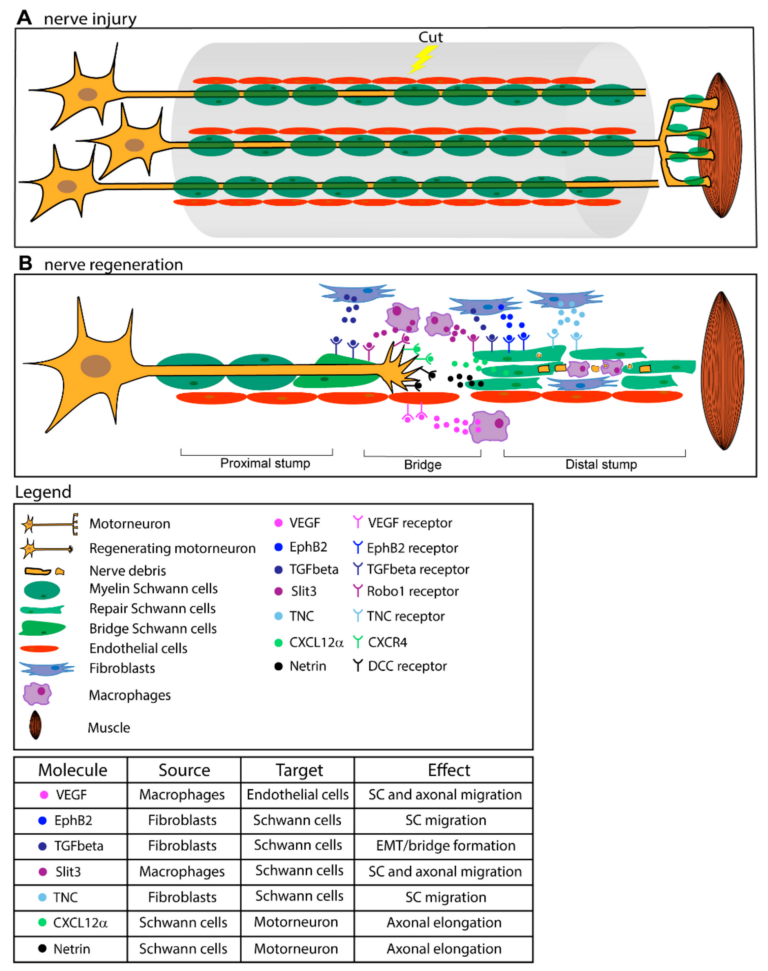
When a peripheral nerve is crushed or severed, biology faces one of its hardest engineering problems: a living cable, sometimes a metre long, must rebuild itself from the cut end outward, at roughly a millimetre a day, threading axons back to muscle and skin that may have waited months. Most attempts fail or finish badly. So when a four-amino-acid peptide called Cortagen appeared in Russian laboratories at the turn of the millennium with the claim that it could nudge an injured rat sciatic nerve toward recovery, it earned a second look — because of all the compounds in the Khavinson bioregulator catalogue, this is the one with the most concrete preclinical story to tell.15
What is Cortagen, and where did it come from?
Cortagen is a synthetic tetrapeptide — the amino-acid sequence Ala-Glu-Asp-Pro, often written AED or AEDP — belonging to the class its originators call cytogens: very short peptides designed to act, the theory goes, in a tissue-specific way.14 It is the “cortical” member of a family developed under Vladimir Khavinson at the St Petersburg Institute of Gerontology, the same programme that produced Epitalon, Pinealon and the rest of the bioregulator catalogue. Where Epitalon was framed around the pineal gland and ageing, Cortagen was anchored from the start to the nervous system and connective tissue — the brain cortex on one hand, the peripheral nerve on the other.812
The underlying idea is deliberately minimalist. A full protein hormone is a large, folded machine; a cytogen is a fragment of four residues. Khavinson’s wager was that such fragments could still carry biological instructions — that a peptide too small to be an enzyme or a classic receptor ligand might instead behave like a regulatory signal, reaching into the cell and altering which genes are read.14 It is an elegant hypothesis. Whether it is true in the way proposed is a separate question, and we will come to it.
What does the research say Cortagen does to injured nerves?
The headline work is small, old and specific. In a rat model of sciatic-nerve injury, Turchaninova and colleagues reported in 2000 that the tetrapeptide accelerated regeneration of the damaged nerve.15 Two years later, Kolosova and co-workers extended the finding, describing a delayed effect on the restoration of injured-nerve function — an improvement that emerged not immediately but over a longer recovery window, as if the peptide shifted the trajectory of repair rather than flipping a switch.12 Separately, in a model of chronic cerebral ischaemia, Cortagen (alongside the related preparation Cortexin) was studied for correcting functional and metabolic disturbances in the brain.3
The year Kolosova and colleagues published the delayed restoration of injured sciatic-nerve function in rats treated with Cortagen — the compound’s signature preclinical result, and a finding that, more than two decades on, still awaits independent Western replication.12
That single sentence captures both the appeal and the problem. The nerve-repair claim is the most tangible thing any bioregulator can point to, far more concrete than vague “anti-ageing” language. It is also a couple of papers, from one tradition, in one species.
How is Cortagen thought to work at the molecular level?
Beyond the nerve, researchers in the same school tried to map what a four-residue peptide actually touches inside a cell — and the answer they proposed is striking: gene expression. In a 2004 study, Anisimov and colleagues used a microarray to profile the effect of Cortagen on gene activity in the mouse heart, reporting changes across a panel of transcripts.8 The choice of organ is itself telling: if a “cortical” peptide reshapes cardiac gene expression, the “tissue-specific” thesis is doing a lot of work.
Other lines converge on the immune and chromatin machinery. Short peptides including Cortagen were reported to alter lymphocyte chromatin in elderly subjects9 and, in the “old” or “aged” heterochromatin of cultured cells, to produce epigenetic modifications.12 At the level of signalling, the peptides were studied for effects on interleukin-2 (IL-2) mRNA — both in rat hypothalamic structures7 and in cultured splenocytes11 — and for transmission along the sphingomyelin pathway during thymocyte activation.10 Further work probed free-radical processes5, macrophage production of lymphocyte-activating factors with age6, and immunity and haemostasis in birds.4 Stitched together, the picture the authors paint is of a peptide whose effects are read out as tissue-specific regulation of which genes a cell switches on.1314
How does Cortagen compare to the other cytogens?
Cortagen is easiest to understand as one entry in a family, each assigned to a tissue. The grouping below reflects how the Khavinson programme itself frames these compounds; it is a map of research focus, not of proven function.
| Cytogen | Sequence | Research focus |
|---|---|---|
| Cortagen (AED) | Ala-Glu-Asp-Pro | Cortex & peripheral nerve; nerve regeneration1215 |
| Pinealon (EDR) | Glu-Asp-Arg | Brain / neuroprotection, gene expression |
| Vesugen (KED) | Lys-Glu-Asp | Vascular wall / endothelium |
| Cortexin (related) | Polypeptide complex | Cerebral ischaemia models3 |
The cytogen line, as framed by its originators. Sequences and tissue assignments come from the Khavinson programme; research focus is not the same as validated clinical effect.
How strong is the evidence, really?
Here is where intellectual honesty matters more than enthusiasm. Read the citations in this essay back to back and a pattern is impossible to miss: the names Khavinson, Malinin, Anisimov, Kolosova, Turchaninova recur, study after study.8121415 Almost the entire Cortagen literature originates from a single research school and the surrounding Russian and Eastern-European journals, much of it published two decades ago, with little to no independent replication in Western laboratories. That is a textbook setup for single-group publication bias: when one team designs the hypothesis, runs the experiments, and reports the results, the work can be internally consistent and externally unconfirmed at the same time.
The mechanism compounds the caution. A “cortical bioregulator” is not a category mainstream neuroscience recognises, and the proposed route — a four-residue peptide entering cells and steering gene expression in a tissue-addressed manner — is intriguing but not independently established. It is worth contrasting Cortagen with Semax, another peptide from the Russian neuroscience tradition: Semax has accumulated comparatively more independent study and a clearer mechanistic account, which is precisely what Cortagen still lacks. None of this proves the nerve-repair finding wrong. It means that, on present evidence, it remains an interesting preclinical signal rather than an established fact — and Cortagen is not an approved medicine in the European Union, the United States, or anywhere else.
Why does this make Cortagen a research material, not a remedy?
For a working scientist, that uncertainty is not a deterrent — it is the job. Unreplicated single-group findings are exactly the territory where careful independent work has the most to add, and a compound studied for nerve regeneration and tissue-specific gene regulation is a legitimate object of inquiry. But the entire value of such an inquiry depends on knowing precisely what is in the vial. A “delayed effect on nerve function” is meaningless if the tetrapeptide is impure, misfolded, or simply not the sequence on the label.
That is the line Condor holds. We supply Cortagen strictly as a research-use-only reference material, not for human or veterinary use, with no dosing guidance of any kind — and with a Certificate of Analysis documenting identity and HPLC purity, so the one variable a researcher can control is controlled. The science of Cortagen is genuinely unsettled. The contents of the vial should not be.
- Cortagen is a cortical/peripheral-nerve tetrapeptide (AED-family) from Vladimir Khavinson's Russian bioregulator programme, supplied research-use-only.
- Its most concrete preclinical claim is nerve repair: rat studies report accelerated sciatic-nerve regeneration and a delayed restoration of injured-nerve function.
- Mechanistic work links it to tissue-specific gene-expression changes — a mouse-heart microarray, lymphocyte chromatin effects, IL-2 mRNA and sphingomyelin signalling.
- Almost all of the evidence comes from a single research school and the Russian/Eastern-European literature, with little independent Western replication.
- It is not an approved drug; identity and purity are verifiable only through HPLC analysis and a Certificate of Analysis.
What is Cortagen?
Cortagen is a synthetic short-peptide bioregulator (the tetrapeptide Ala-Glu-Asp-Pro, AED/AEDP) from the “cytogen” class developed in Vladimir Khavinson's Russian gerontology programme. It is associated in the research literature with the brain cortex and peripheral nerve, and is supplied strictly as a research-use-only reference material, not an approved medicine.
What has Cortagen been studied for?
Its most concrete preclinical claim is nerve repair: rat studies report accelerated sciatic-nerve regeneration and a delayed restoration of injured-nerve function. Other work in animal and cell models examined tissue-specific gene-expression effects, including a mouse-heart microarray, lymphocyte chromatin changes, IL-2 mRNA and sphingomyelin-pathway signalling. These are model-oriented findings, not validated human outcomes.
Is Cortagen an approved drug or treatment?
No. Cortagen is not approved as a medicine in the European Union, the United States, or elsewhere. It has no recognised therapeutic indication for humans. Condor supplies it only as a laboratory reference compound for in-vitro and preclinical research use.
How reliable is the evidence for Cortagen?
It should be read with caution. Almost the entire Cortagen literature comes from a single research school and the Russian/Eastern-European journals, much of it two decades old, with little independent Western replication. The proposed mechanism — a tiny peptide regulating gene expression in a tissue-specific way — is intriguing but not independently established, and the field carries a strong single-group publication bias.
How can a researcher verify what they are buying?
Because the science is unsettled, knowing exactly what is in the vial is essential. Reputable reference-grade material ships with a Certificate of Analysis (COA) documenting identity and HPLC purity. Condor provides a COA with Cortagen so that compound identity and purity are confirmed independently of any claimed biological activity.