
Flmodafinil and Fladrafinil on the 2026 WADA Prohibited List
WADA named flmodafinil and fladrafinil under class S6 in 2026. Why it adds examples rather than a new ban, and what it means for confirmatory analysis.
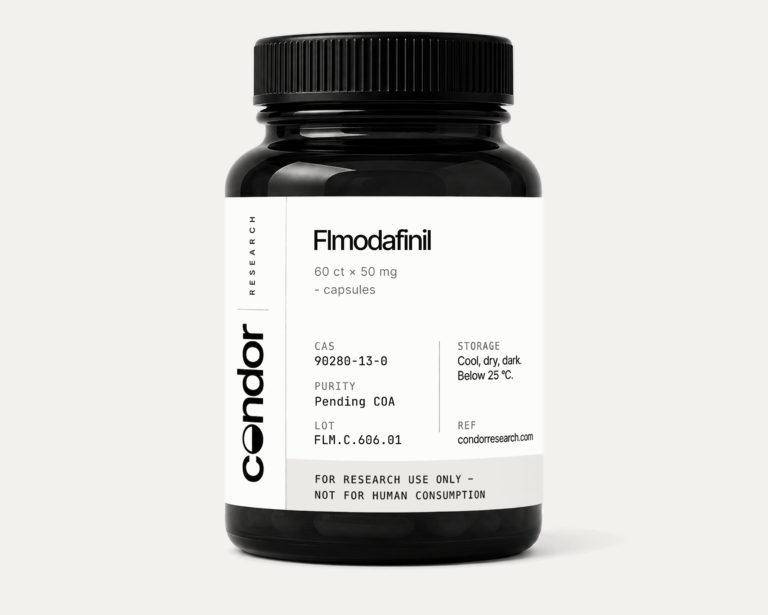
On 1 January 2026 the World Anti-Doping Agency’s Prohibited List came into force naming flmodafinil and fladrafinil for the first time. Most coverage has reported this as two substances being banned. That is not what happened, and the distinction matters for any laboratory planning confirmatory work. This note is written for research and analytical audiences only; it describes regulatory and analytical developments, not human use. Compounds referenced are supplied for research use only (RUO).
What exactly changed on the 2026 List?
Class S6 (stimulants) of the Prohibited List operates by definition rather than by enumeration: it prohibits stimulants as a class and then gives examples. Flmodafinil and fladrafinil were added to that list of examples, spelled out by their systematic names — 2-[bis(4-fluorophenyl)methylsulfinyl]acetamide and 2-[bis(4-fluorophenyl)methylsulfinyl]-N-hydroxyacetamide respectively.
Because S6 already covered them as stimulants, their prohibited status did not begin in 2026. What began in 2026 is their status as named targets. In practice that is the change with operational consequences: a named substance becomes a routine screening and confirmation target, which creates demand for reference material, validated methods and elimination data that a category-level prohibition does not.
1 Jan 2026 the date the current List took effect, naming both fluorinated analogues explicitly for the first time.
Why did the analytical literature appear at the same moment?
It is not a coincidence that the only primary study on flmodafinil was published the same year it was named. Krug and colleagues at the Center for Preventive Doping Research of the German Sport University Cologne — an institution that exists to anticipate exactly this kind of listing — published elimination profiles for flmodafinil, fladrafinil and their metabolites in urine and dried blood spots, analysed by LC-HRMS with limits of detection between 0.2 and 4 ng/mL (Krug et al., 2026).
Their findings give confirmation laboratories the parameters they need. After administration of flmodafinil, the metabolites flmodafinil acid and flmodafinil sulfone were detected; because fladrafinil acts as a prodrug for flmodafinil, the same metabolites appear after fladrafinil. Urinary maxima ranged from 191 to 891 ng/mL for flmodafinil and 52 to 111 ng/mL for fladrafinil; blood maxima from 45 to 98 ng/mL and 11 to 35 ng/mL respectively. The authors note relatively long detection windows for both parent compounds and their metabolites, and caution that this requires careful interpretation in the event of an adverse analytical finding.
What does this mean for identifying the substance correctly?
The prodrug relationship creates a specific interpretive problem that the listing does not resolve. Since fladrafinil converts to flmodafinil, the metabolite profile after either compound is the same. Distinguishing which was administered rests on the parent compound and on timing — Krug and colleagues observed an offset before flmodafinil reached its maximum when fladrafinil was the substance administered.
This is also why catalogue identity matters more here than in most compound families. CRL-40,940 and CRL-40,941 differ by one oxygen atom and one adjacent digit in their development codes, and are interchanged routinely across supplier listings. A reference standard labelled with the wrong code produces a method validated against the wrong analyte.
Naming a substance on the List does not make it newly prohibited. It makes it newly routine — and routine is what generates the demand for reference material.
How does this compare with the older compounds in the series?
| Compound | WADA position | Regulatory status as a medicine |
|---|---|---|
| Modafinil | S6 stimulant, prohibited since 2004 | Authorised; prescription-only in the EU, Schedule IV in the United States |
| Adrafinil | S6 stimulant, prohibited since 2004 | Formerly authorised as Olmifon; withdrawn September 2011 |
| Flmodafinil (CRL-40,940) | S6 stimulant, named on the 2026 List | Never authorised in any jurisdiction |
| Fladrafinil (CRL-40,941) | S6 stimulant, named on the 2026 List | Never authorised in any jurisdiction |
Anti-doping and medicines-regulation status across the eugeroic series. Prohibition dates for modafinil and adrafinil as reported by Ameline et al. (2020).
The pattern is worth reading carefully. The two compounds with the longest anti-doping history are also the two that passed through medicines regulation. The two added to the List in 2026 never did, which is precisely why they circulated for years in a space where neither a medicines regulator nor an anti-doping list had named them.
Three compounds, one oxygen apart: identity at a glance
The structural logic of the series is more regular than most catalogues suggest. Adrafinil and fladrafinil are the two N-hydroxy compounds; modafinil and flmodafinil are the corresponding acetamides. Adrafinil sits upstream of modafinil in the same way fladrafinil sits upstream of flmodafinil, so flmodafinil is not a prodrug of modafinil and does not convert to it32. The sulfinyl-acetamide core is shared; fluorination of both phenyl rings is what separates flmodafinil from modafinil.
| Compound | Code | CAS | Formula | MW (g/mol) |
|---|---|---|---|---|
| Adrafinil | CRL-40,028 | 63547-13-7 | C15H15NO3S | 289.45 |
| Flmodafinil | CRL-40,940 | 90280-13-0 | C15H13F2NO2S | 309.36 |
| Fladrafinil | CRL-40,941 | 90212-80-9 | C15H13F2NO3S | 325.37 |
Identity data as recorded in PubChem, checked 7 October 2026. Flmodafinil also appears as bisfluoromodafinil and lauflumide; fladrafinil as fluorafinil.
A 16 g/mol difference is the whole of the gap between the two fluorinated compounds, which is why accurate mass separates them cleanly while the metabolite profile does not. Method choice matters as much as the label: the family degrades thermally in the gas-chromatography injector, so a GC route can misrepresent what is in the vial8 (see why GC misleads for this compound family).
How much published evidence sits behind each compound?
The series is not one body of knowledge. A PubMed name search run on 7 October 2026 returns 43 records for adrafinil, one for flmodafinil, one for fladrafinil and 2,419 for modafinil9. The single flmodafinil/fladrafinil record is the analytical study that characterised their elimination2: it tells a laboratory how to detect the compounds, not what they do.
The adrafinil literature is small by pharmaceutical standards but spans four decades. It includes comparative pharmacology from the programme that produced the series10 and forensic work in which adrafinil and its metabolite modafinil were characterised in human hair3. Because adrafinil converts to modafinil, the large modafinil literature is partly informative about it; no equivalent bridge exists for flmodafinil, because fluorination changes the molecule and the work needed to say how has not been published.
The difference is one of kind, not of degree. Adrafinil is a compound that was studied and then withdrawn from the market; flmodafinil is a compound that was never studied in that way. Only the first kind of uncertainty can be reduced by reading.
What a vendor survey showed (21–22 September 2026)
On 21–22 September 2026 Condor Research surveyed 25 vendor sites for the -afinil family, querying the WooCommerce Store API where it was exposed and reading product pages where it was not. Five returned listings. The table is a snapshot of listed offers, not of sales, and covers only vendors reachable by that method; vendor names are withheld.
| Format | Compound | Quantity | Listed price (USD) | USD per gram |
|---|---|---|---|---|
| Powder | Flmodafinil | 10 g | 69.95 | 7.00 |
| Powder | Flmodafinil | 2 g | 19.95 | 9.98 |
| Powder | Flmodafinil | 10 g | 107.38 | 10.74 |
| Powder | Flmodafinil | 2 g | 31.78 | 15.89 |
| Capsules | Flmodafinil | 60 × 50 mg (3 g) | 74.99 | 25.00 |
| Capsules | Fladrafinil | 60 × 50 mg (3 g) | 59.99 | 20.00 |
| Capsules | Adrafinil | 60 × 50 mg (3 g) | 64.99 | 21.66 |
| Capsules | Flmodafinil | 20 × 50 mg (1 g) | 70.66 | 70.66 |
Listed offers for the -afinil family across five vendors, 21–22 September 2026. Prices as displayed, excluding shipping and duties.
Two observations follow. Powder listings of the same compound differ about two-fold in price per gram, and about ten-fold once the smallest capsule listing is included; that is not a market with a settled reference price. And one vendor lists flmodafinil, fladrafinil and adrafinil in an identical 60 × 50 mg format; a unit quantity that does not vary across three different compounds looks like a property of the filling line, which is an inference from the listings and not a documented fact. Either way, a listed quantity says nothing about identity, and identity is what the analytical literature above exists to check.
What should a laboratory take from this?
Three things follow directly. First, confirmatory methods for S6 now need to resolve four structurally related analytes rather than two, and the two new ones share a metabolite set. Second, method choice is not free: the compound family degrades thermally in the GC injector, which is a documented argument for liquid-chromatography approaches. Third, reference material needs to be identity-confirmed against analytical data rather than against a supplier’s product name.
Condor Research supplies flmodafinil strictly as a research reference compound. It is not a drug, food, supplement or article for human or veterinary use, and nothing in this note constitutes guidance on administration to any living subject.
References
- Krug O, Guddat S, Görgens C, Walpurgis K, Toma F, Thomas A, Thevis M. Investigations into the metabolism and elimination of flmodafinil and fladrafinil for sports drug testing purposes. Drug Testing and Analysis. 2026;18(8):1076–1087. PMID 42210629. doi:10.1002/dta.70100
- Ameline A, Gheddar L, Raul JS, Kintz P. Identification of adrafinil and its main metabolite modafinil in human hair. Self-administration study and interpretation of an authentic case. Forensic Sciences Research. 2020;5(4):322–326. PMID 33457050. doi:10.1080/20961790.2019.1704482
- UK Anti-Doping. The 2026 Prohibited List: Summary of Changes. ukad.org.uk (accessed 22 September 2026)
- Bakota EL, Nandrea JM. Development and validation of an analytical method to identify and quantitate novel modafinil analogs in products marketed as dietary supplements. Journal of Dietary Supplements. 2025;22(2):329–344. PMID 39466147. doi:10.1080/19390211.2024.2417673
- National Center for Biotechnology Information. PubChem Compound Summary, CID 13271852, Flmodafinil. pubchem.ncbi.nlm.nih.gov (accessed 22 September 2026)
- National Center for Biotechnology Information. PubChem Compound Summary, CID 13316557, Fladrafinil. pubchem.ncbi.nlm.nih.gov (accessed 22 September 2026)
Were flmodafinil and fladrafinil banned for the first time in 2026?
Not exactly. Class S6 prohibits stimulants as a class and then lists examples, so both compounds were already covered. What changed on 1 January 2026 is that they are now named explicitly, which turns them into routine screening and confirmation targets.
Why does naming a substance matter if it was already prohibited?
Because it changes laboratory practice rather than legal status. A named substance becomes a routine confirmation target, which creates a documented requirement for reference material, validated methods and elimination data that a category-level prohibition alone does not generate.
What analytical data exist for confirmation work?
Krug and colleagues characterised elimination profiles for both compounds and their metabolites in urine and dried blood spots by LC-HRMS, with limits of detection between 0.2 and 4 ng/mL, identifying flmodafinil acid and flmodafinil sulfone as the principal metabolites.
Can the two compounds be distinguished after administration?
Not by metabolites alone. Because fladrafinil converts to flmodafinil, both produce the same metabolite set. Discrimination rests on the parent compound and on timing; an offset was observed before flmodafinil reached its maximum when fladrafinil was administered.
How does this affect reference material?
Identity confirmation becomes critical. CRL-40,940 and CRL-40,941 differ by one oxygen atom and one digit in their development codes and are frequently interchanged in supplier listings, so reference standards should be confirmed against analytical data rather than a product name.