
CJC-1295 DAC vs CJC-1295 (no DAC / Modified GRF 1-29): What the “DAC” Actually Changes
CJC-1295 DAC and CJC-1295 no-DAC (Modified GRF 1-29) share one peptide backbone but differ in half-life. A research-use-only comparison of structure, pharmacokinetics and the published evidence, with verified references.
CJC-1295 DAC and CJC-1295 (no DAC, or Modified GRF(1-29)) are one GHRH-analogue backbone with and without a Drug Affinity Complex. The DAC covalently binds serum albumin, extending the reported half-life from minutes to roughly a week; the receptor target is unchanged. Human data are limited, and both are research reference materials only.
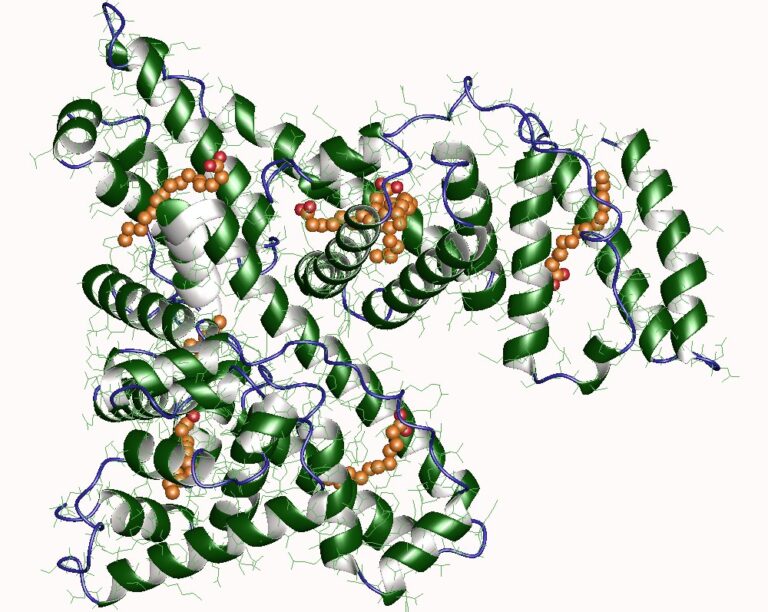
CJC-1295 DAC and CJC-1295 (no DAC) are not two different molecules so much as one peptide with and without a chemical anchor. Both are built on the same Modified GRF(1-29) backbone — a stabilised fragment of growth-hormone-releasing hormone (GHRH). The “DAC” is a Drug Affinity Complex that binds the peptide covalently to circulating serum albumin, stretching its residence in research models from minutes to days. That single addition is the entire difference: same receptor target, vastly different duration. Everything below treats both compounds strictly within a research-use-only (RUO) framework — chemistry, receptor mechanism and the published preclinical and early-human literature. Nothing here describes human use, dosing or therapeutic outcomes.
What is the core difference between CJC-1295 DAC and no-DAC?
The distinction lives in four letters, and it is purely one of duration, not of receptor target. Both products are analogues of the bioactive N-terminal fragment of GHRH — the 29-residue scaffold known as Modified GRF(1-29), carrying substitutions (notably D-Ala at position 2) that resist enzymatic cleavage.7 Native GHRH is metabolically fragile: in human plasma it is degraded within minutes, primarily by dipeptidyl peptidase-IV (DPP-IV) and trypsin-like enzymes acting at the N-terminus.6 The D-Ala² substitution blunts that first cut, but the bare peptide still clears quickly, with an activity window measured in minutes to a few hours.
CJC-1295 (no DAC) is that bare, shorter-acting Modified GRF(1-29) peptide. CJC-1295 DAC adds a Drug Affinity Complex — a maleimidopropionyl group appended through a C-terminal lysine — that forms a covalent bond with a nucleophilic site on serum albumin. By hitching the peptide to the body’s most abundant circulating protein, the DAC shields it from clearance and renal filtration, extending the reported half-life dramatically.12
~3368 vs ~3647 g/mol separates the no-DAC peptide from the DAC variant — a difference of roughly 280 g/mol that is the mass of the albumin-binding linker itself. The receptor-binding head of the molecule is, in both cases, the same GRF(1-29) sequence.
How does the DAC change the pharmacokinetics?
This is where the two forms genuinely diverge, and it is the only place they meaningfully diverge. The foundational demonstration came from Jetté and colleagues, who showed that hGRF(1-29)-albumin bioconjugates activate the GRF receptor on the rat anterior pituitary and explicitly identified CJC-1295 as a long-lasting GRF analogue.1 The mechanism is elegant: instead of being PEGylated or otherwise bulked up — strategies long explored to slow GRF clearance8 — the peptide is engineered to grab albumin in vivo, turning a large carrier protein into its own slow-release depot.
The human pharmacokinetic profile of the DAC form was characterised by Teichman and colleagues in two randomised, placebo-controlled ascending-dose studies in healthy adults.2 A single subcutaneous injection produced dose-dependent increases in mean plasma growth hormone of roughly two- to ten-fold lasting six days or more, and in mean IGF-1 of about 1.5- to three-fold lasting nine to eleven days; the estimated half-life was 5.8 to 8.1 days.2 That week-long window is the defining feature of the DAC variant — and it is precisely what the no-DAC peptide, lacking the albumin anchor, does not have.
Same backbone, same receptor, one bond’s difference: the DAC does not change how hard CJC-1295 pulls on the GHRH receptor, only how long it lingers before it is cleared.
Why does the no-DAC form still exist if the DAC lasts longer?
Because in research, a shorter, sharper kinetic profile is sometimes the point — not a limitation. The no-DAC peptide produces a brief, GHRH-like pulse and then clears, which more closely approximates the body’s native, episodic GHRH signalling. The pituitary does not respond to growth-hormone secretagogues with a steady stream; it releases growth hormone in discrete bursts, and the pattern of exposure is itself a biological variable. A week-long albumin-tethered stimulus is a substantial departure from that native rhythm, which raises a legitimate physiological question that a short-acting analogue sidesteps.
Notably, even under continuous DAC stimulation, growth-hormone secretion has been reported to remain pulsatile in humans, because somatostatin tone still gates the pituitary.3 But for a study designed around discrete, controllable stimulation — or one pairing a GHRH-mimetic pulse with a ghrelin-mimetic such as CJC-1295 (no DAC) + Ipamorelin — the no-DAC form is the natural counterpart, because its kinetics sit on a comparable, short timescale.
How do the two forms compare at a glance?
| Attribute | CJC-1295 (no DAC) | CJC-1295 DAC |
|---|---|---|
| Also known as | Modified GRF(1-29) | CJC-1295 with DAC; long-acting GRF analogue |
| Backbone / receptor target | Modified GRF(1-29), D-Ala² · GHRH receptor | Modified GRF(1-29), D-Ala² · GHRH receptor |
| DAC (albumin anchor) | No | Yes — maleimidopropionyl group, covalent albumin binding |
| CAS · molecular formula | 863288-34-0 · C₁₅₂H₂₅₂N₄₄O₄₂ | 446262-90-4 · C₁₆₅H₂₆₉N₄₇O₄₆ |
| Molecular weight | 3367.9 g/mol | 3647.2 g/mol |
| Reported half-life (research models) | Short — minutes to a few hours | Extended — estimated ~5.8–8.1 days in healthy adults2 |
| Typical role in research protocols | Short, pulse-like GHRH stimulus; pairs with short-acting secretagogues | Sustained, multi-day GHRH stimulus from a single administration |
| Format | 10 mg/vial, white lyophilized powder, water-soluble | 10 mg/vial, white lyophilized powder, water-soluble |
| Characterisation / COA | ≥99% purity by HPLC; third-party tested; COA available | ≥99% purity by HPLC; third-party tested; COA available |
| Product page | CJC-1295 (no DAC) | CJC-1295 DAC |
Side-by-side reference specifications for CJC-1295 (no DAC) and CJC-1295 DAC, as supplied for research use only. Half-life figures are drawn from the published literature and describe experimental observations, not human-use guidance.
What does the evidence actually support — preclinical or clinical?
Honesty about the evidence base is where most comparisons quietly fail, so it is worth being blunt: the entire CJC-1295 story rests on a remarkably thin foundation, and the DAC and no-DAC forms do not share it equally. The albumin-conjugate concept and receptor activation were established in animal work (rat pituitary).1 A knockout-mouse study reported that once-daily DAC administration normalised growth, demonstrating the practical consequence of the extended half-life.4 The human data are confined to a small number of early-phase reports in healthy volunteers describing GH/IGF-1 responses, pharmacokinetics and preserved pulsatility,23 alongside one analysis of serum protein-profile changes.5
What that body of work establishes is narrow but real: in healthy adults, the DAC variant raised and sustained surrogate biomarkers (GH and IGF-1) over a multi-day window, and the kinetics behaved as the albumin-binding design predicted. What it does not establish is anything beyond that — no long-term safety profile, no outcome in any disease population, no replication, and no published head-to-head pharmacology of the no-DAC form against the DAC form in humans. CJC-1295 reached early clinical development and that programme was discontinued; it holds no marketing authorisation as a medicine anywhere. These studies describe biological activity in experimental settings; they do not establish efficacy or safety for any human or veterinary application.
One regulatory fact is unambiguous and worth stating precisely because it is so often elided: as GHRH analogues, both CJC-1295 forms fall under category S2 of the World Anti-Doping Agency framework and are prohibited in sport, with dedicated mass-spectrometric detection methods developed for GHRH-class peptides.10 Any work involving samples from competitive athletes inherits that status directly.
Which form fits which research question?
There is no general “better” — the choice follows the experimental design, not any consumer outcome. A study needing a brief, controllable GHRH-receptor pulse, a closer approximation of native episodic signalling, or co-stimulation with a short-acting ghrelin mimetic points toward the no-DAC peptide. A study probing sustained GHRH-receptor drive, multi-day IGF-1 dynamics, or the pharmacology of albumin-tethered half-life extension points toward the DAC form. For the deeper mechanism and the single-study problem behind CJC-1295’s reputation, see the CJC-1295 research guide; for how CJC-1295 differs from a ghrelin-receptor secretagogue, see Ipamorelin vs CJC-1295. In every case the work is restricted to qualified professionals in an appropriately equipped laboratory and is for research use only.
Both products are supplied strictly for laboratory research use only (RUO). They are characterised at ≥99% purity by HPLC, third-party tested by an independent laboratory, and ship with a Certificate of Analysis (COA). They are not drugs, foods, cosmetics, or dietary supplements, and are not for human or veterinary use, ingestion, or diagnostic application.
- CJC-1295 DAC and no-DAC share the same Modified GRF(1-29) backbone (a stabilised GHRH fragment with D-Ala² that resists DPP-IV); the receptor target is identical.
- The only meaningful difference is the DAC — a maleimidopropionyl-lysine that covalently binds serum albumin — extending the reported half-life from minutes to roughly 5.8–8.1 days.
- The two differ in mass by about 280 g/mol (~3368 g/mol no-DAC vs ~3647 g/mol DAC): the albumin-binding linker, not the receptor-binding head.
- Human evidence is thin and rests largely on a single 2006 ascending-dose pharmacokinetic study of the DAC form; the no-DAC peptide is studied mainly preclinically.
- The no-DAC form gives a short, GHRH-like pulse closer to native episodic signalling; neither is an approved drug, and both are research reference materials only.
Is CJC-1295 DAC a different molecule from CJC-1295 no-DAC?
They share the same Modified GRF(1-29) peptide backbone and the same GHRH-receptor target. The DAC form adds a Drug Affinity Complex — a maleimidopropionyl group that binds covalently to serum albumin — which extends its circulating residence. The no-DAC form lacks that anchor and is shorter-acting. The difference is duration, not receptor identity.
Is "CJC-1295 no DAC" the same thing as Modified GRF(1-29)?
Yes. In research-market usage, "CJC-1295 no DAC" and "Modified GRF(1-29)" refer to the same stabilised GHRH(1-29) analogue carrying the D-Ala² substitution, without any albumin-binding complex.
How much longer does the DAC version last?
The DAC variant's reported half-life in healthy adults is approximately 5.8 to 8.1 days, versus minutes-to-hours for the no-DAC peptide. These figures describe experimental pharmacokinetics in published studies and are not human-use guidance.
Why does native GHRH need stabilising in the first place?
Native growth-hormone-releasing hormone is cleaved in human plasma within minutes, principally by dipeptidyl peptidase-IV and trypsin-like enzymes acting at its N-terminus. The D-Ala² substitution in Modified GRF(1-29) resists that first cleavage, and the DAC anchor further extends residence by binding albumin.
Is there human clinical evidence for either form?
The evidence base is predominantly preclinical, with a small number of early-phase human reports for the DAC form describing GH/IGF-1 responses and pharmacokinetics. There is no published human head-to-head of the two forms, no long-term safety data, and neither form is an approved drug. The studies do not establish human safety or efficacy.
Are both forms prohibited in sport?
Yes. As GHRH analogues, both CJC-1295 forms fall under the World Anti-Doping Agency framework and are prohibited in sport, with dedicated detection methods developed for GHRH-class peptides. This is stated purely as a regulatory fact for context; it is not guidance, and both compounds are supplied strictly for laboratory research use only.
How are these compounds characterised for quality?
Both CJC-1295 (no DAC) and CJC-1295 DAC are supplied as white lyophilized powder at ≥99% purity by HPLC, in 10 mg vials, water-soluble, third-party tested, with a Certificate of Analysis (COA) available. Because two compounds with very different pharmacokinetics circulate under one name, identity and purity documentation — HPLC purity plus mass-spectrometric confirmation of identity — is a precondition for interpretable results, not a formality.