
CJC-1295: A Long Half-Life Built on a Single Study
The DAC modification is an elegant piece of chemistry that stretches a peptide's half-life from minutes to a week. The human evidence behind it is one combined PK/PD trial from 2006. That asymmetry is the whole story.
CJC-1295 is a Modified GRF(1-29) analogue in two forms: a short-acting DAC-free version that clears within minutes, and a DAC version that binds albumin and persists for roughly a week. Despite heavy grey-market popularity, its human evidence rests essentially on one 2006 combined pharmacokinetic and pharmacodynamic study; development was later halted after a trial death. It is WADA-prohibited.
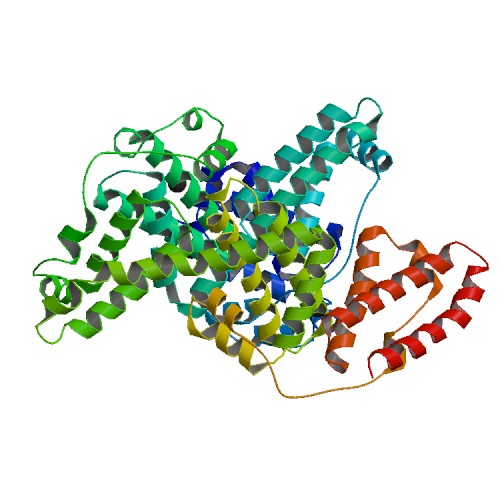
Strip away the marketing and CJC-1295 reduces to a single, uncomfortable ratio: an extended-release peptide engineered to circulate for roughly a week, supported in humans by essentially one published study from 2006.9 Few compounds in the grey-market peptide world enjoy a wider reputation on a thinner evidentiary base. The chemistry is genuinely clever. The human data are genuinely sparse. Holding both facts at once is the only honest way to read it.
What exactly is CJC-1295, and why does the “DAC” matter?
CJC-1295 is a synthetic analogue of growth hormone-releasing hormone (GHRH), built on the truncated, stabilised GHRH(1-29) backbone known as Modified GRF(1-29).116 Native GHRH is metabolically fragile, cleaved in plasma within minutes by the enzyme dipeptidyl peptidase-4 and other proteases.12 The Modified GRF(1-29) scaffold introduces amino-acid substitutions that resist that degradation, but on its own it still clears quickly, with an activity window measured in the order of minutes rather than hours.1513
The entire distinction between the two products sold under this name lives in four letters. The DAC-free version — marketed as “CJC-1295 no-DAC” and chemically equivalent to Modified GRF(1-29) — has no half-life extension. The DAC version carries a Drug Affinity Complex: a maleimidopropionyl-lysine group appended at the C-terminus that bioconjugates to a nucleophilic site on circulating serum albumin.11 By hitching the peptide to albumin, the DAC shields it from clearance and stretches its half-life to an estimated six to eight days.119 Crucially, the DAC alters duration, not receptor potency — it changes how long the molecule lingers, not how hard it pulls on the GHRH receptor.11
| Form | Chemistry | Approx. circulating duration |
|---|---|---|
| Native GHRH | Endogenous 44-residue peptide | Minutes |
| Modified GRF(1-29) / no-DAC | Stabilised GHRH(1-29) backbone | Order of minutes |
| CJC-1295 with DAC | Backbone + albumin-binding complex | ~6-8 days |
The two products sold as “CJC-1295” differ by orders of magnitude in persistence — a difference engineered entirely by the DAC.
What did the 2006 study actually establish?
The cornerstone reference is Teichman and colleagues, published in the Journal of Clinical Endocrinology & Metabolism in 2006.9 It comprised two randomised, placebo-controlled, double-blind ascending-dose trials, run over 28 and 49 days in healthy adults, and it measured both pharmacokinetics and pharmacodynamics.9 A single subcutaneous injection produced dose-dependent increases in mean plasma GH of two- to ten-fold for six days or longer, and in mean IGF-1 of 1.5- to three-fold for nine to eleven days.9 The estimated half-life was 5.8 to 8.1 days, and after repeated administration IGF-1 remained above baseline for up to 28 days.9 The authors reported the compound was safe and relatively well tolerated over the doses studied.9
1 the number of published human PK/PD studies that anchors CJC-1295’s entire reputation
What the data establish is narrow but real: in healthy volunteers, the DAC version raised and sustained GH and IGF-1 over a multi-day window, and the pharmacokinetics behaved as the albumin-binding design predicted.115 What they do not establish is anything beyond that — no long-term safety profile, no outcome in any disease population, no head-to-head comparison with shorter-acting secretagogues, and no replication. A surrogate biomarker moving in the expected direction in one set of trials is a starting point, not a body of evidence.
Why does a week-long GHRH signal raise a physiological question?
The pituitary does not secrete growth hormone in a steady stream. It releases it in discrete bursts, and the serum half-life of GH itself is on the order of minutes.7 This pulsatility is not incidental decoration; the pattern of GH exposure is an independent regulator of its biological effects. In animal models, continuous GH exposure preferentially augments hepatic IGF-1 production, whereas pulsatile exposure preferentially drives lipolysis, and the two patterns diverge in their effects on bone turnover and hepatic enzyme expression.8 Basal rather than purely pulsatile secretion appears to set ambient IGF-1 levels.8
A GHRH analogue that persists for a week therefore invites a legitimate concern: does a continuous stimulus flatten the physiological pulse into something more tonic? The picture is not one-sided — infusion work with native GHRH suggests pulsatile GH release can be partly preserved under continuous stimulation, because somatostatin tone still gates the pituitary.7 The point is not that the DAC version is known to be harmful, but that a multi-day GHRH signal is a meaningful departure from native physiology whose long-term consequences are simply uncharacterised in humans.
A clever half-life is a pharmacokinetic achievement, not a clinical endorsement.
How honest is the evidence — and what failed?
Here the record demands candour. CJC-1295 reached Phase II clinical development, under investigation in indications including lipodystrophy, but that programme was discontinued.91 The discontinuation followed the death of a trial subject; the attending physician judged the most likely explanation to be asymptomatic coronary artery disease with plaque rupture, probably unrelated to treatment.9 The causal link is unproven either way — but the plain fact is that formal development of this long-acting GHRH analogue stopped and never resumed, and it holds no marketing authorisation as a medicine anywhere.1
For comparison, related GHRH-axis compounds have taken very different paths. Tesamorelin is an approved GHRH analogue for a specific indication; sermorelin has a long regulatory history as a diagnostic and therapeutic agent; ipamorelin acts through the distinct ghrelin/growth-hormone-secretagogue receptor rather than the GHRH receptor.11 Readers comparing options across the GH hub should note that CJC-1295 sits at the under-evidenced end of that spectrum, not the licensed end. Its popularity in research and grey-market circles reflects the appeal of weekly dosing, not the weight of data behind it — and popularity is not evidence.1
One regulatory fact is unambiguous. CJC-1295, alongside other GHRH analogues such as CJC-1293, sermorelin and tesamorelin, is prohibited at all times in sport under category S2 of the WADA Prohibited List, and anti-doping laboratories have developed dedicated detection methods for it.23 Any work involving samples from competitive athletes inherits that status directly.
This article describes CJC-1295 — both the no-DAC and DAC variants — strictly as a Research Use Only reference material, supplied for laboratory investigation and not for human or veterinary administration. Because two compounds circulate under one name with vastly different pharmacokinetics, identity and purity documentation is not a formality but a precondition for interpretable results: a current certificate of analysis, with HPLC purity and mass-spectrometric confirmation of identity, is what distinguishes a defined research input from an unverified powder.4 In a compound this thinly characterised in humans, the analytics on the bench are the part of the story you can actually control.
- Two distinct compounds share a name: Modified GRF(1-29) ('no-DAC') clears in minutes, while the DAC version binds albumin and persists for roughly a week
- The DAC is a chemical add-on, a maleimidopropionyl-lysine group, that bioconjugates to serum albumin, extending circulation without changing receptor potency
- Human evidence is remarkably thin, resting essentially on a single 2006 ascending-dose study reporting sustained GH and IGF-1 elevation
- A week-long GHRH signal raises a physiological question: native GH secretion is pulsatile, and continuous versus pulsatile patterns drive different downstream effects
- Clinical development reached Phase II but was discontinued after a trial subject died, though the attending physician judged it likely unrelated to treatment
- CJC-1295 is prohibited at all times by WADA under category S2; popularity in research circles is not a substitute for evidence
What is the practical difference between CJC-1295 no-DAC and the DAC version?
Both share the same Modified GRF(1-29) backbone and act on the GHRH receptor. The no-DAC form clears within minutes, behaving like a short pulse. The DAC version adds an albumin-binding complex that extends its half-life to roughly six to eight days. The DAC changes how long the peptide circulates, not how potently it stimulates the receptor.
How strong is the human evidence for CJC-1295?
It is thin. The principal human data come from a single 2006 study by Teichman and colleagues, comprising two ascending-dose trials in healthy adults that observed sustained GH and IGF-1 elevation alongside pharmacokinetic measurements. There is no long-term safety data, no disease-population outcome study, and no replication. Formal clinical development reached Phase II and was then discontinued.
Why is pulsatile versus continuous GH secretion mentioned as a concern?
Native growth hormone is released in pulses, and the pattern of exposure independently shapes its effects, with continuous exposure favouring hepatic IGF-1 output while pulsatile exposure favours lipolysis. A GHRH analogue persisting for a week represents a departure from that native rhythm whose long-term physiological consequences in humans remain uncharacterised, which is why it is flagged rather than dismissed.
Is CJC-1295 banned in sport?
Yes. CJC-1295 is prohibited at all times under category S2 of the WADA Prohibited List, grouped with other GHRH analogues such as CJC-1293, sermorelin and tesamorelin. Anti-doping laboratories have developed specific analytical methods to detect it, so any research involving samples from competitive athletes carries that prohibited status directly.