
What Is IGF-1 LR3? The Growth Factor Engineered to Outlast Its Own Brakes
IGF-1 LR3 is a re-engineered version of insulin-like growth factor 1, redesigned to slip past the binding proteins that normally rein it in. Here is what the chemistry actually does, what the preclinical literature shows, and why the honest reading carries a serious caveat.
IGF-1 LR3 is an 83-amino-acid recombinant analogue of insulin-like growth factor 1, engineered with a 13-residue N-terminal extension and an Arg3 substitution that lower its affinity for IGF-binding proteins and extend how long it stays active. It is studied in animal and cell models, not in human trials. It is not an approved medicine; Condor supplies it strictly as a research-use-only reference material with a Certificate of Analysis.
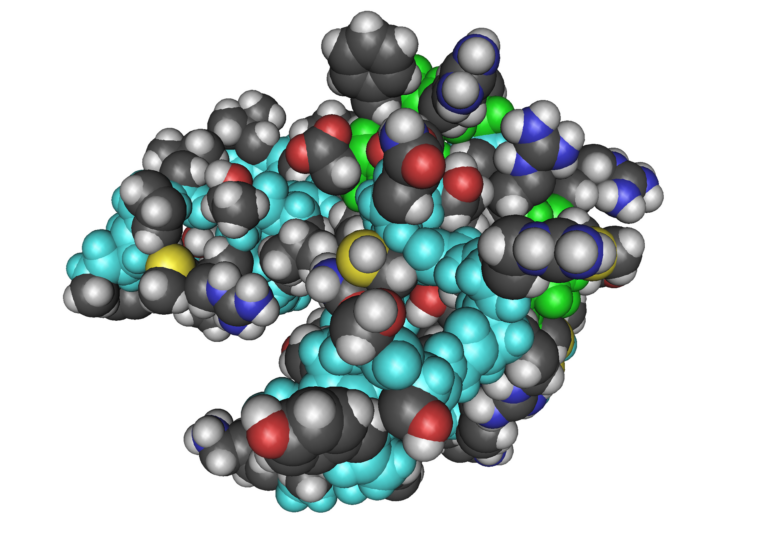
Every powerful signal in the body comes with a brake. Insulin-like growth factor 1 — the hormone that translates much of growth hormone’s message into actual tissue building — spends most of its life in custody. The great majority of the IGF-1 circulating in the blood is clamped to a family of carrier molecules, the IGF-binding proteins, which hold it inert until it is needed. It is an elegant piece of biological accounting: keep the growth signal abundant but leashed. IGF-1 LR3 is what happens when a protein engineer decides to cut the leash.
The result is a molecule designed around a single idea — a growth factor redesigned to slip past the body’s own restraints and stay active far longer than nature intended.1 That design choice is precisely what makes it interesting in the laboratory, and precisely what makes the honest reading of it more complicated than the enthusiastic one.
What exactly is IGF-1 LR3, and how is it different from natural IGF-1?
IGF-1 LR3 — the name unpacks to Long R3 IGF-1 — is an 83-amino-acid recombinant analogue of the 70-residue native hormone.1 Two deliberate modifications account for its behaviour. The first is an N-terminal extension of thirteen extra amino acids (the “Long”), grafted onto the front of the molecule. The second is a single substitution at position three, where the native glutamate is swapped for an arginine (the “R3”).12 Neither change touches the surface that engages the IGF-1 receptor; both were chosen to sabotage a different interaction entirely.
That interaction is binding to the IGFBPs. The foundational work on IGF muteins — analogues with targeted point mutations — established that altering residues near the N-terminus could dramatically weaken the hormone’s grip on its carrier proteins while leaving receptor binding broadly intact.13 Characterisation of these engineered variants showed that the modified molecules retained their ability to switch on the receptor but were no longer efficiently sequestered by the binding proteins, and were correspondingly more potent in systems where binding proteins are present.23 In effect, the designers separated two functions that evolution had bundled together: the “go” signal and the “wait” signal. IGF-1 LR3 keeps the first and discards much of the second.
In one diabetic-rat study, IGF-1 variants that “bind poorly to IGF-binding proteins” — including long-R3-IGF-1 — were reported as 2.5 to 3 times more potent than native IGF-1 at restoring growth. Escaping the binding proteins, rather than any change at the receptor, is what drives that potency gain.2
What does the preclinical research on IGF-1 LR3 actually show?
Most of what is known sits in muscle and nerve biology. In skeletal muscle, IGF-1 signalling is a central regulator of the satellite cells — the resident stem-cell pool that proliferates and then differentiates to repair and enlarge muscle fibres. Cell-culture studies using IGF-1 and its long analogues report that the growth factor drives myogenic-cell proliferation and then differentiation into mature myotubes, the two phases of the regeneration programme.56 Because the LR3 variant resists sequestration by the binding proteins secreted by cultured cells, it tends to produce a more sustained effect in these systems than native IGF-1 at equivalent concentrations.5
Beyond muscle, IGF-1 has long been studied as a trophic factor for peripheral nerve. Recent experimental work on nerve-regeneration conduits — engineered tubes that bridge a severed nerve — has examined controlled IGF-1 LR3 release as a way to encourage axons to grow across the gap in a rat model.7 And a large, older body of literature comes not from medicine at all but from livestock and developmental physiology, where IGF-1 and its long analogues were investigated for their effects on protein metabolism, growth, lactation and mammary development in farm and laboratory animals.489 This is the unglamorous but substantial foundation of the field: much of what we “know” about long-acting IGF-1 analogues was learned in cattle, sheep, pigs and rodents.8
The honest summary of all this is that the evidence is real, mechanistically coherent and almost entirely non-human. It is animal, veterinary, developmental or in vitro.48 That does not make it worthless — the biology of IGF-1 is among the best-characterised in growth physiology — but it means the leap from culture dish or livestock pen to any human conclusion is exactly that: a leap, not a demonstration.
How does IGF-1 LR3 compare with native IGF-1?
| Property | Native IGF-1 | IGF-1 LR3 |
|---|---|---|
| Structure | 70 amino acids, wild-type sequence | 83 amino acids; 13-residue N-terminal extension + Arg3 substitution |
| IGFBP affinity | High — largely held in reserve by binding proteins | Sharply reduced — escapes sequestration |
| Relative potency | Reference | ~2.5–3× in systems where binding proteins are present |
| What is studied | Broad clinical and preclinical biology | Cell & animal models; no human trials of the analogue itself |
| Regulatory status | An approved IGF-1 product exists for a rare paediatric condition | Not approved; research-use-only; WADA-prohibited in sport |
The single design goal — escaping the binding proteins — explains every row that matters: greater potency and longer persistence, but a body of evidence that has not crossed into human clinical study of the analogue itself.12
What is the honest evidence — and the catch?
Here the account has to be candid. There are no human clinical trials of IGF-1 LR3 as such. Whatever is claimed for it in humans is extrapolated from native IGF-1 biology and from animal data on the long analogues — an inference, not a result.48 That alone should temper any confident statement about what it does in a person.
The deeper caveat is mechanistic. IGF-1 LR3 works by engaging the IGF-1 receptor and switching on the PI3K/AKT/mTOR cascade — the master growth-and-survival pathway that tells cells to take up nutrients, grow and resist programmed death.10 That pathway is not a niche curiosity. It is one of the most frequently dysregulated axes in human cancer, and elevated IGF-1 signalling is associated with proliferative and survival advantages in transformed cells. A growth factor engineered to activate that axis more persistently than nature allows is, by construction, pulling on a lever that oncology spends enormous effort trying to switch off. Any honest treatment of IGF-1 LR3 must state this plainly: persistent, unregulated activation of a pro-growth pathway is precisely the kind of signal whose long-term consequences cannot be waved away. (We explore the trade-offs of this pathway in our editorial on IGF-1, mTOR, muscle and longevity.)
There is a regulatory corollary, too. IGF-1 and its analogues are prohibited in sport by the World Anti-Doping Agency, classed among the growth factors banned at all times. That status reflects exactly the properties described above: a molecule that amplifies anabolic signalling.2 It is a fact worth stating not as a moral point but as a factual one about how these compounds are regulated.
Why does identity and purity matter so much here?
Because IGF-1 LR3 is an 83-residue engineered protein, it is also one of the harder peptides to make correctly.1 The thirteen-residue extension and the single point substitution have to be exactly right; misfolding, truncation, deamidation or contamination with native-sequence material would all change what a sample actually is. For a reference material destined for the bench, the difference between “Long R3 IGF-1” and “something close to it” is the difference between an interpretable experiment and a wasted one.
That is why the chemistry of trust matters as much as the chemistry of the molecule. Condor supplies IGF-1 LR3 strictly as a research-use-only reference material — not a medicine, not for human or veterinary use, with no protocol, route or dosing implied or provided. It is not an approved drug for any human indication. What we can offer is the thing a researcher genuinely needs: a defined identity and a verified purity, documented in a Certificate of Analysis, so that whatever the literature eventually concludes about long-acting IGF-1 analogues, your sample is the molecule the label says it is. Researchers working in adjacent tissue-repair chemistry may also be reading our notes on TB-500 and on Ipamorelin and CJC-1295.
References
- Francis GL, Ross M, Ballard FJ, Milner SJ, Senn C, et al. Novel recombinant fusion protein analogues of insulin-like growth factor (IGF)-I indicate the relative importance of IGF-binding protein and receptor binding for enhanced biological potency. J Mol Endocrinol. 1992;8(3):213–223. PMID: 1378742. pubmed.ncbi.nlm.nih.gov/1378742
- Tomas FM, Knowles SE, Owens PC, Chandler CS, Francis GL, et al. Insulin-like growth factor-I and more potent variants restore growth of diabetic rats without inducing all characteristic insulin effects. Biochem J. 1993;291(Pt 3):781–786. PMID: 7683875. doi:10.1042/bj2910781. pubmed.ncbi.nlm.nih.gov/7683875
- Bryant KJ, Read LC, Forsberg G, Wallace JC. Design and characterisation of long-R3-insulin-like growth factor-I muteins which show resistance to pepsin digestion. Growth Factors. 1996;13(1–2):11–21. PMID: 8919033. doi:10.3109/08977199609003227. pubmed.ncbi.nlm.nih.gov/8919033
- Hill RA, Hunter RA, Lindsay DB, Owens PC. Action of long(R3)-insulin-like growth factor-1 on protein metabolism in beef heifers. Domest Anim Endocrinol. 1999;16(4):219–229. PMID: 10370861. doi:10.1016/s0739-7240(99)00015-6. pubmed.ncbi.nlm.nih.gov/10370861
- Xi G, Kamanga-Sollo E, Pampusch MS, White ME, Hathaway MR, et al. Effect of recombinant porcine IGFBP-3 on IGF-I and long-R3-IGF-I-stimulated proliferation and differentiation of L6 myogenic cells. J Cell Physiol. 2004;200(3):387–394. PMID: 15254966. doi:10.1002/jcp.20068. pubmed.ncbi.nlm.nih.gov/15254966
- Pesall JE, McFarland DC, McMurtry JP, Clapper JA, Francis GL, et al. The effect of insulin-like growth factor analogs on turkey satellite cell and embryonic myoblast proliferation. Poult Sci. 2001;80(7):944–948. PMID: 11469659. doi:10.1093/ps/80.7.944. pubmed.ncbi.nlm.nih.gov/11469659
- Yavuz E, Sağır MS, Ercan A, Erginer M, Barlas FB, et al. Decellularized Alstroemeria stem-based nerve conduit integrated with GelMA and controlled IGF-1 LR3 release for enhanced rat sciatic nerve regeneration. Int J Biol Macromol. 2025;329(Pt 2):147888. PMID: 41015370. doi:10.1016/j.ijbiomac.2025.147888. pubmed.ncbi.nlm.nih.gov/41015370
- Conlon MA, Tomas FM, Owens PC, Wallace JC, Howarth GS, et al. Long R3 insulin-like growth factor-I (IGF-I) infusion stimulates organ growth but reduces plasma IGF-I, IGF-II and IGF binding protein concentrations in the guinea pig. J Endocrinol. 1995;146(2):247–253. PMID: 7561636. doi:10.1677/joe.0.1460247. pubmed.ncbi.nlm.nih.gov/7561636
- Hadsell DL, Parlow AF, Torres D, George J, Olea W. Enhancement of maternal lactation performance during prolonged lactation in the mouse by mouse GH and long-R3-IGF-I is linked to changes in mammary signaling and gene expression. J Endocrinol. 2008;198(1):61–70. PMID: 18577570. doi:10.1677/JOE-07-0556. pubmed.ncbi.nlm.nih.gov/18577570
- Sundgren NC, Giraud GD, Schultz JM, Lasarev MR, Stork PJ, et al. Extracellular signal-regulated kinase and phosphoinositol-3 kinase mediate IGF-1 induced proliferation of fetal sheep cardiomyocytes. Am J Physiol Regul Integr Comp Physiol. 2003;285(6):R1481–R1489. PMID: 12947030. doi:10.1152/ajpregu.00232.2003. pubmed.ncbi.nlm.nih.gov/12947030
- IGF-1 LR3 (Long R3 IGF-1) is a recombinant analogue with a 13-residue N-terminal extension and an Arg3-for-Glu3 substitution that reduce binding to the IGF-binding proteins, making it markedly more potent and longer-acting than native IGF-1 in experimental systems.
- The preclinical literature centres on muscle satellite-cell proliferation and differentiation, nerve-regeneration conduits, and a large body of livestock and developmental physiology — almost all of it animal, veterinary or in vitro rather than human.
- There are no human clinical trials of IGF-1 LR3 as such; its activity is inferred from native IGF-1 biology and animal data on the long analogues.
- It activates the IGF-1/PI3K/AKT/mTOR growth-signalling axis, a pathway deeply implicated in cancer — a caveat any honest account must state — and IGF-1 and its analogues are prohibited in sport by WADA.
- It is not an approved medicine for any human use; Condor supplies it strictly research-use-only, identity- and purity-verified by Certificate of Analysis.
What does the “LR3” in IGF-1 LR3 mean?
It encodes the two engineering changes. “L” (Long) is a 13-amino-acid N-terminal extension added to the front of the molecule, and “R3” marks an arginine substituted for the native glutamate at position three. Together they reduce binding to the IGF-binding proteins, producing an 83-residue analogue that is markedly more potent and longer-acting than native 70-residue IGF-1 in experimental systems where those binding proteins are present.
Are there human clinical trials of IGF-1 LR3?
No. There are no human clinical trials of IGF-1 LR3 as such. The research base is preclinical — cell-culture work on myogenic and satellite cells, nerve-regeneration studies, and a large body of livestock and developmental physiology. Any human claim is an extrapolation from native IGF-1 biology and animal data, not a demonstrated result.
Why is the cancer pathway caveat important?
IGF-1 LR3 activates the IGF-1/PI3K/AKT/mTOR signalling cascade, which drives cell growth and survival and is one of the most frequently dysregulated pathways in human cancer. A molecule engineered to activate that axis more persistently than native IGF-1 is pulling on a pro-growth lever, so any honest account has to flag the theoretical concern around sustained, unregulated activation.
Is IGF-1 LR3 banned in sport?
Yes. IGF-1 and its analogues are prohibited at all times by the World Anti-Doping Agency, classed among the banned growth factors. That status reflects their anabolic, growth-promoting signalling. This is a factual point about how the compounds are regulated, not an endorsement of any use.
How does Condor supply IGF-1 LR3?
Strictly as a research-use-only reference material — not a medicine, not for human or veterinary use, with no dosing, route or protocol implied. It is not an approved drug for any human indication. Each batch ships with a Certificate of Analysis documenting identity and purity, which matters especially for an 83-residue engineered protein where correct folding and sequence are easy to get wrong.