
The IGF-1 / mTOR Dilemma: Muscle Versus Longevity
The same growth signalling that builds muscle is the one whose quieting extends lifespan in animals. An honest look at a paradox biology has not cleanly resolved in humans — and at the research tools used to probe it.
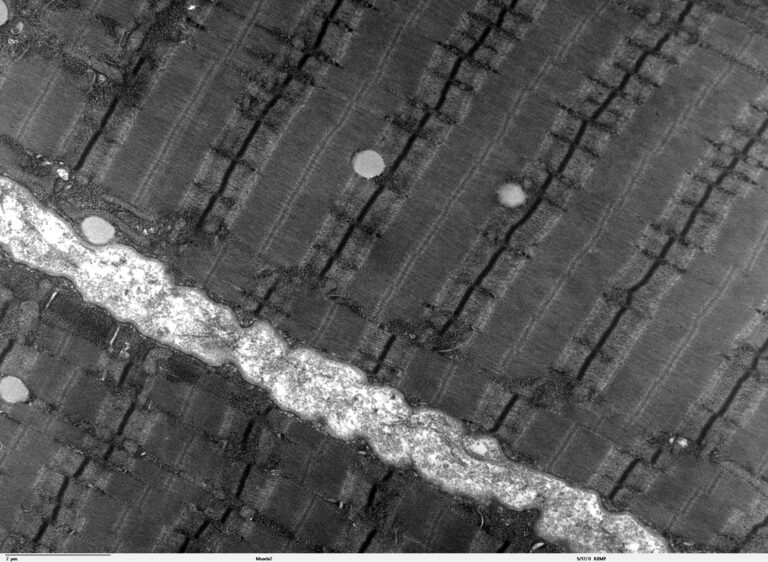
The GH→IGF-1→PI3K/AKT/mTOR axis drives anabolism and tissue repair, yet in model organisms turning that same signalling down extends lifespan. The muscle-versus-longevity trade-off is unresolved in humans, and IGF-1/mTOR activity carries a real cancer-association caveat. IGF-1 LR3 and Ipamorelin are research-use-only reference materials, not approved therapies.
Here is one of the strangest sentences in modern biology, and it is true: the molecular signal that builds a bicep is, give or take, the same signal that — turned down — lets a worm, a fly, or a mouse live conspicuously longer. The pathway that says “grow, repair, store, divide” is also, read the other way, the pathway that whispers “age faster.” Biology has spent three decades staring at this contradiction without cleanly resolving it in humans. It is not a footnote. It is arguably the central tension in the science of ageing, and it sits right inside a handful of peptides that researchers now use as tools to probe it.
What is the GH→IGF-1→mTOR axis, and why does it matter?
Start with the plumbing. The pituitary releases growth hormone (GH) in pulses; GH instructs the liver and peripheral tissues to produce insulin-like growth factor 1 (IGF-1), a small protein that does much of GH’s actual downstream work. IGF-1 binds its receptor and switches on the PI3K→AKT→mTOR cascade — the cell’s master controller of anabolism.1 When mTOR is active, cells build proteins, take up nutrients, suppress autophagy (their internal recycling programme), and prepare to divide. This is the engine of muscle hypertrophy and tissue repair. It is also, almost word for word, the engine of growth in general — which is precisely where the trouble begins.
To study a pathway you need a clean way to push on it, and IGF-1 itself is awkward: in the bloodstream it is bound by a fleet of IGF-binding proteins that sequester it within minutes. So researchers turned to IGF-1 LR3, a long-arginine-3 analogue engineered with an extended N-terminus and a single amino-acid substitution that dramatically reduces its affinity for those binding proteins.2 The practical effect is a far longer biological half-life and stronger, more sustained receptor activation — which is exactly why it became a workhorse reagent in cell-culture and animal-physiology work.3 Much of what we know about LR3’s potency comes from livestock and cell-line studies, where it reliably drives growth and protein accretion.4 There are no human clinical trials of LR3 as such; it is a probe, not a medicine.
How can the same pathway both build muscle and shorten life?
Now the paradox. In the 1990s, geneticists working on the roundworm C. elegans found that crippling a single gene in its insulin/IGF-like signalling pathway roughly doubled the animal’s lifespan — and the long-lived mutants were not frail invalids but active, resilient worms.5 The finding generalised with uncomfortable consistency: dialling down insulin/IGF/mTOR signalling extends life across an evolutionary span from yeast to flies to mice.6 The three classic levers all converge on the same node. Dietary restriction lowers the signal by limiting nutrients. Rapamycin — the most reproducible pharmacological life-extender in mice — inhibits mTOR directly.7 And naturally long-lived mutants tend to carry loss-of-function variants somewhere along the IGF/insulin axis.8
A single loss-of-function mutation in the insulin/IGF-1 signalling pathway can roughly double lifespan in C. elegans — the founding observation that reduced growth signalling and extended longevity are linked across model organisms.5
So one literature says: activate this pathway and you build tissue, heal wounds, and counter the muscle loss of ageing. The other says: quiet this pathway and you live longer. Both are well supported. They are pointing in opposite directions. That is the dilemma, stated without ornament.
Where do the research tools — LR3 and Ipamorelin — fit in?
Because the axis has two ends — the GH signal at the top and IGF-1/mTOR at the bottom — it can be interrogated from either direction, and different reagents do different jobs.
IGF-1 LR3 pushes on the bottom: it floods the IGF-1 receptor directly and durably, letting researchers ask what sustained anabolic signalling does to a tissue.3 Ipamorelin works at the top. It is a selective GH secretagogue — a pentapeptide that stimulates the pituitary to release its own GH pulse by acting on the ghrelin/GH-secretagogue receptor, and it was characterised specifically for its selectivity: in the original pharmacology it released GH without the cortisol and prolactin spillover that dogged earlier secretagogues.9 That clean profile is what made it a useful tool for studying the GH→IGF-1 arm with fewer confounds.10 One tool turns the tap; the other floods the basin. (For the molecular detail, see our IGF-1 LR3 primer and the Ipamorelin and CJC-1295 primer.)
| Node on the axis | Effect on muscle / tissue (in models) | Effect on lifespan (in model organisms) |
|---|---|---|
| GH signal (top) | Drives IGF-1 output; supports growth and repair1 | GH/IGF-deficient mutants often longer-lived8 |
| IGF-1 / IGF-1R | Activates anabolism; LR3 sustains the signal3 | Reduced IGF signalling extends lifespan5 |
| mTOR (bottom) | Builds protein; suppresses autophagy1 | Inhibition (e.g. rapamycin, dietary restriction) extends lifespan7 |
The GH/IGF-1/mTOR axis, read from both ends: the levers that build tissue are, broadly, the same levers whose down-regulation lengthens life in non-human models. Human translation remains unsettled.
How honest is the evidence in humans?
This is where intellectual honesty has to do the heavy lifting, because the temptation — especially in fitness culture — is to take the muscle half of the story and quietly drop the longevity half. The candid position is that the trade-off is not resolved in humans, and the data pull in both directions.
On one side, IGF-1 signalling genuinely matters for maintaining tissue: sarcopenia, the progressive muscle wasting of ageing, and the slowing of repair are real problems, and anabolic signalling is part of any honest discussion of them. On the other side sits a caveat that cannot be waved away. The IGF-1→PI3K/AKT/mTOR pathway is one of the most frequently dysregulated cascades in human cancer; sustained pro-growth signalling is, almost by definition, also pro-proliferation.11 Epidemiological work has repeatedly noted associations between higher circulating IGF-1 and certain cancer risks — associations, not proof of causation, but not noise either.12 The model-organism longevity data and the human cancer-association data are, disquietingly, telling a consistent story: more of this signal is not unambiguously good.
The honest synthesis is that there is probably no single “correct” level of IGF-1/mTOR activity for a whole organism across a whole life. The setting that optimises a young athlete’s muscle repair may not be the setting that optimises a sixty-year-old’s cancer risk or lifespan. Researchers call this antagonistic pleiotropy — a gene or pathway that helps early and harms late — and the GH/IGF/mTOR axis is its textbook example. Anyone who tells you the dilemma is settled is selling something. It is also worth stating plainly that IGF-1 and its analogues are prohibited in sport under the WADA code, a regulatory fact independent of the biology.13
What does this mean for the lab bench?
None of these molecules is an approved medicine for the questions raised here. IGF-1 LR3 is a long-acting research analogue with no human clinical-trial pedigree; Ipamorelin is a characterised secretagogue used as a physiological probe. They earn their place in a laboratory precisely because the muscle-versus-longevity dilemma is unresolved — they are instruments for asking the question, not answers to it.
That status is exactly why identity and purity are not pedantry but the whole point. A study probing a pathway this finely calibrated is only as trustworthy as the molecule in the vial: the right peptide, at the stated content, free of the wrong impurities. Condor Research supplies IGF-1 LR3 and Ipamorelin strictly as research-use-only reference materials — not for human or veterinary use, with no dosing, route, or protocol implied — each accompanied by a Certificate of Analysis documenting what is actually in the vial. In a field where the central question is still open, the least a supplier can do is remove all doubt about the reagent.
- The growth-and-anabolism pathway (GH→IGF-1→PI3K/AKT/mTOR) that builds and repairs tissue is the very pathway whose down-regulation extends lifespan in worms, flies and mice.
- Reduced IGF-1/insulin/mTOR signalling — via dietary restriction, rapamycin, or naturally long-lived mutants — lengthens lifespan in model organisms, while activation favours growth.
- IGF-1 LR3 is a long-acting IGF-1 analogue used as a research tool; most of its data comes from animal and livestock models, and IGF-1/mTOR signalling is implicated in cancer.
- Ipamorelin is a selective GH secretagogue studied as a tool to stimulate endogenous GH release without the off-target effects of older compounds.
- The trade-off is genuinely unsettled in humans; these are research-use-only reference materials supplied with a Certificate of Analysis, not therapies, with no human dosing implied.
What is the IGF-1 / mTOR dilemma?
It is the unresolved tension between two well-supported findings. The GH→IGF-1→PI3K/AKT/mTOR pathway drives muscle growth and tissue repair, yet in model organisms turning that same signalling down — via dietary restriction, rapamycin or long-lived mutations — extends lifespan. The two literatures point in opposite directions, and the trade-off has not been cleanly resolved in humans.
What is IGF-1 LR3 and how does it differ from natural IGF-1?
IGF-1 LR3 is a long-arginine-3 analogue of IGF-1 engineered with an extended N-terminus and a single substitution that sharply lowers its affinity for IGF-binding proteins, giving it a longer half-life and more sustained receptor activation. It is used as a research tool to probe IGF-1 signalling; most data come from animal and livestock models, and there are no human clinical trials of it as such.
Why is IGF-1 signalling linked to cancer?
The IGF-1→PI3K/AKT/mTOR cascade is a master pro-growth pathway and is one of the most frequently dysregulated signalling routes in human cancer, since pro-growth signalling is also pro-proliferation. Epidemiological studies have associated higher circulating IGF-1 with certain cancer risks. These are associations rather than proof of causation, but they are a genuine caveat, not noise.
How does Ipamorelin relate to this axis?
Ipamorelin is a selective GH secretagogue: a pentapeptide that prompts the pituitary to release its own growth-hormone pulse, sitting at the top of the GH→IGF-1 axis. It was characterised for releasing GH with minimal cortisol and prolactin spillover, which makes it useful as a research probe of the GH arm with fewer confounds. Like LR3, it is a research tool, not an approved therapy.
Are IGF-1 LR3 and Ipamorelin approved medicines?
No. Neither is an approved medicine for the muscle or longevity questions discussed here. IGF-1 LR3 has no human clinical-trial pedigree and IGF-1 analogues are prohibited in sport under the WADA code. Condor Research supplies both strictly as research-use-only reference materials — not for human or veterinary use, with no dosing implied — each with a Certificate of Analysis.