
“Leaky Gut” Examined: Zonulin, Tight Junctions and Larazotide
A myth-versus-mechanism fact-check on one of wellness's most abused phrases. The intestinal barrier is real biology; “leaky gut” as a catch-all diagnosis is not — and the one peptide that put the hypothesis to a large human test tells a sobering story.
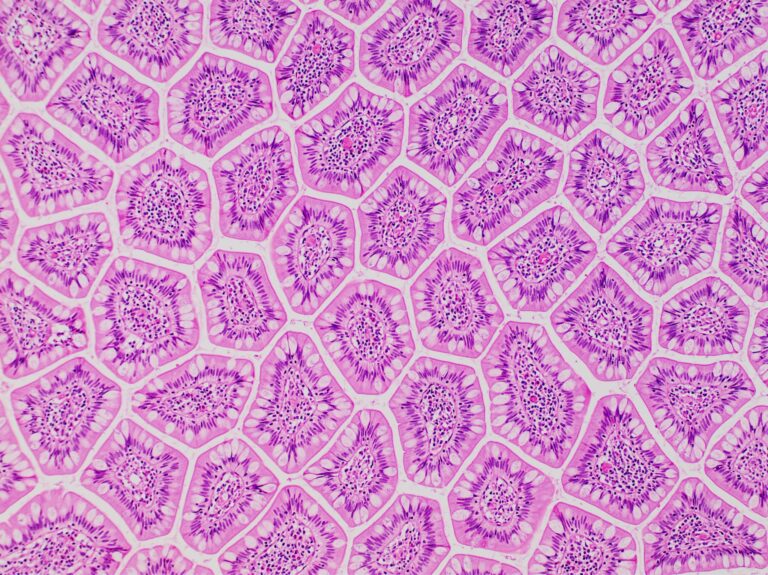
“Leaky gut” conflates real intestinal-barrier biology with an everything-explaining wellness slogan. Tight-junction disruption and increased permeability are genuinely documented in coeliac disease; the zonulin/PAR2 pathway is plausible but contested. Larazotide, the peptide that tested it, reached phase III in coeliac disease and that trial was discontinued for futility — it failed to show the expected benefit. All compounds discussed are research-use-only reference materials, not approved medicines.
Few phrases in modern wellness travel further on less ballast than “leaky gut.” It is invoked to explain fatigue, brain fog, autoimmunity, acne, mood and a dozen conditions besides, often by the same voice in the same breath. And yet beneath the slogan lies something genuinely real: a single layer of cells, one-thirtieth the thickness of paper, that decides what passes from the gut lumen into the bloodstream. “Leaky gut” sits on a fault line. On one side is documented intestinal-barrier biology that serious gastroenterologists study with serious instruments. On the other is an everything-explaining catch-all that no clinic will write on a chart. The interesting work is telling the two apart.
Is the intestinal barrier actually real, or is “leaky gut” just marketing?
The barrier is unambiguously real. The gut lining is sealed by tight junctions, protein zippers — claudins, occludin, the ZO family — that stitch adjacent epithelial cells together and police the paracellular space between them.2 When those zippers loosen, the barrier becomes more permeable, and that permeability is not folklore. In coeliac disease it is among the best-characterised features of the pathology: gluten-derived peptides trigger a cascade that disrupts the junctional complex, raising permeability and feeding the immune activation that damages the mucosa.1 Researchers can measure this disruption, image it, and trace its molecular machinery.16
So the cellular story holds. The problem begins when a measurable phenomenon in defined diseases is stretched into a universal explanation. Documented barrier dysfunction in coeliac disease, inflammatory bowel disease and a handful of other conditions is not a licence to diagnose “leaky gut” as the hidden root of unrelated symptoms. The mechanism is specific; the slogan is not.
What is zonulin, and can you test for a leaky gut?
The concept that gave “leaky gut” its scientific veneer is zonulin — a protein proposed as a physiological regulator of tight junctions, dialling paracellular permeability up and down via signalling that involves the protease-activated receptor PAR2.2 It is an elegant idea: a single endogenous switch for gut leakiness, implicated across a range of chronic inflammatory disorders.2 Elegant, and genuinely worth studying. But it is also where rigour and marketing part ways.
The commercial serum-zonulin test sold to consumers as a “leaky gut” readout rests on contested ground. The specificity of what these assays actually measure has been repeatedly questioned, and the term “zonulin” itself covers a family of related proteins rather than one cleanly defined molecule.2 A plausible pathway in the literature is not the same as a validated diagnostic in the clinic. Reviews of the zonulin literature treat it as a live research hypothesis about barrier regulation — not as a settled biomarker you can buy and self-interpret.2
The largest clinical test of the tight-junction hypothesis — larazotide in coeliac disease — reached phase III and was discontinued for futility at a pre-planned interim analysis, a result that should calibrate every claim built on the “leaky gut” mechanism.3
Did anyone actually test the leaky-gut hypothesis in humans?
Yes — and this is the part the slogan tends to omit. Larazotide acetate (AT-1001) is an eight-amino-acid peptide designed to do exactly what the hypothesis demands: stabilise tight junctions and antagonise the zonulin/PAR2 pathway, reducing paracellular permeability.2 Of all the agents in the barrier field, its mechanism is comparatively well characterised. It became the first such peptide to be tested at scale in coeliac disease, advancing as an adjunct to the gluten-free diet through to phase III.36
That phase-III programme did not deliver the win its mechanism promised. The trial was halted at a pre-planned interim analysis for futility — an independent assessment concluded that the additional enrolment needed to reach statistical significance was too large to justify continuing.3 That is the load-bearing fact of this whole essay: the most rigorous, best-funded test of the “fix the leaky barrier” idea, in the disease where barrier disruption is most firmly established, failed to show the expected benefit. A futility stop does not mean the molecule is inert or the biology is fiction; it means the clean translational story — close the junctions, resolve the symptoms — did not hold the way its proponents hoped.
Since that result, larazotide has reappeared in more exploratory settings — all preclinical or early-stage. It has been investigated in children with post-COVID multisystem inflammatory syndrome (MIS-C), where one small study reported accelerated clearance of viral spike antigen and improved recovery.6 It has been formulated into sustained-release hydrogels for colitis in animal models,5 tested against anoxia/reoxygenation injury in intestinal barrier preparations,8 and probed as a PAR2 antagonist against histamine-driven barrier disruption in keratinocytes for atopic dermatitis.7 Even a mouse model of non-alcoholic fatty liver disease has been used to ask whether stabilising the gut barrier matters upstream of the liver.4 Intriguing, all of it — and all of it firmly upstream of approved clinical use.
What do KPV and BPC-157 add to the gut-barrier picture?
Two other peptides surface constantly in gut-barrier conversations, and both deserve honest framing. KPV, the C-terminal tripeptide of α-MSH, is transported into intestinal cells via the PepT1 oligopeptide transporter, where preclinical work reports anti-inflammatory effects.12 In murine models it has been associated with reduced colitis-associated tumourigenesis through that PepT1 route,9 and KPV-loaded hydrogels have been shown to help restore the mucosal barrier in inflamed colon10 and to ease chemically induced ulcerative colitis in rats.11 BPC-157, a stable gastric pentadecapeptide, carries an even larger animal literature spanning gut and tissue repair,15 though much of it originates from a concentrated set of investigators and remains at the investigational, formulation-challenged stage.1314 The common thread is unmistakable and worth saying plainly: animal models and in-vitro systems, not human clinical proof. You can read the primers for each — the larazotide primer, the KPV primer and the BPC-157 primer.
| Marker / agent | What it is | State of the evidence |
|---|---|---|
| Serum-zonulin test | Commercial assay marketed as a “leaky gut” readout | Pathway plausible; assay specificity contested, not a validated diagnostic2 |
| Larazotide (AT-1001) | Tight-junction-stabilising, zonulin/PAR2-antagonist peptide | Reached phase III in coeliac disease; discontinued for futility; newer work exploratory36 |
| KPV | α-MSH-derived tripeptide, PepT1-transported | Animal-model anti-inflammatory and barrier-restoring data only912 |
| BPC-157 | Stable gastric pentadecapeptide | Large but concentrated animal literature; investigational, no approved gut indication1315 |
Agents and markers in intestinal-barrier research, with their honest evidence tier. None is an approved treatment for “leaky gut.”
So what does the honest evidence actually say?
Three things, held together without flinching. First, the barrier biology is real: tight junctions, paracellular permeability and their disruption in coeliac disease are documented, mechanistic and measurable.12 Second, “leaky gut” as a catch-all diagnosis is not clinically recognised — it is a folk label stretched across symptoms that the underlying science never claimed to cover, and the consumer test that supposedly measures it is contested.2 Third, the larazotide phase-III futility stop is the reality check: when the cleanest version of the hypothesis was tested in the disease that best fits it, the trial was halted before it could show the benefit its proponents predicted.3 The newer larazotide, KPV and BPC-157 findings are real signals worth investigating, but they are early, often single-group, and overwhelmingly preclinical.5913 Honest evidence means letting the negative result sit beside the promising mechanism, rather than quietly dropping it.
Where does that leave a researcher working with these compounds?
Exactly where good science usually leaves us: with a real phenomenon, a contested biomarker, and a small set of reference peptides whose intestinal effects are interesting enough to study and unproven enough to demand caution. None of larazotide, KPV or BPC-157 is an approved medicine for any “leaky gut” indication, and nothing here is a protocol, a dose, or a therapeutic recommendation for humans or animals. These are research-use-only reference materials — tools for in-vitro and animal-model work, not products for consumption.
For that work to mean anything, the molecule in the vial has to be the molecule on the label. An eight-residue peptide tested for tight-junction effects is only as trustworthy as its identity and purity — which is why every Condor reference compound ships with a Certificate of Analysis documenting HPLC purity and mass-spec identity. In a field where the biology is real but the claims so often outrun it, the least negotiable thing a supplier can offer is honesty about what you are actually holding.
- The intestinal barrier and its tight junctions are real, well-characterised biology; increased permeability is genuinely documented in coeliac disease and other inflammatory conditions.
- "Leaky gut" as a stand-alone, everything-explaining diagnosis is not a recognised clinical entity, and the commercial serum-zonulin test has contested specificity.
- Larazotide (AT-1001), the one tight-junction-regulating peptide to reach phase III in coeliac disease, saw its trial discontinued for futility and failed to show the expected benefit — a result that should calibrate expectations.
- Newer exploratory larazotide work spans MIS-C, colitis models and barrier injury, while KPV and BPC-157 carry animal-model intestinal data — preclinical, not clinical proof.
- Condor supplies larazotide, KPV and BPC-157 strictly as research-use-only reference materials with a Certificate of Analysis; none is an approved medicine for these uses.
Is "leaky gut" a real medical diagnosis?
The underlying biology — intestinal permeability and tight-junction disruption — is real and documented in conditions such as coeliac disease. But "leaky gut" as a stand-alone, everything-explaining diagnosis is not a recognised clinical entity, and the commercial serum-zonulin test marketed to measure it has contested specificity.
What is zonulin and the PAR2 pathway?
Zonulin is a protein proposed to regulate tight junctions and paracellular permeability, signalling in part through the protease-activated receptor PAR2. It is a plausible and actively studied mechanism for barrier regulation, but it is a research hypothesis rather than a settled, validated diagnostic biomarker.
Did larazotide work for coeliac disease?
Larazotide (AT-1001) is a tight-junction-stabilising peptide that reached phase III as an adjunct to the gluten-free diet in coeliac disease, but that trial was discontinued for futility at a pre-planned interim analysis and failed to show the expected benefit. More recent work in MIS-C, colitis models and barrier injury is exploratory and preclinical or early-stage.
How do KPV and BPC-157 relate to gut-barrier research?
Both have animal-model and in-vitro data touching intestinal biology — KPV via the PepT1 transporter and anti-inflammatory effects, BPC-157 across gut and tissue-repair models. Importantly, this is preclinical evidence, much of it from concentrated research groups, not human clinical proof, and neither is an approved treatment.
Are these compounds approved or safe to take?
No. Larazotide, KPV and BPC-157 are supplied strictly as research-use-only reference materials for in-vitro and animal studies. None is an approved medicine for any "leaky gut" indication, and nothing here constitutes a dose, protocol or therapeutic recommendation for humans or animals.