
BPC-157 Purity: How HPLC and Mass Spectrometry Verify It
How a BPC-157 COA actually verifies the molecule: HPLC area-% purity, mass-spectrometry identity against the 15-amino-acid sequence, and the SPPS impurities to look for.
A BPC-157 certificate verifies two separate things with two separate methods. Reversed-phase HPLC gives purity as the main peak’s relative area-% versus all detected peaks — typically reported as ≥ 99% — while mass spectrometry confirms identity by matching the observed mass to the calculated mass of the 15-residue sequence (GEPPPGKPADDAGLV, average mass ≈ 1419.5 Da). HPLC says “how pure”; MS says “pure what”. The impurities a good method must resolve are the ordinary debris of solid-phase peptide synthesis — deletion sequences missing a residue, truncated chains and incompletely deprotected fragments — so a credible BPC-157 COA shows both the HPLC chromatogram and a batch-specific MS result, not a headline number alone.
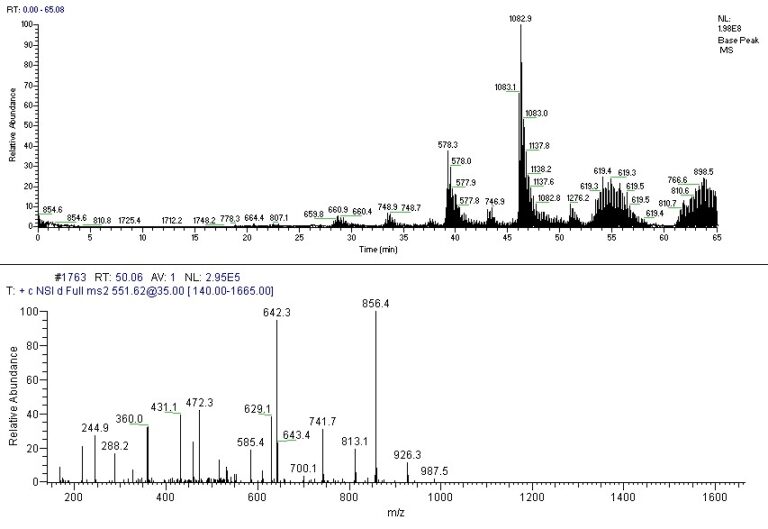
A vial labelled BPC-157 makes two distinct promises, and most certificates of analysis only make one of them legible. The first promise is purity — that the contents are overwhelmingly a single compound. The second, quieter and more important, is identity — that the single compound is this compound, the 15-amino-acid sequence the label names, and not some near neighbour that happens to behave similarly on a column. Verifying both is the entire job of a real BPC-157 COA, and it takes two different instruments answering two different questions. This piece is the BPC-157-specific companion to our broader explainer on how HPLC and mass spectrometry verify COA purity; for what the molecule actually is, see what is BPC-157.
What exactly is being verified in a BPC-157 vial?
BPC-157 is not a vague class of substance; it is a precisely defined peptide. Its sequence is Gly-Glu-Pro-Pro-Pro-Gly-Lys-Pro-Ala-Asp-Asp-Ala-Gly-Leu-Val — in single-letter code, GEPPPGKPADDAGLV — a chain of fifteen amino acids whose composition is fixed.6 Because the sequence is fixed, so is the molecule’s calculated mass: roughly 1419.5 Da as an average mass, the value that falls directly out of summing the residue masses plus a molecule of water. That single number is what makes BPC-157 tractable to verify — it gives mass spectrometry an exact target to test against, the way a known answer lets you check arithmetic.
So the verification problem decomposes cleanly. Purity asks how much of the vial is one dominant species; identity asks whether that species has the mass expected for GEPPPGKPADDAGLV. A certificate that addresses only the first has shown you a clean peak of something; it has not shown you that the something is BPC-157.4
BPC-157 is a defined fifteen-residue sequence with a calculable target mass of about 1419.5 Da (average).6 A fixed sequence means a fixed mass, which is precisely what lets mass spectrometry confirm identity rather than merely guess at it.
How does HPLC measure BPC-157 purity — and what does the number really say?
The purity figure on a BPC-157 COA — usually presented as ≥ 99% — almost always comes from reversed-phase HPLC with UV detection, read in the low-UV window (around 214–220 nm) where the peptide bond absorbs.5 The sample is pushed through a column; species that interact differently with the stationary phase emerge at different retention times, each registering as a peak. The software integrates the area under every peak, following chromatographic conventions of the kind USP <621> lays out.3
Here is the part worth internalising: the reported purity is the area of the main peak as a percentage of the total area of all detected peaks.3 It is a relative measurement, not an absolute concentration by weight. A BPC-157 vial reading 99% by HPLC can still contain less peptide than its label implies, because adsorbed water and counter-ion (salt) mass are real mass the area-% figure simply does not see — which is exactly why those attributes get their own dedicated tests.5 The number is honest about the chromatogram and silent about everything outside it.
Why does identity need mass spectrometry, not just a clean peak?
A single symmetrical peak at 99.5% tells you the sample is chromatographically homogeneous — mostly one thing. It does not tell you what that thing is. Retention time is suggestive, not definitive; a different peptide of similar hydrophobicity can elute in the same neighbourhood.5 For a molecule as widely studied and widely scrutinised as BPC-157, where the biopharmaceutical-characterisation literature stresses that identity and purity are distinct attributes that must each be demonstrated, leaning on a chromatogram alone is precisely the gap to avoid.6
That is where mass spectrometry earns its place. By ionising the molecule and measuring its mass-to-charge ratio — whether by electrospray ionisation (ESI-MS) or matrix-assisted laser desorption (MALDI-TOF) — the analysis compares the calculated mass of the intended GEPPPGKPADDAGLV sequence against the observed mass of what is actually in the vial.4 For BPC-157, the target is the average mass near 1419.5 Da (the monoisotopic [M+H]+ works out close to 1419.7); a match within instrument tolerance is positive evidence the molecule carries the molecular weight expected for the sequence. If the observed mass is off, the prettiest chromatogram in the world cannot rescue it. Orthogonal identity confirmation of this kind is treated in synthetic-peptide quality practice as integral rather than optional.4
Which impurities show up in synthetic BPC-157 — and what to look for on the COA
BPC-157 is made by solid-phase peptide synthesis (SPPS), building the chain one residue at a time. SPPS is remarkably reliable but never perfect, and its characteristic failures leave a recognisable family of related substances behind — the small peaks scattered around the main one on a chromatogram.5 These structurally close impurities are exactly what regulatory frameworks treat as the thing to control: ICH Q3A is built around identifying, reporting and qualifying impurities rather than waving them away,2 and ICH Q6A frames purity as one specification among several that together decide whether a substance meets its acceptance criteria.1 The value of a good HPLC method is that it actually resolves these from the parent rather than hiding co-eluting junk under the main peak — the same separation challenge documented when characterising structurally related impurities in other synthetic peptides by HPLC–QTOF–MS/MS.5
| What can appear in synthetic BPC-157 | Where it comes from (SPPS) | How a COA should expose it |
|---|---|---|
| Deletion sequence (missing one residue) | An incomplete coupling step skips a residue, yielding a 14-mer with a mass lighter by one amino acid5 | An extra HPLC peak near the parent plus a shifted mass on MS — resolvable only if the method separates close relatives3 |
| Truncated chain | Synthesis stalls or is capped early, leaving a shorter fragment of the sequence5 | Distinct lower-mass species on MS; a separate, earlier- or later-eluting HPLC peak3 |
| Incomplete deprotection / side-chain adducts | Protecting groups not fully removed, or side reactions during cleavage5 | Mass offset by the residual group on MS; a related-substance peak on HPLC2 |
| Water & counter-ion (salt) content | Hygroscopic lyophilised powder; isolated as a TFA or acetate salt5 | Not seen by area-% purity — needs separate water and counter-ion testing5 |
The ordinary debris of solid-phase BPC-157 synthesis and how a credible certificate should make each one visible. Purity (HPLC) and identity (MS) answer different questions; some attributes sit outside both and need dedicated tests, in line with ICH and regulatory characterisation practice for synthetic peptides.12
What does a complete BPC-157 certificate of analysis look like?
Pulling it together, a BPC-157 COA you can actually trust is a small portfolio, not a single line. It carries an HPLC purity result with the chromatogram shown, read at a stated UV wavelength by a method that resolves the deletion and truncation impurities above; a mass-spectrometry identity result matching the observed mass to the calculated mass of GEPPPGKPADDAGLV; and — because neither method sees them — separate water, counter-ion and endotoxin tests.4 Crucially it is batch-specific to the vial in hand, not a generic product sheet, because a purity specification is a threshold a batch must meet, not a per-vial metaphysical guarantee.1 Regulatory thinking on characterising synthetic and generic peptide products converges on exactly this combination of orthogonal evidence.7
If the certificate is conditional, your defence is to ask better questions. Is the COA batch-specific and does it include both HPLC purity and an MS identity result?7 Can I see the chromatogram and the mass spectrum, not just the percentage?3 At what wavelength was purity read, and does the method resolve known related impurities?3 Are water, counter-ion and endotoxin content reported separately?5 For the broader anatomy of these documents, see how to read a Certificate of Analysis and our companion piece on endotoxins and sterility.
A word on framing. The BPC-157 discussed here is a research reference material supplied strictly for in-vitro and laboratory research use only — not a medicine, and nothing above is a protocol, a dosing instruction or a claim of effect.6 Analytical rigour matters in this field for a plain reason: reproducible science is impossible when you cannot say, with evidence, exactly what is in the vial. For BPC-157, that evidence is HPLC for purity, mass spectrometry for identity against a known 15-residue sequence, and dedicated tests for everything those two methods cannot see — reported batch by batch. Insisting on the difference is what separates a reagent you can trust from a number you merely hope is true.
Research use only. The information above concerns the analytical characterisation of a laboratory reference material and is not medical advice, a protocol, or a claim of therapeutic effect. — Condor Research · Scientific desk
- BPC-157 is a defined 15-amino-acid sequence (GEPPPGKPADDAGLV) with an average mass of about 1419.5 Da, so its identity has a single calculable target mass that mass spectrometry can check against.<sup><a href="#references">6</a></sup>
- HPLC purity on a BPC-157 COA is a <strong>relative area-% of the main peak versus all UV-detected peaks</strong> — not a by-weight concentration and not proof of identity.<sup><a href="#references">3</a></sup>
- Mass spectrometry (ESI-MS or MALDI-TOF) supplies identity by comparing the observed mass with the calculated mass of the intended sequence; orthogonal identity confirmation is treated as integral, not optional.<sup><a href="#references">4</a></sup>
- The impurities to look for are the signatures of solid-phase synthesis — deletion sequences, truncated chains and incompletely deprotected fragments — and a method should actually resolve them rather than hide them under the main peak.<sup><a href="#references">5</a></sup>
- A credible BPC-157 COA is batch-specific and shows both the chromatogram and an MS identity result; regulatory and characterization frameworks (ICH Q6A, ICH Q3A, USP <621>, EMA synthetic-peptide guideline) define how purity and impurities should be set and reported.<sup><a href="#references">1</a></sup><sup><a href="#references">2</a></sup>
What is the theoretical mass of BPC-157 that mass spectrometry checks against?
BPC-157 is the 15-residue sequence Gly-Glu-Pro-Pro-Pro-Gly-Lys-Pro-Ala-Asp-Asp-Ala-Gly-Leu-Val (GEPPPGKPADDAGLV), which corresponds to an average molecular mass of roughly 1419.5 Da. Mass spectrometry compares this calculated value against the observed mass of what is in the vial; a match within instrument tolerance is positive evidence that the molecule has the molecular weight expected for the sequence. This is illustrative of the method, not a substitute for a batch-specific certificate.
If a BPC-157 HPLC chromatogram shows one clean peak, why is mass spectrometry still needed?
Because a single symmetrical peak proves the sample is mostly one thing, not what that thing is. Retention time is suggestive but not definitive, and a peptide of similar hydrophobicity can elute in the same region. Only an orthogonal identity method such as ESI-MS or MALDI-TOF, comparing observed mass against the calculated mass of the BPC-157 sequence, demonstrates identity.
What impurities should a BPC-157 COA method be able to resolve?
The related substances typical of solid-phase peptide synthesis: deletion sequences missing one residue, truncated chains that stopped short, and incompletely deprotected or side-reaction fragments. These can be structurally very close to the parent, so the value of the HPLC method lies in actually separating them rather than letting them co-elute under the main peak.
Does “≥ 99% HPLC” on a BPC-157 vial mean it is 99% peptide by weight?
No. It is a relative chromatographic area percentage — the main peak as a fraction of all UV-detected peaks — not an absolute by-weight concentration. A vial can read 99% pure and still contain less peptide than the label implies because of adsorbed water and counter-ion (salt) mass that the purity figure does not address, which is why those are tested separately.
What should I ask a supplier specifically about BPC-157 analytics?
Ask whether the COA is batch-specific to the vial you are buying and includes both an HPLC purity result and a mass-spectrometry identity result; whether you can see the actual chromatogram and the MS spectrum, not just the integrated percentage; at what UV wavelength purity was read and whether the method resolves known deletion and truncation impurities; and whether water/counter-ion and endotoxin content are reported through separate tests.