
Methylene Blue Storage: Capsules vs Solution
An honest comparison of how methylene blue behaves in solid capsule form vs aqueous solution — covering photosensitivity, azure B impurities, stability windows, and what each format means for a research workflow.
Methylene blue is significantly more stable in solid/capsule form than in aqueous solution. As a phenothiazine photosensitizer with an absorption peak near 660 nm, MB in solution undergoes photo-reduction to colourless leuco-MB on light exposure and generates reactive oxygen species that accelerate self-degradation. Dry crystalline powder in an opaque capsule is shielded from both vectors. The principal impurity in both formats is azure B, a mono-N-demethylated analogue already present in bulk MB trihydrate; its concentration should be declared on the Certificate of Analysis. For research use only — not for human or veterinary use.
Methylene blue is chemically unusual in a way that matters enormously for storage: it is simultaneously a dye, a redox shuttle, and a photosensitizer. Put it in solution and expose it to ordinary laboratory light, and it begins to degrade itself. Keep it dry and shielded and it is stable for years. Understanding why those two states are so different is not a minor handling detail — it is the foundation of getting clean, reproducible results from one of the most concentration-sensitive molecules in the research toolkit. This piece complements the broader chemistry covered in What Is Methylene Blue?
The framing question — capsule or solution? — turns out to be a question about photochemistry and redox state. Once you understand the mechanism, the storage rules follow naturally, and so does the rationale for every specification on a Certificate of Analysis.
Why methylene blue is a photosensitizer, and what that means for storage
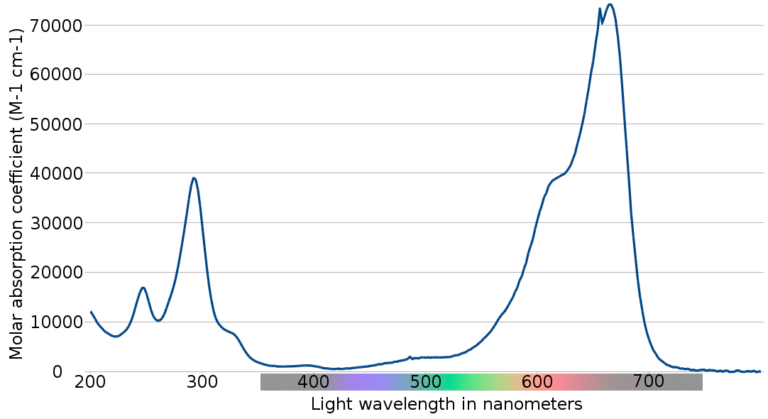
Methylene blue belongs to the phenothiazinium family of dyes. Its extended conjugated ring system gives it a strong absorption peak in the red, around 660–665 nm1 — which is, inconveniently, the wavelength of ordinary visible light. When a photon of that energy is absorbed, MB is promoted to a triplet excited state that can react with dissolved molecular oxygen to produce singlet oxygen (1O2) and other reactive oxygen species2. That is precisely the mechanism exploited in photodynamic therapy, where light activation of MB is the intended effect1. In a storage container, it is an unintended one: the ROS generated attack the MB molecule itself and drive progressive degradation2.
In aqueous solution, this process runs along two pathways. The first is photo-reduction to leuco-MB: MB accepts two electrons and a proton, converting to its colourless reduced form, leucomethylene blue. Leuco-MB is stable and can re-oxidise back to blue MB in the presence of oxygen, but in a partly-reduced solution the effective concentration of intact, oxidised MB is lower than the nominal value4. The second pathway is irreversible photo-oxidation by the very singlet oxygen that MB generates: the dye becomes its own destroying agent, producing colourless, ring-opened degradation products that cannot be regenerated2.
Methylene blue’s absorption peak falls in the visible red, meaning ordinary laboratory and household lighting — not just UV — is sufficient to initiate photo-reduction and singlet-oxygen generation in solution.1
The solid state changes the picture entirely. In a dry crystalline powder or inside an opaque HPMC capsule shell, molecular mobility is dramatically reduced and there is no solvent to sustain the ionic and radical intermediates that photo-degradation requires. The same photolability that makes MB solutions fragile makes dry MB robust: the photochemistry simply does not run at meaningful rates without the liquid medium. This is exactly the principle formalised in ICH Q1B photostability testing, where drug substances in solid and solution states are tested under different conditions because their vulnerability to light is categorically different78.
The azure B question: a real impurity in both formats
Azure B — systematic name methylenazure, also called mono-N-demethyl methylene blue — is the single most practically important impurity associated with MB. It is not unique to degraded material: azure B is present as a synthesis-related impurity in all commercial MB trihydrate, and studies measuring it in biological matrices have confirmed it as “a significant impurity in methylene blue trihydrate” even before any degradation has occurred3.
In solution, that background level can increase over time through N-demethylation, a reaction that has been documented as both a metabolic and a chemical pathway for MB3. The practical consequence is that an MB solution prepared from material with a given azure B content will, over time, accumulate more — particularly under conditions that promote oxidative chemistry. The solid form, by suppressing reactivity, holds the azure B level closer to the starting value in the raw material.
Azure B is not inert. It is a phenothiazinium dye in its own right with its own photochemical and biological activity, and its presence alters the effective composition of any preparation. This is why a properly written Certificate of Analysis for research-grade MB should quantify azure B (and ideally the full phenothiazine-related impurity profile) separately from overall purity, not simply report an aggregate HPLC figure.
Solid vs solution: a stability comparison
| Attribute | Dry capsule / bulk powder | Aqueous solution |
|---|---|---|
| Principal degradation pathways | Minimal: low molecular mobility, no solvent medium, no dissolved O2 | Photo-reduction to leuco-MB; photo-oxidation by self-generated singlet O2; hydrolytic pathways |
| Light sensitivity | Low: opaque capsule shell and dry state together suppress photoreaction | High: absorption at ~660 nm means ordinary visible light drives degradation12 |
| Azure B accumulation over time | Stable near the as-manufactured level; no significant new formation | Can increase via N-demethylation, particularly under oxidative conditions3 |
| Leuco-MB formation | Negligible in absence of solvent and reducing equivalents | Present; reversible if O2 available; can lower effective MB concentration4 |
| Recommended container | Opaque, moisture-resistant blister or amber glass with desiccant | Amber glass only; light-blocking secondary packaging where possible7 |
| Temperature | Controlled room temperature (15–25 °C), away from heat sources | Refrigerated (2–8 °C); minimises reaction kinetics |
| Usable window | Multi-year if sealed and stored correctly | Days to weeks depending on conditions; prepare fresh where possible |
| Visual degradation cue | Loss of characteristic deep blue colour of powder | Fading or near-colourlessness indicating substantial leuco-MB formation4 |
| Best-fit research use | Oral-route studies in animal models; long-term archiving of reference standard | Solution-phase assays, in vitro studies, photodynamic protocol development |
A QC-first comparison of MB in solid capsule format vs aqueous solution. The stability advantage of the solid state is mechanistically grounded, not merely conventional. All material is supplied for research use only.
What the pharmacokinetic data tells us about oral MB
For researchers interested in oral-route bioavailability studies in validated animal models, the human pharmacokinetic literature on oral MB provides a relevant formulation reference. Studies of MB given as an aqueous oral solution observed absolute bioavailability of approximately 72% in healthy volunteers5. Work with solid oral formulations (delayed-release tablets for colonic staining applications) confirmed systemic exposure after oral dosing, with time-to-peak plasma concentrations typically in the range of 12–16 hours, reflecting slow colonic release6. These are published findings from human clinical settings and are cited here as literature, not as guidance for any use of Condor material. All research-grade MB from Condor is supplied strictly for in vitro and in vivo research use only, not for human or veterinary use.
What the pharmacokinetic literature confirms — and what matters for the QC argument — is that oral MB is meaningfully absorbed, meaning that impurity levels in the starting material are not diluted away by transit. For animal-model researchers, the purity of the capsule contents is directly relevant to the biological readout.
Practical handling guidance for each format
Capsules (Condor product #670, methylene blue capsules)
Store in the original sealed container, in a cool, dry location away from direct sunlight and sources of heat. The opaque HPMC shell provides immediate shielding; the secondary packaging maintains the moisture barrier. Inspect the lot-specific Certificate of Analysis for HPLC purity, azure B level, and identity confirmation (see how to read a CoA) before use.
Solutions prepared from MB powder
Use amber glass vessels throughout. Minimise the time between preparation and use. When storage of a solution is unavoidable, refrigerate at 2–8 °C in a sealed amber vessel and exclude light during storage. Prepare solutions under subdued lighting where possible. Observe colour: fading of the characteristic deep blue toward pale blue or near-colourless indicates leuco-MB formation and should trigger fresh preparation. Do not use a solution whose colour suggests significant reduction unless the experimental design specifically calls for the leuco form.
The broader question of when to choose a capsule format over a lyophilised vial for any research compound is covered in our capsule vs vial format comparison; the principles established there apply equally to MB.
For research use only. Not for human or veterinary use, not for diagnostic or therapeutic application. Condor Research · Scientific desk — Atrio Sciences s.r.o., IČO 57 669 651, Nitra (SK). Independent laboratory analysis in CZ. info@condorresearch.com
- Methylene blue is a photosensitizer: its conjugated phenothiazine ring absorbs red light (~660 nm) and generates singlet oxygen, which attacks the dye itself in solution, producing colourless leuco-MB and driving irreversible degradation.
- In dry solid form (crystalline powder or filled capsule) the same reactions are suppressed by orders of magnitude because molecular mobility and solvent interactions are absent — ICH Q1B photostability frameworks treat solid and solution states as categorically different risk levels.
- Azure B (mono-demethylated methylene blue) is a recognised significant impurity in commercial MB trihydrate; it arises during synthesis and can also form as a degradation product in solution via N-demethylation. A valid CoA should quantify azure B separately.
- Aqueous solutions should be stored in amber glass, protected from light, refrigerated, and used within the shortest practical window; capsules store at controlled room temperature away from direct light and moisture.
- The leuco (reduced, colourless) form of MB regains colour on exposure to oxygen — a visible sign that the oxidation-reduction equilibrium has been disturbed; this matters for both the researcher and the QC chemist checking visual appearance.
Does methylene blue need to be stored in the dark?
Yes, in both formats, but the risk is far greater for solutions. As a phenothiazine photosensitizer, MB absorbs red light (~660 nm) and generates singlet oxygen that can degrade the dye itself. Solutions should be kept in amber glass, away from direct light. Solid capsules are inherently shielded by the opaque shell, but should still be kept out of prolonged direct sunlight and stored in a cool, dry place.
What is leuco-methylene blue and why does it matter?
Leuco-methylene blue is the reduced, colourless form of MB. It forms when MB accepts electrons — which light and reducing agents in solution can facilitate. The conversion is partially reversible: leuco-MB re-oxidises back to blue MB in the presence of oxygen. For researchers, a solution that has turned pale or colourless has partially converted to the leuco form, meaning the effective concentration of intact oxidised MB is lower than expected.
What is azure B and is it in Condor’s methylene blue?
Azure B (mono-N-demethyl methylene blue) is a mono-demethylated analogue present as a synthesis-related impurity in all commercial MB trihydrate at varying levels, and can also form as a degradation product in solution over time. Condor Research’s methylene blue is characterised by HPLC with independent CoA documentation; azure B and other related substance levels are declared on that document.
How long does a methylene blue solution stay stable once prepared?
There is no universal answer because stability depends on concentration, solvent, container material, oxygen content, light exposure, and temperature. As a principle derived from ICH Q1B photostability practice, any solution of a photosensitive compound should be treated as having a short working window and prepared freshly whenever possible.
Is a capsule format just a convenience, or does it offer genuine stability advantages?
It offers a genuine, mechanistically grounded stability advantage for the dry compound. The solid state eliminates the hydrolytic and photo-driven degradation pathways that operate in solution. For research workflows that study oral exposure routes in validated animal models, the capsule also provides pre-portioned consistency. However, a capsule cannot be used for solution-based or in-vitro assays requiring defined working concentrations; those studies still require reconstitution from a characterised solid.
Can I dissolve the capsule contents to make a solution?
The powder from a capsule can be dissolved in an appropriate solvent in the same way as any bulk MB powder. The stability considerations described above then apply to the resulting solution. For research purposes, prepare solutions fresh, use amber glass, and store under refrigeration when not in immediate use. See also the capsule vs vial comparison for broader context on format choice.