
Is Research-Market Retatrutide Legit? The Drug, the Vial, and the Gap Between Them
Retatrutide is a real phase III triple agonist that produced some of the largest weight-loss figures in trial history. The vial sold on a research-chemical site is not that drug — and here is the honest distinction.
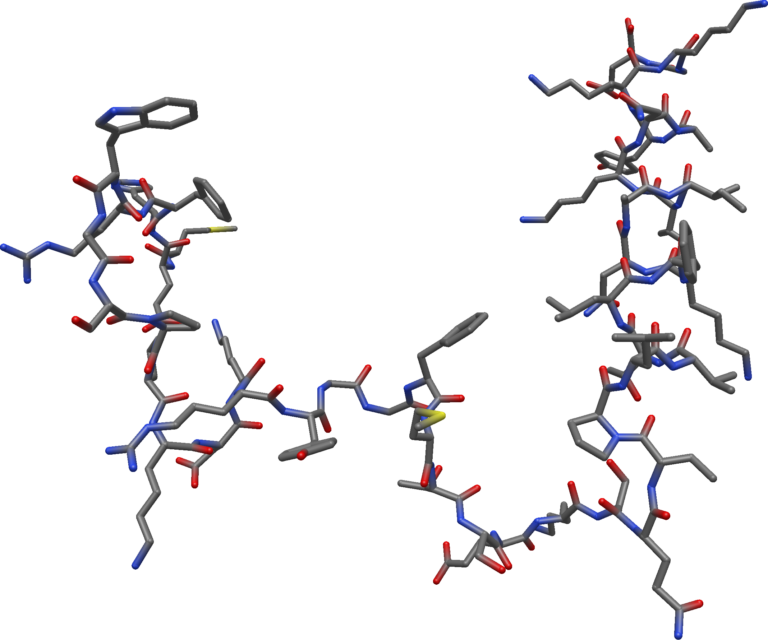
The science behind Retatrutide is unambiguously real: it is an Eli Lilly triple agonist (GIP, GLP-1 and glucagon receptors) in phase III trials that produced striking weight-loss data, with the TRIUMPH-1 trial reporting up to 28.3% average reduction at 80 weeks and extension data passing 30%. But a gray-market research vial is not that characterised investigational drug; its identity and purity are unknown unless a batch-specific Certificate of Analysis proves otherwise. Retatrutide is not an approved medicine anywhere, and Condor supplies it strictly as a research-use-only reference material — never for human use and with no dosing.
Type three words into a search bar — “is retatrutide legit” — and you are really asking two questions wearing one coat. The first is about a molecule: is the science behind this much-hyped triple agonist actually as remarkable as the headlines say? The second is about a transaction: is the white powder in a vial from a research-chemical site the same thing those headlines are about? The answers point in opposite directions, and the gap between them is the entire story.
Retatrutide is real. It is one of the most closely watched investigational drugs in metabolic medicine, the next rung on a ladder that climbed through semaglutide and tirzepatide.4 It is also — in the form most people picture when they imagine buying it — not for sale to anyone. Untangling that is what separates an informed researcher from a hopeful shopper.
What exactly is Retatrutide, and who makes the real one?
Retatrutide (development code LY3437943) is a single engineered peptide that acts on three receptors at once: the receptors for GIP, GLP-1 and glucagon.1 That third target is the twist. Semaglutide hits GLP-1; tirzepatide adds GIP; Retatrutide layers glucagon-receptor agonism on top, and in preclinical and mechanistic work glucagon does something its predecessors do not — it appears to nudge energy expenditure and hepatic fat oxidation upward rather than only dialling appetite down.2 Structural studies have since mapped exactly how a single molecule engages all three receptors, confirming the pharmacology is a genuine step beyond the dual agonists rather than a marketing flourish.2
The real one is made by Eli Lilly. It is a defined 39-amino-acid peptide, manufactured to pharmaceutical specifications, characterised down to the impurity, and advanced through a registrational programme — the TRIUMPH phase 3 trials in obesity and the TRANSCEND programme in type 2 diabetes and chronic kidney disease.78 When researchers and clinicians discuss “Retatrutide,” this is the object they mean: a rigorously controlled investigational drug, not yet approved anywhere, but real in every sense the word implies.
Why is everyone talking about Retatrutide?
Because the numbers are arresting. The reason the search term exists at all is a cluster of widely reported figures: in the phase 3 TRIUMPH-1 trial, Retatrutide produced average weight loss of up to 28.3% at 80 weeks at the highest dose, with extension data carrying some participants past 30% — among the largest reductions ever recorded in an obesity drug trial, approaching territory once reserved for bariatric surgery.7 The earlier phase 2 trial had already shown placebo-adjusted reductions of roughly 24% at 48 weeks, an unusually steep curve that did not obviously plateau.1 Network meta-analyses of the incretin class place Retatrutide among the most effective agents for weight reduction, alongside tirzepatide.4
Mean weight loss reported in TRIUMPH-1 extension data at 104 weeks in a subgroup maintained on the highest dose — building on the 28.3% primary-endpoint figure at 80 weeks, and the single set of numbers driving most of the “is it legit” searches.7
The story does not stop at the scale. Beyond weight, the diabetes programme — including the phase 3 TRANSCEND-T2D-1 readout — reported strong glycaemic control alongside weight reduction, with average HbA1c falling by up to roughly two percentage points.8 Investigators have also begun probing kidney outcomes in chronic kidney disease through the TRANSCEND-CKD trial, and metabolic effects across organ systems.3 If you want the full ladder of incretin drugs and where Retatrutide sits on it, our semaglutide vs tirzepatide vs retatrutide comparison walks through each rung; the Retatrutide primer covers the molecule itself.
So is the vial on a research-chemical site the same drug?
No — and this is the crux of the legitimacy question. The molecule under regulatory review and the powder in a gray-market vial are two different objects that happen to share a name. One is a defined investigational drug whose every batch is documented; the other is a research chemical whose contents are unknown until something independent verifies them.
Consider what “manufactured to specification” actually buys you. Retatrutide is a 39-residue peptide, and assembling a peptide of that length cleanly is genuinely hard.1 A truncated chain, a deletion sequence, an incompletely deprotected intermediate, residual solvent: any of these can ride along in a batch that “looks like” white powder. The approved investigational drug is held to limits on exactly these impurities. A vial bought as a research chemical carries no such guarantee unless its specific batch has been independently tested and the result handed to you.
| Dimension | Investigational drug (in Lilly’s trials) | Research-market vial (gray market) |
|---|---|---|
| Manufacturing & identity | Pharmaceutical-grade, batch-characterised, impurities controlled7 | Unknown unless a batch-specific COA proves identity and purity |
| Legal / regulatory status | Unapproved investigational drug under formal review8 | Unapproved research chemical; not a medicine |
| What can honestly be claimed | Phase 3 efficacy and safety data, in trial populations7 | Only what its Certificate of Analysis documents — identity, purity, nothing more |
The same name does not make the same product. Trial efficacy belongs to the characterised drug; a research vial inherits none of it without independent proof of what it contains.
This is why the honest answer to “is it legit” refuses to be a simple yes or no. The science is legit. A gray-market product is only as legit as the document that proves what is inside it.
What does the honest evidence actually say — and not say?
Intellectual honesty cuts in two directions here, and both matter. On the one hand, the efficacy signal is not hype: it rests on randomised phase 3 trial data, a coherent mechanistic story about why triple agonism outperforms dual, and meta-analytic comparisons against other incretin agents.427 On the other hand, several caveats deserve to be stated plainly.
First, Retatrutide is not an approved medicine — anywhere, for any use. It is in phase III; the registrational readouts are recent, and regulatory review takes time.87 A research-market vial is emphatically not “the drug you read about,” because that drug does not yet exist as an approved product. Second, the most dramatic figures come from controlled trials in defined patient populations, under medical supervision, using a characterised compound — conditions that share nothing with a vial of unverified powder.1 Third, like the whole incretin class, the safety profile in trials includes real adverse effects — predominantly gastrointestinal — and the long-term cardiovascular, kidney and metabolic picture is still being assembled across ongoing outcome trials.13 Quoting a 30% weight-loss headline without mentioning that it came from a supervised phase 3 trial, in a specific population, is the kind of half-truth that makes a number misleading.7
And a final honesty: for a research-market vial, none of the trial data transfers automatically. A phase 3 readout tells you about the molecule Lilly tested — not about the contents of a vial whose identity has not been confirmed.7 The evidence is about a thing; whether you actually hold that thing is a separate empirical question, answered only by analysis.
How should a researcher judge a research-use-only vial?
By the paperwork, not the promise. In a market where the headline molecule is genuinely impressive, the only thing that distinguishes a credible reference material from an unknown is documentation: a batch-specific Certificate of Analysis establishing identity by mass spectrometry and purity by HPLC. Everything else — the brand, the label, the packaging — is marketing. Our guide on how to read a Certificate of Analysis shows what a real one looks like, and our FDA peptide review of July 2026 covers the shifting regulatory backdrop.
Condor Research supplies Retatrutide strictly as a research-use-only reference material — for in-vitro and laboratory research only, not for human or veterinary use, with no dosing, protocols or therapeutic claims of any kind. The trial efficacy described above belongs to Eli Lilly’s characterised investigational drug; it is reported here as scientific context, not as a property of any product on this site.78 What we can stand behind is what a Certificate of Analysis lets us stand behind: the identity and purity of the specific material in the vial. That is the whole of the legitimacy a research compound can honestly carry — and, in a gray market full of unverified powder, it is the part that actually matters.
- Retatrutide (LY3437943) is a genuine GIP, GLP-1 and glucagon receptor triple agonist developed by Eli Lilly, now in phase III registrational trials.
- Its phase 3 TRIUMPH-1 readout reported up to 28.3% average weight loss at 80 weeks, with extension data exceeding 30% in some participants — among the largest figures in obesity-trial history.
- The molecule under regulatory review is a rigorously manufactured 39-amino-acid investigational drug; a research-market vial is an unapproved chemical of unknown identity and purity.
- The honest verdict: the science is legit, but a gray-market product is only as legit as the third-party Certificate of Analysis that documents the specific batch.
- Retatrutide is not an approved medicine anywhere; Condor supplies it strictly as a research-use-only reference material, never for human use and with no dosing or therapeutic claims.
Is Retatrutide a real drug or a scam?
The drug is real. Retatrutide (LY3437943) is an Eli Lilly triple agonist of the GIP, GLP-1 and glucagon receptors, now in phase III trials, with phase 3 TRIUMPH-1 weight loss reported at up to 28.3% at 80 weeks and extension data past 30% in some participants. The scam risk is not the science but the supply chain: a research-market vial is not the investigational drug, and its identity and purity are unknown unless a batch-specific Certificate of Analysis documents them.
Is research-market Retatrutide the same as the drug in the TRIUMPH trials?
No. The TRIUMPH trials used Eli Lilly's characterised, pharmaceutical-grade investigational drug with controlled impurities. A vial sold as a research chemical shares the name but inherits none of that assurance. The trial efficacy data describe the defined 39-amino-acid molecule, not whatever a gray-market vial actually contains, which only independent analysis can confirm.
Is Retatrutide approved or legal to buy as a medicine?
Retatrutide is not an approved medicine anywhere; it remains an investigational drug under regulatory review following its phase III readouts. It is supplied only as a research-use-only reference material, not for human or veterinary use, and is not a weight-loss product.
Why does Retatrutide get such large weight-loss numbers?
Its third target sets it apart. Adding glucagon-receptor agonism to GIP and GLP-1 activity appears, in mechanistic and preclinical work, to raise energy expenditure and fat oxidation rather than only suppressing appetite, which reviewers credit for the step-change over dual agonists like tirzepatide. The phase 3 TRIUMPH-1 figure of up to 28.3% average weight loss reflects that combined mechanism in a supervised trial population.
How do I know if a Retatrutide vial is legitimate?
Judge it by its Certificate of Analysis, not its label. A credible research material comes with batch-specific documentation establishing identity by mass spectrometry and purity by HPLC. Without that, the contents are unverified regardless of branding. The COA is the only evidence that transfers to the actual vial in front of you.