
Cortagen vs Cerluten vs Cortexin: Synthetic Peptide, Natural Extract, and Registered Drug
Cortagen, Cerluten and Cortexin are three different kinds of material: a synthetic tetrapeptide, an undefined cortex extract, and a registered drug. What the literature actually shows.
The three names are not interchangeable. Cortagen is a defined synthetic tetrapeptide (Ala-Glu-Asp-Pro) with animal-only data; Cerluten is a natural cortex extract with no indexed scientific literature; Cortexin is a registered Russian medicine with published clinical trials. Only one holds a real clinical file.
Three products get filed together under the same loose heading — “brain peptides”, “cortex peptides”, “Khavinson peptides” — and the grouping hides the most important fact about them: they are not the same kind of thing. Cortagen is a single synthetic molecule with a known four-amino-acid sequence. Cortexin is a registered pharmaceutical made from animal brain tissue, sold as a drug in Russia and studied in formal trials. Cerluten is a commercial extract with, as far as the indexed scientific record is concerned, no literature at all. Sorting one registered drug’s clinical file from two research reagents — one of which has no science behind it — is the entire job of this page. Everything below describes laboratory and literature findings, not use in people.
What is Cortagen, structurally?
Cortagen is a synthetic tetrapeptide, Ala-Glu-Asp-Pro (abbreviated AEDP), belonging to the “Cytogen” family of short synthetic peptides associated with the St. Petersburg gerontology school of Vladimir Khavinson. The sequence is not in doubt. Two independent reports state it directly: a mouse cardiac gene-expression study describes Cortagen as the tetrapeptide Ala-Glu-Asp-Pro obtained by directed synthesis1, and an in-vitro splenocyte study lists the same sequence alongside its cousins Vilon (Lys-Glu) and Epithalon (Ala-Glu-Asp-Gly)2. So Cortagen is a fully defined chemical entity — you can write its structure, weigh it, and confirm it by mass spectrometry. That alone separates it from the other two products discussed here.
The origin story is worth stating precisely, because it is the source of most of the confusion. The originating group reports that Cortagen was designed by taking the amino-acid analysis of the natural cortex preparation Cortexin and synthesising a short peptide from the dominant residues1. That is the seed of the popular claim that “Cortagen is the active fragment of Cortexin”. Note what the claim actually rests on: a manufacturer-described derivation, not an independently demonstrated equivalence. More on that below.
4 Cortagen is four amino acids long; Cortexin is an uncharacterised mixture, and Cerluten’s composition is not described in any indexed paper.
What does the Cortagen literature actually show?
The primary literature on the isolated synthetic peptide is entirely preclinical. In a rat sciatic-nerve model, intramuscular Cortagen was reported to increase the growth rate of regenerating fibres and nerve conduction velocity by 27% and 40% respectively3. Antioxidant work in rats found that Cortagen and Epithalon reduced lipid-peroxidation products and protein oxidative modification in serum and cerebral cortex5. In an ischemic-preconditioning model, neurospecific peptide preparations of this class reduced neurological deficit6. At the molecular level, an in-vitro splenocyte assay showed weak activation of the interleukin-2 gene2, and a microarray study reported gene-expression shifts in mouse heart1.
There is one unusually useful study: a rat chronic-ischemia model that put the polypeptide preparation Cortexin and the synthetic peptide Cortagen side by side, and found both improved behaviour and reduced lipid peroxidation4. That head-to-head is rare and it is animal-only. Across all of this, there is no human clinical trial of the isolated synthetic Cortagen peptide.
A defined molecule with real animal data is still an early-stage research reagent, not a medicine.
What is Cortexin, and why is it different?
Cortexin is a registered Russian medicine: a polypeptide complex extracted from cattle and pig cerebral cortex, manufactured by Geropharm. Unlike Cortagen, it has a genuine human clinical-trial record. The DIACORT study was a multicenter, parallel-group, randomized clinical trial (n=110) of Cortexin in the neurological complications of type 2 diabetes7. A separate clinical study examined Cortexin in post-stroke aphasia patients (n=71)10. Importantly, some evidence comes from outside the originating school: a rodent study directly compared Cortexin against Cerebrolysin and Actovegin in ischemia models8, and a blinded, placebo-controlled embolic-stroke study from the Chopp laboratory benchmarked peptide preparations of this type against Cerebrolysin9.
Cortexin is a comparator drug in this discussion, nothing more. It is not sold by Condor Research and appears here only as literature context. Its closest analogue, Cerebrolysin, is a porcine-brain-derived peptide-and-amino-acid mixture used clinically in Russia, Eastern Europe and parts of Asia and essentially absent from Western practice — the same regional pattern applies to Cortexin.
What is Cerluten?
Cerluten is described commercially as a natural polypeptide extract of cerebral cortex, part of the “Cytomax” natural-extract line — the parallel product family to the synthetic Cytogen peptides. Here the honest answer is short: the term “Cerluten” returns zero hits on PubMed under any framing. It has no indexed scientific literature. It is a supplement and reagent brand name, not a term the primary literature uses. Anything said about Cerluten’s “activity” is a manufacturer or marketing description, and it cannot borrow the clinical data that belongs to Cortexin, nor the animal data that belongs to Cortagen.
| Property | Cortagen | Cerluten | Cortexin |
|---|---|---|---|
| Kind of material | Synthetic tetrapeptide | Natural cortex extract | Registered drug (extract) |
| Defined structure? | Yes — Ala-Glu-Asp-Pro | No (undefined mixture) | No (undefined mixture) |
| Primary literature | Animal / in vitro only | None indexed (0 hits) | Clinical trials + preclinical |
| Human trials | None | None | Yes (RCT, e.g. DIACORT) |
| Sold by Condor? | Yes (research reagent) | Research reagent | No (drug, comparator only) |
All entries describe research materials or literature status only. No row implies human use, benefit, or a dosing regimen. Cortexin is included solely as a registered-drug comparator and is not a Condor product.
An honest read of the evidence
Set the three products against each other honestly and the picture is uneven. Cortagen’s human efficacy is unproven — every isolated-peptide study is animal or in vitro, and almost all of it comes from the Khavinson/St. Petersburg lineage and its collaborators. That is a single-lineage evidence base with little independent Western replication, and the mechanistic claims (epigenetic and heterochromatin effects, gene-expression shifts) cluster in a small set of authors and specialised journals. Treat those as hypothesis-generating, not established. The Khavinson group’s own reviews positioning this peptide line for cognitive disorders12 are useful for understanding the framing but are themselves a marker of that single-lineage promotion.
Cerluten is the starkest case: no indexed literature at all. There is nothing to appraise, so any claim about it is marketing, not evidence, and it must never inherit Cortexin’s trials or Cortagen’s animal data. Cortexin has the strongest file of the three, but even that comes with heavy caveats — the clinical trials are overwhelmingly Russian-language, single-country, often small and open-label or observational, and concentrated in one journal (Zh Nevrol Psikhiatr im S.S. Korsakova). Publication and regional-practice bias are real concerns. And the whole class fares poorly under rigorous appraisal: the 2023 Cochrane review of the analogous drug Cerebrolysin found no convincing benefit for acute ischaemic stroke and flagged small, mostly regional trials11. That external yardstick should temper any halo effect around Cortexin — and, by extension, any hope that its reputation transfers to the two research reagents. Finally, the neat “Cortagen is the active fragment of Cortexin” story is an originating-lab narrative: Cortexin’s exact composition is not fully characterised, so the equivalence is asserted, not proven.
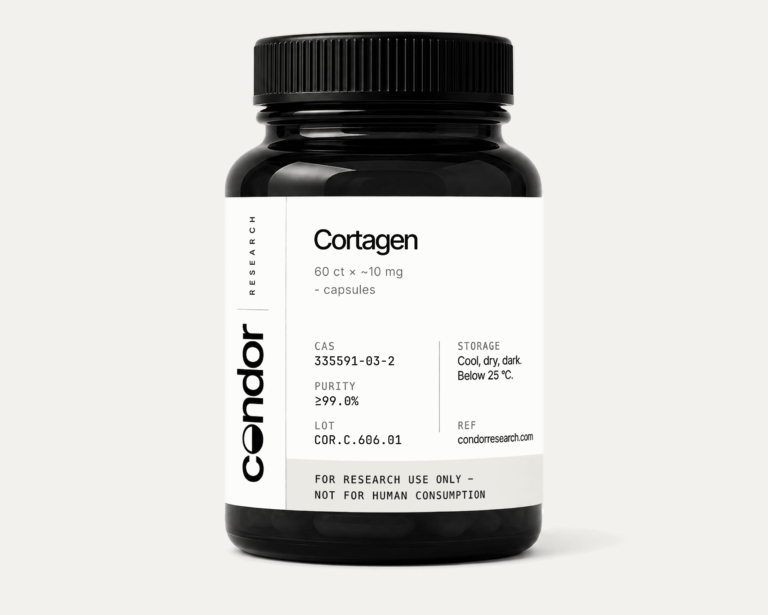
If you want the background on the people and product families behind these names, see who Vladimir Khavinson was, the full bioregulator catalog, and the dedicated page on what Cortagen is. A related synthetic peptide from the same line is covered in Pinealon. The synthetic Cortagen peptide is available as a research reagent — Cortagen capsules — strictly for laboratory and literature work.
All materials supplied by Condor Research are Research Use Only (RUO). Everything above reflects in-vitro and literature findings and is not a dosing protocol, clinical guidance, or a safety assessment for any organism. Cortexin is discussed only as a registered comparator drug in the published literature and is not offered for sale by Condor Research.
Condor Research · Scientific desk
Atrio Sciences s.r.o., IČO 57 669 651, Nitra (SK) · info@condorresearch.com
- Cortagen is a sequence-defined synthetic tetrapeptide (Ala-Glu-Asp-Pro, AEDP) from the Khavinson 'Cytogen' line, made by directed synthesis from the amino-acid analysis of the cortex preparation Cortexin.
- Every study of the isolated Cortagen peptide is preclinical — rat, mouse, or in vitro — and dominated by a single research lineage. There are no human trials of the synthetic peptide.
- Cortexin is a registered Russian polypeptide medicine (Geropharm) with genuine published clinical trials, including the DIACORT multicenter RCT and a post-stroke aphasia study.
- Cerluten has zero PubMed footprint. Under every framing the search returns nothing, so it is a commercial extract brand, not a term used in the primary literature.
- The nearest analogue drug, Cerebrolysin, failed to show convincing benefit for acute ischaemic stroke in a 2023 Cochrane review — the honest yardstick for this whole peptide-mixture class.
- Cortagen is not a 'mini-Cortexin'. The derivation narrative comes from the originating lab; independent proof of equivalence does not exist.
Is Cortagen just a synthetic version of Cortexin?
Not quite. The originating group reports that Cortagen (Ala-Glu-Asp-Pro) was designed by directed synthesis from the amino-acid analysis of the cortex preparation Cortexin. That describes an origin, not proven equivalence. Cortexin is an uncharacterised mixture, so calling Cortagen its "active fragment" is a manufacturer narrative, not an independently demonstrated fact.
Does Cerluten have any published research?
No. The term "Cerluten" returns zero PubMed hits under any framing. It is a commercial cortex-extract brand from the Cytomax natural-extract line and has no indexed primary literature. Claims about it are marketing descriptions, not evidence, and it cannot borrow data from Cortexin or Cortagen.
Which of the three is an actual medicine?
Only Cortexin. It is a registered Russian drug (Geropharm) with formal clinical trials, including the DIACORT multicenter randomized trial in diabetic neurological complications and a post-stroke aphasia study. Cortagen and Cerluten are research materials, not registered medicines.
What has Cortagen been shown to do in studies?
In animal and in-vitro work only: a rat sciatic-nerve study reported increased fibre regeneration and conduction velocity, rat studies reported antioxidant effects, and cell and microarray work reported modest gene-expression changes. None of this involves humans, and none of it establishes a clinical effect.
How reliable is the evidence overall?
Mixed and, for the class as a whole, weak under strict appraisal. Cortagen's data are single-lineage and preclinical; Cerluten has none; Cortexin's trials are mostly small, Russian-language and regional. The 2023 Cochrane review of the analogous drug Cerebrolysin found no convincing benefit for acute stroke, which is the honest reference point for the whole peptide-mixture family.
Are these interchangeable for research purposes?
No. A defined synthetic tetrapeptide, an undefined cortex extract, and a registered pharmaceutical mixture are three different materials with three different literature profiles. Substituting one for another in a research design would confound any result, and none of them should be read as equivalent to the others.