
Melanocortins: From Vyleesi to Melanotan II
Tanning and arousal run through the same family of receptors. That single fact explains both Melanotan II’s appeal and its downfall — and why pharmacology eventually chose selectivity over the catch-all peptide.
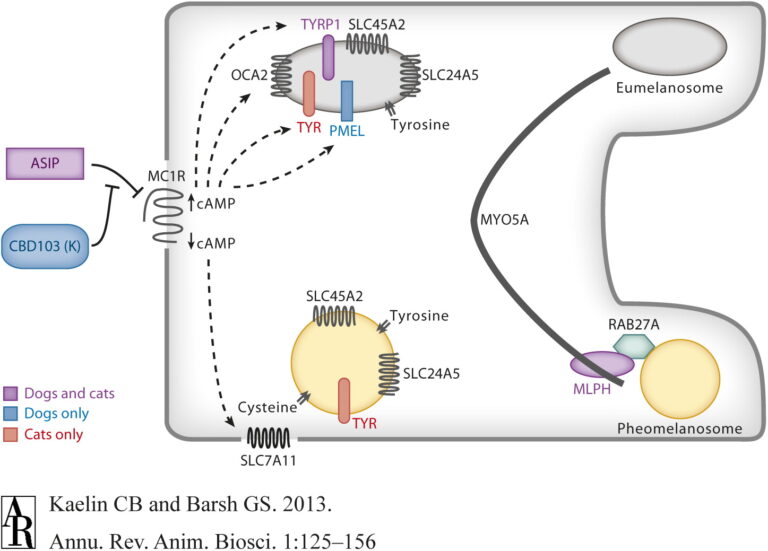
The melanocortin system is a family of five receptors governing pigmentation, appetite and sexual signalling. Non-selective Melanotan II engages several of them at once and is not approved anywhere, circulating only on the gray market; its selective descendants (bremelanotide, setmelanotide, afamelanotide) became approved drugs by aiming at a single receptor. Condor supplies all of these strictly as research-use-only reference materials with a Certificate of Analysis, never for human or veterinary use.
It is one of biology’s stranger coincidences that the hormone which darkens your skin in summer also speaks the language of hunger and arousal. The body, it turns out, did not build separate machinery for getting a tan, feeling full and feeling aroused. It built one ancient signalling family and let evolution divide the labour between its members. That single fact — that pigmentation and sexual signalling are cousins, wired through the same set of receptors — is the key that unlocks the whole melanocortin story. It explains why a peptide marketed as a “tanning agent” also caused erections and nausea, why that peptide stalled while its more disciplined relatives became approved medicines, and why a forum peptide shop will never tell you the full version.
What is the melanocortin system, and why does it control such different things?
Melanocortins are short peptides — α-MSH and the ACTH fragments chief among them — carved from a single precursor protein. They act on a family of five G-protein-coupled receptors, MC1R through MC5R, and the elegance of the system lies in how it splits its duties by location. MC1R sits on the pigment-making melanocytes of the skin and tunes how much dark eumelanin they produce. MC4R lives largely in the brain, where it is a master switch for energy balance and a node in the circuitry of sexual response. The remaining receptors handle steroid output and other peripheral roles. Same chemical vocabulary; entirely different conversations, depending on which receptor happens to be listening.
This is why the pharmacology of melanocortin agonists reads like a list of seemingly unrelated effects. Work mapping the receptor activity of Melanotan II — a synthetic, cyclic, non-selective agonist — finds it engaging multiple human melanocortin receptors rather than picking one,10 and chemists have since used it as a scaffold precisely because of that promiscuity, modifying its structure to probe how selectivity might be engineered in.7 In animal models the breadth is striking. Microinjected into the nucleus accumbens, Melanotan II suppressed appetitive and consumptive responding for food in rodents,9 a clean demonstration of the MC4R appetite arm. Other rodent work reports it partially rescuing impaired thermogenic capacity,13 reversing memory impairment induced by a high-fat diet,8 and producing antidepressant-like and antistress effects alongside the related peptide Semax.6 One molecule, many doors — because it knocks on all of them at once.
Why did Melanotan II stall while its relatives became approved drugs?
Here is the pivot the field turned on. A non-selective key opens every lock, which sounds like an advantage until you remember that some of those locks should have stayed shut. Hit MC1R and you darken pigment; hit MC4R and you alter appetite and sexual signalling; hit them together and you get a tan, a flush of nausea and an erection from the same molecule. The breadth that made Melanotan II interesting is exactly what made it unviable as a medicine. The body’s response could not be aimed.
The lesson the pharmaceutical industry drew was simple to state and hard to execute: build a key that fits one lock. That principle of functional selectivity is now an explicit design goal, with researchers screening Melanotan-II-derived libraries specifically to find agonists that activate a single receptor subtype cleanly rather than the whole family.10 The pay-off was real medicines. Bremelanotide (Vyleesi), a melanocortin agonist weighted toward central MC4R signalling, was approved by the FDA in 2019 for hypoactive sexual desire disorder in certain women. Setmelanotide, a selective MC4R agonist, was approved for rare monogenic forms of obesity. Afamelanotide, an α-MSH analogue, became an approved phototoxicity therapy. Melanotan II, the non-selective forerunner from which several of these ideas descend, was approved nowhere.
The year bremelanotide (Vyleesi) won FDA approval. Together with setmelanotide and afamelanotide, the selective melanocortin agonists reached the clinic — while the non-selective parent, Melanotan II, remains approved in no jurisdiction.
| Agonist | Selectivity & target | Status / indication |
|---|---|---|
| Melanotan II | Non-selective (MC1R, MC3R, MC4R, MC5R) | Not approved anywhere; gray market |
| Bremelanotide (Vyleesi) | Central, MC4R-weighted | FDA-approved 2019 — HSDD (certain women) |
| Setmelanotide | Selective MC4R | Approved — rare monogenic obesity |
| Afamelanotide | α-MSH analogue, MC1R-leaning | Approved — phototoxicity (EPP) |
The melanocortin agonists, ranked roughly by how narrowly they aim. Selectivity, not potency, is what separated the approved descendants from the gray-market parent.
What does the evidence actually show about Melanotan II?
Honesty requires conceding the uncomfortable part: in a narrow sense, Melanotan II “works.” A large body of preclinical work establishes that it does produce melanocortin effects — pigmentation among them — which is precisely why it found a gray-market audience. The molecule is real, and its chemistry is well characterised down to its cyclic peptide structure and its tissue distribution.715 The problem was never that it does nothing. The problem is the bill that comes attached to the breadth.
That bill is documented in the clinical literature as a string of case reports, and the research reader deserves to see them plainly. Injected Melanotan II has been associated with priapism — prolonged, painful erection — reported both as an overdose phenomenon3 and as a rare cause traced to tanning injections.12 It has been linked to rhabdomyolysis with systemic toxicity, the breakdown of muscle tissue,2 and in one report to renal infarction, a clot-driven death of kidney tissue.1 Because the peptide drives pigmentation indiscriminately, clinicians have flagged changes to the oral mucosa in a case report4 and raised the spectre of melanoma risk, including a case framing nasal-spray use as a possible risk factor for oral mucosal malignant melanoma5 — a particular concern, the authors note, in anyone with atypical naevi. A qualitative study of online user forums, meanwhile, captures a community trading exactly these effects as folklore.14 None of this is dosing guidance; it is a hazard ledger.
The gray-market context compounds the risk. What circulates is not a regulated product but black-market material, and analytical chemists have had to develop methods simply to identify what is in the vials — one study using LC-HRMS to characterise Melanotan II and bremelanotide sold on the illicit market for performance- and image-enhancing drugs.11 When a substance requires forensic mass spectrometry to confirm its identity and purity, that absence of any quality guarantee is itself part of the hazard.
Where does this leave the responsible researcher?
The melanocortin story is, in the end, a parable about precision. The system’s beauty is that one peptide language controls pigment, appetite and arousal through different receptors in different tissues; the field’s maturity arrived when medicinal chemists learned to speak to one receptor at a time. Selective agonists like bremelanotide and setmelanotide are the disciplined descendants. Melanotan II is the untargeted ancestor — pharmacologically instructive, commercially abandoned, and approved by no regulator for any human use.
For that reason Condor Research supplies Melanotan II, bremelanotide and the wider melanocortin family strictly as research-use-only reference materials. None is a medicine; none is intended for human or veterinary use; nothing here is a protocol. What a laboratory can legitimately demand of a reference compound is the one thing the gray market cannot provide: verified identity and purity, documented on a Certificate of Analysis. In a class of molecules where a non-selective key opens too many doors, knowing exactly which molecule is in the vial is not a luxury — it is the whole point. For the compound-specific background, see our Melanotan II primer.
- Five melanocortin receptors split the labour: MC1R drives pigmentation while MC4R drives appetite and sexual signalling — so one non-selective peptide produces tanning, arousal and nausea together.
- Melanotan II is non-selective and not approved in any jurisdiction; it persists only on the gray market, where analytical studies have detected it alongside bremelanotide.
- Selectivity is the whole story of the field’s success: bremelanotide (Vyleesi, FDA 2019) and setmelanotide became approved drugs by targeting MC4R rather than the entire receptor family.
- Published case reports tie injected Melanotan II to serious harms — priapism, rhabdomyolysis, renal infarction and oral-mucosal changes — with melanoma concern in atypical naevi; these are documented case-report findings, not usage guidance.
- Condor supplies all melanocortin peptides strictly as research-use-only reference materials with a Certificate of Analysis; none is an approved medicine for its headline use.
Is Melanotan II an approved medicine?
No. Melanotan II is not approved as a medicine in any jurisdiction. It circulates on the gray market, where analytical studies have had to use mass spectrometry simply to confirm what the vials contain. Condor supplies it strictly as a research-use-only reference material with a Certificate of Analysis, never for human or veterinary use.
How is Melanotan II different from bremelanotide (Vyleesi)?
Both are melanocortin receptor agonists, but selectivity divides them. Melanotan II is non-selective, engaging multiple melanocortin receptors at once, which produces pigmentation, appetite and sexual signalling together. Bremelanotide is weighted toward central MC4R signalling and was approved by the FDA in 2019 for hypoactive sexual desire disorder in certain women. Selectivity, not potency, is what separated them.
Why does one peptide affect both tanning and sexual signalling?
Because the melanocortin system uses one chemical vocabulary across a family of five receptors that sit in different tissues. MC1R on skin melanocytes drives pigmentation; MC4R in the brain governs appetite and sexual response. A non-selective agonist like Melanotan II activates several at once, which is why a peptide marketed for tanning also has effects on arousal and appetite.
What adverse events have been reported with Melanotan II?
Published case reports document serious harms following injected Melanotan II, including priapism (prolonged painful erection), rhabdomyolysis with systemic toxicity, renal infarction, and changes to the oral mucosa, with concern raised over melanoma risk in people with atypical naevi. These are reported case-report findings in humans; none of this constitutes dosing or usage guidance, and the compound is supplied research-use-only.
What are setmelanotide and afamelanotide?
They are approved, selective descendants of melanocortin pharmacology. Setmelanotide is a selective MC4R agonist approved for rare monogenic forms of obesity. Afamelanotide is an alpha-MSH analogue approved as a phototoxicity therapy. Both illustrate the field's central lesson: targeting a single receptor cleanly is what turned melanocortin agonists into approved medicines.