
What Is Livagen? The Lys-Glu-Asp-Ala (KEDA) Liver Bioregulator
Livagen is the tetrapeptide Lys-Glu-Asp-Ala (KEDA), a Khavinson liver bioregulator studied for chromatin decondensation in old-donor lymphocytes. A cited, RUO look at the real evidence.
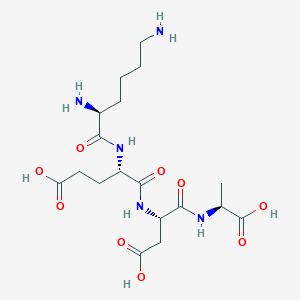
Livagen is a synthetic tetrapeptide, Lys-Glu-Asp-Ala (KEDA, C18H31N5O9), from the Khavinson Cytogen bioregulator family. It was derived from liver-extract amino-acid analysis and is studied in vitro for reactivating age-silenced chromatin. It is Research Use Only; no human trials exist.
Livagen is one of the shorter members of the Khavinson “Cytogen” peptide program: a synthetic tetrapeptide with the sequence Lys-Glu-Asp-Ala, usually abbreviated KEDA from its single-letter amino-acid code. It sits alongside Vilon, Epitalon and Cortagen in a body of work built almost entirely around one phenomenon — the reopening of tightly packed “aged” chromatin in cultured cells from elderly donors. Everything below describes laboratory and literature findings, not use in people or animals.
What is Livagen, structurally?
Livagen is a linear tetrapeptide built from four residues in fixed order: L-lysine, L-glutamic acid, L-aspartic acid and L-alanine. The sequence Lys-Glu-Asp-Ala appears verbatim across multiple independent PubMed abstracts, so the identity of the molecule is not in doubt129. Its chemistry is equally well pinned: molecular formula C18H31N5O9, a average molecular weight near 461.5 g/mol, and an independent structural record under PubChem CID 8791968312.
The CAS number is where things get muddier. Vendors cite Livagen as 195875-84-4, and some list a deprecated or alternate 402856-42-2. Neither is carried by PubMed, and the two disagree, so the honest position is to treat any CAS you see as vendor-sourced metadata and to anchor identity on the PubChem chemistry instead. When a compound’s registry numbers conflict across suppliers, the formula and CID are the reliable fingerprint.
461.5 the approximate molecular weight in g/mol of the KEDA tetrapeptide (C18H31N5O9), per its independent PubChem record.
Why is it called a “liver” bioregulator?
The label is a matter of derivation, not of demonstrated human hepatology. Livagen came out of the St. Petersburg Institute of Bioregulation and Gerontology, where the working method was to analyse the amino-acid composition of tissue-specific polypeptide extracts and then synthesise short peptides that recapitulated a dominant motif. For Livagen, that source tissue was liver: the KEDA sequence was drawn from amino-acid analysis of liver polypeptide extracts, which is what ties the peptide to the organ2. A same-lineage 2020 review restates the identity plainly — “KEDA tetrapeptide (Lys-Glu-Asp-Ala, Livagen)” — and summarises claimed hepatoprotective and immunoprotective effects in animal liver-pathology models3.
There is also tissue-specific in-vitro work. In cultured rat hepatocytes, Livagen was reported to raise protein synthesis with the largest effect in cells from old animals, while Epitalon under the same conditions did not2. In organotypic liver culture, the tetrapeptide was described as stabilising cell-population morphology and reinforcing regenerative processes10. These are cell- and tissue-culture observations, not outcomes in a living liver, and certainly not in a human one.
The “liver” in liver bioregulator describes where the peptide’s sequence was read off, not a proven clinical effect on the organ.
What is the core studied mechanism?
The centre of gravity for Livagen research is chromatin. The foundational primary paper is Khavinson, Lezhava and Monaselidze, “Effects of Livagen peptide on chromatin activation in lymphocytes from old people,” published in the Bulletin of Experimental Biology and Medicine in 20021. Working with lymphocytes from elderly donors, that study reported three linked events: activation of ribosomal genes at the nucleolar organiser regions, decondensation of pericentromeric structural heterochromatin, and a broader “de-heterochromatinization” of condensed euchromatin. In plain terms, regions of the genome that fall silent and physically compact with age were reported to loosen and become transcriptionally active again in the dish.
The rest of the Livagen literature is largely the same group extending that one result. A 2004 comparison across Vilon, Epithalon, Livagen, Prostamax and Cortagen in leukocytes from 75-88-year-old subjects found all of them activated ribosomal genes, with Epithalon and Livagen additionally decondensing the pericentromeric heterochromatin of chromosomes 1 and 94. A 2006 paper reported the same reactivation and the same chromosome-1-and-9 specificity for Epitalon and Livagen but not Vilon5. Later work in 2020 and 2023 directly names Lys-Glu-Asp-Ala as Livagen and reports selective de-heterochromatinization of particular chromosome regions in old-donor lymphocytes78. The highest-visibility venue in the whole set — Annals of the New York Academy of Sciences, 2007 — sits within the same lineage and describes Livagen reactivating chromatin and reducing cobalt-chloride-induced chromosomal aberrations in aged-donor lymphocytes6.
How does Livagen differ from Vilon?
The comparison with Vilon (Lys-Glu, KE) is the cleanest way to place Livagen. Both peptides reactivate chromatin in old-donor lymphocytes, and the companion Vilon study establishes the shared mechanism the Livagen work draws on11. The reported difference is specificity: Livagen — grouped with Epitalon in these assays — decondenses the pericentromeric structural heterochromatin of chromosomes 1 and 9, whereas Vilon in the same experiments does not511. If you want the wider map of how these sequences relate, see our notes on Vilon, the Khavinson bioregulator program as a whole, and the practical rundown of which bioregulator maps to which tissue.
| Peptide | Sequence | Reactivates chromatin (in assay) | Decondenses chr 1/9 pericentromeric HC |
|---|---|---|---|
| Vilon | Lys-Glu (KE) | Reported yes | Reported no |
| Livagen | Lys-Glu-Asp-Ala (KEDA) | Reported yes | Reported yes |
| Epitalon | Ala-Glu-Asp-Gly (AEDG) | Reported yes | Reported yes |
All entries describe ex-vivo observations in cultured lymphocytes from elderly donors within a single research lineage. In-vitro / literature only; no human or veterinary use is implied.
What about oral handling?
One rat study is worth naming because it is often over-read. It confirmed the Lys-Glu-Asp-Ala sequence, reported that Livagen is only weakly hydrolysed by intestinal peptidases, and found that per-os administration shifted digestive-enzyme activity in old rats toward the pattern seen in younger animals9. That is a specific finding in a specific rodent model about digestive-enzyme profiles — not evidence of oral efficacy for the chromatin effects, and not a bioavailability figure that transfers to any other endpoint or species.
An honest read of the evidence
The identity and chemistry of Livagen are solid — the sequence is confirmed across independent abstracts and the PubChem record is unambiguous. The biology is a different matter, and the honest summary is that it rests on a single research lineage. Essentially every chromatin and gene-expression result traces back to the Khavinson group in St. Petersburg and the Lezhava, Jokhadze and Monaselidze collaborators in Tbilisi. No independent Western laboratory has replicated the deheterochromatinization effect. That is not an accusation of error; it is a statement about how much weight a body of work can carry when it never leaves the lab that produced it.
The publication venues compound this. Most papers appear in Georgian Medical News, the Bulletin of Experimental Biology and Medicine, and Advances in Gerontology, many in Russian, and several re-report the same phenomenon across a rotating panel of peptides between 2002 and 2023. The single higher-profile outlet, the 2007 Annals of the New York Academy of Sciences paper, is still the same lab. So the raw citation count overstates how much independent corroboration actually exists — a dozen papers from two allied groups is closer to one sustained line of inquiry than to a dozen confirmations.
The design of the studies also caps how far the claims should travel. The findings come from cultured lymphocytes, hepatocytes and organotypic cultures — small-n, ex-vivo systems — not from controlled in-vivo experiments, and there are no human clinical trials of Livagen and no registered RCTs. The frequently repeated mechanistic story that these peptides “enter the nucleus and bind DNA directly” is largely theoretical and in-silico within the program; it has not been established by independent structural or biochemical work for KEDA specifically. Readers coming from the Epitalon replication picture will recognise the pattern: interesting, internally consistent, and still waiting for outside confirmation.
All materials supplied by Condor Research are Research Use Only (RUO). Everything above reflects in-vitro and literature findings and is not a dosing protocol, clinical guidance, or a safety assessment for any organism. Regulatory status is worth stating plainly: Livagen is not an approved drug in the EU or US, and it is sold strictly for laboratory research. Reports that it is absent from the WADA Prohibited List are vendor-sourced and should be verified independently, since non-approved-substance provisions can still apply in sport contexts.
Condor Research · Scientific desk
Atrio Sciences s.r.o., IČO 57 669 651, Nitra (SK) · info@condorresearch.com
- Livagen is a synthetic linear tetrapeptide with the sequence Lys-Glu-Asp-Ala (KEDA), verified verbatim in multiple PubMed abstracts.
- Its chemistry is fixed: molecular formula C18H31N5O9, MW ~461.5 g/mol, PubChem CID 87919683; vendor CAS numbers conflict and are not PubMed-verified.
- It belongs to the Khavinson 'Cytogen' bioregulator family and was designed from amino-acid analysis of liver polypeptide extracts, which is where the 'liver' label comes from.
- The core studied mechanism is chromatin decondensation in cultured lymphocytes from old donors (75-88 yr): activation of ribosomal genes and de-heterochromatinization of pericentromeric structural heterochromatin.
- Unlike Vilon (Lys-Glu), Livagen — like Epitalon — also decondenses the pericentromeric heterochromatin of chromosomes 1 and 9 in these assays.
- Essentially all of this evidence comes from a single research lineage (Khavinson in St. Petersburg, Lezhava/Monaselidze in Tbilisi), with no independent Western replication and no human clinical trials.
What is Livagen in one sentence?
Livagen is a synthetic tetrapeptide, Lys-Glu-Asp-Ala (KEDA, C18H31N5O9), from the Khavinson Cytogen bioregulator family, studied in vitro for reactivating age-silenced chromatin in cultured cells. It is supplied for research use only.
Why is Livagen called a liver bioregulator?
Because its sequence was derived from amino-acid analysis of liver polypeptide extracts, and because hepatocyte and organotypic-liver culture studies exist for it. The label reflects the peptide's origin and its cell-culture data, not any demonstrated effect on a human liver.
Is Livagen the same as Vilon or Epitalon?
No. Vilon is the dipeptide Lys-Glu and Epitalon is the tetrapeptide Ala-Glu-Asp-Gly; Livagen is the distinct sequence Lys-Glu-Asp-Ala. In the published assays, Livagen and Epitalon decondense chromosome 1 and 9 pericentromeric heterochromatin while Vilon does not.
What is the strongest single study on Livagen?
The anchor paper is Khavinson, Lezhava and Monaselidze, Bull Exp Biol Med 2002;134(4):389-92, which first reported activation of ribosomal genes and decondensation of pericentromeric heterochromatin in lymphocytes from old people. Later papers largely extend that finding within the same lineage rather than independently confirming it.
Has Livagen been tested in humans?
No. There are no registered clinical trials of Livagen. The human-derived material in the literature is ex-vivo lymphocytes cultured from elderly donors, which is a laboratory model, not a clinical study in living people.
What CAS number should I trust for Livagen?
Treat CAS numbers with caution. Vendors list 195875-84-4, sometimes with an alternate 402856-42-2, and PubMed carries neither; the two disagree. The reliable identity anchors are the molecular formula C18H31N5O9 and PubChem CID 87919683.