
What Is Thymalin? Khavinson’s Original Thymus Peptide Bioregulator
Thymalin is a calf-thymus polypeptide bioregulator developed by Khavinson and Morozov. Its chemistry, mechanism, evidence base, and the CAS mix-up, explained.
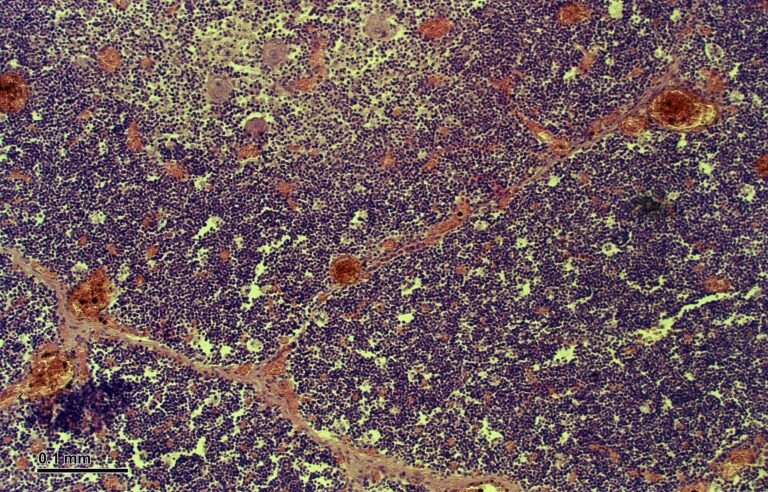
Thymalin is a polypeptide complex extracted from calf thymus, developed in the 1970s-80s by Vladimir Khavinson and Vyacheslav Morozov. It is a mixture below roughly 10 kDa, not a single molecule, studied as an immunomodulator. All findings described here are laboratory and literature only.
Thymalin is one of the oldest entries in the Soviet-era “peptide bioregulator” program: a crude but reproducibly prepared polypeptide fraction pulled out of young calf thymus, studied since the 1970s as an immunomodulator. It is not a designer peptide with a tidy sequence and molecular weight — it is a mixture, and that fact shapes everything about how its chemistry, its evidence, and its marketing should be read. Everything below describes laboratory and published literature findings, not use in people.
What is Thymalin, chemically?
Thymalin belongs to a class the originating group called cytomedins — low-molecular-weight peptide fractions isolated from animal tissue by mild acid extraction followed by ultrafiltration, retaining peptides below roughly 10 kDa. In Thymalin’s case the source tissue is the thymus of young calves. The output is a heterogeneous polypeptide complex rather than a single purified compound, which is the single most important thing to understand before reading any “spec sheet” for it.1
The complex was developed by Vladimir Khavinson and Vyacheslav Morozov at the Military Medical Academy in Leningrad, work that later continued at the St Petersburg Institute of Bioregulation and Gerontology. Thymalin sits at the historical root of the bioregulator program, alongside the pineal-derived Epithalamin that eventually gave rise to Epitalon. For the broader lineage and the people behind it, see who was Vladimir Khavinson and the Khavinson peptide bioregulators overview.19
Later fractionation identified the active fragments. The dipeptide L-Glu-L-Trp (EW) was isolated directly from Thymalin by reversed-phase HPLC and became the synthetic drug Thymogen; the dipeptide Lys-Glu (KE) became Vilon. In this sense Thymalin is the “parent” extract from which several defined synthetic dipeptides were later carved out and marketed separately.17
The CAS-number problem
Because Thymalin is a mixture, it has no single molecular formula, no single molecular weight, and no clean CAS number for a discrete molecule. The extract is sometimes given a designation such as 61509-27-1, but there is no defined structure behind it. This is where a recurring vendor error creeps in: many product pages attach the CAS number 63958-90-7, the formula C33H54N12O15, and the molecular weight 858.9 Da to “Thymalin.” Those identifiers belong to thymulin — the zinc-dependent nonapeptide serum thymic factor — which is a different entity entirely and only sounds similar. Any Thymalin listing carrying a precise molecular weight and CAS for a single molecule should be treated skeptically.1
| Property | Thymalin | Thymulin (often confused) |
|---|---|---|
| Type | Polypeptide extract (mixture) | Single defined nonapeptide |
| Source | Calf thymus, acid extraction | Serum thymic factor, zinc-dependent |
| Molecular weight | No single value (fraction <~10 kDa) | ~858.9 Da (C33H54N12O15) |
| CAS | Extract designation only (e.g. 61509-27-1) | 63958-90-7 |
Comparison of catalog identifiers. These are chemistry-database designations only and imply nothing about biological activity or fitness for any use; all Condor material is supplied for in-vitro / literature research only.
What is the proposed mechanism?
The consistent theme across the mechanistic literature is immunomodulation, specifically a “thymus-restorative” framing — nudging immature immune precursors toward mature T lymphocytes. In one in-vitro study on human hematopoietic stem cells, Thymalin reduced the stem/intermediate markers CD44 and CD117 by roughly two- to three-fold and increased the mature T-lymphocyte marker CD28 by 6.8-fold, which the authors read as stimulation of stem-cell differentiation into mature T cells.6
6.8× the in-vitro increase in the mature T-cell marker CD28 reported after Thymalin exposure of human hematopoietic stem cells.
The other half of the mechanistic story is cytokine modulation. In an LPS-stimulated peripheral blood mononuclear cell model, Thymalin and its component dipeptides EW and KE reduced IL-1β, IL-6 and TNF-α by 1.4- to 6.0-fold, and molecular-docking work modelled those dipeptides binding to double-stranded DNA and to genes such as ACE2, CHUK and AKT1/2. This is a plausible immunological narrative, but note the scale: that particular study drew blood from only four donors.7
Thymalin is best understood as a heterogeneous immunology reagent with a long paper trail, not a characterised molecule with a clean dose-response.
The clinical literature, described plainly
The headline claims for Thymalin fall into two buckets. The first is geroprotection. A long-term study followed 266 elderly persons for 6-8 years, with bioregulators administered during the first 2-3 years, and reported mortality reductions versus control of roughly 2.0-2.1-fold for Thymalin alone, 2.5-fold for Thymalin combined with Epithalamin, and up to 4.1-fold in a subgroup dosed annually. The same dataset was reported again in a Russian-language companion paper with identical figures.23
The second bucket is severe inflammation. A severe-COVID study split patients into control, tocilizumab-added, and Thymalin-added arms and reported hospital mortality of 40.9% (control) versus 28.4% (tocilizumab) versus 20.6% (Thymalin), alongside normalised lymphocyte and monocyte counts and lowered fibrinogen, LDH and D-dimer. An English-language report from the same group described adding Thymalin to standard therapy accelerating the decline of IL-6, CRP and D-dimer and tying the effect to the hematopoietic-stem-cell differentiation mechanism.45
Within Russian pharmacology, Thymalin also functions as a reference standard: a comparative study used pharmacopoeial Thymalin as the benchmark immunomodulator against a squid-derived peptide, with both raising TNF-α, IL-1 and IL-10 in blood-cell cultures.11 A secondary review summarises its immunocorrection applications across immune dysfunction and infection.12
An honest read of the evidence
The problem with Thymalin is not that the data are fabricated — the studies are real and PubMed-indexed — but that they nearly all come from one place. Almost every in-vivo and clinical result traces to Khavinson, Morozov and the St Petersburg Institute of Bioregulation and Gerontology, plus close collaborators such as Kuznik’s group in Chita. Independent Western replication is essentially absent. The one non-Russian laboratory that tested these peptides — a group in Chieti, Italy — worked only at the cell-culture level, on THP-1 monocytes, and co-published with the Khavinson group itself.8
The geroprotection headline compounds this. Those striking 2.0-4.1-fold mortality reductions all derive from a single 266-person cohort reported more than once; the underlying data are from the 1980s-90s and, by modern standards, are thinly reported for randomisation, blinding and statistics.23 Small sample sizes run throughout: the mechanistic cytokine work used four donors,7 and the clinical COVID studies are single-centre, non-blinded, add-on designs.4 Publication venues skew toward Russian-language or Russian-affiliated journals, which limits external scrutiny, and some abstracts read as promotional.
Two further cautions. The chemistry is ill-defined — a heterogeneous extract, not a characterised single molecule — so any confident “CAS number” or molecular weight on a product page is a red flag rather than a reassurance.1 And the group’s own influenza model found no direct antiviral activity for Thymalin; the effect was immunological resistance, not virucidal action.10 Any “antiviral” claim therefore overstates what was actually observed. Thymalin is also distinct from Western thymic peptides such as Thymosin alpha-1, a defined 28-amino-acid peptide with its own separate literature; the two should not be conflated. For where Thymalin sits among the other extracts, see the Khavinson bioregulators catalog.
All materials supplied by Condor Research are Research Use Only (RUO). The findings above describe in-vitro assays, animal models and published clinical literature; they are not a dosing protocol, clinical guidance, or a safety assessment for any organism. Nothing here concerns human or veterinary use. Storage and handling questions for peptide reagents are covered separately in does a peptide need refrigeration.
Condor Research · Scientific desk
Atrio Sciences s.r.o., IČO 57 669 651, Nitra (SK) · info@condorresearch.com
- Thymalin is a heterogeneous polypeptide extract (a cytomedin) from young calf thymus, obtained by mild acid extraction and ultrafiltration, not a single synthesized peptide.
- It was developed by Vladimir Khavinson and Vyacheslav Morozov and is among the earliest peptide bioregulators, predating the pineal-derived Epitalon lineage.
- Its principal identified active fragments are the dipeptides Glu-Trp (later the synthetic drug Thymogen) and Lys-Glu (Vilon).
- Vendors frequently mislabel Thymalin with the CAS number, formula and molecular weight of thymulin, a completely different, defined nonapeptide.
- Proposed mechanism is immunomodulatory: promoting T-lymphocyte differentiation and modulating inflammatory cytokines in cell and animal models.
- Nearly all in-vivo and clinical evidence originates from a single research lineage, with essentially no independent Western replication.
- Thymalin is a Russian-registered pharmaceutical but is not approved by EMA or FDA; outside Russia it is a Research Use Only reagent only.
What is Thymalin made of?
It is a polypeptide fraction extracted from young calf thymus by mild acid extraction and ultrafiltration, retaining peptides below roughly 10 kDa. It is a mixture rather than a single purified molecule. Its identified active fragments include the dipeptides Glu-Trp and Lys-Glu.
Why do product pages list different CAS numbers for it?
Because Thymalin has no single defined molecule, it has no true single-compound CAS. Many vendors incorrectly borrow the CAS (63958-90-7), formula and molecular weight of thymulin, a different, defined nonapeptide. Treat any precise molecular weight on a Thymalin listing with caution.
How strong is the evidence behind it?
The published record is real but almost entirely single-lineage — Khavinson, Morozov and close collaborators — with old, small-n studies and no independent Western clinical replication. The geroprotection figures trace to one 266-person cohort, and the closest non-Russian corroboration is a cell-culture study co-authored with the same group.
Is it approved by the EMA or FDA?
No. Thymalin is a Russian-registered pharmaceutical but has no marketing authorisation from the EMA or FDA. Outside Russia it is handled strictly as a Research Use Only reagent, with no Western clinical or consumer framing.
What is its proposed mechanism?
The literature frames it as immunomodulatory: promoting differentiation of hematopoietic stem cells toward mature T lymphocytes and lowering inflammatory cytokines such as IL-1β, IL-6 and TNF-α in cell and animal models. These are laboratory observations, not established clinical effects.
How does it relate to Thymogen and Vilon?
Thymogen (synthetic Glu-Trp) and Vilon (synthetic Lys-Glu) are defined dipeptides that were isolated as active fragments of the Thymalin complex and then synthesised and marketed separately. Thymalin is effectively the parent extract from which those cleaner molecules were derived.