
Semaglutide: The Rare Catalogue Entry With Too Much Evidence
Most research peptides suffer from thin, animal-only data. This GLP-1 receptor agonist has the opposite problem — and the gap between a licensed medicine and a reference vial is the whole story.
Semaglutide is a GLP-1 receptor agonist licensed as Ozempic and Wegovy, supported by large randomised trials (STEP, SUSTAIN, SELECT) reporting substantial weight reduction and cardiovascular benefit. A research-grade reference vial is an analytical, in-vitro standard for identity and purity work — not the licensed medicine, and not a protocol for any use in people or animals.
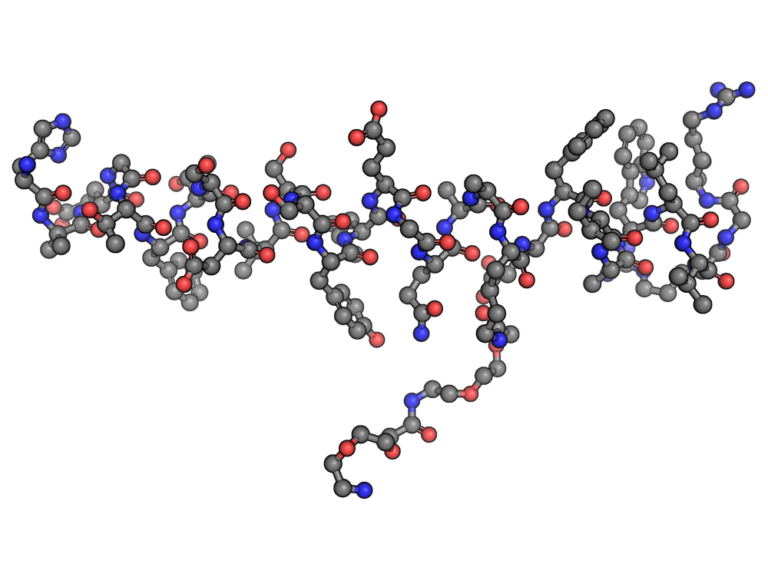
In a catalogue where most entries are defended by a handful of rodent studies and a hopeful mechanism, semaglutide is the awkward outlier: it arrives buried under a clinical record running to large multi-year randomised trials. The problem is not too little evidence. It is that the evidence belongs to a licensed prescription medicine — a regulated object that is not the same thing as a reference vial on a laboratory bench.
What is semaglutide, mechanistically?
Semaglutide is a long-acting analogue of glucagon-like peptide-1 (GLP-1), an incretin hormone released from the gut in response to nutrients.1 As a GLP-1 receptor agonist it engages receptors in the pancreas, gastrointestinal tract and central nervous system.13 Three actions recur across the mechanistic literature, and they are worth stating precisely. It potentiates glucose-dependent insulin secretion — meaning insulin release is amplified when circulating glucose is elevated rather than driven indiscriminately12 — it slows gastric emptying, and it acts on hypothalamic and hindbrain circuits implicated in appetite regulation.11
The glucose-dependence is not a footnote; it shapes the pharmacological profile. Unlike insulin or sulphonylureas, which can lower glucose regardless of how low it already is, GLP-1 receptor agonism carries a comparatively low intrinsic hypoglycaemia risk when used as a single agent12, precisely because its insulinotropic effect tracks the prevailing glucose level. The structural engineering matters too: fatty-acid acylation promotes binding to serum albumin and resistance to enzymatic degradation, converting native GLP-1 — whose circulating half-life is famously measured in minutes — into a molecule with a duration of action long enough to be dosed weekly in the clinic.3
The science here is not in doubt; what is in doubt is the conflation of an approved medicine with a research reference standard.
What does the human evidence actually show?
Three trial programmes anchor the clinical record, and they are worth naming precisely. The STEP programme (Wilding and colleagues, reported in the New England Journal of Medicine in 2021) evaluated semaglutide for weight management in adults with obesity or overweight.2 The SUSTAIN programme studied glycaemic control in type 2 diabetes across a series of randomised comparisons.7 The SELECT trial (Lincoff and colleagues, New England Journal of Medicine, 2023) asked the harder, more expensive question: whether the drug reduces major adverse cardiovascular events in people with established cardiovascular disease and overweight or obesity, but without diabetes.1
The headline finding from the obesity work, in the pivotal STEP 1 analysis, was a mean body-weight reduction in the region of 15% over 68 weeks2 — an effect size that, for a metabolic agent, is genuinely large and historically closer to bariatric surgery than to earlier weight drugs. SELECT then reported a statistically significant reduction in the composite cardiovascular endpoint, the first time an obesity-indicated GLP-1 agent demonstrated cardiovascular benefit in a population selected without diabetes.1 That is a meaningful shift: it moved the conversation from cosmetic weight loss towards hard outcomes. Throughout these programmes the glycaemic findings from SUSTAIN reinforced the same picture in diabetes, with reductions in HbA1c relative to comparators.7
~15% approximate mean body-weight reduction reported over 68 weeks in the pivotal STEP 1 obesity trial2 — a supervised trial result in a defined population, not a guaranteed individual outcome.
| Trial programme | Population studied | Primary question | Headline reported result |
|---|---|---|---|
| STEP | Obesity / overweight, diabetes not required | Body-weight change | ~15% mean weight reduction over 68 weeks (STEP 1) |
| SUSTAIN | Type 2 diabetes | Glycaemic control (HbA1c) | Greater HbA1c reduction versus comparators7 |
| SELECT | Established CVD with overweight/obesity, no diabetes | Cardiovascular outcomes (MACE) | Significant reduction in composite MACE endpoint1 |
A scorecard of the three landmark programmes. Each asked a different question in a different population, and the reported effects describe the licensed medicine under trial conditions — a reminder that effect sizes are not transferable across designs.
What is the real adverse-event profile?
The honest summary is that tolerability, not safety surprises, dominates the record. Gastrointestinal effects — nausea, vomiting, diarrhoea and constipation — are by far the most reported events across trials, typically most intense during dose escalation and a leading reason participants discontinued.3 Beyond the gut, several signals deserve sober attention rather than alarm.
- Gallbladder events. Cholelithiasis and related biliary events appear more frequently with GLP-1 agonists, an association that may be linked to rapid weight loss as much as to the drug itself.4
- Pancreatitis. A pancreatitis signal has been scrutinised since the class emerged; the balance of large trial data has not established a clear causal excess, but it remains a monitored concern rather than a closed question.10
- Lean-mass loss. Because total weight falls substantially, a recurring debate is how much of the loss is fat versus lean mass, and what that means for body composition over time.8 This is an active, genuinely unsettled area.
How honest should we be about the limits?
Even with this volume of data, several caveats are non-negotiable. The trials measured supervised use in selected populations with defined inclusion criteria; effect sizes do not transfer cleanly to people outside those criteria, and real-world adherence is markedly worse than trial adherence.6 Durability is another open edge: substantial weight regain following discontinuation was reported in the STEP 1 extension work (Wilding and colleagues, 2022)2, raising questions about what the intervention is actually buying over a lifetime rather than over a trial. The lean-mass debate remains unresolved, and long-horizon data on rarer outcomes are still maturing.
Regulatory status must also be stated plainly. Semaglutide is an approved prescription medicine in the United States, the European Union and elsewhere, under specific brand names and indications, per the relevant FDA and EMA labelling.5 Approval attaches to a manufactured, quality-controlled pharmaceutical product dispensed under medical supervision — not to material sold as a laboratory reference. Conflating the two is both a scientific and a regulatory error, and worth naming directly rather than blurring.
Why does the reference-standard distinction matter?
This is the crux for a researcher. A research-grade semaglutide reference material is an analytical and in-vitro standard — a characterised compound used for identity confirmation, purity assessment, assay calibration, receptor-binding studies and method development.13 It is categorically not the licensed medicine, carries no clinical indication, and nothing in the human-trial record functions as a usage protocol. The body of randomised-controlled-trial evidence describes the approved product in patients; it says nothing that licenses use of a reference vial in any organism.15
For that reason the only claims this material should make are about itself: what it is and how pure it is. A meaningful certificate of analysis, with identity confirmed by mass spectrometry and purity quantified by HPLC, is what makes a reference standard fit for reproducible bench work9 — and what separates a defensible analytical input from an undocumented unknown. This material is supplied strictly for research use only, as an in-vitro reference standard, and is not for human or veterinary use, diagnosis, or any application in or on the body. In a field where provenance is frequently the weakest link, documentation is the product.
- Semaglutide acts as a GLP-1 receptor agonist: glucose-dependent insulin secretion, slowed gastric emptying, and central appetite suppression are its core reported mechanisms.
- The clinical programme is unusually deep for this catalogue — STEP (obesity), SUSTAIN (diabetes) and SELECT (cardiovascular outcomes) are large randomised trials, not preclinical signals.
- Reported adverse events are dominated by gastrointestinal effects; gallbladder events, a debated pancreatitis signal, and the lean-mass-loss question are the honest open issues.
- Effect sizes are large by metabolic-drug standards but were measured under supervised trial conditions in defined populations — not a promise to any individual.
- Weight regain after discontinuation has been reported, so durability over a lifetime remains an open question rather than a settled benefit.
- A research-grade reference vial is an analytical standard for identity and purity, categorically distinct from the approved prescription medicine; COA and HPLC/MS documentation is what makes it fit for reproducible work.
Is a research-grade semaglutide vial the same as Ozempic or Wegovy?
No. Ozempic and Wegovy are licensed, quality-controlled prescription medicines approved for specific indications and dispensed under medical supervision. A research-grade reference vial is an analytical, in-vitro standard intended for identity, purity and laboratory method work. They share a molecule name but are different regulated objects, and the clinical evidence applies to the approved product, not the reference material.
What does the strongest human trial actually show?
As a non-cited summary of the published programmes: the pivotal STEP 1 obesity trial reported a mean body-weight reduction of roughly 15% over 68 weeks, and the SELECT trial later reported a significant reduction in major adverse cardiovascular events in people with established cardiovascular disease and overweight or obesity. These were supervised results in defined trial populations and describe the approved medicine — not outcomes any individual or reference-material user should expect.
What adverse effects were documented in the studies?
Summarising the published trials: gastrointestinal effects — nausea, vomiting, diarrhoea, constipation — dominated and were a leading reason for discontinuation, typically during dose escalation. Gallbladder events were reported more often, a pancreatitis signal has been scrutinised without a clear established causal excess, and the proportion of weight lost as lean mass remains an actively debated, unresolved question. None of this constitutes guidance for use.
Why does a certificate of analysis matter for a reference standard?
Because the only legitimate claims a reference material makes are about its own identity and purity. A certificate of analysis with mass-spectrometry identity confirmation and HPLC purity quantification lets a laboratory verify what it is actually working with, supporting reproducible assays and method development. Without that documentation, an analytical input is an undocumented unknown — the weakest link in any rigorous protocol.