
What Is Noopept? The Proline-Containing Dipeptide Nootropic
Noopept (omberacetam, GVS-111): a proline-containing dipeptide designed as a piracetam analogue. Its chemistry, the proposed prodrug metabolite, and an honest read of the single-lab evidence.
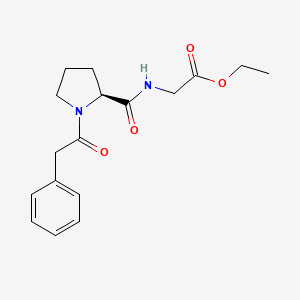
Noopept is a synthetic proline-containing dipeptide (N-phenylacetyl-L-prolylglycine ethyl ester; INN omberacetam, code GVS-111) designed at a Moscow institute as a topological analogue of piracetam. In rodents it is reported active at roughly a thousandth of piracetam's dose. It is not FDA/EMA-approved.
Noopept is one of the more chemically specific entries in the nootropic literature: a single, rationally designed molecule — N-phenylacetyl-L-prolylglycine ethyl ester — rather than a loose class of compounds. It was built at a Moscow pharmacology institute as a dipeptide analogue of piracetam, and almost everything that has been reported about how it works comes from that same research lineage. Everything below describes laboratory and literature findings in rodents and cell lines, not use in people or any other organism.
What is Noopept, structurally?
Noopept is the ethyl ester of N-phenylacetyl-L-prolylglycine — a two-residue peptide (proline and glycine) capped with a phenylacetyl group and esterified at the C-terminus. Its molecular formula is C17H22N2O4, molecular weight approximately 318.4 g/mol, and it carries CAS number 157115-85-0. It is known by the development code GVS-111 and the International Nonproprietary Name omberacetam. That last name signals its design intent: it sits in the „-racetam” naming family despite being a peptide, because it was conceived as a functional analogue of piracetam rather than as a member of the peptide-hormone world.
The design came out of the V.V. Zakusov Research Institute of Pharmacology in Moscow, where Gudasheva and colleagues developed a „peptide-based drug design” strategy: take a known small-molecule drug, identify a plausible beta-turn conformation, and construct a short peptide that reproduces that topology.8 Applied to piracetam, that approach produced noopept as a topological dipeptide analogue.7 The same program is credited with other dipeptide candidates from the institute, so noopept is best understood not as a one-off but as the flagship output of a deliberate structural methodology.
~1000× the reported potency of piracetam by dose in rodent memory models — noopept was described as active at roughly 0.5–10 mg/kg.
What did the rodent behavioural work report?
In the originating group’s memory paradigms — passive-avoidance and related antiamnesic tests in rats — noopept was reported active at roughly a thousandth of the dose required for piracetam, in the 0.5–10 mg/kg range.7 Importantly for a peptide-derived molecule, the activity was retained after oral administration rather than only by injection, and the reports distinguished noopept’s behavioural profile from that of both piracetam and its own metabolite.6 These are rodent behavioural readouts, not measures of use or benefit in any other species.
The proposed prodrug and metabolite hook
One of the more distinctive claims about noopept concerns what actually reaches the brain. In a 1997 study, Gudasheva and colleagues reported that after intraperitoneal GVS-111, the parent compound was essentially undetectable in rat brain, while cyclo-L-prolylglycine — a cyclic dipeptide — rose about 2.5-fold.1 They proposed that noopept functions as a prodrug, converting to cyclo-L-prolylglycine, and noted that this metabolite is identical to an endogenous cyclopeptide already present in the brain. Later pharmacokinetic work from the same institute (2018) again identified cyclo-prolylglycine as the active rat metabolite, with its own distinct kinetics but a pharmacological (memory) profile similar to the parent.9
This is an interesting and internally consistent story, but it is worth being precise about its provenance: the foundational metabolite paper and its pharmacokinetic confirmation both come from the Zakusov Institute lineage. The prodrug framing rests on that work; it has not been extensively re-examined by independent laboratories.
The prodrug-to-cycloprolylglycine story is coherent and has been reported twice — but both times by the group that first proposed it.
The neurotrophin claim
The finding that draws the most attention is the reported effect on neurotrophins. Ostrovskaya and colleagues (2008) reported that noopept raised NGF and BDNF mRNA in rat hippocampus, measured by Northern blot, after both acute and 28-day treatment, and specifically noted no tolerance developing across the chronic regimen.2 A follow-up from the same group (2010) offered mechanistic context, reporting that chronic noopept lowered stress-activated kinases (JNK, phospho-ERK1/2) while raising BDNF mRNA in rat hippocampus and hypothalamus.3
Alongside the neurotrophin work, the group reported neuroprotection in two very different models. In a rat middle-cerebral-artery-occlusion (MCAO) stroke model, noopept was reported to reduce cortical infarct area from 18.6% to 12.2% — about a one-third reduction.5 In an in-vitro PC12 cell model challenged with amyloid-beta(25–35), 10 µM noopept was reported to attenuate reactive oxygen species, calcium overload, apoptosis, and tau phosphorylation at Ser396.4 The cell-model paper appeared in an international peer-reviewed journal, though the authorship again traces to the same Russian group.
| Property | Reported detail |
|---|---|
| Chemistry | N-phenylacetyl-L-prolylglycine ethyl ester; C17H22N2O4; MW ~318.4; CAS 157115-85-0 |
| Codes / INN | GVS-111 (development code); omberacetam (INN) |
| Pochodzenie | V.V. Zakusov Research Institute of Pharmacology, Moscow (beta-turn dipeptide design) |
| Proposed active metabolite | Cyclo-L-prolylglycine (parent largely undetectable in rat brain) |
| Reported neurotrophin effect | Raised NGF / BDNF mRNA in rat hippocampus (single-lab, rodent) |
| Regulatory status | Prescription nootropic in Russia; not FDA/EMA approved |
All entries above summarise in-vitro and rodent literature or regulatory classification. None describes use, dosing, or benefit in humans or any other organism.
An honest read of the evidence
The single most important thing to say about noopept’s evidence base is that it is dominated by one research lineage. The core findings — the cyclo-prolylglycine prodrug mechanism, the NGF/BDNF up-regulation, and the neuroprotection data — come overwhelmingly from Ostrovskaya, Gudasheva, Seredenin and colleagues at the Zakusov Institute. That does not make the findings wrong, but it means most of them are effectively unreplicated by independent groups, which is exactly the situation where cautious readers should hold conclusions loosely.
Independent and Western replication is thin, and what exists is mixed. The rare non-Russian positive study — an intranasal forskolin-plus-noopept formulation reported to raise brain BDNF/NGF and reduce dopaminergic neurodegeneration in PINK1-knockout rats — carries a direct commercial conflict of interest, because the authors own the startup commercialising that formulation.10 Meanwhile, an independent Turkish group studying noopept in diabetic rats found no significant difference in hippocampal NGF or BDNF, and no significant difference in spatial learning, between treated and control animals.11 That is a partial non-replication of the central neurotrophin story, from one of the few groups with no stake in the outcome — and it deserves as much weight as the positive reports.
The evidence is also narrow by design and species. Essentially all mechanistic work is rodent in vivo or immortalised cell lines (PC12 and related), so there is no controlled human confirmation of the metabolite or neurotrophin effects. The human data that exist are small, mostly open-label, non-blinded Russian studies — for example a 60-patient stroke cohort reporting cognitive improvement over two months — rather than large double-blind placebo-controlled trials.12 Much of the primary literature also sits in Russian-language pharmacology journals that are less indexed and harder to scrutinise for methodological detail. None of this establishes any effect in people.
Regulatory status reinforces the caution. Noopept is a prescription nootropic in Russia and some former-Soviet states, but it is not approved by the FDA or EMA. The FDA has explicitly stated that noopept and related racetams are not dietary supplements and treats them as unapproved drugs.13 It has also faced jurisdiction-specific controls — it was scheduled in Hungary in 2020 and falls under the UK’s Psychoactive Substances Act. Condor Research does not list noopept as a confirmed catalogue product, and nothing here should be read as an availability or purchase statement.
All materials referenced by Condor Research are described strictly as Research Use Only (RUO). The findings above are in-vitro and literature reports in rodents and cell lines; they are not a dosing protocol, clinical guidance, efficacy claim, or safety assessment for humans, animals, or any other organism. No human or veterinary use is implied.
For adjacent chemistry and context, see our notes on other designed peptides from the same tradition — Semax and Selank — as well as the broader overviews of nootropic peptides, non-peptide nootropics, and the Cerebrolysin research guide.
Condor Research · Dział naukowy
Atrio Sciences s.r.o., IČO 57 669 651, Nitra (SK) · info@condorresearch.com
- Noopept is N-phenylacetyl-L-prolylglycine ethyl ester (C17H22N2O4, MW ~318.4, CAS 157115-85-0); development code GVS-111, INN omberacetam.
- It was rationally designed at the V.V. Zakusov Research Institute of Pharmacology (Moscow) as a beta-turn dipeptide topological analogue of the racetam piracetam.
- In rodent memory models it was reported active at roughly 1/1000 the dose of piracetam and retained activity after oral dosing.
- A proposed prodrug mechanism holds that noopept is largely undetectable in rat brain while its metabolite cyclo-L-prolylglycine rises; the metabolite matches an endogenous neuropeptide.
- The originating group reported that noopept raised NGF and BDNF mRNA and protein in rat hippocampus with no tolerance over 28 days.
- Almost all mechanistic and efficacy data come from a single Russian research lineage; one independent Turkish study found no NGF/BDNF effect, and the sole notable non-Russian positive study carries a commercial conflict of interest.
- Noopept is a prescription nootropic in Russia and some former-Soviet states, but is not approved by FDA or EMA; the FDA treats it as an unapproved drug, not a supplement.
Is Noopept a peptide or a racetam?
Both descriptions apply, depending on whether you mean structure or design intent. Chemically it is a proline-containing dipeptide — N-phenylacetyl-L-prolylglycine ethyl ester. Functionally it was designed as a topological analogue of the racetam piracetam using a beta-turn dipeptide strategy, which is why it carries a racetam-style INN, omberacetam.
What is the proposed active metabolite of Noopept?
The originating group reported that after dosing, noopept itself is largely undetectable in rat brain, while cyclo-L-prolylglycine rises. They proposed noopept acts as a prodrug for this cyclic dipeptide, which they described as identical to an endogenous neuropeptide. Later pharmacokinetic work from the same institute again identified cyclo-prolylglycine as the active rat metabolite.
Does Noopept really raise NGF and BDNF?
That is what the Zakusov Institute group reported in rat hippocampus, both acutely and over 28 days, with no tolerance. The claim should be read as reported rather than settled: an independent Turkish study in diabetic rats found no significant NGF or BDNF difference, and the main non-Russian positive study carries a commercial conflict of interest. The picture is genuinely mixed.
Is Noopept approved as a medicine or supplement?
It is a prescription nootropic in Russia and some former-Soviet states, but it is not approved by the FDA or EMA. The FDA has stated it is not a dietary supplement and treats it as an unapproved drug. Some jurisdictions have imposed additional controls, including Hungary and the UK.
Is there any human clinical evidence?
Only limited, low-rigour human data exist — small, mostly open-label, non-blinded Russian studies such as a 60-patient stroke cohort reporting cognitive improvement over two months. There are no large Western double-blind placebo-controlled randomised trials and no Western regulatory dossier. This is not sufficient to establish efficacy in people.
How strong is the overall evidence base?
It is coherent but narrow. Almost all mechanistic and efficacy findings originate from a single Russian research lineage, in rodents and cell lines, with scarce independent replication and at least one independent partial non-replication. Treat the mechanistic story as a well-developed single-lab hypothesis rather than as independently confirmed fact.