
What Is Thymogen? The Glu-Trp Dipeptide Successor to Thymalin
Thymogen is the synthetic dipeptide L-Glu-L-Trp (oglufanide, CAS 38101-59-6). A structural, mechanistic and honest-evidence look at this Khavinson-school immunoregulator.
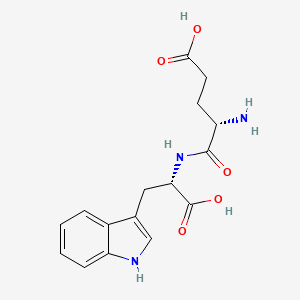
Thymogen is the synthetic dipeptide L-alpha-glutamyl-L-tryptophan (L-Glu-L-Trp, CAS 38101-59-6), also called oglufanide. Rationalized by the Khavinson/Deigin school as a minimal-motif immunoregulatory peptide in the same tradition as the thymus preparation Thymalin, it is studied for cytokine modulation in vitro. RUO only.
Thymogen is one of the shortest peptides ever advanced as an immunoregulator: a two-residue chain, L-alpha-glutamyl-L-tryptophan, that the St. Petersburg school around Vladimir Khavinson and Vladislav Deigin proposed as a minimal synthetic counterpart to the thymus-extract preparation Thymalin. Its story is genuinely interesting and genuinely mixed — a clean chemical identity, a curious chirality trick, a thin and single-lineage evidence base, and one large Western trial that failed outright. Everything below describes laboratory, animal and literature findings, not use in people. Nothing here concerns human or veterinary use.
What is Thymogen, structurally?
Thymogen is the dipeptide L-alpha-glutamyl-L-tryptophan — glutamic acid joined through its alpha-carboxyl to tryptophan. In the older Russian literature it is written with the single-letter shorthand “EW” (E for glutamate, W for tryptophan). PubChem resolves CAS 38101-59-6 to compound CID 100094, molecular formula C16H19N3O5, molecular weight 333.34 g/mol1. The same record carries the synonyms Thymogen, oglufanide (its INN), and “EW dipeptide”1. The immunostimulant identity is stated directly by Deigin and colleagues, who name “the immunostimulant Thymogen (L-Glu-L-Trp)” in a 2024 review2.
Two structural details do real work here. The first is the peptide bond: the alpha-linked form (alpha-Glu-Trp) is the canonical Thymogen, and studies show that switching to a gamma-linkage changes the biology3. The second is chirality, which turns out to be the compound’s defining feature.
333.34 the molecular weight, in g/mol, of a molecule with just two amino acids and a documented mirror-image twin that does the opposite thing.
Chirality as a switch: Thymogen versus Thymodepressin
Invert the stereochemistry of both residues and you get D-Glu-D-Trp — a distinct compound, Thymodepressin, that acts as an immunosuppressor rather than a stimulant. Deigin and colleagues present these two as “the first reciprocal activities of chiral peptide pharmaceuticals”: the same sequence, opposite handedness, opposite direction of effect2. This is not a marketing flourish; it is the clearest experimental handle anyone has on how the dipeptide works, because it implies the activity depends on a specific three-dimensional fit rather than on the amino acids simply being present.
The hematopoietic work reinforces this. In irradiated and intact mice, the L-forms of the Glu-Trp dipeptide supported regeneration of hemopoietic progenitors (measured as colony-forming units, CFU-S), while D-glutamyl-containing isomers inhibited them3. A companion structure-activity study found the same pattern: D-Glu-bearing isomers suppressed stem-cell colonies, whereas L-forms were inert or stimulatory4. The observation reported across these papers is that stereochemistry and bond type, not sequence alone, govern the effect.
A two-amino-acid peptide whose biological direction reverses when you flip its handedness is either telling you something real about receptor geometry — or telling you the effect is subtle enough to be fragile.
The proposed mechanism
The most concrete mechanistic data come from human cells in culture. Working with endothelial cells and peripheral blood mononuclear cells, one group reported that alpha-glutamyl-tryptophan lowered TNF-alpha-induced secretion of IL-1alpha and IL-8 while raising expression of the adhesion molecule ICAM-15. That pattern — dampening some inflammatory cytokines while modulating leukocyte-adhesion signalling — is what the Khavinson school points to when describing an “immunomodulatory” rather than purely stimulatory profile. In a broader review, the same lineage situates “EW” among a small family of short peptides (alongside sequences such as KE and AEDG) claimed to normalize cytokine synthesis6, though that framing is hypothesis-level rather than demonstrated efficacy. See also our overviews of Khavinson peptide bioregulators and the Khavinson research programme.
| Name / synonym | Structure | Reported role in the literature |
|---|---|---|
| Thymogen / oglufanide / IM862 | L-Glu-L-Trp (alpha) | Immunostimulant / immunomodulator |
| Thymodepressin | D-Glu-D-Trp | Immunosuppressor (reciprocal enantiomer) |
| Thymalin | Thymus-derived peptide fraction | Extract-based immunoregulator; the lineage predecessor |
All roles listed are as reported in in-vitro, animal or single-network clinical literature. This is not a claim of efficacy or a use recommendation for any organism; the compound is Research Use Only.
The human and animal signal
Two kinds of in-vivo work exist. In an influenza model, Glu-Trp was studied mainly as an adjunct: combined with glycyrrhizic acid it reduced mortality and lung viral titers in mice, but on its own it underperformed the standard antiviral rimantadine7. The stronger human signal is gastrointestinal. In a multicenter double-blind placebo-controlled study of chronic atrophic gastritis (n=116), alpha-Glu-Trp was associated with increased gastric gland density and CDX-2 expression versus placebo8; a companion placebo-controlled study (n=80), using the branded formulation Regasthym Gastro, reported reduced gastric mucosal edema and lower acute-inflammation scores9. Those are real randomized, blinded designs — which is more than most short peptides in this space can point to.
An honest read of the evidence
The chemistry is settled; the biology is not. Three problems sit at the centre of any honest account.
First, the single-lineage problem. Almost every positive result — the cytokine work, the hematopoietic data, both gastritis trials — traces back to the same St. Petersburg network (the Institute of Bioregulation and Gerontology, the Shemyakin-Ovchinnikov Institute, and associated companies), published largely in Russian-language journals. The gastritis studies, though double-blind and placebo-controlled, come from one investigator group and use branded products, so source and commercial-interest bias cannot be excluded. Independent, non-Russian replication is essentially absent.
Second, and most important, the one large rigorous Western trial of this exact molecule failed. As IM862 — a synthetic L-Glu-L-Trp dipeptide, the same compound as Thymogen/oglufanide — it went into a randomized placebo-controlled phase III trial in AIDS-related Kaposi’s sarcoma and was ineffective; the analysis even suggested it may have shortened time to progression10. An earlier randomized study had reported an encouraging ~36% response rate11, but that promise did not survive confirmation. This is the classic promising-phase-II, negative-phase-III pattern, and it is the strongest counterweight to any efficacy narrative built on the compound.
Third, the “is the dipeptide even the active thing?” problem. A peer-reviewed study found that for Glu-Trp, the immune, phagocytosis-modulating and antitoxic effects were no different from those of its constituent free amino acids — glutamate plus tryptophan12. That result is hard to reconcile with the microgram-per-kilogram potencies reported elsewhere, and it leaves open whether the intact peptide, rather than its building blocks, is doing the work. A minor but real naming caveat compounds the uncertainty: some Western IM862 papers describe the molecule as glutamine-tryptophan (Gln-Trp) rather than glutamyl-tryptophan (Glu-Trp), whereas the canonical Thymogen/oglufanide structure per PubChem is the glutamyl form1. And regulatorily, the bottom line is simple: oglufanide/IM862 never gained EMA or FDA approval. Related short bioregulators in this family, such as Vilon, share the same evidentiary caution.
All materials supplied by Condor Research are Research Use Only (RUO). Everything above summarizes in-vitro, animal and literature findings and is not a dosing protocol, clinical guidance, therapeutic claim, or safety assessment for any organism. No human or veterinary use is intended or implied.
Condor Research · Scientific desk
Atrio Sciences s.r.o., IČO 57 669 651, Nitra (SK) · info@condorresearch.com
- Thymogen is the synthetic dipeptide L-alpha-glutamyl-L-tryptophan (L-Glu-L-Trp, 'EW'), CAS 38101-59-6, PubChem CID 100094, formula C16H19N3O5, MW 333.34 g/mol.
- It is the INN compound oglufanide; the identical molecule was developed in the West as IM862, whose large Kaposi's-sarcoma phase III trial FAILED.
- It is best framed as a minimal-motif synthetic analog in the same immunoregulatory lineage as the thymus-extract Thymalin, not a literal cleavage product of it.
- Its mirror-image enantiomer D-Glu-D-Trp is the immunosuppressor Thymodepressin, a documented reciprocal-activity pair where chirality flips the biology.
- In vitro on human cells, alpha-Glu-Trp lowered TNF-alpha-induced IL-1alpha and IL-8 while raising ICAM-1, consistent with an immunomodulatory profile.
- Nearly all positive data come from a single St. Petersburg research network, largely in Russian-language journals, with little independent Western replication.
- One peer-reviewed study found its immune effects were indistinguishable from its free constituent amino acids, questioning whether the intact dipeptide is the active agent.
What exactly is Thymogen?
It is the synthetic dipeptide L-alpha-glutamyl-L-tryptophan (L-Glu-L-Trp, "EW"), CAS 38101-59-6, PubChem CID 100094, formula C16H19N3O5, MW 333.34 g/mol. Deigin and colleagues explicitly identify it as the immunostimulant "Thymogen (L-Glu-L-Trp)".
Is Thymogen actually derived from Thymalin?
Not in a literal biochemical sense. The sources support framing Thymogen as a minimal-motif synthetic peptide in the same immunoregulatory tradition as the thymus-extract preparation Thymalin — a successor or analog — rather than a proven cleavage product of it. The "successor to Thymalin" framing is directionally accurate; a derivation claim would overreach the evidence.
Why does its mirror image do the opposite thing?
Inverting both residues gives D-Glu-D-Trp, which is the immunosuppressor Thymodepressin. Deigin and colleagues describe the two as a reciprocal-activity pair, meaning the biological direction depends on the molecule's three-dimensional handedness, not just its sequence. The hematopoietic isomer studies show the same L-versus-D dependence.
Has it been tested in humans?
Yes, but the record is split. Double-blind placebo-controlled Russian studies in gastritis (n=116 and n=80) reported improved mucosal-repair and reduced-inflammation markers. In contrast, the identical molecule as IM862 failed a large randomized placebo-controlled phase III trial in Kaposi's sarcoma after an encouraging earlier study. The positive human data are preliminary and single-network; the negative confirmatory trial is the more rigorous.
Is the intact dipeptide the active molecule?
That is genuinely unsettled. One peer-reviewed study found Glu-Trp's immune, phagocytosis and antitoxic effects were indistinguishable from its free constituent amino acids, which raises the possibility that the intact peptide is not the true active principle. The in-vitro cytokine data point the other way, so the question remains open.
Is Thymogen an approved medicine?
No. Oglufanide/IM862 never received EMA or FDA marketing approval, and its pivotal Western trial was negative. It is supplied strictly as a research-use-only compound, with no human dosing or therapeutic use stated or implied.