
Net Peptide Content (NPC): Why HPLC Purity Isn’t the Whole Story
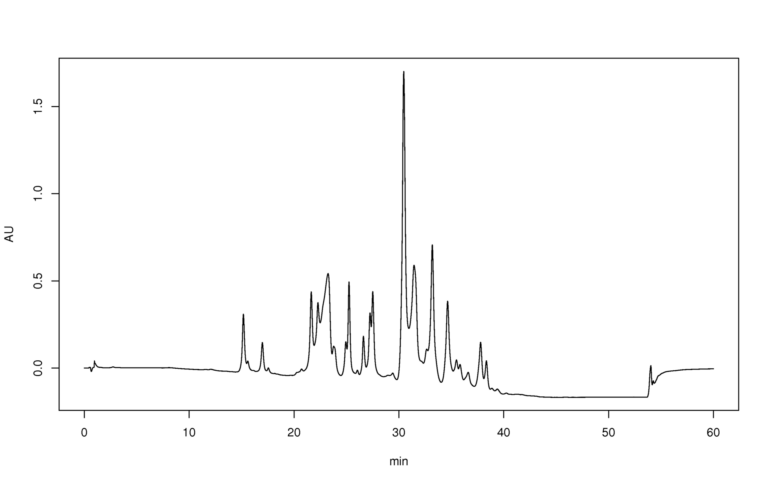
Net Peptide Content (NPC) is the actual mass of target peptide in a labelled amount, and it is almost always lower than the number on the vial. It is calculated as gross mass × HPLC purity × peptide content factor, where the peptide content factor discounts the counter-ions (trifluoroacetate or acetate) and bound water that every synthetic peptide salt carries. HPLC purity answers "how much of what is here is the right molecule"; NPC answers the question researchers actually need — "how much peptide do I actually have" — and the two are not the same number.
Net Peptide Content (NPC) is the actual mass of target peptide in a labelled amount, and it is almost always lower than the number on the vial. It is calculated as gross mass × HPLC purity × peptide content factor, where the peptide content factor discounts the counter-ions (trifluoroacetate or acetate) and bound water that every synthetic peptide salt carries. HPLC purity answers “how much of what is here is the right molecule”; NPC answers the question researchers actually need — “how much peptide do I actually have” — and the two are not the same number.
Why HPLC purity is not the whole story
A certificate that reads “99% by HPLC” is telling you that, of the material detected, 99% is the target peptide and 1% is related impurities. It says nothing about counter-ions or water. Synthetic peptides are purified as salts — most commonly trifluoroacetate (TFA), sometimes acetate — and they retain bound water. That salt-and-water mass is real mass on the balance, but it is not peptide. A vial labelled 10 mg at 99% HPLC purity can contain meaningfully less than 10 mg of actual peptide once the TFA and water are subtracted. This is not a defect; it is chemistry. What is missing from the field is an honest, named figure for it.
The NPC formula
Net Peptide Content = gross mass × (HPLC purity ÷ 100) × (peptide content factor ÷ 100)
The peptide content factor is the fraction of the salt mass that is actually peptide. It is measured directly by amino-acid analysis (AAA) and is the single most honest quality figure a peptide certificate can carry. For small TFA-salt peptides it commonly sits around 70–85%; without AAA it can only be estimated. Purity and peptide content are independent axes: a peptide can be 99% pure and still be, say, 78% peptide by mass.
Stock-preparation calculator
Enter the amount in the vial and the volume of solvent to get the working concentration and the volume to withdraw for a given amount. The advanced panel applies the NPC correction so you can see actual peptide mass, not just labelled mass. This is a laboratory aliquoting aid for research stock preparation — not dosing guidance, and not for human or veterinary use.
Advanced: Net Peptide Content (NPC)
Peptide content factor accounts for counter-ions (TFA/acetate) and bound water. If unknown, an amino-acid analysis (AAA) on the certificate gives the real figure; TFA salts of small peptides commonly sit near 70–85%.
Open standard
Condor Research publishes the NPC definition openly so that researchers, and any vendor who wishes to, can adopt a common, honest figure for deliverable peptide mass. Where a certificate reports amino-acid analysis, Condor uses it; where it does not, the peptide content factor is flagged as an estimate rather than presented as fact. The goal is simple: report the number that survives contact with a balance and an AAA, not the flattering one.
Condor Research · Analytical desk
Research use only. Laboratory stock-preparation aid, not dosing or medical advice.
Quantitative worked example
Why chromatographic purity and net peptide content are different numbers
HPLC area purity describes the proportion of detected chromatographic peptide-related peaks assigned to the main component under a stated method. It does not, by itself, quantify counterions, water, residual solvents or inorganic residue. A mass-balance assignment instead accounts for those non-peptide fractions using orthogonal tests. Therefore, a vial can have high HPLC area purity while its assigned peptide content is materially lower.
| Measurement | Reported value | What it answers |
|---|---|---|
| HPLC area purity | 97.5% | Relative chromatographic composition under the stated method |
| Peptide content | 78.89% | Independent quantitative peptide measurement in the bulk material |
| TFA | 13.52% | Counterion contribution |
| Loss on drying | 4.06% | Volatile/moisture-related mass under the method |
| Assigned value | 80.4% | Final value assignment after the study design and statistical evaluation |
The figures above come from a published reference-standard case study and cannot be transferred to another compound or lot. The measurements are method-dependent and are not intended to be naively added or subtracted as if they shared an identical analytical basis.
Primary sources
- McCarthy et al., 2023, Pharmaceutical Research — DOI: 10.1007/s11095-023-03493-1; PMID: 36949371.
- EMA: ICH Q6B specifications and analytical procedures.
- FDA: ICH Q6A specifications guidance.
- NPC = gross mass × HPLC purity × peptide content factor (the honest deliverable-peptide figure)
- HPLC purity ignores counter-ions (TFA/acetate) and bound water; NPC does not
- Peptide content factor is measured by amino-acid analysis (AAA); TFA salts often ~70–85%
- Purity and peptide content are independent: 99% pure can still be ~78% peptide by mass
- Includes a laboratory stock-preparation calculator; research use only