
What Is GHRP-6? The Original Growth Hormone-Releasing Hexapeptide
GHRP-6 is the prototype growth hormone-releasing hexapeptide (His-D-Trp-Ala-Trp-D-Phe-Lys-NH2). Its chemistry, GHS-R1a and CD36 pharmacology, and the honest evidence.
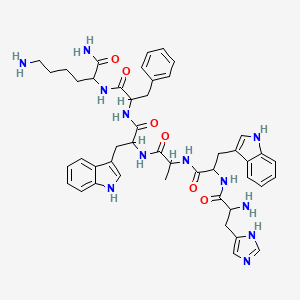
GHRP-6 is a synthetic hexapeptide (His-D-Trp-Ala-Trp-D-Phe-Lys-NH2, CAS 87616-84-0). In laboratory studies it acts as a ghrelin-mimetic agonist at the GHS-R1a receptor to release growth hormone, and also binds the scavenger receptor CD36. It has no approved human use.
GHRP-6 is where an entire field started. Before ghrelin had a name and before the growth hormone secretagogue receptor had been cloned, a short synthetic peptide — six amino acids, half of them in the unnatural D-configuration — was shown to make the pituitary release growth hormone through a pathway that GHRH alone could not explain. That peptide is GHRP-6, and tracing its pharmacology is effectively tracing how the ghrelin system was discovered. Everything below describes laboratory and literature findings, not use in people.
What is GHRP-6, structurally?
GHRP-6 is a synthetic hexapeptide with the sequence His-D-Trp-Ala-Trp-D-Phe-Lys-NH2. The chemistry of record lists CAS number 87616-84-0, molecular formula C46H56N12O6, and a molar mass of roughly 873 g/mol; it also appears under the synonyms SKF-110679 and Hexapeptide-2.7 The stereochemistry matters: the residues are L-histidine, D-tryptophan, L-alanine, L-tryptophan, D-phenylalanine and L-lysine, with a C-terminal amide, as catalogued in the IUPHAR/BPS pharmacology database.6 Two of the six positions carry D-amino acids, and that deliberate design is part of what gives the molecule its resistance to rapid enzymatic breakdown compared with an all-L peptide.
The sequence itself is not new information dressed up. It was named and reported in the primary literature in the mid-1980s: Sartor and colleagues explicitly called the peptide „GH-RP-6“ and gave the full His-D-Trp-Ala-Trp-D-Phe-Lys-NH2 string while characterizing its growth hormone response in the rat.3 That early rat work also flagged something important — the response was age- and sex-dependent, and a single dose produced rapid desensitization.
6 Six amino acids — two of them in the D-configuration — were enough to define an entirely new class of growth hormone releasers.
How does GHRP-6 work?
Mechanistically, GHRP-6 acts as an agonist at the growth hormone secretagogue receptor, GHS-R1a, which is expressed in the pituitary and hypothalamus. The landmark human study by Bowers and colleagues gave intravenous GHRP-6 to 18 normal men and reported dose-dependent GH release that acted synergistically with GHRH — a synergy that only makes sense if GHRP-6 works through a separate, independent GH-releasing system rather than simply reinforcing the GHRH pathway.1 Earlier in vitro work in rat primary pituitary cell cultures had already shown that the hexapeptide releases GH by acting directly on pituitary cells, distinct from GHRH.4
The receptor those studies were probing had no name at the time. The pharmacology of GHRP-6 and its analogues is precisely what led Howard and colleagues to clone the GH-secretagogue receptor in 1996 and to predict that an undiscovered endogenous hormone must exist to occupy it.5 That hormone turned out to be ghrelin. Bowers‘ own first-person history traces the arc from the synthetic hexapeptides through the receptor to endogenous ghrelin, which is why GHRP-6 is usually described as the prototype ghrelin-mimetic secretagogue.11
Beyond releasing growth hormone, GHRP-6 was the molecular probe that helped uncover the ghrelin system.
What is the CD36 connection?
GHRP-6 is not a single-target ligand. It also binds CD36, a scavenger receptor, and the medicinal-chemistry literature states directly that GHRP-6 „exhibits dual affinity for GHS-R1a and the CD36 receptor.“7 Proulx and colleagues built azapeptide analogues of GHRP-6 that separate the two activities — retaining CD36 binding while reducing GHS-R1a affinity — which both proves the dual-affinity claim and gives researchers a way to isolate the CD36 arm.7
That CD36 arm has been explored in animal models. In one rat and rabbit study, topical GHRP-6 attenuated inflammatory and fibrotic mediators and accelerated wound closure, an effect attributed to CD36 agonism.8 In apolipoprotein-E-deficient mice, GHRP-6-derived selective CD36 ligands showed atheroprotective and even atheroregressive effects.9 These are interesting mechanistic leads, but note the pattern: animal models, and in several cases derivatives rather than GHRP-6 itself.
GHRP-6 and appetite
A separate line of rodent pharmacology links GHRP-6 to feeding behaviour. Lawrence and colleagues gave GHRP-6 by central (intracerebroventricular) injection in rats and reported stimulated food intake, activation of hypothalamic and brainstem appetite centres (measured by c-Fos), and activation of orexin neurons; the feeding response was blocked by a Y1 NPY-receptor antagonist.6 This is a mechanistically clean result, but it is central-injection pharmacology in rats — not oral or systemic dosing, and not a human observation.
How does it compare with related peptides?
| Compound | Class | Receptor | Selectivity note |
|---|---|---|---|
| GHRP-6 | GHRP (ghrelin-mimetic) | GHS-R1a + CD36 | Non-selective; raised prolactin/cortisol at higher doses |
| Ipamorelin | Selective GH secretagogue | GHS-R1a | Reported not to raise ACTH/cortisol |
| CJC-1295 | GHRH analogue | GHRH receptor | Different receptor and mechanism entirely — not a GHRP |
Comparison drawn from primary literature; all entries describe in-vitro and animal/early-clinical research findings, not human use or dosing. GHRP-6 and ipamorelin are ghrelin-receptor ligands; CJC-1295 is a GHRH-receptor agonist.
The selectivity contrast is the historically decisive one. Raun and colleagues characterized ipamorelin as „the first selective growth hormone secretagogue,“ explicitly because — unlike GHRP-6 — it did not stimulate ACTH and cortisol release.10 That single distinction is why GHRP-6 sits at the head of the family tree rather than at its cutting edge. For broader context on this receptor class, see our overview of growth hormone secretagogues, the ipamorelin research guide, and the note on CJC-1295 DAC as a distinct GHRH-analogue class.
An honest read of the evidence
The GHRP-6 literature is real and, in places, foundational — but it should not be oversold, and the weaknesses are worth stating plainly. The core human growth-hormone-releasing data come from small early-1990s studies: on the order of 18 men and 9 children, using serum GH as a surrogate endpoint rather than any clinical outcome.12 There is no modern registered clinical trial establishing a therapeutic benefit for GHRP-6.
The oral pharmacokinetics are frankly poor. Bowers and colleagues reported oral activity in men and children but calculated oral bioavailability at only about 0.3% of the intravenous dose, with a serum half-life around 20 minutes.2 Non-selectivity is the other structural weakness: at higher doses the peptide raised prolactin and cortisol, which is exactly what limited its development and drove the search for cleaner agents.10
The CD36 story deserves the same caution. The cytoprotective, anti-fibrotic and atheroprotective findings originate in rats, rabbits and ApoE-deficient mice, and in several cases they use azapeptide derivatives of GHRP-6 rather than the parent compound — so they do not translate into human evidence.89 Some of the wound-healing work also traces to a single research lineage, which means independent replication is limited. The appetite data are rodent, central-injection pharmacology and cannot be read as an appetite effect in people.6 And much of the primary GH-releasing work is now decades old (1985–1996); it was largely superseded scientifically by ghrelin biology and by more selective secretagogues.511 Today, GHRP-6 is chiefly a mechanistic and reference tool.
All materials supplied by Condor Research are Research Use Only (RUO). Everything above describes in-vitro assays and animal or early-literature findings; none of it is a dosing protocol, clinical guidance, or a safety assessment for any organism. GHRP-6 has no approved human therapeutic indication and no marketing authorization from the EMA or FDA, and the IUPHAR entry lists no ATC code.6 GHRP-6 is described here strictly as a research-use-only reference material and is not a confirmed Condor Research catalogue product.
Condor Research · Wissenschaftlicher Support
Atrio Sciences s.r.o., IČO 57 669 651, Nitra (SK) · info@condorresearch.com
- GHRP-6 is a synthetic hexapeptide, sequence His-D-Trp-Ala-Trp-D-Phe-Lys-NH2, CAS 87616-84-0, formula C46H56N12O6 (~873 g/mol); also catalogued as SKF-110679 and Hexapeptide-2.
- It is the prototype growth hormone-releasing peptide from C.Y. Bowers' program; the hunt for its receptor led to cloning of the GHS-R1a and, later, the discovery of endogenous ghrelin.
- In the reported studies it acts as an agonist at GHS-R1a, stimulating pulsatile GH release and acting synergistically with GHRH — evidence of an independent pathway.
- GHRP-6 has a documented second target: it binds CD36, a scavenger receptor, and is described in the literature as having dual affinity for GHS-R1a and CD36.
- It is non-selective: at higher doses the studies also reported raised prolactin and cortisol, which is the explicit contrast that motivated later, selective secretagogues such as ipamorelin.
- Oral activity is poor — around 0.3% of the intravenous dose, with a serum half-life near 20 minutes in the reported human work.
- GHRP-6 has no approved human therapeutic indication and no marketing authorization; it is supplied and studied strictly as a Research Use Only compound.
What does GHRP-6 stand for?
Growth Hormone-Releasing Peptide-6. It is the sixth in a series of synthetic peptides that C.Y. Bowers and colleagues characterized as direct releasers of growth hormone in animal and early human studies. The name was already in the primary literature in the 1980s, written as "GH-RP-6."
Is GHRP-6 the same as ghrelin?
No. GHRP-6 is a fully synthetic hexapeptide, whereas ghrelin is a natural, acylated peptide hormone. They converge at the receptor: GHRP-6 acts at GHS-R1a, the receptor that was later found to be ghrelin's target. That is why GHRP-6 is called a ghrelin-mimetic secretagogue. Historically, GHRP-6 came first and helped lead investigators to ghrelin.
How is GHRP-6 different from CJC-1295?
They belong to different pharmacological classes. GHRP-6 is a GHS-R1a agonist — a ghrelin-mimetic that works through the secretagogue receptor. CJC-1295 is a long-acting analogue of GHRH and acts at the GHRH receptor, an entirely different receptor and mechanism. In laboratory studies, GHRP-6 and GHRH-type molecules act synergistically precisely because they use separate pathways.
Why was GHRP-6 largely superseded?
Selectivity. In the reported studies GHRP-6 raised prolactin and cortisol at higher doses, so its GH-releasing action was not clean. That limitation is the stated reason ipamorelin was developed and described as "the first selective GH secretagogue" — one that does not stimulate ACTH and cortisol. Combined with poor oral bioavailability, this pushed research toward newer agents.
What is the CD36 arm of GHRP-6 pharmacology?
Beyond the GH-secretagogue receptor, GHRP-6 binds CD36, a scavenger receptor, and the literature explicitly describes dual affinity for GHS-R1a and CD36. Animal-model work has explored CD36-mediated effects such as wound healing and atheroprotection. Importantly, several of those studies used azapeptide derivatives engineered to favour CD36 over GHS-R1a, so the findings are not directly about GHRP-6 in humans.
Is GHRP-6 approved for any human use?
No. There is no EMA or FDA marketing authorization, no approved therapeutic indication, and no ATC code assigned in the IUPHAR pharmacology entry. It is supplied and studied strictly as a Research Use Only compound. The available human data are limited to small, decades-old studies using serum GH as a surrogate endpoint.