Lyophilisiert · ≥99% (HPLC) ·
Lyophilisiert geliefert. Für die Rekonstitution wird üblicherweise bakteriostatisches Wasser verwendet.
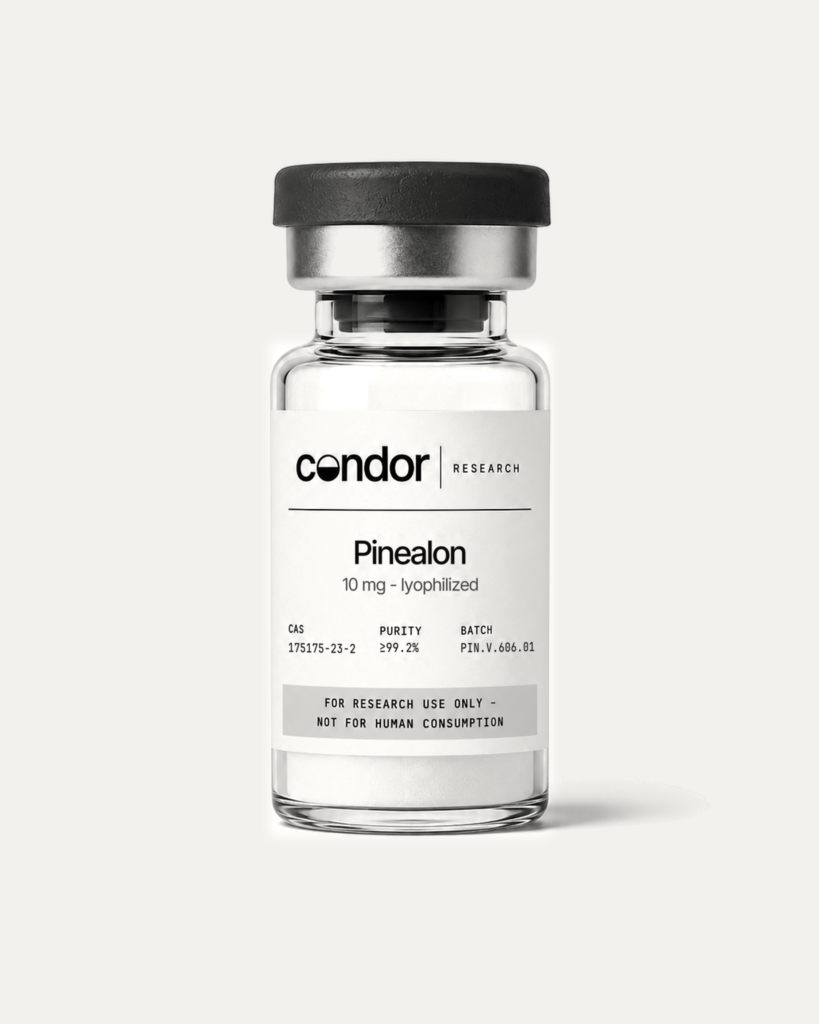
Pinealon is a synthetic tripeptide (Glu-Asp-Arg; EDR) derived from the pineal gland, studied for neuroprotective and neurogenic activity in preclinical models of neurodegeneration, oxidative stress, and cognitive decline. Molecular formula C15H26N6O8; molecular weight 418.40 g/mol; supplied as a 10 mg lyophilized vial at HPLC ≥99% purity. For laboratory research use only; not for human or veterinary use.
Some of the shortest peptides in biology may carry instructions that reach all the way to the genome. Pinealon is a synthetic tripeptide, Glu-Asp-Arg (the "EDR" peptide), developed within the field of short peptide bioregulators. Composed of just three amino acids, it is studied as a model for how minimal peptide sequences may influence neuronal viability, oxidative balance, and gene expression in cell and animal systems.
A three-letter word in the peptide-bioregulator alphabet. Research on short peptides proposes that sequences such as EDR are small enough to enter cells and even interact with DNA, potentially modulating the expression of specific genes — an epigenetic-style hypothesis that distinguishes this peptide class from receptor-only signaling molecules (Khavinson et al., 2020). Pinealon is frequently examined alongside other tripeptide bioregulators as a tool for probing these proposed mechanisms.
What the research explores. The literature centers on neuronal and protective endpoints:
These findings come from in vitro and animal research describing biological activity; they do not establish safety or efficacy in humans. Full citations are listed under the Scientific References tab.
Physicochemical profile. CAS 175175-23-2 · Molecular formula C₁₅H₂₆N₆O₈ · Molecular weight 418.40 g/mol · Sequence Glu-Asp-Arg · Appearance: white lyophilized powder · Soluble in water.
Specification & quality. Each individually sealed vial contains 10 mg of Pinealon as a white lyophilized powder at ≥99% purity by HPLC. Every batch is third-party tested, with a Certificate of Analysis (COA) available. Store at −20 °C, protected from light and moisture.
This product is intended for laboratory research use only (RUO). It is not a drug, food, cosmetic, or dietary supplement, and is not for human or veterinary use, ingestion, or diagnostic application. Handling is restricted to qualified research professionals operating in an appropriately equipped laboratory.
Ausschließlich für den Einsatz in der In-vitro-Laborforschung geliefert (RUO). Kein Arzneimittel, Lebensmittel oder Nahrungsergänzungsmittel; nicht für den menschlichen oder tierärztlichen Gebrauch.
Analysenzertifikat — das chargenspezifische COA wird mit jeder Bestellung mitgeliefert und ist auf Anfrage erhältlich.
Each lot is tested by an independent third-party laboratory for identity (mass spectrometry) and purity (HPLC). The Certificate of Analysis for your specific batch ships with the order and is available on request — no house data, no exceptions.
Die Referenzen veranschaulichen die Forschungsliteratur zu dieser Verbindung. Alle Aussagen beziehen sich ausschließlich auf In-vitro- und Tiermodelle.
Pinealon ist ein synthetischer kurzer Peptid-Bioregulator mit der Sequenz Glu-Asp-Arg (das EDR-Tripeptid), untersucht in der Neuroprotektions- und Zellalterungsforschung. Es gehört zur Familie kurzer „Peptid-Bioregulatoren“, die auf Wirkungen untersucht werden, die bis zum Genom reichen, in Forschungsmodellen. Condor Research liefert es als lyophilisiertes 10-mg-Vial mit ≥99% HPLC-Reinheit, ausschließlich für den In-vitro-Laborgebrauch.
Beide sind kurze synthetische Peptid-Bioregulatoren, unterscheiden sich jedoch in Sequenz und Forschungseinordnung. Pinealon ist das Tripeptid Glu-Asp-Arg (EDR), betont in der Neuroprotektionsforschung, während Epitalon das Tetrapeptid Ala-Glu-Asp-Gly (AEDG) ist, modelliert auf dem Zirbeldrüsen-Peptidkomplex und untersucht in der Zellalterungsforschung. Condor Research bietet jedes als separate ≥99% HPLC-reine Referenzverbindung ausschließlich für Forschungszwecke an.
Pinealon (Glu-Asp-Arg) ist ein Tripeptid-Bioregulator, untersucht hauptsächlich auf neuroprotektive Mechanismen, während Epitalon (Ala-Glu-Asp-Gly) ein Tetrapeptid ist, das mit dem Zirbeldrüsenkomplex assoziiert und in der Langlebigkeitsforschung untersucht wird. Sie teilen sich die Klasse der kurzen Peptid-Bioregulatoren, unterscheiden sich jedoch um einen Rest in der Länge und im Forschungsschwerpunkt. Beide werden als separate ≥99% HPLC-reine Referenzmaterialien geliefert, jedes mit einem Chargen-COA.
Pinealon ist ein Glu-Asp-Arg-Tripeptid-Bioregulator, untersucht in der Neuroprotektions- und Alterungsforschung, während P21 (P021) ein synthetisches, BDNF-nachahmendes neurotrophes Tetrapeptid ist, verwendet in der Neurodegenerationsforschung. Beide tragen eine neuroprotektive Einordnung, stammen jedoch aus unterschiedlichen Konzepten — Peptid-Bioregulation versus Nachahmung neurotropher Faktoren. Condor Research liefert jedes als eigenständige ≥99% HPLC-reine Referenzverbindung.
Pinealon (Glu-Asp-Arg) ist ein kurzer Peptid-Bioregulator, untersucht in Neuroprotektions- und Zellalterungskontexten, während DSIP (Delta Sleep-Inducing Peptide) ein natürlich vorkommendes Nonapeptid ist, untersucht in der Schlaf- und Neuromodulationsforschung. Sie adressieren unterschiedliche Forschungsfragen über nicht verwandte Mechanismen. Beide werden als separate ≥99% HPLC-reine Referenzmaterialien ausschließlich für die In-vitro-Laborstudie angeboten.
Pinealon (EDR-Tripeptid) wird gewählt, wenn ein Forschungsmodell auf neuroprotektive Mechanismen ausgerichtet ist, während Epitalon (AEDG-Tetrapeptid) stärker mit der Zellalterungs- und Telomerforschung assoziiert ist. Die Wahl hängt davon ab, welche Einordnung als kurzer Peptid-Bioregulator zu Ihrer In-vitro-Studie passt. Beide bleiben Referenzmaterialien ausschließlich für Forschungszwecke ohne menschliche oder tierärztliche Anwendung.
Ja. Die Tripeptidsequenz Glu-Asp-Arg (CAS 175175-23-2) wird für jede Charge von einem unabhängigen Drittlabor mittels HPLC auf Reinheit und Massenspektrometrie auf Identität verifiziert. Die Ergebnisse werden im chargenspezifischen Analysenzertifikat dokumentiert, das vor der Bestellung unter info@condorresearch.com angefordert werden kann.
Ja. Pinealon wird ausschließlich für die Laborforschung (in vitro) geliefert. Es ist kein Arzneimittel, Lebensmittel, Nahrungsergänzungsmittel, Kosmetikum oder Medizinprodukt und ist nicht für den menschlichen oder tierärztlichen Gebrauch, die Verabreichung oder den Verzehr bestimmt. Condor Research stellt keine Dosierungen, Protokolle oder Anleitungen für den menschlichen Gebrauch bereit. Der Kauf ist auf qualifizierte Fachleute und Institutionen ab 18 Jahren beschränkt.
Ja. Jede Pinealon-Charge wird von einem unabhängigen Drittlabor per HPLC auf Identität und Reinheit geprüft, mit massenspektrometrischer Bestätigung, und mit einem chargenspezifischen Analysenzertifikat versandt, das ≥99% Reinheit bestätigt. Um das COA für die aktuelle Charge vor der Bestellung anzufordern, kontaktieren Sie info@condorresearch.com.
Ausschließlich für die analytische Laborvorbereitung ist Pinealon wasserlöslich und kann mit einem sterilen wässrigen Verdünnungsmittel rekonstituiert werden; das gewählte Volumen bestimmt die Arbeitskonzentration. Lagern Sie das versiegelte lyophilisierte Vial bei -20°C, vor Licht geschützt, mit einer Haltbarkeit von 24 Monaten ab Herstellung. Dies sind Handhabungsinformationen für den Laborgebrauch, keine Anleitung für den menschlichen oder tierischen Gebrauch.
Der lyophilisierte Kuchen war gleichmäßig und löste sich vollständig auf. Ein digitales COA-Portal wäre wünschenswert, aber das PDF auf Anfrage funktionierte problemlos.
Identität mittels MS in unserer Einrichtung bestätigt. Die Kommunikation zu Lagerung und Handhabung war präzise und professionell.
Reconstitution was clean with no visible particulates. The lot-specific COA matched the assay we ran in-house — purity is exactly as stated.
We verify every incoming compound by HPLC; this batch came back within tolerance of the certificate. Dispatch from the EU warehouse was quick.
Cookies
Wir verwenden unbedingt erforderliche Cookies, um den Shop zu betreiben. Mit Ihrer Einwilligung setzen wir außerdem Analyse-Cookies (Bestellzuordnung) und Marketing-Cookies (Omnisend) ein. Lesen Sie unsere Cookie-Richtlinie.