Liofilizado · ≥99% (HPLC) ·
Suministrado liofilizado. La reconstitución suele realizarse con agua bacteriostática.
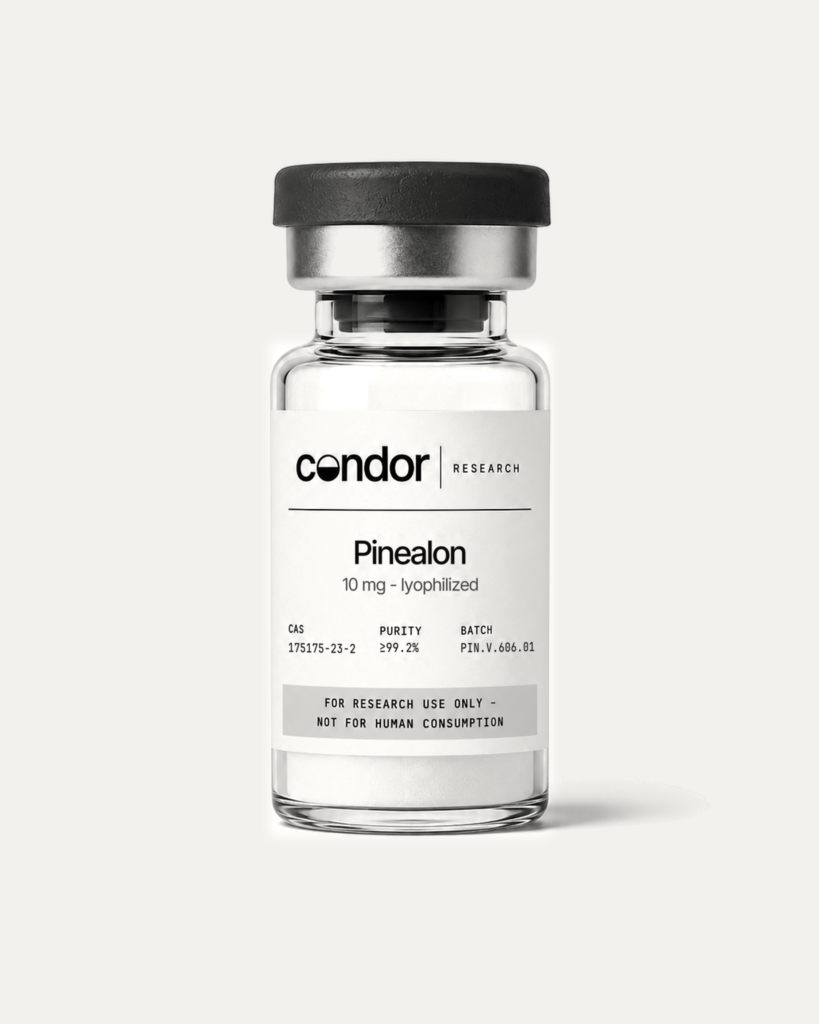
Pinealon is a synthetic tripeptide (Glu-Asp-Arg; EDR) derived from the pineal gland, studied for neuroprotective and neurogenic activity in preclinical models of neurodegeneration, oxidative stress, and cognitive decline. Molecular formula C15H26N6O8; molecular weight 418.40 g/mol; supplied as a 10 mg lyophilized vial at HPLC ≥99% purity. For laboratory research use only; not for human or veterinary use.
Some of the shortest peptides in biology may carry instructions that reach all the way to the genome. Pinealon is a synthetic tripeptide, Glu-Asp-Arg (the "EDR" peptide), developed within the field of short peptide bioregulators. Composed of just three amino acids, it is studied as a model for how minimal peptide sequences may influence neuronal viability, oxidative balance, and gene expression in cell and animal systems.
A three-letter word in the peptide-bioregulator alphabet. Research on short peptides proposes that sequences such as EDR are small enough to enter cells and even interact with DNA, potentially modulating the expression of specific genes — an epigenetic-style hypothesis that distinguishes this peptide class from receptor-only signaling molecules (Khavinson et al., 2020). Pinealon is frequently examined alongside other tripeptide bioregulators as a tool for probing these proposed mechanisms.
What the research explores. The literature centers on neuronal and protective endpoints:
These findings come from in vitro and animal research describing biological activity; they do not establish safety or efficacy in humans. Full citations are listed under the Scientific References tab.
Physicochemical profile. CAS 175175-23-2 · Molecular formula C₁₅H₂₆N₆O₈ · Molecular weight 418.40 g/mol · Sequence Glu-Asp-Arg · Appearance: white lyophilized powder · Soluble in water.
Specification & quality. Each individually sealed vial contains 10 mg of Pinealon as a white lyophilized powder at ≥99% purity by HPLC. Every batch is third-party tested, with a Certificate of Analysis (COA) available. Store at −20 °C, protected from light and moisture.
This product is intended for laboratory research use only (RUO). It is not a drug, food, cosmetic, or dietary supplement, and is not for human or veterinary use, ingestion, or diagnostic application. Handling is restricted to qualified research professionals operating in an appropriately equipped laboratory.
Suministrado exclusivamente para uso en investigación de laboratorio in vitro (RUO). No es un medicamento, alimento ni complemento; no apto para uso humano ni veterinario.
Certificado de análisis — el COA específico del lote se envía con cada pedido y está disponible previa solicitud.
Each lot is tested by an independent third-party laboratory for identity (mass spectrometry) and purity (HPLC). The Certificate of Analysis for your specific batch ships with the order and is available on request — no house data, no exceptions.
Las referencias son ilustrativas de la literatura de investigación sobre este compuesto. Todas las afirmaciones se refieren únicamente a modelos in vitro y animales.
Pinealon es un bioregulador peptídico sintético corto con la secuencia Glu-Asp-Arg (el tripéptido EDR), estudiado en investigación de neuroprotección y envejecimiento celular. Pertenece a la familia de «bioreguladores peptídicos» cortos investigados por efectos que alcanzarían el genoma en modelos de investigación. Condor Research lo suministra como vial liofilizado de 10 mg a ≥99% de pureza por HPLC, exclusivamente para uso en laboratorio in vitro.
Ambos son bioreguladores peptídicos sintéticos cortos, pero se diferencian en secuencia y enfoque de investigación. Pinealon es el tripéptido Glu-Asp-Arg (EDR), con énfasis en investigación de neuroprotección, mientras que Epitalon es el tetrapéptido Ala-Glu-Asp-Gly (AEDG), modelado sobre el complejo peptídico pineal y estudiado en investigación de envejecimiento celular. Condor Research ofrece cada uno como compuesto de referencia separado a ≥99% por HPLC, solo para uso en investigación.
Pinealon (Glu-Asp-Arg) es un tripéptido bioregulador estudiado principalmente por mecanismos neuroprotectores, mientras que Epitalon (Ala-Glu-Asp-Gly) es un tetrapéptido asociado al complejo pineal e investigación de longevidad. Comparten la clase de bioreguladores peptídicos cortos pero difieren en un residuo de longitud y en el énfasis de investigación. Ambos se suministran como materiales de referencia separados a ≥99% por HPLC, solo para uso en investigación, cada uno con un certificado de análisis del lote.
Pinealon es un tripéptido bioregulador Glu-Asp-Arg estudiado en investigación de neuroprotección y envejecimiento, mientras que P21 (P021) es un tetrapéptido neurotrófico sintético mimético del BDNF utilizado en investigación de neurodegeneración. Ambos llevan un enfoque neuroprotector pero derivan de conceptos diferentes — bioregulación peptídica frente a mimetismo de factor neurotrófico. Condor Research suministra cada uno como compuesto de referencia distinto a ≥99% por HPLC, solo para uso en investigación.
Pinealon (Glu-Asp-Arg) es un bioregulador peptídico corto estudiado en contextos de neuroprotección y envejecimiento celular, mientras que DSIP (Delta Sleep-Inducing Peptide) es un nonapéptido de origen natural investigado en investigación del sueño y neuromodulación. Abordan preguntas de investigación diferentes a través de mecanismos no relacionados. Ambos se ofrecen como materiales de referencia separados a ≥99% por HPLC, solo para uso en investigación de laboratorio in vitro.
Pinealon (tripéptido EDR) se selecciona cuando un modelo de investigación se orienta hacia mecanismos neuroprotectores, mientras que Epitalon (tetrapéptido AEDG) se asocia más con investigación de envejecimiento celular y relacionada con telómeros. La elección depende de qué enfoque de bioregulador peptídico corto se ajuste a su estudio in vitro. Ambos siguen siendo materiales de referencia solo para uso en investigación, sin aplicación humana ni veterinaria.
Sí. La secuencia tripeptídica Glu-Asp-Arg (CAS 175175-23-2) se verifica para cada lote mediante un laboratorio independiente por terceros usando HPLC para la pureza y espectrometría de masas para la identidad. Los resultados se documentan en el certificado de análisis específico del lote, que puede solicitarse antes de realizar el pedido en info@condorresearch.com.
Sí. Pinealon se suministra estrictamente para uso en investigación de laboratorio (in vitro). No es un medicamento, alimento, complemento, cosmético ni producto sanitario, y no es apto para uso humano ni veterinario, administración ni consumo. Condor Research no ofrece dosificación, protocolos ni orientación de uso humano. La compra está limitada a profesionales e instituciones cualificados mayores de 18 años.
Sí. Cada lote de Pinealon se analiza en un laboratorio independiente por terceros mediante HPLC para determinar identidad y pureza, con confirmación por espectrometría de masas, y se envía con un certificado de análisis específico del lote que verifica una pureza ≥99%. Para solicitar el certificado de análisis del lote actual antes de realizar el pedido, contacte con info@condorresearch.com.
Exclusivamente para preparación analítica de laboratorio, el Pinealon es soluble en agua y puede reconstituirse con un diluyente acuoso estéril; el volumen elegido fija la concentración de trabajo. Conserve el vial liofilizado sellado a -20 °C, protegido de la luz, con una vida útil de 24 meses desde la fabricación. Esta es información de manipulación de laboratorio, no orientación para ningún uso humano ni animal.
La torta liofilizada era uniforme y se disolvió por completo. Agradecería un portal digital de COA, pero el PDF bajo solicitud funcionó bien.
Identidad confirmada por MS en nuestras instalaciones. La comunicación sobre almacenamiento y manipulación fue precisa y profesional.
Reconstitution was clean with no visible particulates. The lot-specific COA matched the assay we ran in-house — purity is exactly as stated.
We verify every incoming compound by HPLC; this batch came back within tolerance of the certificate. Dispatch from the EU warehouse was quick.
Cookies
Utilizamos cookies estrictamente necesarias para el funcionamiento de la tienda. Con su consentimiento, también utilizamos cookies analíticas (atribución de pedidos) y de marketing (Omnisend). Lea nuestra Política de cookies.