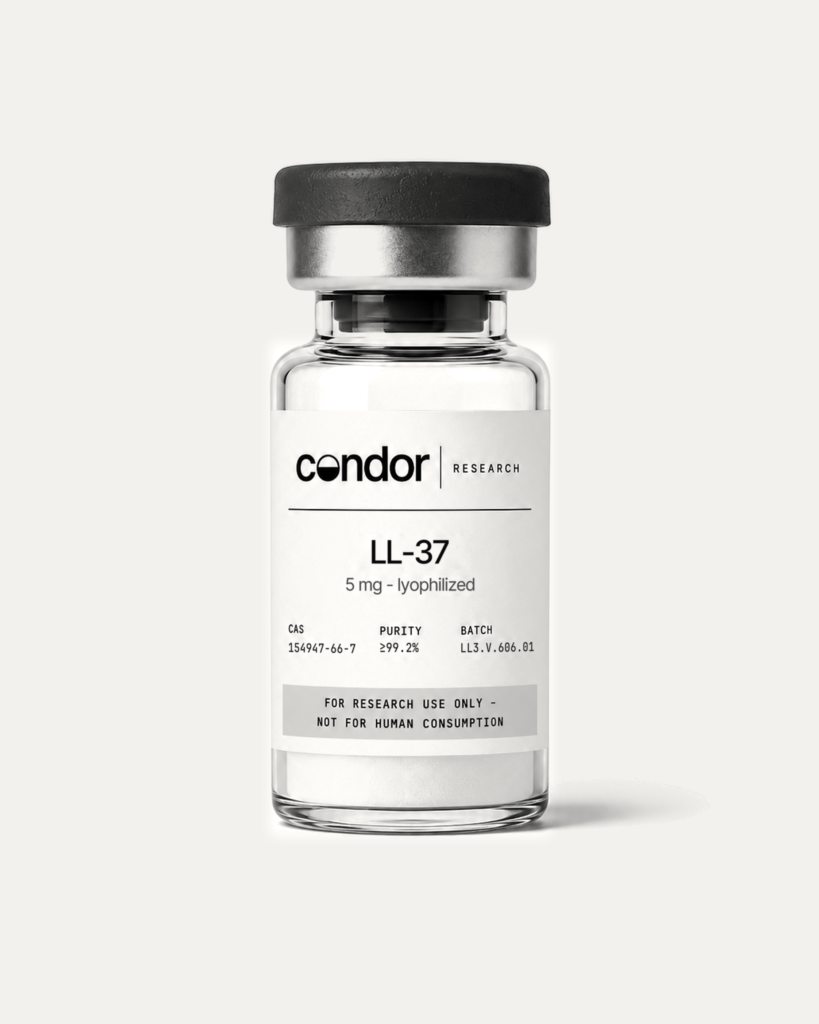
Gelyofiliseerd · ≥99% (HPLC) ·
Geleverd gelyofiliseerd. Voor reconstitutie wordt doorgaans bacteriostatisch water gebruikt.
LL-37 is a 37-amino-acid cationic host-defence peptide, the sole known human cathelicidin, cleaved from the C-terminus of the hCAP-18 precursor protein and studied for its broad-spectrum antimicrobial, immunomodulatory, and wound-healing activities in vitro and in animal models. CAS 154947-66-7; molecular weight approximately 4493 g/mol; supplied lyophilised at ≥99% purity by HPLC. For laboratory research use only; not for human or veterinary use.
Released by immune and epithelial cells at the very first sign of microbial invasion, LL-37 is the only human cathelicidin-derived antimicrobial peptide and a cornerstone molecule in innate-immunity research. This 37-residue, cationic, amphipathic peptide (sequence LLGDFFRKSKEKIGKEFKRIVQRIKDFLRNLVPRTES) is cleaved from the precursor protein hCAP18 and has become one of the most studied effectors of the body's first line of host defence.
A peptide forged at the front line of host defence. LL-37 takes its name from the two leucine residues that begin its 37-amino-acid chain. Stored as an inactive precursor in neutrophil granules and produced by epithelial surfaces, it is liberated by proteolytic processing when tissues encounter pathogens. Its positively charged, helix-forming structure lets it associate with the negatively charged membranes of microbes — a biophysical property that places it at the intersection of antimicrobial action, immune signalling, and tissue biology, and explains why it remains a reference scaffold for peptide design.
What the research explores. Work across biochemical, cellular, and animal models has examined several facets of cathelicidin biology:
These findings stem from in vitro, animal, and clinical studies in controlled research settings; they characterise the peptide's biology and do not represent evidence of benefit for any non-investigational application. Full citations are listed under the Scientific References tab.
Physicochemical profile. CAS 154947-66-7 · Molecular formula C₂₀₅H₃₄₀N₆₀O₅₃ · Molecular weight 4493 · Sequence: LLGDFFRKSKEKIGKEFKRIVQRIKDFLRNLVPRTES · Appearance: white lyophilized powder · Solubility: soluble in water.
Specification & quality. Each individually sealed vial contains 5 mg of LL-37 as a white lyophilized powder, verified at ≥99% purity by HPLC. Every batch is third-party tested, and a Certificate of Analysis (COA) is available. Store at −20 °C, protected from light and moisture.
This product is intended for laboratory research use only (RUO). It is not a drug, food, cosmetic, or dietary supplement, and is not for human or veterinary use, ingestion, or diagnostic application. Handling is restricted to qualified research professionals operating in an appropriately equipped laboratory.
Uitsluitend geleverd voor in-vitro laboratoriumonderzoek (RUO). Geen geneesmiddel, voedingsmiddel of supplement; niet voor menselijk of diergeneeskundig gebruik.
Analysecertificaat — een partijspecifieke COA wordt met elke bestelling meegeleverd en is op aanvraag beschikbaar.
Each lot is tested by an independent third-party laboratory for identity (mass spectrometry) and purity (HPLC). The Certificate of Analysis for your specific batch ships with the order and is available on request — no house data, no exceptions.
De referenties zijn illustratief voor de onderzoeksliteratuur rond deze stof. Alle beweringen hebben uitsluitend betrekking op in-vitro- en diermodellen.
LL-37 is het enige uit cathelicidine afgeleide antimicrobiële peptide bij de mens, een kationisch peptide van 37 residuen dat wordt gebruikt als hoeksteenreagens in onderzoek naar aangeboren immuniteit. Het wordt geleverd als synthetisch peptide uitsluitend voor laboratoriumonderzoek (in vitro). Het is geen geneesmiddel, voedingsmiddel, supplement of medisch hulpmiddel, en is niet voor menselijk of diergeneeskundig gebruik, toediening of consumptie.
LL-37 is een uit cathelicidine afgeleid antimicrobieel peptide dat centraal staat in onderzoek naar aangeboren immuniteit, terwijl Thymosin Alpha-1 een thymuspeptide van 28 aminozuren is dat wordt onderzocht als immuunmodulator. Het ene is een direct antimicrobieel kationisch peptide; het andere is een immunoregulerend peptide afkomstig uit de thymus. Het zijn afzonderlijke moleculen met verschillende sequenties. Beide worden uitsluitend geleverd voor laboratoriumonderzoek (in vitro).
LL-37 is een cathelicidine-antimicrobieel peptide van 37 residuen dat wordt onderzocht op aangeboren immuun- en gastheerafweeractiviteit, terwijl KPV een tripeptide van drie aminozuren is, afgeleid van α-MSH, dat vooral wordt onderzocht in ontstekingsremmende en weefselcontexten. Ze verschillen sterk in grootte en onderzoeksfocus. Beide worden uitsluitend aangeboden als in-vitro onderzoeksreagentia en zijn niet voor menselijk of diergeneeskundig gebruik, toediening of consumptie.
LL-37 is de enige uit cathelicidine afgeleide antimicrobiële peptide bij de mens, wat het referentiemolecuul maakt bij het specifiek bestuderen van humane aangeboren antimicrobiële afweer. Andere immuunpeptiden (bijv. Thymosin Alpha-1, KPV) hebben andere mechanismen en oorsprongen. De keuze hangt af van de onderzoeksvraag. LL-37 wordt uitsluitend geleverd voor laboratoriumonderzoek (in vitro), zonder toepassing bij mens of dier.
LL-37 is een cathelicidine-antimicrobieel peptide dat wordt onderzocht in aangeboren immuniteit en gastheerafweer, terwijl BPC-157 een pentadecapeptide is dat wordt onderzocht in weefselherstel en cytoprotectie. Ze richten zich op geheel verschillende onderzoeksgebieden en delen geen sequentierelatie. Beide worden geleverd als synthetische peptiden uitsluitend voor laboratoriumonderzoek (in vitro), niet voor menselijk of diergeneeskundig gebruik.
Elke batch wordt getest door een onafhankelijk laboratorium van derden, waarbij identiteit wordt bevestigd door massaspectrometrie en zuiverheid wordt geverifieerd op ≥99% via HPLC, gedocumenteerd in een Certificate of Analysis per partij. Neem voor endotoxinestatus of aanvullende assay-specifieke parameters van een bepaalde partij contact op met info@condorresearch.com, zodat de beschikbare documentatie kan worden bevestigd. Uitsluitend geleverd voor laboratoriumonderzoek.
Zuiverheid wordt per batch geverifieerd op ≥99% via HPLC en identiteit via massaspectrometrie, met resultaten op het Certificate of Analysis. Bij sterk geladen peptiden kunnen netto peptidegehalte en tegenion (bijv. TFA) functionele assays beïnvloeden; neem voor de specifieke waarden van een bepaalde partij contact op met info@condorresearch.com. Het product wordt uitsluitend geleverd voor laboratoriumonderzoek (in vitro).
Ja. Elke partij wordt getest door een onafhankelijk laboratorium van derden, waarbij identiteit wordt bevestigd door massaspectrometrie en zuiverheid op ≥99% via HPLC, en per batch wordt een Certificate of Analysis uitgegeven. Fabrikantendocumentatie wordt niet gepubliceerd, om de integriteit van de toeleveringsketen te behouden. Vraag de partijspecifieke COA aan via info@condorresearch.com. LL-37 wordt uitsluitend geleverd voor laboratoriumonderzoek.
LL-37 staat vermeld als oplosbaar in water, dus het wordt gereconstitueerd met een waterig verdunningsmiddel voor analytische laboratoriumbereiding; het flacon bevat 5 mg gelyofiliseerd peptide. Bewaar het ongeopende flacon bij -20°C, beschermd tegen licht (houdbaarheid 24 maanden). Eventuele reconstitutiegegevens zijn uitsluitend voor in-vitro laboratoriumgebruik, nooit voor gebruik bij mens of dier, en er wordt geen doseringsrichtlijn gegeven.
Ja. LL-37 wordt uitsluitend verkocht voor laboratoriumonderzoek (in vitro) en is geen geneesmiddel, voedingsmiddel, supplement, cosmeticum of medisch hulpmiddel, en niet voor menselijk of diergeneeskundig gebruik, toediening of consumptie. Hantering betreft uitsluitend laboratoriumbereiding; eventuele reconstitutiegegevens gelden voor analytisch werk, niet voor gebruik bij mens of dier. Vragen: info@condorresearch.com.
We verify every incoming compound by HPLC; this batch came back within tolerance of the certificate. Dispatch from the EU warehouse was quick.
Cold-chain handling was respected end to end. Vials arrived sealed, labelled and intact. Documentation is the most thorough I've seen from an EU supplier.
Oplosbaarheid en stabiliteit waren zoals beschreven. Één ster afgetrokken omdat de opties voor expresverzending beperkt zijn, maar de kwaliteit staat buiten kijf.
Derde bestelling bij Condor. De variatie tussen batches is minimaal, wat belangrijk is voor ons longitudinale werk. De mono-gelabelde flacons zijn eenvoudig te traceren.
Geen marketingpraat — alleen gekarakteriseerd materiaal met documentatie. Het gegevensblad en het CAS-nummer kwamen precies overeen met onze gegevens.
Cookies
Wij gebruiken strikt noodzakelijke cookies om de winkel te laten werken. Met uw toestemming gebruiken wij ook analytische (orderattributie) en marketingcookies (Omnisend). Lees onze Cookiebeleid.