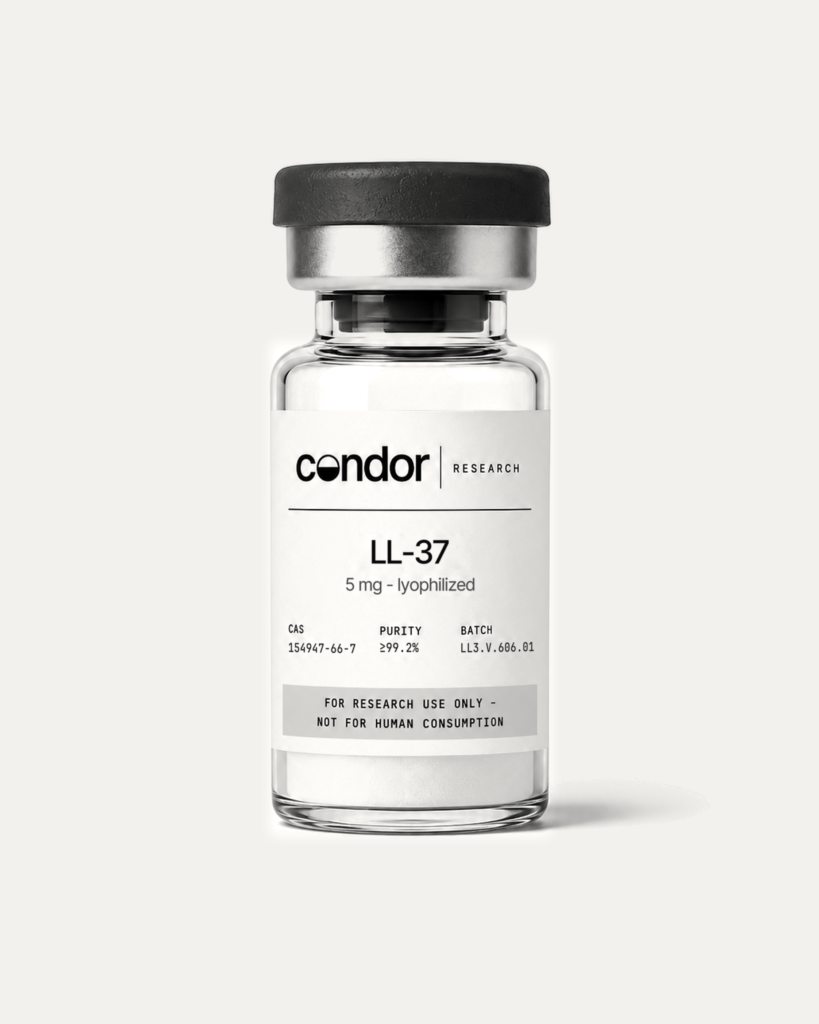
Lyophilisé · ≥99% (HPLC) ·
Fourni lyophilisé. La reconstitution se fait généralement avec de l'eau bactériostatique.
LL-37 is a 37-amino-acid cationic host-defence peptide, the sole known human cathelicidin, cleaved from the C-terminus of the hCAP-18 precursor protein and studied for its broad-spectrum antimicrobial, immunomodulatory, and wound-healing activities in vitro and in animal models. CAS 154947-66-7; molecular weight approximately 4493 g/mol; supplied lyophilised at ≥99% purity by HPLC. For laboratory research use only; not for human or veterinary use.
Released by immune and epithelial cells at the very first sign of microbial invasion, LL-37 is the only human cathelicidin-derived antimicrobial peptide and a cornerstone molecule in innate-immunity research. This 37-residue, cationic, amphipathic peptide (sequence LLGDFFRKSKEKIGKEFKRIVQRIKDFLRNLVPRTES) is cleaved from the precursor protein hCAP18 and has become one of the most studied effectors of the body's first line of host defence.
A peptide forged at the front line of host defence. LL-37 takes its name from the two leucine residues that begin its 37-amino-acid chain. Stored as an inactive precursor in neutrophil granules and produced by epithelial surfaces, it is liberated by proteolytic processing when tissues encounter pathogens. Its positively charged, helix-forming structure lets it associate with the negatively charged membranes of microbes — a biophysical property that places it at the intersection of antimicrobial action, immune signalling, and tissue biology, and explains why it remains a reference scaffold for peptide design.
What the research explores. Work across biochemical, cellular, and animal models has examined several facets of cathelicidin biology:
These findings stem from in vitro, animal, and clinical studies in controlled research settings; they characterise the peptide's biology and do not represent evidence of benefit for any non-investigational application. Full citations are listed under the Scientific References tab.
Physicochemical profile. CAS 154947-66-7 · Molecular formula C₂₀₅H₃₄₀N₆₀O₅₃ · Molecular weight 4493 · Sequence: LLGDFFRKSKEKIGKEFKRIVQRIKDFLRNLVPRTES · Appearance: white lyophilized powder · Solubility: soluble in water.
Specification & quality. Each individually sealed vial contains 5 mg of LL-37 as a white lyophilized powder, verified at ≥99% purity by HPLC. Every batch is third-party tested, and a Certificate of Analysis (COA) is available. Store at −20 °C, protected from light and moisture.
This product is intended for laboratory research use only (RUO). It is not a drug, food, cosmetic, or dietary supplement, and is not for human or veterinary use, ingestion, or diagnostic application. Handling is restricted to qualified research professionals operating in an appropriately equipped laboratory.
Fourni exclusivement pour un usage de recherche en laboratoire in vitro (RUO). Ne constitue ni un médicament, ni une denrée alimentaire, ni un complément ; ne convient pas à un usage humain ou vétérinaire.
Certificat d'analyse — un COA propre au lot est fourni avec chaque commande et disponible sur demande.
Each lot is tested by an independent third-party laboratory for identity (mass spectrometry) and purity (HPLC). The Certificate of Analysis for your specific batch ships with the order and is available on request — no house data, no exceptions.
Ces références illustrent la littérature de recherche relative à ce composé. Toutes les données mentionnées concernent exclusivement des modèles in vitro et animaux.
Le LL-37 est le seul peptide antimicrobien dérivé de la cathélicidine humaine, un peptide cationique de 37 résidus utilisé comme réactif pilier en recherche sur l'immunité innée. Il est fourni comme peptide synthétique pour un usage de recherche en laboratoire uniquement (in vitro). Ce n'est ni un médicament, ni un aliment, ni un complément, ni un dispositif médical, et il ne convient pas à un usage humain ou vétérinaire, à l'administration ou à la consommation.
Le LL-37 est un peptide antimicrobien dérivé de la cathélicidine, central aux études d'immunité innée, tandis que la Thymosine Alpha-1 est un peptide thymique de 28 acides aminés étudié comme modulateur immunitaire. L'un est un peptide cationique antimicrobien direct ; l'autre un peptide immunorégulateur dérivé du thymus. Ce sont des molécules distinctes de séquences différentes. Les deux sont fournis strictement pour un usage de recherche en laboratoire uniquement (in vitro).
Le LL-37 est un peptide antimicrobien cathélicidine de 37 résidus étudié pour son activité immunitaire innée et de défense de l'hôte, tandis que le KPV est un tripeptide dérivé de l'α-MSH de trois acides aminés étudié largement dans des contextes anti-inflammatoires et tissulaires. Ils diffèrent grandement en taille et en axe de recherche. Les deux sont proposés uniquement comme réactifs de recherche in vitro et ne conviennent pas à l'usage humain ou vétérinaire, à l'administration ou à la consommation.
Le LL-37 est l'unique peptide antimicrobien dérivé de la cathélicidine humaine, ce qui en fait la molécule de référence lorsqu'on étudie spécifiquement la défense antimicrobienne innée humaine. D'autres peptides immunitaires (par ex. Thymosine Alpha-1, KPV) ont des mécanismes et origines différents. La sélection dépend de la question de recherche. Le LL-37 est fourni strictement pour un usage de recherche en laboratoire uniquement (in vitro), sans application humaine ou vétérinaire.
Le LL-37 est un peptide antimicrobien cathélicidine étudié en immunité innée et défense de l'hôte, tandis que le BPC-157 est un pentadécapeptide étudié en recherche sur la réparation tissulaire et la cytoprotection. Ils ciblent des domaines de recherche entièrement différents et ne partagent aucun rapport de séquence. Les deux sont fournis comme peptides synthétiques pour un usage de recherche en laboratoire uniquement (in vitro), non destinés à un usage humain ou vétérinaire.
Chaque lot est testé par un laboratoire tiers indépendant avec identité confirmée par spectrométrie de masse et pureté vérifiée à ≥99 % par HPLC, documentée dans un certificat d'analyse par lot. Pour le statut d'endotoxine ou tout autre paramètre spécifique à un test sur un lot donné, contactez info@condorresearch.com afin que la documentation disponible puisse être confirmée. Fourni pour un usage de recherche en laboratoire uniquement.
La pureté est vérifiée à ≥99 % par HPLC et l'identité par spectrométrie de masse par lot, avec les résultats sur le certificat d'analyse. Pour les peptides fortement chargés, le contenu net en peptide et les détails du contre-ion (par ex. TFA) peuvent affecter les tests fonctionnels ; pour les valeurs spécifiques d'un lot donné, contactez info@condorresearch.com. Le produit est fourni strictement pour un usage de recherche en laboratoire uniquement (in vitro).
Oui. Chaque lot est testé par un laboratoire tiers indépendant, avec identité confirmée par spectrométrie de masse et pureté à ≥99 % par HPLC, et un certificat d'analyse est délivré par lot. La documentation du fabricant n'est pas publiée, afin de préserver l'intégrité de la chaîne d'approvisionnement. Demandez le COA spécifique au lot via info@condorresearch.com. Le LL-37 est fourni pour un usage de recherche en laboratoire uniquement.
Le LL-37 est répertorié comme soluble dans l'eau, il est donc reconstitué avec un diluant aqueux pour la préparation analytique en laboratoire ; le flacon contient 5 mg de peptide lyophilisé. Conservez le flacon non ouvert à -20 °C, à l'abri de la lumière (durée de conservation de 24 mois). Toute donnée de reconstitution concerne un usage en laboratoire in vitro uniquement, jamais un usage humain ou animal, et aucune indication de dosage n'est donnée.
Oui. Le LL-37 est vendu strictement pour un usage de recherche en laboratoire uniquement (in vitro) et n'est ni un médicament, ni un aliment, ni un complément, ni un cosmétique, ni un dispositif médical, et ne convient pas à un usage humain ou vétérinaire, à l'administration ou à la consommation. La manipulation se limite à la préparation en laboratoire ; toute donnée de reconstitution s'applique au travail analytique, non à un usage chez l'humain ou l'animal. Questions : info@condorresearch.com.
We verify every incoming compound by HPLC; this batch came back within tolerance of the certificate. Dispatch from the EU warehouse was quick.
Cold-chain handling was respected end to end. Vials arrived sealed, labelled and intact. Documentation is the most thorough I've seen from an EU supplier.
Solubilité et stabilité conformes à la description. Une étoile retirée uniquement car les options d'expédition express sont limitées, mais la qualité n'est pas en cause.
Troisième commande passée chez Condor. La variation d'un lot à l'autre est minime, ce qui compte pour nos travaux longitudinaux. Les flacons à étiquette unique sont faciles à suivre.
Aucun discours marketing — seulement du matériel caractérisé et documenté. La fiche technique et le numéro CAS correspondaient exactement à nos données.
Cookies
Nous utilisons des cookies strictement nécessaires au fonctionnement de la boutique. Avec votre consentement, nous utilisons également des cookies d'analyse (attribution des commandes) et marketing (Omnisend). Consultez notre Politique relative aux cookies.