
What Is FOXO4-DRI? The Senolytic Peptide That Cleared Senescent Cells in Aged Mice
FOXO4-DRI is a D-retro-inverso senolytic peptide that disrupted the FOXO4-p53 interaction and cleared senescent cells in aged mice. What the research actually shows.
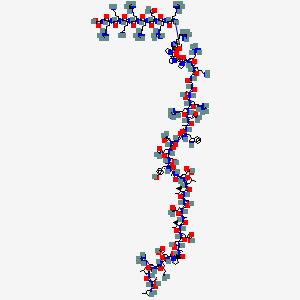
FOXO4-DRI is a synthetic D-retro-inverso peptide that perturbs the FOXO4-p53 interaction, causing p53 nuclear exclusion and apoptosis selectively in senescent cells. In a 2017 Cell study it cleared senescent cells and restored fitness, fur density and renal function in aged mice. Evidence is preclinical only.
FOXO4-DRI is one of the more precisely reasoned senolytic peptides in the aging literature: a short, chemically hardened peptide designed to exploit a single molecular dependency that senescent cells acquire and normal cells do not. It became widely discussed after a 2017 Cell paper reported that a version of it cleared senescent cells and partially reversed markers of aging in mice. Everything below describes laboratory and literature findings — cell assays and mouse experiments — not use in people.
What is FOXO4-DRI, structurally?
FOXO4-DRI is a synthetic peptide derived from a segment of the transcription factor FOXO4. The “DRI” denotes its chemistry: D-retro-inverso, meaning it is built from D-amino acids strung together in the reverse order of the parent L-peptide. Retro-inversion is a well-established peptide trick. By reversing the backbone direction and swapping to D-residues, the side chains end up occupying roughly the same spatial positions as in the original sequence, so the molecule can still engage its target — but proteases that recognize natural L-peptide bonds struggle to cleave it, and immunogenicity tends to drop.1 The result is a peptide with a longer functional lifetime than the natural fragment it imitates.
It is worth being precise about what FOXO4-DRI is not. It is a defined peptide sequence, not a simple small molecule with a single canonical CAS registry entry. There is no one authoritative purity or lot figure attached to the name; batch identity is defined per synthesis run.
How does it work?
Senescent cells are cells that have exited the cell cycle but refuse to die. Many of them survive by keeping the tumor-suppressor protein p53 under control, and in the model behind FOXO4-DRI, they lean on FOXO4 to do that. FOXO4 binds p53 and helps hold it in the nucleus in a configuration that blocks p53 from triggering apoptosis.1
FOXO4-DRI was designed to slot into that interaction and break it. When the peptide perturbs the FOXO4-p53 interface, p53 is excluded from the nucleus. In a senescent cell, losing that restraint releases a p53-driven, cell-intrinsic apoptosis program — the cell kills itself. In a proliferating or quiescent cell, which is not depending on FOXO4 in the same way, the effect is far weaker, which is the basis of the selectivity claim.1 Later molecular-modelling work mapped the FOXO4-TP53 binding surface in detail to rationalize and refine peptides of this type, reinforcing the design logic behind the D-retro-inverso construct.4
1 lab produced the foundational 2017 Cell result (Baar et al., de Keizer) behind the senescent-cell-clearance claim; independent in-vivo replication is still limited.
What did the landmark study actually report?
The pivotal work is Baar and colleagues, “Targeted Apoptosis of Senescent Cells Restores Tissue Homeostasis in Response to Chemotoxicity and Aging,” published in Cell in 2017 from the de Keizer lab at Erasmus MC, with Judith Campisi among the authors.1 The study designed the FOXO4 peptide, showed it disrupted the FOXO4-p53 interaction, and reported that it drove p53 nuclear exclusion and apoptosis selectively in senescent cells.
In vivo — and this is mouse work throughout — the study reported three headline observations under conditions where the peptide was well tolerated: it neutralized doxorubicin-induced chemotoxicity; and in both fast-aging XpdTTD/TTD progeroid mice and naturally aged mice, it restored fitness, fur (coat) density, and renal function. A commentary in the same issue of Cell framed the result as a proof of concept for therapeutic elimination of senescent cells, which is a fair reading of how the field received it at the time.2
The elegance is in the selectivity: exploit the one thing a senescent cell cannot do without, and it removes itself.
What has follow-up work added?
Several groups have used FOXO4-DRI-type peptides since. In aged mice, the peptide reduced senescent Leydig cells and improved testosterone secretion in one study,5 and a later report from an overlapping group found reduced senescence-associated secretory phenotype (SASP) from Leydig cells and improved spermatogenesis.6 Both are mouse-only. On the human side, the closest evidence is in vitro: FOXO4-DRI selectively removed senescent cells from in-vitro-expanded human chondrocytes.3 Disease-model mouse studies have also reported effects in the lung, where a FOXO4 peptide reduced bleomycin-induced pulmonary fibrosis,7 and in radiation/cancer contexts targeting senescent-like fibroblasts.8
| Study context | System | Reported observation | Ref |
|---|---|---|---|
| Aging / chemotoxicity | Progeroid & aged mice; cells | Senescent-cell apoptosis; restored fitness, fur, renal function | 1 |
| Testosterone / Leydig cells | Aged mice | Fewer senescent Leydig cells; higher testosterone | 5 |
| Spermatogenesis / SASP | Aged mice | Reduced Leydig-cell SASP; improved spermatogenesis | 6 |
| Human chondrocytes | Human cells, in vitro | Selective clearance of senescent cells | 3 |
| Pulmonary fibrosis | Mice (bleomycin model) | Reduced fibrosis | 7 |
All rows are in-vitro or mouse in-vivo findings. None represent human clinical outcomes, and none should be read as evidence of an effect in people.
An honest read of the evidence
The case for FOXO4-DRI is scientifically interesting but far thinner than its popularity implies, and it is worth saying so plainly. The foundational in-vivo aging result rests heavily on a single 2017 paper from one laboratory.1 That paper is peer-reviewed and influential, but the pivotal progeroid/naturally-aged result has not been broadly and independently reproduced in the same paradigm by unrelated groups. Some of the apparent “replication” is concentrated rather than independent — for example, the two Leydig-cell papers come from a small cluster of overlapping investigators,56 which is not the same as multiple separate labs converging on the same answer.
Every efficacy datapoint is preclinical. There are no published human clinical trials of FOXO4-DRI, and no human efficacy or safety data. The only human-derived signal is from cultured cells.3 On top of that, senolysis itself is not uniformly good. A 2023 Circulation study found that eliminating senescent cells promoted the development and progression of pulmonary hypertension, a direct counterexample to any blanket “clearing senescent cells rejuvenates tissue” narrative.9 Reviews from within the senescence field are careful to frame senescent-cell clearance as a target with real limits, not a settled therapy.1011
There are peptide-specific uncertainties too. In-vivo delivery, the tolerability window, potential off-target consequences of manipulating p53, and batch-to-batch sequence variability are all real. The original study itself was explicit that results held “under conditions where it was well tolerated,” language that implies a narrow margin rather than a forgiving one.1 FOXO4-DRI circulates in longevity-enthusiast and grey-market channels well ahead of its evidence base; the distance between a promising mouse result and anything resembling human use is large, and pretending otherwise would be dishonest.
All materials supplied by Condor Research are Research Use Only (RUO). The information above summarizes in-vitro and animal literature and is not a dosing protocol, clinical guidance, or a safety assessment for any organism. FOXO4-DRI is an experimental research peptide with no approved use; Condor Research does not list it as a confirmed catalogue product, and nothing here should be read as a purchase recommendation or a claim of effect in humans or animals.
Condor Research · Sportello scientifico
Atrio Sciences s.r.o., IČO 57 669 651, Nitra (SK) · info@condorresearch.com
- FOXO4-DRI is a D-retro-inverso peptide (all-D residues, reversed sequence) built from a FOXO4 motif; the design mimics side-chain topology while resisting protease breakdown.
- Its mechanism is senolytic: it competes at the FOXO4-p53 interface, drives p53 out of the nucleus in senescent cells, and releases a p53-driven apoptosis program that is normally held in check.
- The landmark study (Baar et al., Cell 2017, PMID 28340339) reported clearance of senescent cells and restored fitness, fur density and renal function in progeroid and naturally aged mice.
- In that study the peptide killed senescent cells while sparing proliferating and quiescent cells, and neutralized doxorubicin-induced chemotoxicity.
- Follow-up work extended the senolytic effect to aged-mouse Leydig cells (PMID 31959736; PMID 39025385) and to human chondrocytes in vitro (PMID 33996787) — still no human clinical data.
- The foundational aging result rests heavily on a single 2017 lab (de Keizer, Erasmus MC); several follow-ups come from overlapping investigators rather than fully independent groups.
- Clearing senescent cells is not uniformly beneficial: in a 2023 Circulation study, senolysis promoted pulmonary hypertension (PMID 36515093).
What does FOXO4-DRI stand for?
DRI stands for D-retro-inverso. The peptide is assembled from D-amino acids in the reverse of the natural sequence order. This geometry lets it approximate the original peptide's side-chain positions while resisting protease degradation and lowering immunogenicity relative to the natural L-peptide.
Is FOXO4-DRI approved for any therapeutic use?
No. It has no regulatory approval anywhere and no published human clinical trials. It is an experimental compound handled strictly as Research Use Only.
Has it been tested in humans?
Not in clinical trials. The closest human-relevant data are in vitro, in cultured human cells such as senescent chondrocytes, where the peptide selectively cleared senescent cells. That is still a dish, not a person.
How selective is it for senescent cells?
In the 2017 study it induced apoptosis in senescent cells while sparing proliferating and quiescent cells. The selectivity is attributed to the specific reliance of senescent cells on FOXO4 to keep p53 restrained; cells that are not senescent do not depend on that interaction in the same way.
Is removing senescent cells always beneficial?
No, and this is an important caveat. In a 2023 Circulation study, senolysis promoted pulmonary hypertension, showing that clearing senescent cells can be harmful in some tissue contexts. Senescent cells are not simply "bad cells to be removed" in every setting.
Does FOXO4-DRI have a defined CAS number and purity?
It is a defined peptide sequence rather than a simple chemical, so it does not carry a single universally cited small-molecule CAS number the way a basic reagent does. Any identity, sequence, and purity figures are specific to a given synthesis lot.