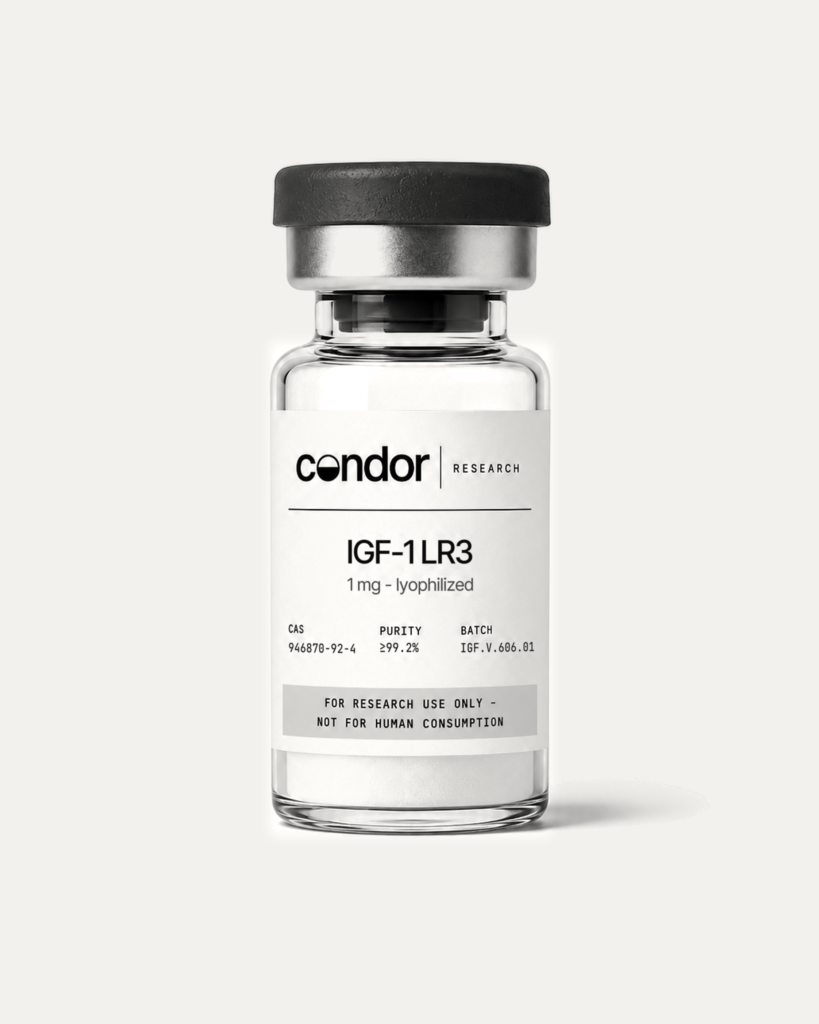
Lyophilisé · ≥99% (HPLC) ·
Fourni lyophilisé. La reconstitution se fait généralement avec de l'eau bactériostatique.
IGF-1 LR3 (Insulin-like Growth Factor-1 Long R3) is a synthetic 83-amino-acid analogue of human IGF-1, engineered with an N-terminal 13-amino-acid extension and an Arg3 substitution to reduce IGF-binding-protein affinity and extend biological half-life in vitro; molecular weight approximately 9.1 kDa; supplied lyophilised at ≥99% purity by HPLC. For laboratory research use only; not for human or veterinary use.
A bioengineered variant of one of the body's central growth signals, IGF-1 LR3 (Long R3 Insulin-like Growth Factor-1) is an 83-amino-acid recombinant analogue of human IGF-1. It carries two deliberate modifications: an arginine substituted for glutamate at position 3, and a 13-residue N-terminal extension. Together these changes dramatically reduce its binding to IGF-binding proteins, leaving more of the molecule free to engage its receptor and giving researchers a long-acting, high-potency tool for studying the IGF axis.
A growth factor redesigned to evade its own carrier proteins. In native physiology, circulating IGF-1 is largely sequestered by a family of binding proteins that tightly regulate its availability. To create a reagent that resists this sequestration, protein engineers designed the Long-R3 muteins specifically to show reduced binding-protein affinity while retaining receptor activity (Bryant et al., 1996). The outcome is an analogue whose biological signal is both stronger and more persistent than the parent molecule in experimental systems.
What the research explores. The literature on Long R3 IGF-1 spans developmental biology, tissue growth and neuroscience, exclusively in cellular and animal models:
These results are confined to in‑vitro and animal research and do not support conclusions about human use. Full citations are listed under the Scientific References tab.
Physicochemical profile. CAS 946870-92-4 · Molecular formula C400H625N111O115S9 · Molecular weight 9117.50 g/mol · 83-residue polypeptide · Appearance white lyophilized powder · Soluble in 0.1 M acetic acid at 0.1 mg/mL.
Specification & quality. Each individually sealed vial contains 1 mg of IGF-1 LR3 at ≥99% purity by HPLC. Every batch is third-party tested, with a Certificate of Analysis (COA) available. Store at −20 °C, protected from light and moisture.
This product is intended for laboratory research use only (RUO). It is not a drug, food, cosmetic, or dietary supplement, and is not for human or veterinary use, ingestion, or diagnostic application. Handling is restricted to qualified research professionals operating in an appropriately equipped laboratory.
Fourni exclusivement pour un usage de recherche en laboratoire in vitro (RUO). Ne constitue ni un médicament, ni une denrée alimentaire, ni un complément ; ne convient pas à un usage humain ou vétérinaire.
Certificat d'analyse — un COA propre au lot est fourni avec chaque commande et disponible sur demande.
Each lot is tested by an independent third-party laboratory for identity (mass spectrometry) and purity (HPLC). The Certificate of Analysis for your specific batch ships with the order and is available on request — no house data, no exceptions.
Ces références illustrent la littérature de recherche relative à ce composé. Toutes les données mentionnées concernent exclusivement des modèles in vitro et animaux.
L'IGF-1 LR3 (Long R3 Insulin-like Growth Factor-1) est un analogue recombinant de 83 acides aminés de l'IGF-1 humain, bio-conçu pour une plus grande stabilité que le signal de croissance natif. Condor Research le fournit en flacon lyophilisé de 1 mg à une pureté HPLC de ≥99 %, strictement comme protéine de référence réservée à la recherche pour étude en laboratoire in vitro.
Ils agissent aux extrémités opposées de l'axe GH/IGF. L'IGF-1 LR3 est un analogue recombinant de l'IGF-1 — une protéine de référence de facteur de croissance directe. Le CJC-1295 est un sécrétagogue analogue de la GHRH, étudié pour sa signalisation en amont plutôt que d'être lui-même une molécule d'IGF. Les chercheurs choisissent l'IGF-1 LR3 pour étudier directement le critère IGF et les sécrétagogues pour étudier la voie en amont.
Ils se situent à des points différents du système GH/IGF. L'IGF-1 LR3 est un analogue recombinant de 83 résidus de l'IGF-1 agissant comme référence directe de facteur de croissance. L'AOD-9604 est un court fragment synthétique de la région C-terminale de l'hormone de croissance (résidus 177-191), étudié pour des propriétés de recherche métabolique distinctes. Les deux sont des matériels réservés à la recherche à ≥99 % HPLC mais ne sont pas des composés de référence interchangeables.
L'IGF-1 LR3 est une grande protéine recombinante de 83 acides aminés (MM ≈ 9117 Da), fournie à 1 mg par flacon comme quantité de référence analytique adaptée à cette molécule. La masse du flacon reflète la spécification du produit, non une dose. Pour comparer la valeur entre les formats, contactez info@condorresearch.com. Toutes les quantités sont des quantités de référence réservées à la recherche.
Pour la préparation analytique en laboratoire uniquement, l'eau pure n'est pas le solvant indiqué. L'IGF-1 LR3 est spécifié comme soluble dans l'acide acétique 0,1 M à 0,1 mg/mL, et non librement soluble dans l'eau comme les peptides plus petits. Utilisez le diluant acidifié indiqué sur la fiche technique pour le travail en laboratoire. Il s'agit d'informations de manipulation pour un usage in vitro, non d'une indication pour un usage humain ou animal quelconque.
En tant que protéine recombinante plus grande et moins soluble dans l'eau, l'IGF-1 LR3 se dissout de manière fiable dans un milieu légèrement acide, ce qui explique pourquoi sa fiche technique spécifie de l'acide acétique 0,1 M à 0,1 mg/mL plutôt que de l'eau pure. Ce comportement de solubilité est une propriété de la molécule. Ce sont des informations de préparation analytique en laboratoire, non une instruction pour un usage non lié à la recherche.
Chaque lot d'IGF-1 LR3 est testé par un laboratoire tiers indépendant par HPLC pour l'identité et la pureté à ≥99 %, avec confirmation par spectrométrie de masse, et est expédié avec un certificat d'analyse (COA) spécifique au lot. S'agissant d'une protéine recombinante fragile, une documentation correspondant au lot est importante ; demandez le COA en cours avant de commander à info@condorresearch.com.
Le format lyophilisé scellé de l'IGF-1 LR3 est comparativement tolérant au transport, et le flacon est conservé à long terme à -20 °C, à l'abri de la lumière, avec une durée de conservation de 24 mois. Pour des précisions sur la manipulation avec accumulateurs de froid vers votre destination et les considérations de retard douanier, contactez info@condorresearch.com ; les délais de livraison au sein de l'Europe sont normalement de quelques jours ouvrables mais ne sont pas garantis.
Pour un usage en laboratoire uniquement, une solution mère primaire d'acide acétique peut généralement être diluée davantage dans un tampon compatible pour les dosages, l'approche exacte dépendant de votre système expérimental. Conservez le flacon lyophilisé scellé à -20 °C, à l'abri de la lumière. Traitez toute solution préparée comme une protéine recombinante sensible. Il s'agit d'informations de manipulation in vitro, non d'une indication d'usage humain.
Oui. L'IGF-1 LR3 est fourni strictement pour la recherche en laboratoire (in vitro) uniquement. Ce n'est ni un médicament, ni un aliment, ni un complément, ni un cosmétique, ni un dispositif médical, et il ne convient pas à un usage humain ou vétérinaire, à l'administration ou à la consommation. Condor Research ne fournit aucun dosage ni protocole. L'achat est réservé aux professionnels et institutions qualifiés âgés de 18 ans ou plus.
Troisième commande passée chez Condor. La variation d'un lot à l'autre est minime, ce qui compte pour nos travaux longitudinaux. Les flacons à étiquette unique sont faciles à suivre.
Aucun discours marketing — seulement du matériel caractérisé et documenté. La fiche technique et le numéro CAS correspondaient exactement à nos données.
Le culot lyophilisé était homogène et s'est entièrement dissous. Un portail COA numérique serait apprécié, mais le PDF fourni sur demande a très bien fonctionné.
Identité confirmée par MS dans nos locaux. La communication concernant le stockage et la manipulation a été précise et professionnelle.
Cookies
Nous utilisons des cookies strictement nécessaires au fonctionnement de la boutique. Avec votre consentement, nous utilisons également des cookies d'analyse (attribution des commandes) et marketing (Omnisend). Consultez notre Politique relative aux cookies.