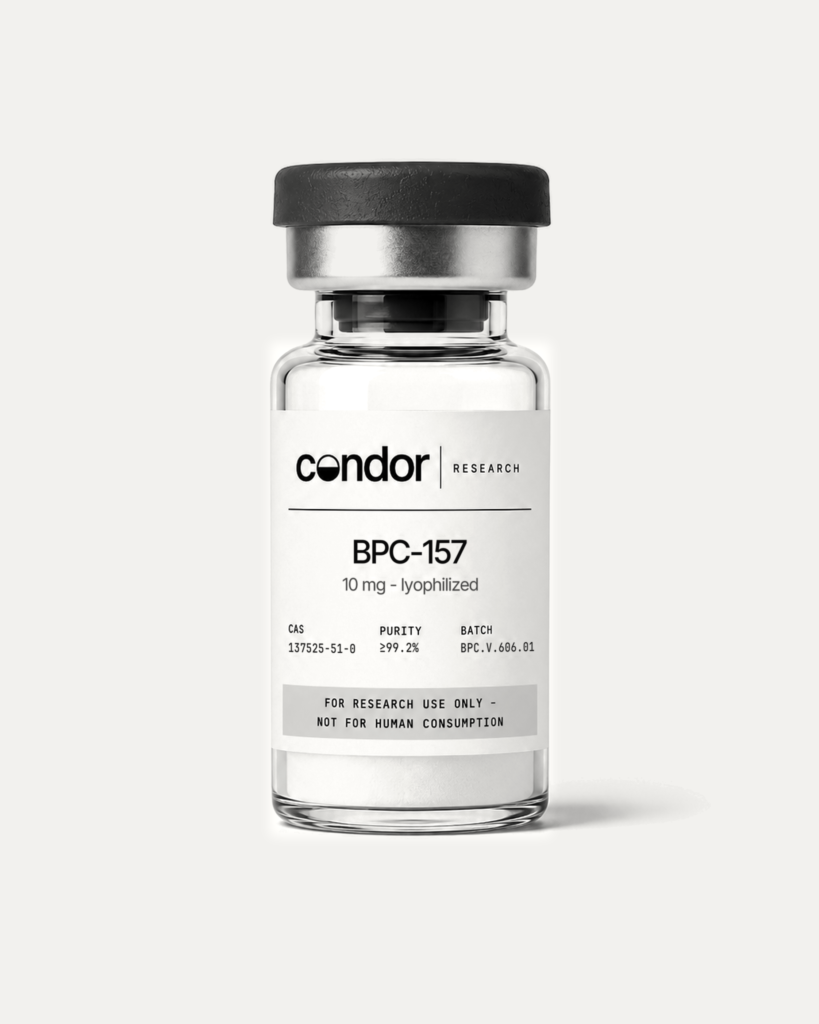
Gelyofiliseerd · ≥99% (HPLC) ·
Geleverd gelyofiliseerd. Voor reconstitutie wordt doorgaans bacteriostatisch water gebruikt.
BPC-157 (Body Protection Compound-157) is a synthetic 15-amino-acid pentadecapeptide derived from a protective protein in human gastric juice, and one of the most studied compounds in regenerative and cytoprotective research. Sequence GEPPPGKPADDAGLV; CAS 137525-51-0; molecular weight 1419.53 g/mol; supplied lyophilised at ≥99% purity by HPLC. For laboratory research use only; not for human or veterinary use.
First identified in a protein that protects the lining of the stomach, BPC-157 (Body Protection Compound-157, also designated PL 14736) is a synthetic pentadecapeptide — a 15-amino-acid chain (Gly-Glu-Pro-Pro-Pro-Gly-Lys-Pro-Ala-Asp-Asp-Ala-Gly-Leu-Val) prized for its stability. Unusually robust in aqueous solution and resistant to gastric acid, it has become one of the most extensively investigated molecules in regenerative and cytoprotective research.
Een peptide dat is ontstaan uit het lichaamseigen afweersysteem. BPC-157 is derived from a naturally occurring protective sequence found in human gastric juice — the tissue that withstands one of the harshest environments in the body. Researchers isolated and stabilised this fragment to study how the organism shields and repairs itself, and since the late 1990s the Zagreb group led by Sikirić and colleagues has built much of the foundational literature around it (Sikirić et al., 2024).
What the research explores. Rather than acting on a single target, BPC-157 is studied as a pleiotroop agent — one that appears to influence several repair pathways at once, with the nitric-oxide (NO) system and angiogenic, growth-factor signalling recurring throughout the literature. Investigations cluster into four broad domains:
All of the above derives from in-vitro and animal studies and is provided strictly for scientific context; it does not constitute evidence of safety or efficacy in humans. Every research statement maps to a verifiable, peer-reviewed source — with PMID and DOI — under the Wetenschappelijke referenties tab.
Physicochemical profile. CAS 137525-51-0 · Molecular formula C₆₂H₉₈N₁₆O₂₂ · Molecular weight 1419.53 g/mol · Sequence GEPPPGKPADDAGLV · Soluble in water (≈1 mg/mL) and standard aqueous buffers.
Specification & quality. Each individually sealed vial contains 10 mg of BPC-157 supplied as a sterile, lyophilised white powder at ≥99% zuiverheid by reversed-phase HPLC. Every batch is independently third-party tested, with identity and purity confirmed by HPLC and mass spectrometry; a Certificate of Analysis is available for verified research accounts. Store lyophilised at −20 °C, protected from light and moisture.
This product is intended for laboratory research use only (RUO). It is not a drug, food, cosmetic, or dietary supplement, and is not for human or veterinary use, ingestion, or diagnostic application. Handling is restricted to qualified research professionals operating in an appropriately equipped laboratory.
Uitsluitend geleverd voor in-vitro laboratoriumonderzoek (RUO). Geen geneesmiddel, voedingsmiddel of supplement; niet voor menselijk of diergeneeskundig gebruik.
Analysecertificaat — een partijspecifieke COA wordt met elke bestelling meegeleverd en is op aanvraag beschikbaar.
Each lot is tested by an independent third-party laboratory for identity (mass spectrometry) and purity (HPLC). The Certificate of Analysis for your specific batch ships with the order and is available on request — no house data, no exceptions.
De referenties zijn illustratief voor de onderzoeksliteratuur rond deze stof. Alle beweringen hebben uitsluitend betrekking op in-vitro- en diermodellen.
BPC-157 (Body Protection Compound-157, ook aangeduid als PL 14736) is een synthetisch peptide van 15 aminozuren waarvan de sequentie is afgeleid van een eiwit dat in maagsap wordt aangetroffen. Het wordt uitsluitend geleverd als referentieverbinding voor onderzoek (research-use-only) voor in-vitro- en dierstudies naar cytoprotectie en weefselherstel, niet voor menselijk of diergeneeskundig gebruik.
BPC-157 is een synthetisch peptide van 15 aminozuren, afgeleid van een maageiwit, bestudeerd voor cytoprotectie en angiogenese in vitro. TB-500 is een veel groter peptide van 43 residuen dat overeenkomt met thymosine beta-4, bestudeerd voor actinebinding en celmigratie. Ze werken via verschillende mechanismen, wat de reden is waarom beide worden gebruikt als afzonderlijke regeneratieve onderzoeksreagentia.
Ze worden bestudeerd als complementaire, niet overlappende reagentia. BPC-157 (een gastrisch afgeleide 15-mer) en TB-500 (een thymosine-beta-4-peptide van 43 residuen) werken via verschillende moleculaire routes in herstelmodellen, wat de reden is voor de samen geformuleerde BPC-157 + TB-500-blend. Uitsluitend voor onderzoek, in-vitro- en diermodellen.
Losse BPC-157 is een enkel peptide van 10 mg om de effecten ervan geïsoleerd te onderzoeken. GLOW combineert het met GHK-Cu (50 mg) en TB-500 (10 mg); KLOW voegt KPV (10 mg) toe als vierde bestanddeel. Kies de losse variant om één variabele te bestuderen, of een blend om de peptiden samen te onderzoeken. Uitsluitend voor onderzoek.
Ja. Condor Research levert BPC-157 uitsluitend als Research Use Only-referentieverbinding (in vitro) aan professionals en instellingen, niet als geneesmiddel, supplement of product voor menselijk of diergeneeskundig gebruik. Kopers zijn zelf verantwoordelijk voor het controleren van de invoerlegaliteit in hun eigen land. Vragen: info@condorresearch.com.
Ja. Elke BPC-157-batch wordt getest door een onafhankelijk laboratorium van derden via HPLC op identiteit en zuiverheid (>=99%), met bevestiging via massaspectrometrie, en wordt geleverd met een partijspecifiek analysecertificaat. Om het COA voor een specifieke partij aan te vragen voordat u bestelt, neemt u contact op met info@condorresearch.com.
Deze BPC-157 heeft de molecuulformule C62H98N16O22 en een molecuulgewicht van 1419,53 (CAS 137525-51-0). De pentadecapeptidesequentie is Gly-Glu-Pro-Pro-Pro-Gly-Lys-Pro-Ala-Asp-Asp-Ala-Gly-Leu-Val. Identiteit en massa worden per batch bevestigd via HPLC en massaspectrometrie, en de waarden worden gedocumenteerd in het partijspecifieke analysecertificaat dat bij het product wordt geleverd.
Bewaar de verzegelde BPC-157-flacon bij -20°C, beschermd tegen licht; houdbaarheid is 24 maanden vanaf productie. Voor laboratoriumbereiding wordt het gereconstitueerd in water (vermelde oplosbaarheid 1 mg/mL). Alle hantering is uitsluitend voor in-vitro- en dieronderzoek; geen enkele bereiding hier is bedoeld voor menselijk of diergeneeskundig gebruik.
De waarde van 1 mg/mL is de geverifieerde oplosbaarheidsreferentie die wordt gebruikt voor laboratoriumbereiding, niet noodzakelijk een absoluut plafond. Voor een flacon van 10 mg levert het toevoegen van 10 mL verdunningsmiddel een oplossing van 1 mg/mL op. Voor concentraties boven dit niveau neemt u contact op met info@condorresearch.com. Deze gegevens zijn uitsluitend voor onderzoeksbereiding in vitro.
Ja. Bestellingen worden verzonden vanuit het EU-magazijn in eenvoudige, neutrale buitenverpakking met tracking, en elke flacon draagt de vereiste laboratoriumlabel Research Use Only. Douaneverklaringen worden naar waarheid opgesteld als RUO-onderzoeksmateriaal met correcte classificatie en waarde; de inhoud wordt nooit onjuist gelabeld of ondergewaardeerd. Vragen: info@condorresearch.com.
Gelyofiliseerd BPC-157 is stabiel voor kort transport op kamertemperatuur, dus koelelementen zijn over het algemeen niet nodig voor verzending; korte levertijden binnen Europa doen geen afbreuk aan het poeder. Bewaar bij aankomst de verzegelde flacon bij -20°C, beschermd tegen licht, voor stabiliteit op lange termijn. Vragen: info@condorresearch.com.
Als een flacon beschadigd of niet-conform aankomt, meld dit bij voorkeur binnen 48 uur met foto's aan info@condorresearch.com, en er kan een vervanging, herverzending of tegoedbon worden geregeld. Elke batch is onafhankelijk HPLC-getest bij >=99% met een analysecertificaat dat de opgegeven zuiverheid onderbouwt. Verzegelde laboratoriumgoederen zijn verder finale verkoop (B2B).
Oplosbaarheid en stabiliteit waren zoals beschreven. Één ster afgetrokken omdat de opties voor expresverzending beperkt zijn, maar de kwaliteit staat buiten kijf.
Derde bestelling bij Condor. De variatie tussen batches is minimaal, wat belangrijk is voor ons longitudinale werk. De mono-gelabelde flacons zijn eenvoudig te traceren.
Geen marketingpraat — alleen gekarakteriseerd materiaal met documentatie. Het gegevensblad en het CAS-nummer kwamen precies overeen met onze gegevens.
De gelyofiliseerde koek was uniform en loste volledig op. Een digitaal COA-portaal zou fijn zijn, maar de PDF op aanvraag werkte prima.
Identiteit bevestigd met MS in onze faciliteit. De communicatie over opslag en behandeling was nauwkeurig en professioneel.
Cookies
Wij gebruiken strikt noodzakelijke cookies om de winkel te laten werken. Met uw toestemming gebruiken wij ook analytische (orderattributie) en marketingcookies (Omnisend). Lees onze Cookiebeleid.