
What Is Cagrilintide? The Long-Acting Amylin Analogue
Cagrilintide (AM833) is a long-acting amylin analogue and dual amylin/calcitonin receptor agonist. Its chemistry, receptor pharmacology, and trial evidence, RUO.
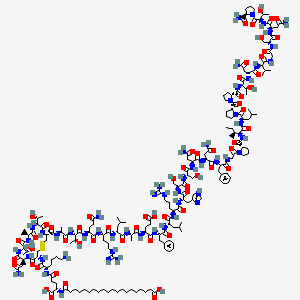
Cagrilintide (AM833) is a synthetic, long-acting amylin analogue engineered by Novo Nordisk. It is a dual amylin/calcitonin receptor agonist built on the pramlintide backbone, lipidated to extend its half-life. In the literature it is studied for metabolic research, often alongside semaglutide.
Cagrilintide is Novo Nordisk’s long-acting amylin analogue, carried through development under the codes AM833 and NN9838. It is a lipidated 37-amino-acid peptide built on the pramlintide backbone, engineered to act at amylin and calcitonin receptors for a once-weekly interval rather than the minutes-long window of native amylin. Most of what is publicly known comes from a compact but well-documented body of primary literature — a medicinal-chemistry design paper, in-vitro receptor pharmacology, and a ladder of phase 1 through phase 3 trials. Everything below describes laboratory and literature findings, not use in people.
What is cagrilintide, chemically?
Cagrilintide is a synthetic acylated peptide with the molecular formula C194H312N54O59S2 and a molecular weight of roughly 4409 Da13. It carries the CAS number 1415456-99-3 and the development codes AM833 and NN9838. The medicinal-chemistry paper that describes its design (compound 23 in that work) frames it as a long-acting amylin analogue derived not from native human amylin but from pramlintide, the synthetic amylin analogue already in clinical use1.
The design choice matters. Native human amylin is notoriously prone to forming amyloid fibrils, which complicates its use as a therapeutic backbone. Pramlintide substitutes several residues to reduce that aggregation tendency, and cagrilintide builds further on that platform, adding a lipid (fatty-acid) modification. The lipidation is the engineering lever for half-life: pramlintide has a reported half-life of about 48 minutes and requires thrice-daily injection, whereas the acylated cagrilintide was deliberately designed to support a once-weekly interval in the trials1. In short, the molecule is an exercise in taking a well-characterised but short-lived hormone class and extending its duration while suppressing its worst physical-chemistry liability.
37 amino acids, one lipid chain — cagrilintide is a small, precisely engineered peptide, not a large biologic.
How does it work — the amylin/calcitonin receptor mechanism?
Cagrilintide is a dual amylin/calcitonin receptor agonist. Its in-vitro pharmacology was characterised under the name AM833 in a study that compared it against six selective and non-selective agonists across the calcitonin receptor family2. That work established agonism across the amylin receptors (AMY1–3) and at the calcitonin receptor itself.
The receptor architecture is worth spelling out, because it is where the amylin class diverges from the more familiar incretin drugs. Amylin receptors are not standalone proteins. They are formed from the calcitonin receptor in complex with receptor activity-modifying proteins (RAMPs); the specific RAMP that associates with the calcitonin receptor determines which amylin receptor subtype (AMY1, AMY2, or AMY3) is presented. This is laid out in the authoritative IUPHAR review of the calcitonin/CGRP receptor family9. Because cagrilintide engages this calcitonin-receptor-derived system, its mechanism is pharmacologically distinct from GLP-1 receptor agonism — a different receptor, a different signalling context. That distinction is the entire reason amylin analogues are studied as a complementary rather than redundant approach.
The class itself has a name in the literature: dual amylin and calcitonin receptor agonists, or DACRAs. Cagrilintide is one member, and the same receptor pharmacology is being explored well beyond metabolism — a recent review examines DACRAs in the context of osteoarthritis, which underscores that the defining feature is receptor engagement, not a single disease indication12.
Amylin receptors are the calcitonin receptor plus a RAMP — which is why cagrilintide’s mechanism sits in a different pharmacological family from the GLP-1 drugs it is often studied alongside.
What does amylin actually do?
Amylin (islet amyloid polypeptide) is a hormone secreted by pancreatic beta cells, co-released with insulin in response to nutrient intake. Its studied physiological roles include satiation signalling, slowing of gastric emptying, and modulation of glucagon1011. Narrative and historical accounts of amylin biology position it as a distinct axis from the incretin hormones — a separate lever on energy balance and glucose handling that operates through the amylin/calcitonin receptor system rather than the GLP-1 pathway11. That physiological separation is what makes an engineered, long-acting amylin analogue interesting as a research tool.
What does the trial literature cover?
The clinical development literature for cagrilintide forms a fairly clean ladder. The first-in-combination phase 1b trial (Enebo, Lau, and colleagues) reported the pharmacokinetics, pharmacodynamics, safety, and tolerability of cagrilintide co-administered with semaglutide 2.4 mg — the pairing referred to in the literature as CagriSema3. A separate phase 2 dose-finding trial studied cagrilintide as monotherapy, testing once-weekly doses from 0.3 to 4.5 mg against both placebo and an active comparator, liraglutide 3.0 mg, in overweight and obesity research4. That monotherapy trial is the main source for what the amylin analogue does on its own, and it defined the compound’s dose-dependent profile and tolerability.
The combination programme then extended into type 2 diabetes with a phase 2 CagriSema trial5, and advanced to phase 3 under the REDEFINE banner. REDEFINE 1 examined the cagrilintide-semaglutide combination in adults with overweight or obesity6; REDEFINE 2 studied it in a type-2-diabetes population7; and REDEFINE 5 tested the combination against semaglutide alone in East Asian populations8. Across all of these, semaglutide appears only as a combination partner or active comparator — the amylin analogue is cagrilintide.
| Study | Phase | Design in the literature | Ref |
|---|---|---|---|
| Enebo / Lau | 1b | Cagrilintide + semaglutide 2.4 mg (CagriSema); PK/PD, safety | 3 |
| Lau 2021 | 2 | Cagrilintide monotherapy 0.3–4.5 mg vs placebo and liraglutide 3.0 mg | 4 |
| Frias 2023 | 2 | CagriSema in type 2 diabetes, active-controlled | 5 |
| REDEFINE 1 / 2 / 5 | 3 | Cagrilintide-semaglutide vs monocomponents / placebo | 6, 7, 8 |
All entries describe published clinical-trial reports. These are literature findings, not dosing guidance; Condor supplies cagrilintide for in-vitro / laboratory research only.
An honest read of the evidence
Cagrilintide is an investigational compound, and the evidence base should be read with that firmly in mind. The phase 1 through phase 3 trials cited here report research outcomes and were largely sponsor-run by Novo Nordisk, the developer. That is normal for a compound at this stage, but it means most of the human clinical data comes from the developer and its collaborators; there is limited fully independent replication of efficacy claims outside the sponsor programme. Independent characterisation of the pharmacology exists — the AM833 receptor work2 is the anchor — but that study is in-vitro, transfected-cell pharmacology. Extrapolating cell-based potency and selectivity to whole-organism effects is inherently limited, and nothing in that assay speaks to what happens in an intact animal, let alone anything beyond it.
The combination design carries its own interpretive caveat. The CagriSema and REDEFINE trials test cagrilintide together with semaglutide, so combination outcomes cannot be attributed to the amylin analogue alone. The cleanest read on cagrilintide by itself is the phase 2 monotherapy dose-finding trial4, which is earlier-stage and, by design, exploratory. Tolerability is a recurring, honestly reported limitation: gastrointestinal effects such as nausea and vomiting — typical of both amylin- and incretin-class agents — appear across the trials and should be acknowledged rather than glossed over. Finally, long-term safety and outcome data beyond the trial windows are not established. The literature is still maturing, with several of the key phase 3 readouts dated 2025 and 2026678. The picture is coherent and reasonably well documented for a compound of this age, but it is not a closed case.
All materials supplied by Condor Research are Research Use Only (RUO). Everything above reflects in-vitro and published-literature findings and is not a dosing protocol, clinical guidance, or a safety assessment for any organism. Nothing here describes or endorses human or veterinary use.
Condor Research · Wissenschaftlicher Support
Atrio Sciences s.r.o., IČO 57 669 651, Nitra (SK) · info@condorresearch.com
- Cagrilintide (codes AM833 / NN9838; CAS 1415456-99-3; formula C194H312N54O59S2, ~4409 Da) is a synthetic 37-amino-acid acylated peptide from Novo Nordisk.
- Its mechanism is agonism at amylin receptors (AMY1-3, built from the calcitonin receptor plus RAMPs) and the calcitonin receptor itself — a dual amylin/calcitonin receptor agonist, pharmacologically distinct from GLP-1 agonism.
- It is derived from pramlintide rather than native human amylin, and lipidated to resist amyloid-fibril formation while extending half-life from minutes to a once-weekly interval in the trials.
- Amylin is a pancreatic beta-cell hormone co-secreted with insulin; studied roles include satiation signalling, slowed gastric emptying, and glucagon modulation.
- Phase 1b (Enebo/Lau) reported PK/PD and tolerability of cagrilintide co-administered with semaglutide 2.4 mg — the combination called CagriSema.
- Phase 2 monotherapy dose-finding (Lau 2021) tested once-weekly cagrilintide 0.3–4.5 mg versus placebo and versus liraglutide 3.0 mg in overweight/obesity research.
- The combination programme advanced to phase 3 (REDEFINE trials, 2025–2026), all comparing cagrilintide-semaglutide against monocomponents or placebo.
Is cagrilintide a GLP-1 drug?
No. Cagrilintide is an amylin analogue that acts at amylin receptors (AMY1–3) and the calcitonin receptor, a mechanism distinct from GLP-1 receptor agonism. It is frequently studied together with the GLP-1 agonist semaglutide, but the two engage different receptor systems.
What do AM833 and NN9838 mean?
They are Novo Nordisk development codes for the molecule now named cagrilintide. The early receptor-pharmacology study refers to it as AM833, and NN9838 appears alongside it as a program code.
What is CagriSema?
CagriSema is the term used in the literature for cagrilintide co-administered with semaglutide 2.4 mg. It was first characterised in a phase 1b trial and later advanced through phase 2 in type 2 diabetes and the phase 3 REDEFINE programme.
How is cagrilintide different from pramlintide?
Cagrilintide is engineered from the pramlintide backbone with a lipid modification added to resist amyloid-fibril formation and extend half-life. Pramlintide's roughly 48-minute half-life required thrice-daily injection, whereas cagrilintide was designed for a once-weekly interval in the trials.
What is amylin, and why is it studied in metabolic research?
Amylin is a pancreatic beta-cell hormone co-secreted with insulin. Its studied physiology includes satiation signalling, slowed gastric emptying, and glucagon modulation. Because it operates through the amylin/calcitonin receptor system rather than the incretin pathway, it is of interest as a mechanistically separate axis.
Is cagrilintide an approved medicine?
As reflected in the cited literature, cagrilintide is an investigational compound studied in sponsor-run clinical trials. Condor Research supplies it strictly for Research Use Only, with no dosing, therapeutic, or safety guidance for any organism.