Gelyofiliseerd · ≥98% (HPLC) ·
Geleverd gelyofiliseerd. Voor reconstitutie wordt doorgaans bacteriostatisch water gebruikt.
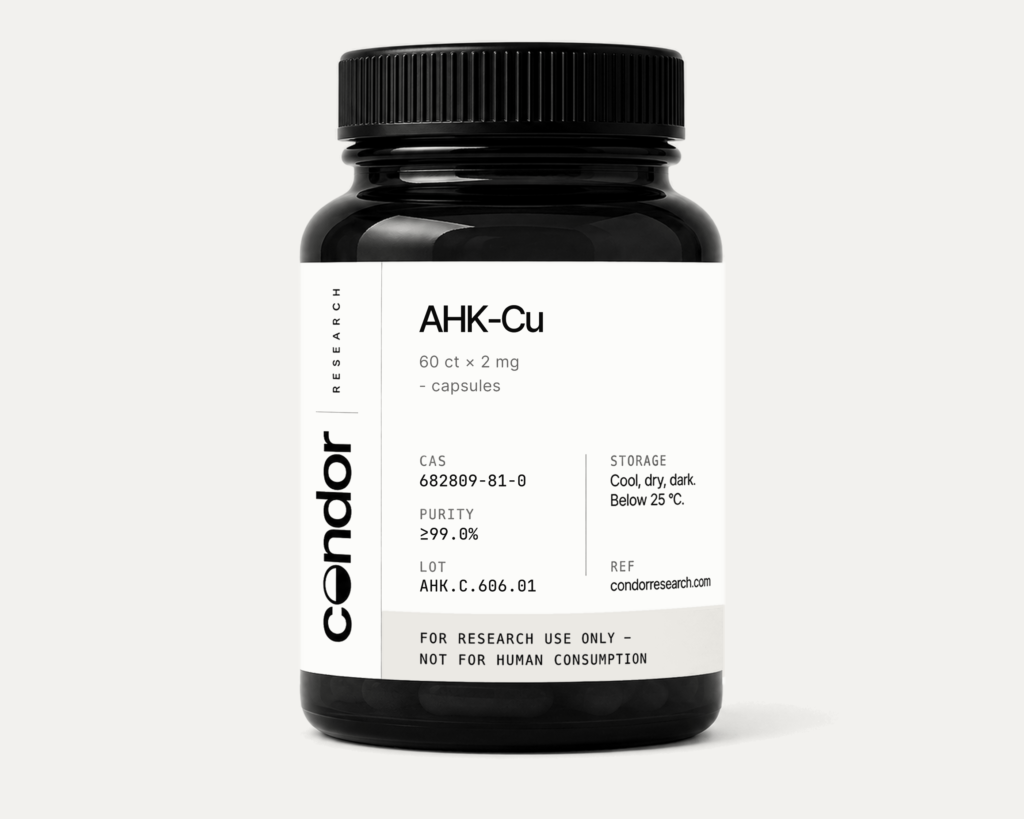
AHK-Cu (tripeptide Ala-His-Lys complexed with copper(II)) is a synthetic copper-peptide complex studied for its roles in extracellular matrix remodelling, antioxidant signalling, and angiogenesis models. Sequence Ala-His-Lys; CAS 126828-32-8 (free tripeptide) / 682809-81-0 (copper complex HCl salt); molecular weight 354.41 g/mol (free peptide, C15H26N6O4). Supplied in encapsulated form at HPLC ≥99% purity. For laboratory research use only; not for human or veterinary use.
Swap a single amino acid at the front of a famous copper-peptide and you get its lesser-known cousin. AHK-Cu is the tripeptide alanyl-histidyl-lysine bound to copper(II) — a blue copper complex that trades GHK's N-terminal glycine for alanine while keeping the histidine-lysine motif that clamps the metal in place. Like its relative, the copper ion is not a passenger but the chemically active centre of the molecule.
A His-anchored copper motif. The His-Lys arrangement at the core of AHK belongs to the same family of N-terminal copper-binding sequences that coordination chemists have mapped in detail, where placing a histidine in the third position creates a defined, high-affinity Cu(II) pocket (Gonzalez et al., 2017). Comparative thermodynamic and structural work on related Xxx-His and DAHK/GHK motifs has shown how subtly the residue identity shifts copper affinity and redox potential — the chemistry that gives each tripeptide its distinct profile (Trapaidze et al., 2012; Hureau et al., 2011).
Within the applied literature, copper tripeptides of this class are studied as scalp- and hair-oriented actives and as redox-active complexes, placing AHK-Cu alongside GHK-Cu in dermatological and cell-biology research (Patel et al., 2024).
What the research explores. Across cell-culture and animal systems, AHK-Cu and closely related copper tripeptides have been investigated along several converging lines:
The activity described here is drawn from in-vitro and animal studies; it characterises biological behaviour in experimental models and does not establish efficacy or safety in humans. Full citations are listed under the Scientific References tab.
Physicochemical profile. CAS No. 682809-81-0 · Molecular formula C15H26N6O4·Cu (copper complex) · Molecular weight 417.95 g/mol · Sequence Ala-His-Lys · copper(II) complex · Appearance: Blue lyophilized powder (copper complex) · Solubility: Soluble in water.
Specification & quality. Each bottle contains 60 HPMC (vegan) capsules, each providing 2mg of AHK-Cu at ≥98% (HPLC). Encapsulated — no reconstitution required. Every batch is independently third-party tested, and a Certificate of Analysis (COA) is available. Store at -20°C, protect from light and moisture; shelf life 24 months from the manufacture date. EU warehoused.
This product is intended for laboratory research use only (RUO). It is not a drug, food, cosmetic, or dietary supplement, and is not for human or veterinary use, ingestion, or diagnostic application. Handling is restricted to qualified research professionals operating in an appropriately equipped laboratory.
Uitsluitend geleverd voor in-vitro laboratoriumonderzoek (RUO). Geen geneesmiddel, voedingsmiddel of supplement; niet voor menselijk of diergeneeskundig gebruik.
Analysecertificaat — een partijspecifieke COA wordt met elke bestelling meegeleverd en is op aanvraag beschikbaar.
Each lot is tested by an independent third-party laboratory for identity (mass spectrometry) and purity (HPLC). The Certificate of Analysis for your specific batch ships with the order and is available on request — no house data, no exceptions.
De referenties zijn illustratief voor de onderzoeksliteratuur rond deze stof. Alle beweringen hebben uitsluitend betrekking op in-vitro- en diermodellen.
AHK-Cu is het tripeptide alanyl-histidyl-lysine (Ala-His-Lys) gebonden aan koper(II), waardoor een blauw koper-peptidecomplex ontstaat dat nauw verwant is aan GHK-Cu. Het wordt onderzocht in cel- en weefselmodellen op eindpunten voor haarfollikels, dermale remodellering en kopercoördinatie. Condor Research levert het strikt als referentieverbinding uitsluitend voor onderzoek, voor in-vitro- en dieronderzoek, niet voor menselijk of diergeneeskundig gebruik.
De blauwe kleur weerspiegelt het koper(II)-ion dat wordt vastgehouden door het histidine-lysinemotief van het tripeptide — het metaal is het actieve centrum van het complex, geen onzuiverheid. Coördinatiestudies hebben in detail beschreven hoe een histidine op de derde positie een gedefinieerde, hoogaffiene Cu(II)-zak vormt (Gonzalez et al., 2017). Het product wordt daarom gepresenteerd als een kopercomplex, uitsluitend geleverd voor laboratoriumonderzoek.
Beide zijn blauwe koper(II)-tripeptidecomplexen die het His-Lys-koperbindingsmotief delen. AHK-Cu (Ala-His-Lys) draagt een N-terminale alanine en wordt het vaakst onderzocht in modellen voor haarfollikels en angiogenese, terwijl GHK-Cu (Gly-His-Lys) meer wordt geassocieerd met onderzoek naar wondherstel en dermale remodellering. De verwisseling van één residu verschuift de koperaffiniteit en het biologische profiel, waardoor ze geschikt zijn voor verschillende onderzoeksvragen. Beide worden geleverd als referentieverbindingen uitsluitend voor onderzoek.
AHK-Cu is een aan koper gebonden tripeptide waarvan de activiteit centreert rond het gecoördineerde koperion, onderzocht in haar- en huidmodellen. BPC-157 is een metaalvrij peptide van 15 residuen, voornamelijk onderzocht in modellen voor letsel aan zacht weefsel en het maag-darmkanaal. Ze behoren tot verschillende structurele klassen en behandelen verschillende experimentele vragen. Beide worden strikt uitsluitend geleverd voor onderzoek.
Ze delen de aan His verankerde koperbindingschemie maar zijn afzonderlijk: AHK-Cu is het tripeptide Ala-His-Lys, onderzocht in haar- en huidcontexten, terwijl DAHK (het N-terminale albuminemotief) is onderzocht in neuroprotectie- en ischemie-reperfusiemodellen (Díaz-Ruíz et al., 2010; Bar-Or et al., 2006). Vergelijkend structureel werk heeft in kaart gebracht hoe deze motieven verschillen in koperaffiniteit en redoxgedrag (Hureau et al., 2011). Beide worden geleverd als referentieverbindingen uitsluitend voor onderzoek.
Ja. Condor Research levert AHK-Cu strikt als referentieverbinding uitsluitend voor onderzoek aan professionals en instellingen, niet als geneesmiddel, supplement of product voor menselijk of diergeneeskundig gebruik. Kopers zijn zelf verantwoordelijk voor het bevestigen van de invoerlegaliteit in hun eigen land. Vragen: info@condorresearch.com.
De capsule is een voorafgewogen vaste-stofformaat dat de laboratoriumhantering en -opslag van een vaste hoeveelheid van het koper-peptidecomplex vereenvoudigt binnen een HPMC (vegan) omhulsel, dat licht- en vochtgevoelig materiaal beschermt. Het is een gemeten vaste-stofformaat, geen dosis, en impliceert geen enkele vorm van consumptie. Uitsluitend voor laboratoriumonderzoek. Niet voor menselijk of diergeneeskundig gebruik.
Nee. Deze zijn geëncapsuleerd — geen reconstitutie nodig. Elke HPMC (vegan) capsule bevat een vaste hoeveelheid van 2mg AHK-Cu in vaste vorm voor laboratoriumhantering. Het formaat is uitsluitend voor onderzoek en niet bedoeld voor inname of menselijk gebruik.
Elk flesje bevat 60 HPMC (vegan) capsules, elk met 2mg AHK-Cu bij ≥98% (HPLC) zuiverheid. De capsules worden onafhankelijk door derden getest. De vermelde hoeveelheid is een voorafgewogen laboratoriumreferentieformaat, geen menselijke dosis, en het materiaal is uitsluitend voor onderzoek.
Onze AHK-Cu heeft CAS-nr. 682809-81-0, molecuulformule C15H26N6O4·Cu (kopercomplex) en een molecuulgewicht van 417,95 g/mol, met de sequentie Ala-His-Lys · koper(II)-complex. Het wordt geleverd als blauw gelyofiliseerd poeder (kopercomplex), oplosbaar in water. Uitsluitend voor laboratoriumonderzoek.
Ja. Elke batch AHK-Cu wordt getest door een onafhankelijk laboratorium van derden via HPLC voor identiteit en zuiverheid (≥98%), en elke partij wordt geleverd met een partijspecifiek Certificate of Analysis. Neem contact op met info@condorresearch.com om de COA voor uw batch aan te vragen. Uitsluitend voor laboratoriumonderzoek. Niet voor menselijk of diergeneeskundig gebruik.
Reconstitution was clean with no visible particulates. The lot-specific COA matched the assay we ran in-house — purity is exactly as stated.
We verify every incoming compound by HPLC; this batch came back within tolerance of the certificate. Dispatch from the EU warehouse was quick.
Cold-chain handling was respected end to end. Vials arrived sealed, labelled and intact. Documentation is the most thorough I've seen from an EU supplier.
Oplosbaarheid en stabiliteit waren zoals beschreven. Één ster afgetrokken omdat de opties voor expresverzending beperkt zijn, maar de kwaliteit staat buiten kijf.
Cookies
Wij gebruiken strikt noodzakelijke cookies om de winkel te laten werken. Met uw toestemming gebruiken wij ook analytische (orderattributie) en marketingcookies (Omnisend). Lees onze Cookiebeleid.